Shastrajna-Vivekahina: Book-Smart but Life-Foolish
Knowledge without common sense is useless
Four brothers set out to seek fortune, three are scholars who have mastered every shastra, one is their 'uneducated' brother who knows only practical wisdom. When the scholars discover a lion skeleton and decide to demonstrate their powers by bringing it back to life, only the unlearned brother sees the danger.
The City of Scholars
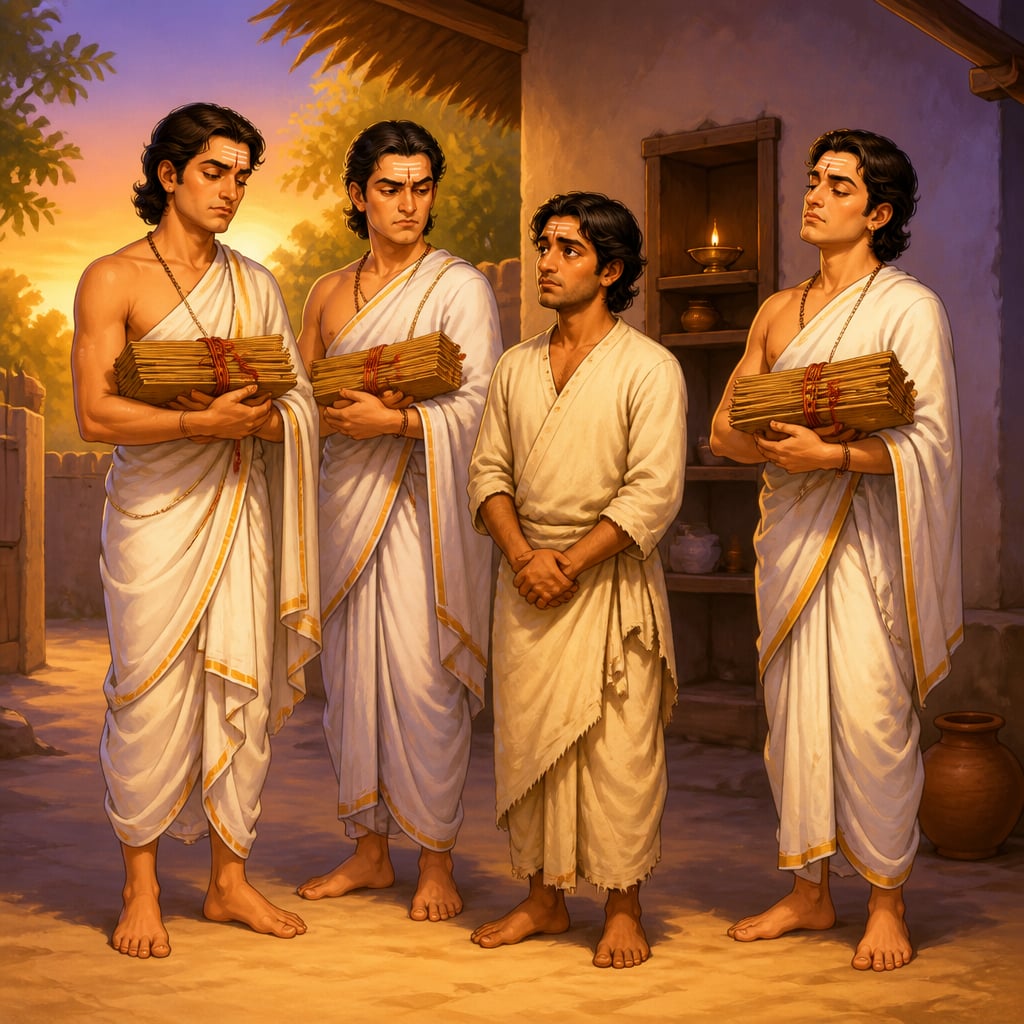
In the prosperous kingdom of Mahilaropya, there lived four Brahmins who were sons of the same father. Three of them had spent twelve years at the great gurukula of Kanyakubja, mastering every shastra, grammar, logic, astronomy, philosophy, and medicine. Their names were Mahasharira, Pranatantra, and Raktadhara.
Their fourth brother, Manthaputra, had never attended the gurukula. While his brothers memorized Sanskrit verses, Manthaputra helped their aging father in the fields. While they debated philosophy, he learned which herbs cured fevers and which berries were poison. While they mastered astronomy, he learned to read storm clouds and animal tracks.
When the three scholars returned home, they looked upon Manthaputra with contempt.
"Brother," said Mahasharira, the eldest, "you have wasted your years. You know nothing of Panini's grammar or Kanada's atomic theory. What will you do in life?"
Manthaputra smiled gently. "I know how to live, brother. Is that not enough?"
Pranatantra laughed. "Living? Even animals know how to live! A scholar knows how to think!"
"Perhaps," Manthaputra replied, "but does a scholar know when to stop thinking and simply act?"
The brothers dismissed this as the foolishness of the unlearned.
The Journey Begins
Their father had recently died, leaving the family with little money. The three scholars decided to travel to distant kingdoms where learned men could earn wealth through their knowledge.
"Kings pay fortunes for scholars who can interpret dreams, cast horoscopes, and settle disputes of philosophy," declared Raktadhara. "We shall present ourselves at royal courts and live like princes!"
"Excellent plan," agreed the other two.
Manthaputra asked to accompany them. The scholars protested.
"What use would you be?" demanded Mahasharira. "You cannot quote a single shloka. You cannot debate a single point of logic. You would embarrass us before kings!"
But Manthaputra persisted. "I am your brother. I ask only to travel with you, not to speak before kings. And perhaps... I might be useful in other ways."
Reluctantly, they agreed.
The four brothers set out at dawn, walking the forest path toward the distant kingdom of Vishalapuri. The three scholars walked ahead, discussing whether space was finite or infinite. Manthaputra walked behind, watching the forest.
Wisdom Rejected
By midday, they came upon a fork in the road. One path was wide and smooth; the other narrow and overgrown.
"The wide path," announced Pranatantra confidently. "Logic dictates that more travelers use it, therefore it must lead somewhere important."
Manthaputra studied both paths. He noticed the wide path sloped downward toward a marshy area. He saw animal tracks on the narrow path, deer and rabbits, which meant safe terrain.
"Brothers," he said quietly, "the narrow path is safer. The wide path leads to marshland."
Mahasharira snorted. "And what text teaches this? What authority do you cite?"
"No text," Manthaputra admitted. "Only observation."
"Observation! The lowest form of knowledge! Anyone can observe. Scholars deduce, reason, analyze!"
They took the wide path.
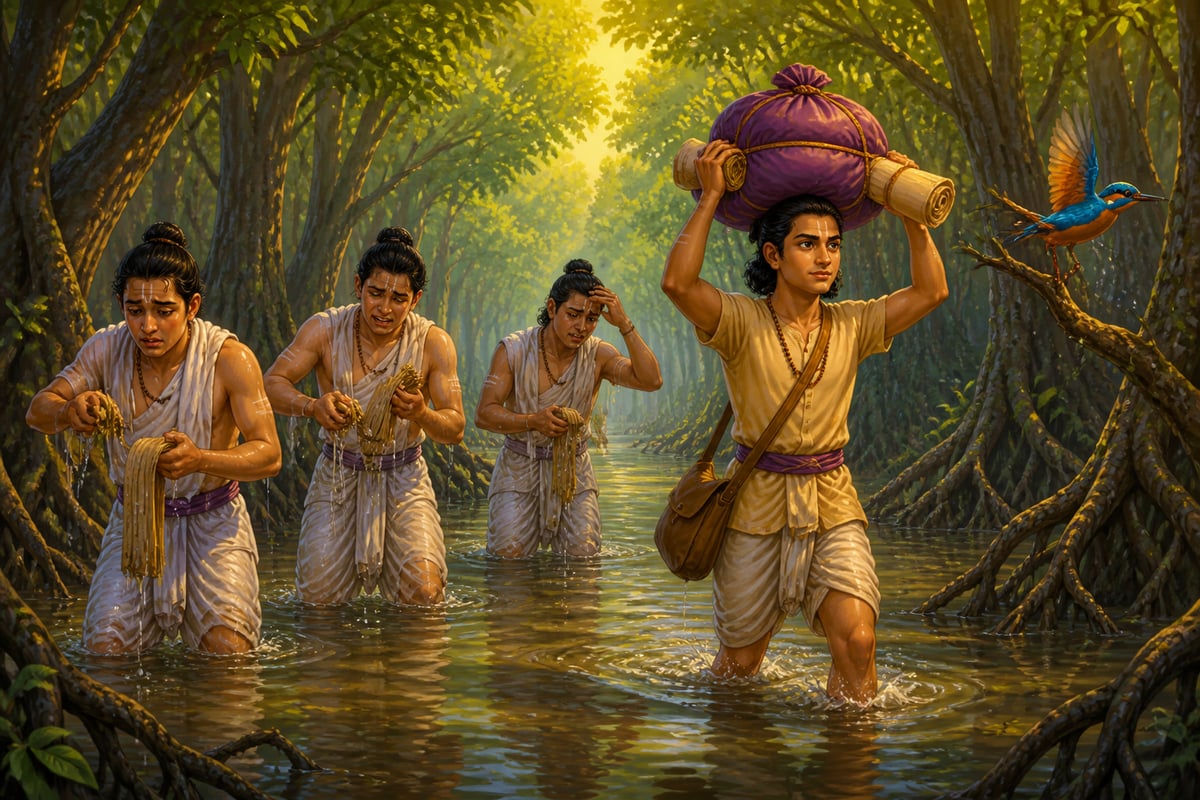
Within an hour, they were knee-deep in swamp water, their books ruined, their clothes soaked. Manthaputra said nothing as he helped them find solid ground.
"A temporary setback," Raktadhara declared, wringing out his manuscripts. "The fault was not in our reasoning but in incomplete information."
Manthaputra sighed. He had tried to provide that information, but they had not listened.
The First Night
As evening approached, the scholars debated where to camp.
"Near water," said Mahasharira. "The texts say water purifies the sleeping area."
"Near a tree," countered Pranatantra. "The Vayu Purana says trees provide protection."
Manthaputra looked around and pointed to a small clearing on elevated ground. "There. Dry ground, good drainage if it rains, clear sightlines for danger."
"And which text prescribes this location?" Raktadhara asked sarcastically.
"The text of survival," Manthaputra replied.
The scholars chose to camp near a stream, beneath a large tree, exactly as their texts prescribed. Manthaputra slept on the elevated clearing.
That night, it rained. The stream flooded. The scholars woke in three inches of water, their remaining manuscripts floating away. Manthaputra, dry on his elevated ground, helped them salvage what he could.
"The texts were correct," Mahasharira insisted, shivering. "We simply encountered an unusual weather pattern."
Manthaputra wondered how many unusual patterns it would take before his brothers recognized that books could not replace common sense.
A Discovery in the Forest
On the third day, deep in the forest, they came upon something extraordinary: a pile of bones, perfectly bleached by sun and time, forming the complete skeleton of a magnificent lion.
The three scholars gathered around, their eyes bright with excitement.
"Do you see what this is?" whispered Mahasharira reverently. "A complete lion skeleton! And we, we three, possess the knowledge to restore it!"
Manthaputra felt a chill run down his spine. "Restore it? Brothers, what do you mean?"
Pranatantra smiled proudly. "I have mastered the Samhitashastra. I know how to assemble bones into their proper form."
"And I," added Raktadhara, "have studied the Jivanavidya. I can clothe bones with flesh, skin, and fur."
"And I," concluded Mahasharira, "know the Pranashastra, the science of infusing life force. Together, we can bring this lion back to life!"
Manthaputra stared at them in horror. "Brothers, have you considered what a living lion will do?"
"It will live," Mahasharira said impatiently. "That is what living things do."
"It will also hunt. It will also kill. It will also... eat."
The scholars laughed. "You see?" said Pranatantra. "This is why uneducated people cannot understand science. They fear what they do not comprehend. We are not creating danger, we are demonstrating the power of knowledge!"
"Brothers," Manthaputra pleaded, "I beg you to stop. There is no wisdom in this."
"Wisdom?" Raktadhara scoffed. "What would you know of wisdom? You have read nothing, studied nothing, learned nothing. Stand aside and watch true scholars at work."
Manthaputra realized his brothers would not be persuaded. Their pride in their learning had blinded them to the simplest truth: that not everything that can be done should be done.
"Then I will climb this tree," he said quietly, "and wait."
The scholars barely noticed as Manthaputra scaled the tallest tree nearby. They were already beginning their work, eager to demonstrate powers that had never been tested outside books.
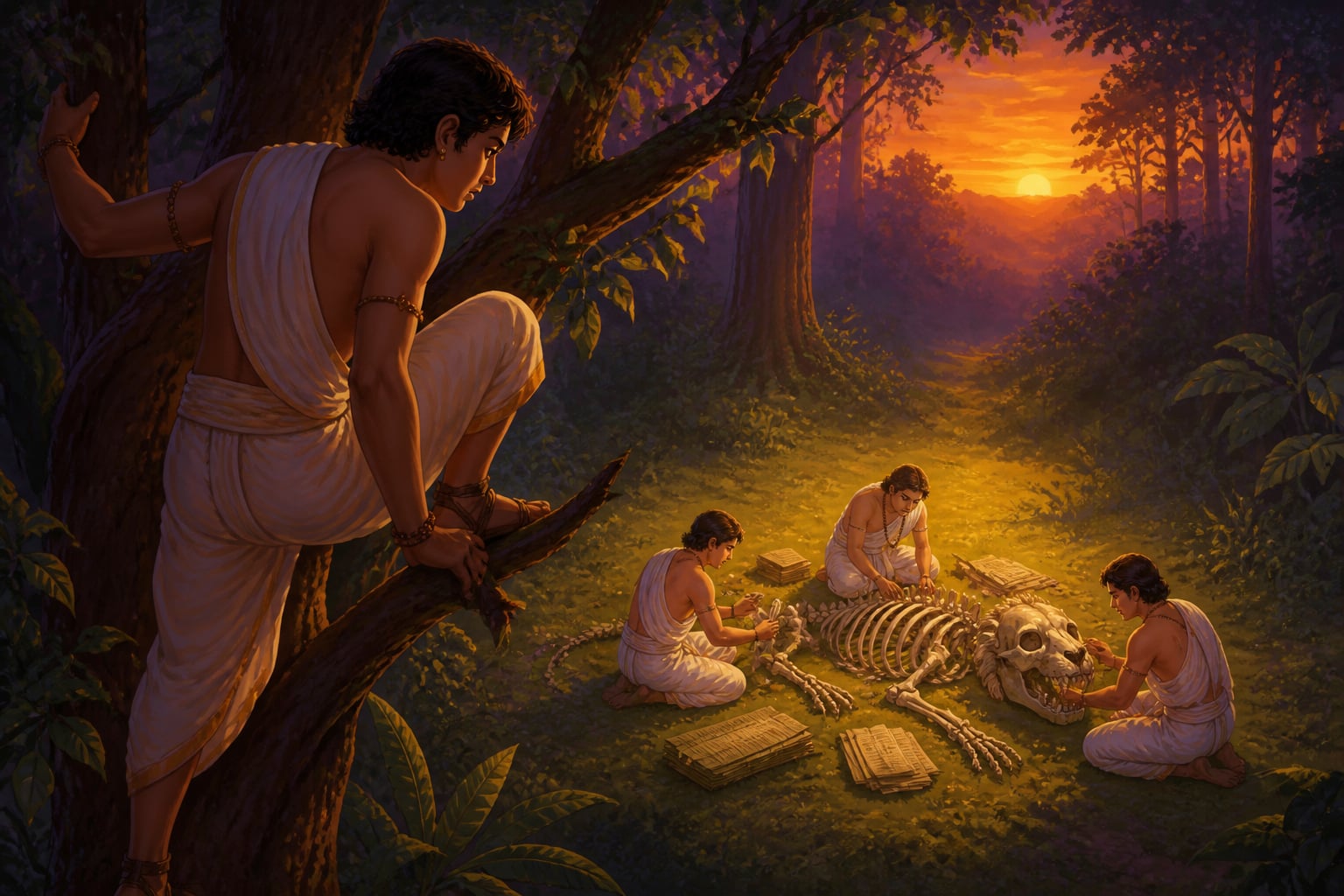
As the sun began to set, Manthaputra sat high in the branches, watching his brothers prepare to awaken something that should have remained forever asleep.
The Wisdom of the Unlearned
Alone in the tree, Manthaputra thought about his brothers. They were not evil men. They were not stupid men. In many ways, they knew far more than he ever would. They could calculate the positions of stars, debate the nature of consciousness, recite thousands of verses from memory.
Yet they could not see what any child would recognize: that bringing a lion back to life in a forest, with four men nearby, was certain death.
This, Manthaputra realized, was the difference between knowledge and wisdom. Knowledge fills the mind with information. Wisdom teaches the mind when to use it, and when to refrain. His brothers had filled themselves so full of texts and theories that there was no room left for simple truth.
"Books are maps," he whispered to himself. "But maps are not the territory. My brothers have memorized every map ever drawn, yet they cannot see the ground beneath their feet."
Below, his brothers worked through the night, confident in their learning, blind to their fate.
Reflection
- Think of a time when you (or someone you know) had the ability to do something but doing it was clearly a bad idea. What helped you recognize that having a capability doesn't mean you should use it?
- The scholars dismissed Manthaputra because he had no formal education. Yet he was the wisest. What determines true wisdom, credentials and degrees, or something else entirely?
- In today's world of powerful technologies, AI, genetic engineering, nuclear energy, how does the tale of the Four Learned Fools apply? What modern 'lion skeletons' are we capable of reviving?