Simhanirvartana: The Resurrected Lion
Using knowledge without wisdom
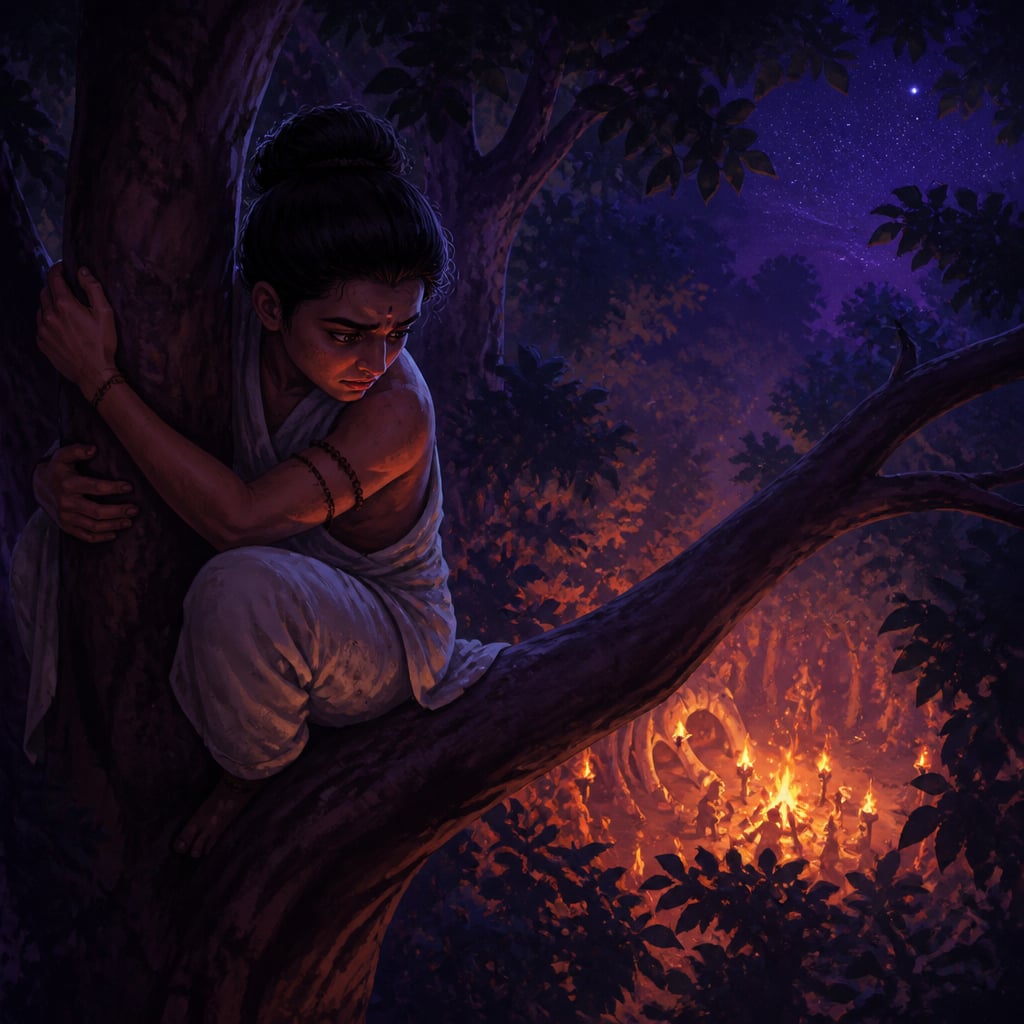
High in his tree, Manthaputra watches as his three brothers demonstrate the terrible power of their learning. Bone joins to bone, flesh clothes the skeleton, and breath enters the body. What rises from death is hungry, and ungrateful.
The Work Begins
As the first stars appeared in the darkening sky, the three scholars gathered around the lion skeleton. Manthaputra, high in his tree, could see them clearly, three figures bent over a pile of bones, their faces illuminated by the lantern they had brought.
"Brothers," called Mahasharira, the eldest, "tonight we shall accomplish what no living man has witnessed. We shall demonstrate the supreme power of knowledge, the reversal of death itself!"
Pranatantra nodded eagerly. "I shall begin. My mastery of Samhitashastra, the science of structure and assembly, will restore this skeleton to its proper form."
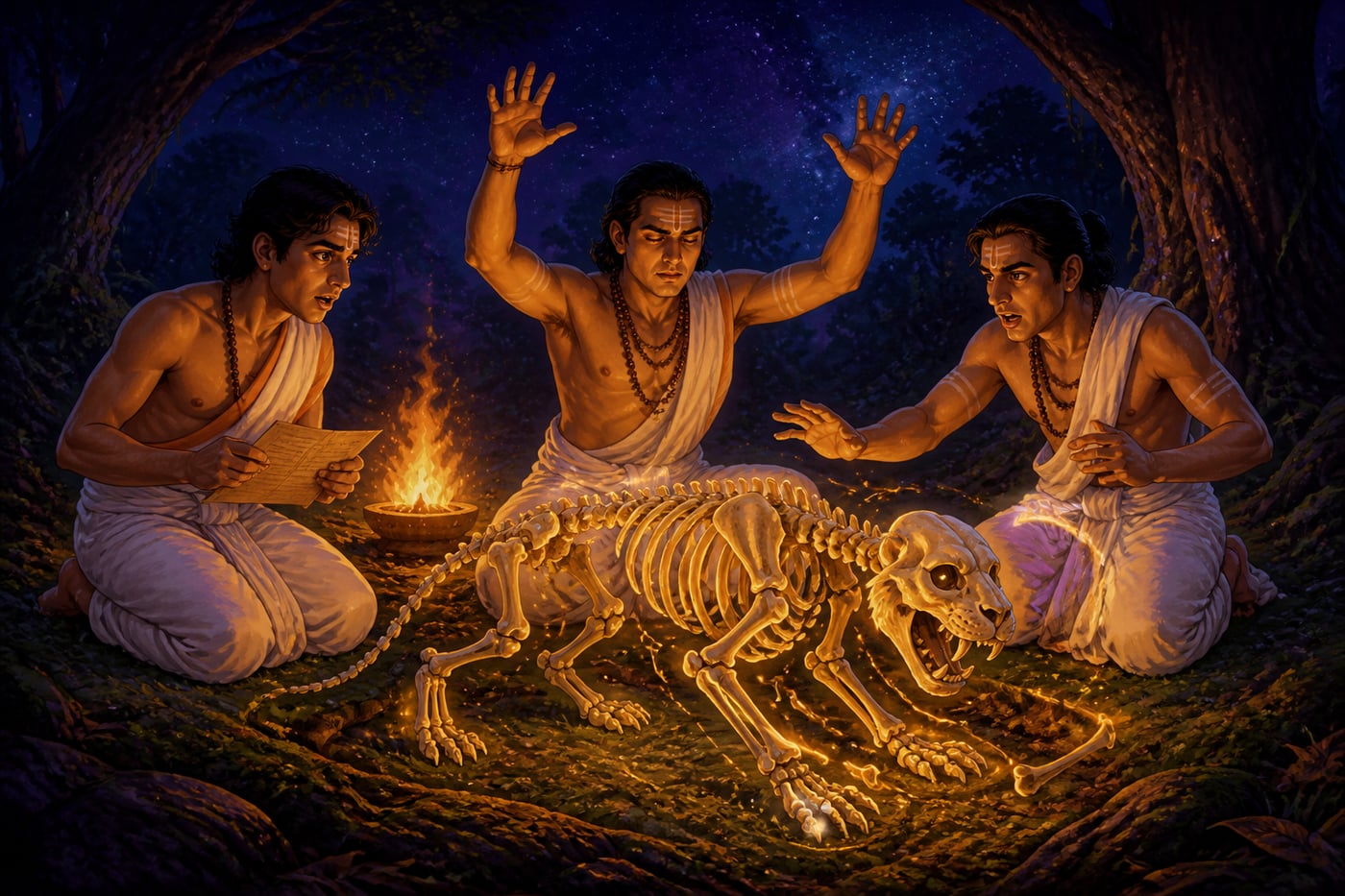
He knelt beside the scattered bones and began to chant. His hands moved with practiced precision, lifting each bone and placing it exactly where anatomy demanded. Skull connected to spine. Ribs curved outward from the vertebrae. Leg bones locked into hip sockets. Paws assembled, each small bone finding its perfect place.
Manthaputra watched in amazement. Whatever else his brothers lacked, their knowledge was real. Before his eyes, the random scatter of bones transformed into the complete skeleton of a magnificent lion, each bone perfectly positioned, the creature's form recognizable even in death.
"It is done," Pranatantra declared, stepping back. "The structure is complete. Raktadhara, your turn."
Flesh Upon Bone
Raktadhara moved forward, his eyes gleaming with anticipation. "Now witness the power of Jivanavidya, the science of living tissue!"
He began a different chant, longer and more complex. As he spoke the ancient words, something extraordinary happened. From nowhere, or perhaps from everywhere, flesh began to appear upon the skeleton. Muscles wrapped around bones. Organs formed within the ribcage. Skin spread across the body like water flowing uphill. Fur sprouted, golden-brown and magnificent.
Where moments before there had been only bones, now lay what appeared to be a sleeping lion, perfect in every detail, from the tuft of its tail to the whiskers on its face. Only the stillness of its chest revealed that this was not yet a living creature.
Manthaputra's grip tightened on his branch. The lion was beautiful, and terrifying. Even in its death-sleep, the creature radiated power. Its claws, visible where one paw lay extended, were the length of a man's finger and sharp as daggers.
"Brothers," he called down one last time, "I beg you, stop now. You have proven your knowledge. There is no need to, "
"Silence!" Mahasharira commanded. "You understand nothing. The greatest demonstration is yet to come. Watch, ignorant one, as I perform the supreme act of knowledge, the infusion of life itself!"
The Breath of Life
Mahasharira raised his hands above the lion's motionless form. His voice deepened as he began the final incantation, the Pranashastra, the science of vital force.
The air itself seemed to thicken. Manthaputra felt his skin prickle. Something was gathering, some force beyond ordinary sight, converging upon the clearing.
"Prana of the winds, enter!" Mahasharira intoned. "Prana of the waters, enter! Prana of the earth, enter! Prana of the fire, enter! Prana of the space between, enter!"
The lion's chest rose.
And fell.
Rose again.
The three scholars stumbled backward, their faces transformed by triumph. They had done it. They had conquered death itself.
"We have succeeded!" Pranatantra shouted. "The ultimate proof of knowledge!"
"Kings will bow before us!" Raktadhara cried. "We shall be the most famous scholars in all the land!"
Mahasharira simply smiled, watching his creation breathe. "Let the uneducated mock us now," he said. "We have achieved what no guru ever, "
The lion opened its eyes.
The Nature of Lions
For one eternal moment, everything was still. The lion lay on its side, blinking slowly, taking in its surroundings with the lazy curiosity of a creature waking from deep sleep.
Then it stood.
The three scholars watched, frozen, as the lion rose to its full height. It was enormous, far larger than it had appeared as bones or even as sleeping flesh. Standing, it reached nearly to Pranatantra's shoulder. Its mane, full and dark, framed a face of terrible beauty.
The lion turned its head, examining each of the three men with ancient, amber eyes.
It yawned, revealing teeth like ivory knives.
And then, very slowly, it began to growl.
"Brothers..." Raktadhara whispered, his voice trembling. "Perhaps we should..."
But there was nowhere to go. The scholars had done their work in a small clearing surrounded by dense brush. The lion stood between them and any path of escape.
Mahasharira stepped forward, raising his hand. "Noble creature," he said, his voice steady with the confidence of the learned, "we have given you the gift of life. We are your, "
The lion moved.
In the stories told afterward, some said Mahasharira never even saw the strike. The lion's paw swept through the air faster than thought, and the eldest scholar fell, never to rise.
Pranatantra screamed and tried to run. He made it three steps.
Raktadhara dropped to his knees, hands raised, mouth forming words of prayer or plea, words that would never be completed.
In the time it takes to draw three breaths, it was over.
The Survivor
Manthaputra clung to his branch, silent as stone, barely breathing. Below, the lion stood among its creators, magnificent and terrible, blood dark upon its muzzle.
The creature looked up.
Its eyes found Manthaputra in the tree. For a long moment, man and lion regarded each other. Manthaputra could see the intelligence in those amber depths, not human intelligence, but something older and perhaps more honest. The lion did not hate. The lion was not evil. The lion was simply being what it was.
A lion hunts. A lion kills. This is the nature of lions.
His brothers had known everything about the lion except this simple truth.
The lion held his gaze for a heartbeat longer, then turned and walked into the forest, disappearing into the darkness as silently as a shadow. It had no quarrel with the man in the tree. He had not disturbed its rest. He had not forced it back into a life it had already left.
Manthaputra remained in the tree until dawn, unable to move, his mind slowly accepting what his eyes had witnessed. When the sun finally rose and painted the clearing in gentle light, he climbed down.
His brothers lay where they had fallen.
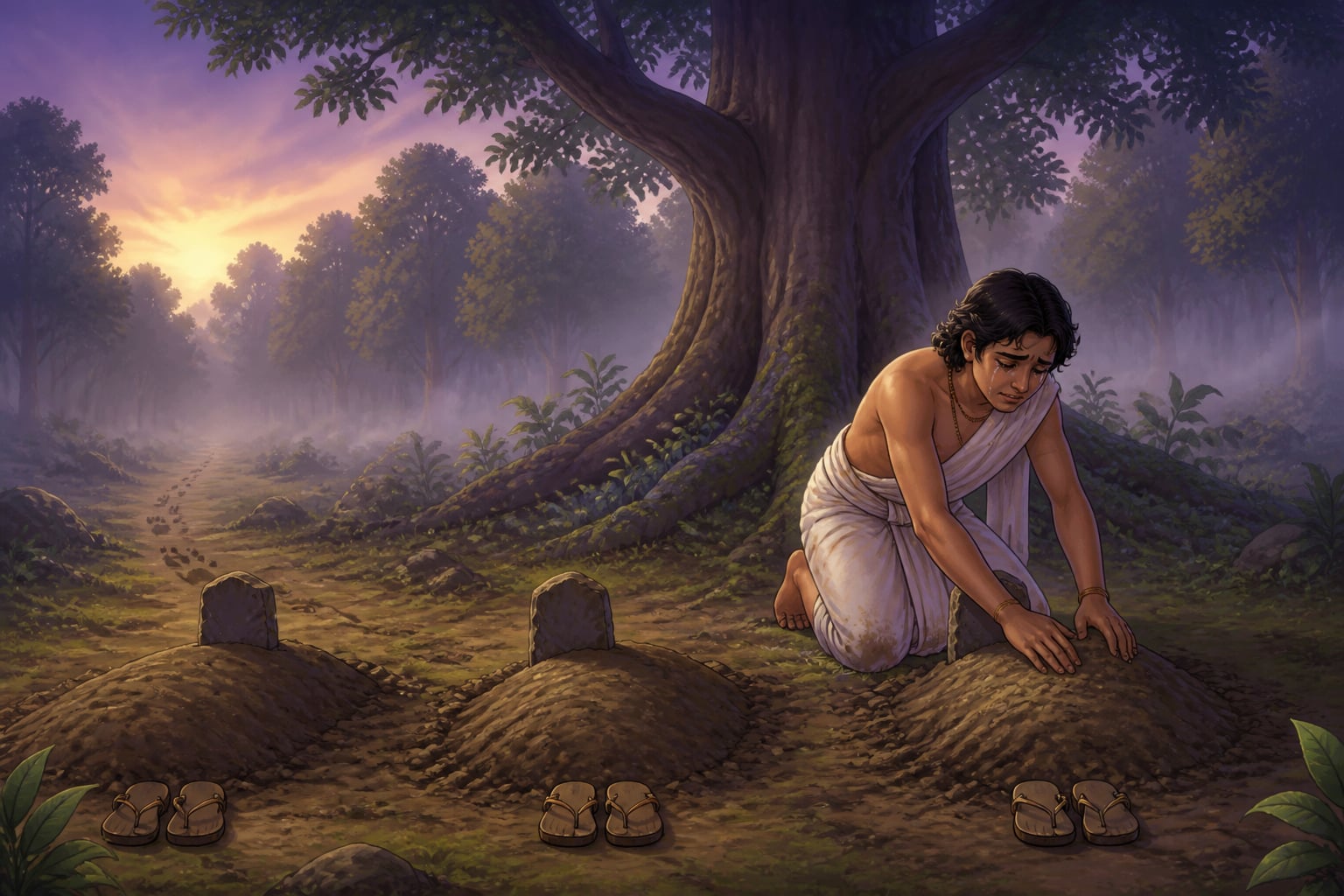
Manthaputra buried them there, beneath the great tree, marking each grave with stones. He said the prayers he remembered from childhood, not the elaborate Sanskrit verses his brothers could have recited, but simple words of grief and love.
As he smoothed the earth over the last grave, he spoke aloud:
"You were my brothers. You were brilliant. You knew more than I could learn in a thousand lifetimes. But you never learned the one thing that would have saved you, that some knowledge is too dangerous to use, and some powers are too terrible to invoke."
The Lesson of the Forest
Manthaputra did not continue to Vishalapuri. There was no point, he had no skills to sell to kings, no knowledge to display in courts. Instead, he returned home, to the village where he had been born, to the fields where he had worked beside his father.
But he carried something back with him, a story. And he told it to anyone who would listen.
"My brothers were the most learned men I ever knew," he would say. "They could recite a thousand shlokas. They could debate any philosopher. They could perform miracles that seemed impossible. But they could not ask one simple question: 'Should we do this?'
"Knowledge is a tool," he continued. "Like a knife, it can nourish or kill. The blade does not choose, the hand that wields it chooses. My brothers had the sharpest blades in all the land, but they never learned when to keep them sheathed."
And so the story passed from village to village, from generation to generation, until it found its place in the Panchatantra, a warning that has echoed across centuries.
For there will always be those who can bring lions back to life.
The question is whether there will also be those wise enough not to.
Reflection
- Have you ever been so excited about showing off a skill or ability that you forgot to consider whether using it was wise? What happened?
- The lion was not evil, it simply acted according to its nature. Who was really responsible for the scholars' deaths: the lion, or the scholars themselves?
- Manthaputra survived by climbing a tree while his brothers died. Was this wisdom or abandonment? When is it right to save yourself rather than try to save others?