Yuddha Dharma: The Rules of War

Bhishma sets the rules of battle

Before the carnage begins, the elders of both sides meet to establish the rules of righteous warfare. What makes a battle honorable? What conduct is forbidden even against enemies? This lesson explores the yuddha dharma, the ancient laws of war that attempted to place moral boundaries around destruction. Yet as we will see, these noble principles would shatter against the reality of eighteen days of desperate combat.

The Council Before Combat

With armies arrayed and war inevitable, the elders of both sides gathered for a final meeting. Not to negotiate peace, that possibility had died with Duryodhana's refusal, but to establish the rules by which the war would be fought.

Bhishma, Drona, Kripa, and other respected figures from both camps met in the space between the armies. Despite being on opposite sides, they shared a common concern: that this war, however terrible, should still be conducted within the bounds of dharma.

"We cannot prevent the killing," Bhishma observed. "But we can determine how men will kill and die. Let us ensure that even in destruction, honor survives."
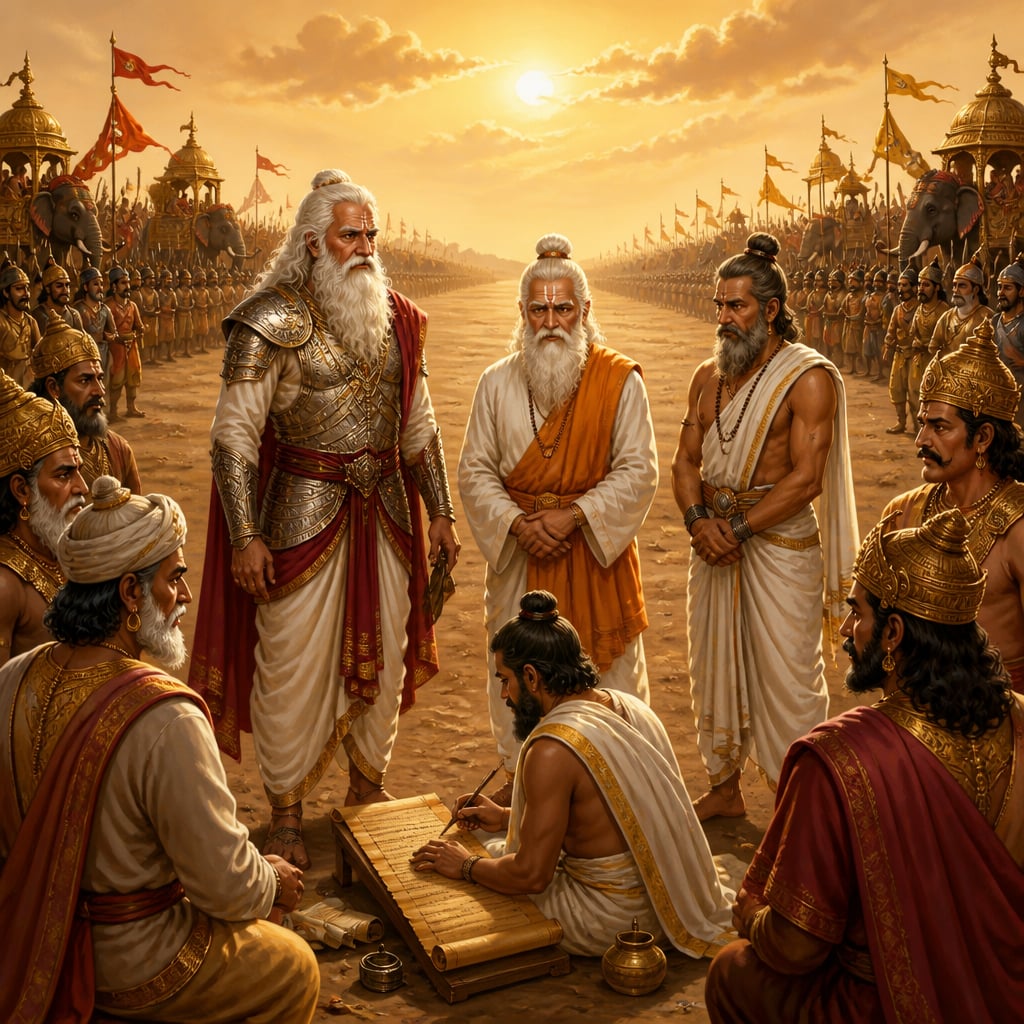
Bhishma, Drona, and Kripa stand with elders of both sides in the open neutral space between the two armies at golden midday, watching a scribe inscribe the agreed rules of war on palm-leaf scrolls.


The Concept of Yuddha Dharma

What Makes War Righteous?

Yuddha dharma, the dharma of war, was not simply a military code but a spiritual and ethical framework. It emerged from centuries of Indian thought about when violence was justified and how it should be conducted.

The Fundamental Principle: Even enemies deserve certain treatment. War is between warriors, not the extermination of humanity. The goal is victory, not annihilation.

The Underlying Philosophy:


The Rules Established

The Code of the Battlefield

The gathered elders agreed upon rules governing combat at Kurukshetra:

1. Combat Between Equals

Warriors must fight opponents of similar status and skill:

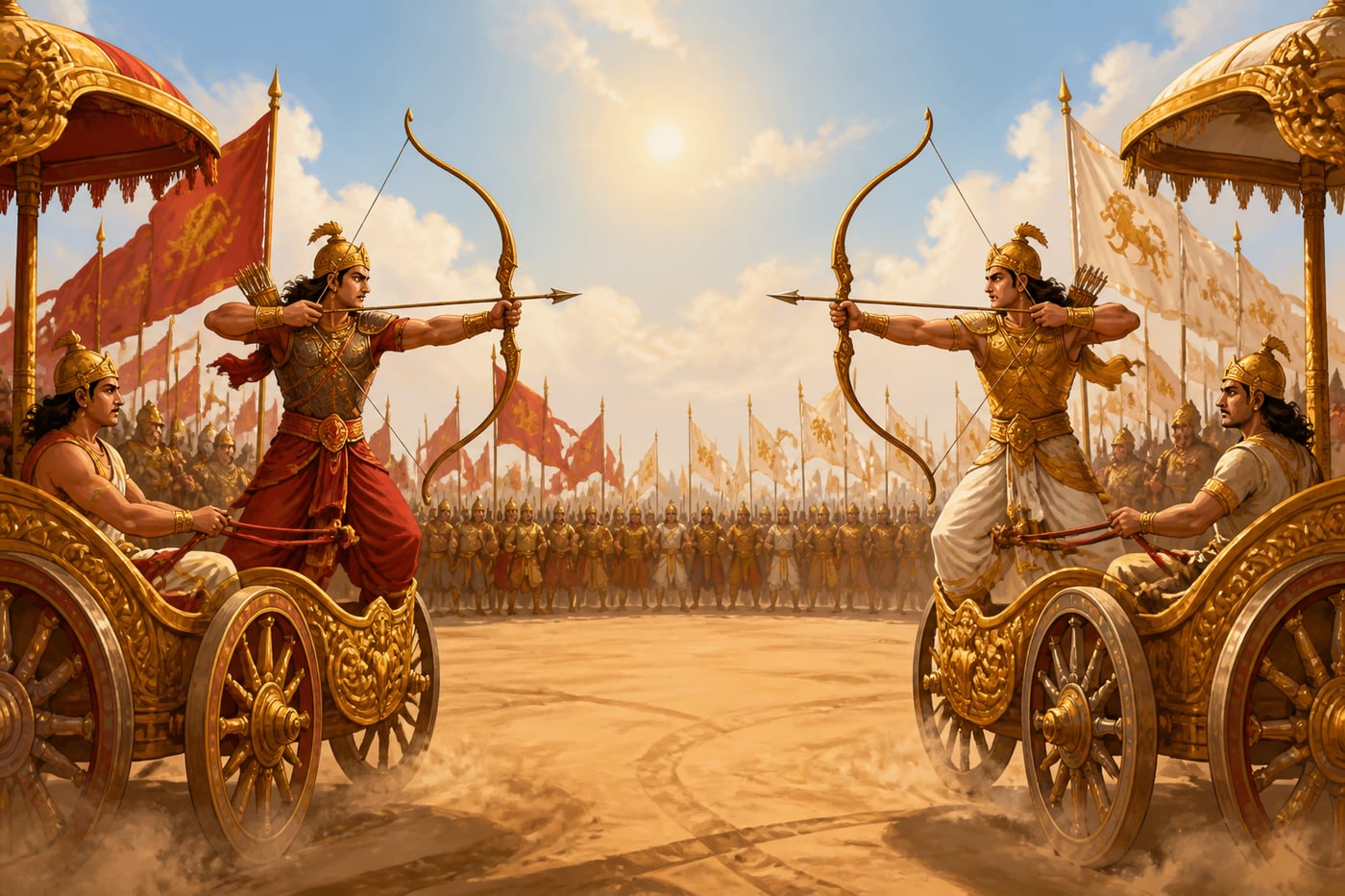
Two equally matched chariot warriors duel inside a ring of witnesses

2. Timing Restrictions

3. Protected Categories

Certain people may not be attacked:

4. Single Combat Honor

5. Weapon Restrictions

Category What Was Permitted What Was Forbidden
Targets Armed warriors Unarmed, surrendered, fleeing
Timing Daylight hours Night attacks
Methods Open combat Deception, concealment
Weapons Standard arms Poison, excessive destruction

The Spirit Behind the Rules

Why Constrain War?

These rules might seem strange to modern readers. If you're going to war anyway, why limit how you fight? The ancient answer reveals a sophisticated understanding of conflict:

War as Dharmic Test: Combat was viewed as a test of virtue, not just strength. How you fought mattered as much as whether you won. A warrior who triumphed through dishonor gained karma worse than defeat.

Post-War Considerations: Both sides understood that after the war, survivors would need to rebuild society together. Excessive atrocities would make reconciliation impossible.

The Cosmic Audience: Warriors believed gods, ancestors, and future generations watched their conduct. Shame before the divine was more terrifying than death.

Professional Courtesy: Warriors on both sides had trained together, were often related, and would meet in future lives. Professional respect transcended immediate enmity.


Bhishma's Special Conditions

The Grandfather's Limits

Bhishma added personal conditions beyond the general rules:

1. "I will not kill the Pandavas": Though leading the Kaurava army, Bhishma declared he would never directly slay Yudhishthira, Bhima, Arjuna, Nakula, or Sahadeva. He would fight them, wound them, drive them back, but not kill them.

2. "I will not fight Shikhandi": Knowing Shikhandi was Amba reborn, Bhishma refused to combat someone he considered a woman, regardless of current form.

3. "I will kill 10,000 Pandava soldiers daily": To fulfill his duty to Duryodhana while honoring his love for the Pandavas, Bhishma committed to a specific daily toll on common soldiers.

These conditions reveal Bhishma's impossible position, leading an army he hoped would lose, fighting family he loved, bound by oaths he wished he'd never made.


The Rules as Ideal and Tragedy

What Would Actually Happen

The yuddha dharma established at this council represents what the warriors hoped to be. What actually happened during the eighteen days of battle was far different.

Rules That Were Broken:

Abhimanyu stands alone surrounded by six Kaurava maharathis

The noble rules lasted until desperation set in. Then, one by one, they were abandoned.


Krishna's Pragmatism

A Different View of Dharma

Krishna, notably, viewed the rules differently. His position:

"Adharma may be met with adharma": When enemies fight dishonorably, responding with rigid honor is not virtue but foolishness.

"Victory for dharma justifies flexible means": The Pandava cause was righteous. If strict rule-following led to defeat, dharma itself would be defeated.

"The Kauravas broke the rules first": From the dice game onwards, Duryodhana had violated dharma repeatedly. Holding the Pandavas to rules their enemies ignored was unjust.

Krishna's position was controversial. It remains debated: Was he a pragmatist who understood that rules mean nothing if the righteous side loses? Or did he corrupt the Pandavas by teaching them that ends justify means?


The Modern Resonance

Just War Theory and International Law

The yuddha dharma anticipates by millennia the questions that modern international humanitarian law attempts to address:

Geneva Conventions (1949) establish:

Just War Theory asks:

The Mahabharata engaged these questions three thousand years before Grotius or the Hague Conventions. The dilemmas remain unsolved.


The Collapse of Rules

Why Honor Did Not Survive

As the war progressed, the noble intentions of the pre-battle council collapsed. Several factors contributed:

1. Escalation: Each rule violation invited retaliation. When Abhimanyu was killed unfairly, Arjuna felt justified in his own violations.

2. Desperation: As commanders fell, survivors grew desperate. Men facing extinction care less about honor.

3. Personal Vengeance: Bhima's vow to kill all hundred Kauravas and drink Dushasana's blood was never compatible with measured warfare.

4. Divine Intervention: The gods themselves seemed to sanction rule-breaking. Krishna's tricks were presented as divine will.

5. The Impossibility of Clean War: Perhaps most deeply, the rules failed because war itself is inherently rule-breaking. You cannot organize mass killing politely.


The Teaching of the Breakdown

What the Failure Reveals

The collapse of yuddha dharma is not a failure of the Mahabharata as moral literature, it is precisely the point. The epic shows us:

1. Ideals Are Necessary but Insufficient: We need rules even knowing they will be broken. The attempt to constrain violence, however imperfect, is better than unconstrained savagery.

2. War Corrupts Everything: The noblest warriors became killers of the unarmed. The most righteous cause led to acts of shame. War is poison that spreads regardless of which side drinks first.

3. There Are No Clean Hands: Both sides violated rules. Both sides had justifications. In the end, nearly everyone was guilty of something. Victory did not confer innocence.

4. The Real Victory Is Avoiding War: The deepest teaching may be that the rules failed because war itself is a failure. The time for dharma was before the first arrow flew.


The Final Council

What They Agreed, What They Hoped

As the council concluded and the warriors returned to their armies, there was a moment of strange unity. Enemies who would soon try to kill each other had just collaborated on rules for dying.

Bhishma's final words to the assembly:

"We have agreed to fight as dharma demands. Some of us will fall tomorrow. Let those who survive remember that we tried, tried to be honorable even in horror. Our failures will be many. Let our intention, at least, be recorded."

The intention was recorded. So were the failures. The Mahabharata preserves both, refusing to simplify war into heroism or condemn it entirely as evil. It shows us humans trying to remain human while doing inhuman things to each other.

As the sun set on the last day before battle, the rules were set. Tomorrow, they would begin to break.


The Aftermath We Know

Eighteen Days Later

When the war ended, the rules had long been forgotten. The battlefield was strewn with millions of dead, many killed in ways that violated every principle established at this council.

Yudhishthira, the king of dharma, would spend years in penance for the sins committed in his name. Arjuna would never fully recover from killing his grandfather and teacher. The Pandavas won their war but lost something irreplaceable in the winning.

The rules of war failed. But perhaps they were always meant to fail, to show us that war itself fails, that no code can sanitize slaughter, that the only true dharma is the dharma that prevents armies from gathering in the first place.

The Udyoga Parva ends with this council. Tomorrow begins the Bhishma Parva, and the dying.

Living traditions

The yuddha dharma principles anticipate modern International Humanitarian Law by millennia. Scholars of Just War Theory (jus in bello) cite the Mahabharata's rules alongside Augustine and Grotius. The Indian Military Academy at Dehradun includes study of kshatra dharma in officer training. The Geneva Conventions' protections for non-combatants and surrendering enemies echo these ancient principles. Legal scholars have written comparative analyses between yuddha dharma and the Hague Conventions. The ethical debates about rule-breaking under extreme circumstances remain relevant in discussions of modern warfare and military ethics.

Reflection

More in Udyoga Parva

All lessons in Udyoga Parva · The Mahabharata course