Vishvarupa: The Universal Form
Krishna reveals his cosmic form
When Duryodhana orders his guards to seize Krishna, he triggers a revelation that shakes the foundations of reality. The Lord of the Universe unveils his cosmic form, the vishvarupa, showing all existence contained within a single being. This moment reveals the true nature of whom the Kauravas defy and foreshadows the more famous revelation to come on the battlefield.
The Moment of Hubris
The assembly hall of Hastinapura fell silent after Krishna's final appeal for peace. Duryodhana had rejected every offer. Five villages? Not even land enough for a needle. The diplomacy had failed, as Krishna had known it would.
But Duryodhana was not finished. In his pride, he saw an opportunity. Here stood Krishna, the Pandavas' greatest strategist, their divine advisor, the one man whose presence might tip the balance of the coming war. And he had walked willingly into the heart of Kaurava power.
Shakuni had whispered the plan days before: "Seize him. Bind him. Without Krishna, the Pandavas are leaderless. Arjuna without his charioteer is an archer without eyes."
Duryodhana gave the signal. Guards moved toward Krishna, chains in hand.
Satyaki, Krishna's bodyguard, reached for his sword. The Yadava warriors in the retinue prepared to fight. Blood was about to flow in the sacred space of diplomacy.
"Stop," Krishna said quietly.
Everyone froze, not because of the command, but because of something in his voice. Something that was not quite human.
The Challenge Accepted
Krishna turned to face Duryodhana directly. There was no anger in his expression, only a kind of distant amusement, as if a child had threatened to imprison the sky.
"You wish to bind me, Duryodhana? You believe chains can hold what you see before you? Very well. Let me show you whom you would capture."
Bhishma, sensing what was coming, rose from his seat: "Krishna, there is no need, "
But it was too late. Krishna had decided to reveal a truth that words could not convey.
He began to grow.
The Vision Unfolds
What followed cannot be adequately described in human language, but the witnesses tried:
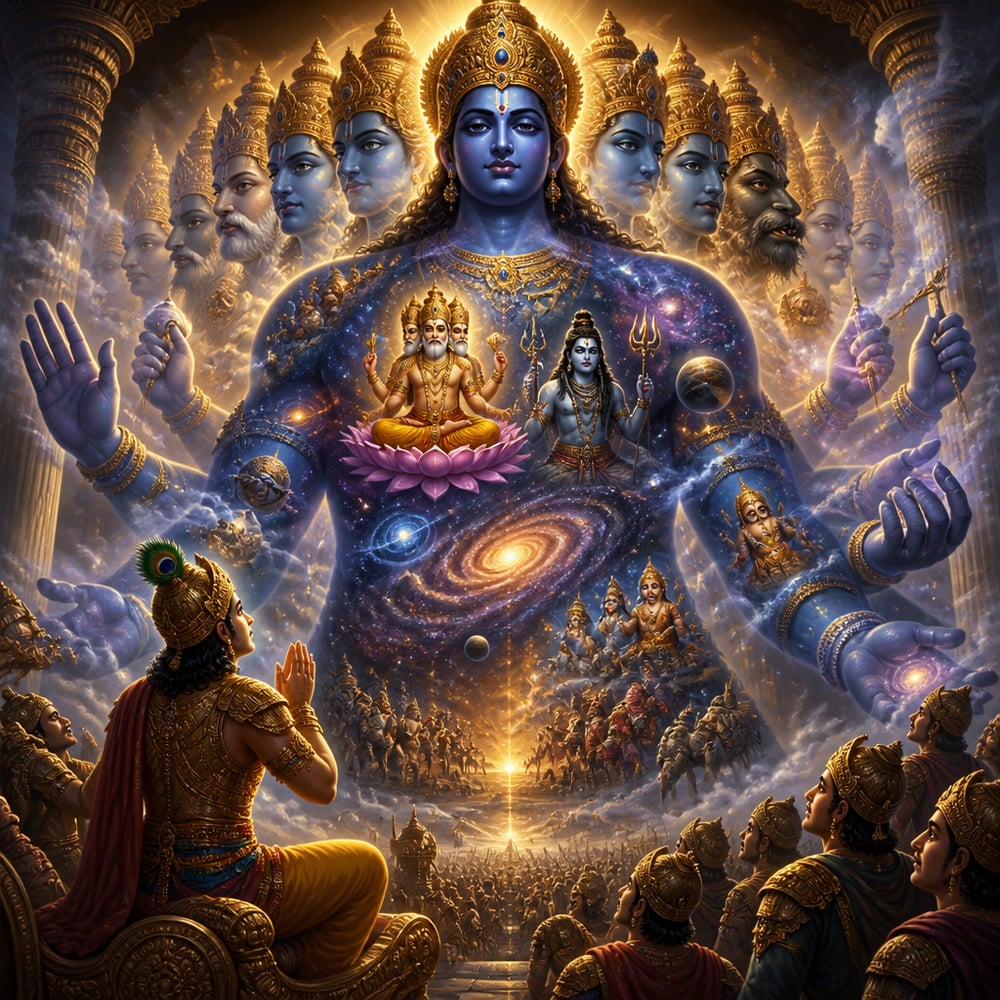
Krishna's form began to expand, filling the assembly hall, then exceeding its walls as if they were made of mist. His skin blazed with the light of a thousand suns. His body contained not one face but countless faces, serene, wrathful, ancient, young, human, divine.
Within his form, the assembly saw:
The Gods
All the devas appeared within Krishna's body, Brahma the Creator seated on his lotus, Shiva the Destroyer with his trident, Indra king of heaven with his thunderbolt, Varuna of the waters, Yama of death, and countless others. The celestial hierarchy, which mortals worship and fear, existed as mere aspects of this single being.
The Universe
Galaxies wheeled within his chest. Mountains rose along his limbs. Rivers flowed through his veins. The earth, the heavens, the underworlds, all the realms of existence were contained within him like cities within a kingdom.
Time Itself
Past, present, and future merged in the vishvarupa. The witnesses saw their own births, their deaths, and everything between. They saw the creation of the universe and its eventual dissolution. They saw the endless cycle of ages, Satya, Treta, Dvapara, Kali, turning like a great wheel within Krishna's being.
The Coming War
Most terrifyingly, they saw visions of the future: warriors falling, elephants screaming, the field of Kurukshetra drenched in blood. They saw themselves, Bhishma pierced by arrows, Drona fallen in treachery, Karna abandoned by his chariot wheel, Duryodhana himself with broken thighs, cursing heaven as he died.
The assembly saw what their choices would bring. They saw the end.
The Response of Mortals
The effect on those present was overwhelming:

Dhritarashtra, blind since birth, was granted momentary divine sight by Vyasa so he could witness this revelation. What he saw drove him to the floor, weeping and trembling. For the first time, he truly understood the magnitude of his sons' folly.
Bhishma and Drona, who had seen much in their long lives, fell to their knees in worship. They had always known Krishna was no ordinary mortal, but this confirmation of his divine nature filled them with both awe and despair, for they knew they must fight against him.
Vidura stood with tears streaming down his face, tears of joy that the truth was finally revealed, tears of sorrow that it would change nothing.
Gandhari, Dhritarashtra's wife, though not present in the hall, later said she felt the revelation through the walls of the palace, a wave of divine terror that passed through stone as if it were water.
And Duryodhana?

He turned away.
The Blindness of Pride
Of all the responses in that assembly, Duryodhana's was the most significant. Confronted with direct evidence of Krishna's divine nature, confronted with visions of his own defeat and death, confronted with proof that he was defying not a man but the Supreme Being itself, he turned away and refused to look.
"Tricks," he muttered. "Illusions. The Yadavas are known for their magic. This changes nothing."
This was not stupidity. Duryodhana was far from foolish. This was something deeper and more tragic: a soul so committed to its chosen path that it could not receive truth, no matter how overwhelming the evidence.
| Observer | Response | Meaning |
|---|---|---|
| Bhishma, Drona | Fell in worship | Recognized divine truth despite being bound to oppose it |
| Dhritarashtra | Wept in terror | Saw consequences too late to change course |
| Vidura | Tears of mixed emotion | Joy at revelation, sorrow at its futility |
| Duryodhana | Turned away | Pride so deep it could reject direct divine evidence |
The vishvarupa could humble warriors who had never known fear. It could grant insight to the blind. But it could not penetrate the armor of absolute pride.
The Return to Normal
As suddenly as it had begun, the vision ended. Krishna stood before them in his normal form, a handsome, dark-skinned man of ordinary stature, smiling gently as if nothing had happened.
"I came to you as a friend, seeking peace. You answered with treachery. I have shown you what you defy. Make of it what you will."
He looked around the assembly, at Bhishma still kneeling, at Drona with eyes wet, at Dhritarashtra collapsed against his throne, at Duryodhana standing rigid with his back turned.
"Remember this day. Remember that the choice was yours."
Then Krishna walked out of the assembly hall. No one tried to stop him. No one could have.
The Meaning of Vishvarupa
The term vishvarupa means "universal form" or "form of the universe." It represents the revelation that the divine is not separate from existence but is existence itself. The gods, the cosmos, time, and all beings are not external to the Supreme, they are contained within it.
This concept has profound implications:
Everything Is Divine
If the universe exists within the Supreme Being, then every atom, every creature, every moment participates in divinity. There is nowhere that God is not. The Kauravas, in fighting against dharma, were fighting against the very ground of their own existence.
The Infinite in the Finite
Krishna normally appeared as a finite person, with a body, a location, a history. Yet within that finite form, the infinite was always present. The vishvarupa revelation showed that apparent limitation does not constrain the divine. What looks ordinary may contain the extraordinary.
Choice Remains
Remarkably, even after witnessing the vishvarupa, Duryodhana remained free to choose his path. Divine revelation does not compel acceptance. The soul's freedom is so profound that it can say "no" even to God. This is simultaneously the glory and the tragedy of human existence.
The Foreshadowing
This revelation in the Kaurava court foreshadowed a more famous vishvarupa, the one Krishna would show to Arjuna on the battlefield of Kurukshetra, described in the Bhagavad Gita's eleventh chapter.
But the two revelations served different purposes:
| Aspect | Kaurava Court | Battlefield (Gita) |
|---|---|---|
| Recipient | Enemies | Beloved friend |
| Purpose | Warning and demonstration of power | Teaching and blessing |
| Response | Terror and denial | Terror, then devotion |
| Effect | Changed nothing | Transformed Arjuna |
Arjuna, after his initial terror, would accept the vision and receive its blessing. Duryodhana, confronted with the same truth earlier, rejected it entirely. The difference was not in the revelation but in the receivers.
The Lesson for Humanity
The vishvarupa in the Kaurava court teaches something crucial about the nature of truth and choice:
Truth can be revealed but not imposed. The most overwhelming evidence, the most direct demonstration, cannot force acceptance. The human will retains its freedom even in the face of the absolute. This is what makes our choices meaningful, and what makes wrong choices so tragic.
Duryodhana saw everything. He saw his own death, the destruction of his family, the futility of his cause. And he chose to continue anyway. Not from ignorance, but from something deeper: a commitment to his path that had become more important than truth itself.
The question for each of us is: What would we have done? When the curtain is pulled back and reality stands revealed, do we have the humility to accept what we see, or have we so invested in our chosen direction that we would turn away even from the infinite?
Living traditions
The vishvarupa has become a significant image in popular culture and philosophical discussion. Carl Sagan quoted the Bhagavad Gita's vishvarupa chapter when discussing nuclear weapons, and J. Robert Oppenheimer famously recalled 'Now I am become Death, the destroyer of worlds' after the first nuclear test. In contemporary spiritual discourse, the vishvarupa is often cited as an early description of what modern physics reveals about the interconnected nature of reality. Virtual reality developers have attempted to create immersive vishvarupa experiences, recognizing that the form challenges the limits of human perception.
- Vishvarupa Meditation: Contemplative practice involving visualization of the universal form, often using the descriptions from the Bhagavad Gita Chapter 11
- Vishvarupa Darshan in Temples: Special worship services featuring images or displays of Krishna's cosmic form, particularly on Gita Jayanti
- ISKCON Temple Vishvarupa Display: Features a renowned light-and-sound presentation of the vishvarupa that attempts to convey the overwhelming nature of the cosmic form
- Prem Mandir: This modern temple complex features extensive sculptural depictions of Krishna's leelas, including representations of his divine forms
- Ranganatha Temple: One of the largest functioning Hindu temples, dedicated to Vishnu in his cosmic reclining form. The temple's vastness itself suggests the infinite nature of the divine
Reflection
- Have you ever witnessed something that should have changed your understanding but found yourself dismissing or explaining it away? What was at stake in maintaining your previous view?
- The vishvarupa contained both beautiful and terrifying elements, creation and destruction, gods and demons, past and future. What does it mean that the ultimate reality includes all opposites?
- If Duryodhana retained free will even when confronted with the infinite, what does this tell us about the nature and limits of divine power? Can the unlimited be limited by human choice?