Shanti Prayas: Krishna's Peace Mission

Krishna goes to Hastinapura

When all other envoys have failed, Krishna Vasudeva himself journeys to Hastinapura as the final ambassador of peace. The Lord of the Universe enters the court of those who would be his enemies, offering a last chance to avoid the bloodshed to come. What happens when divine mercy meets human obstinacy?

The Final Ambassador

All diplomatic options had been exhausted. Drupada's priest had carried the Pandavas' demands. Sanjaya had shuttled between camps with proposals and counter-proposals. Vidura had counseled Dhritarashtra through sleepless nights. None of it had moved the needle toward peace.

Now, as a last resort, the Pandavas sent their most precious asset: Krishna Vasudeva himself.

Yudhishthira spoke to Krishna before his departure:

"Madhava, you know our position. We want peace, genuine peace, with justice. If the Kauravas will return even five villages, Kushasthala, Vrikasthala, Asandi, Varanavata, and any fifth of their choosing, we will accept that and live in friendship. This is far less than we deserve, but we would rather have little with honor than everything through blood."

Krishna nodded gravely.

"I understand, Dharmaraja. I will convey your offer in the clearest possible terms. I will give Duryodhana and Dhritarashtra every opportunity to choose peace. But you must understand: I do not go with much hope. I have seen the hardness in Duryodhana's heart. Still, the effort must be made, if only so that when war comes, the world will know we tried everything."
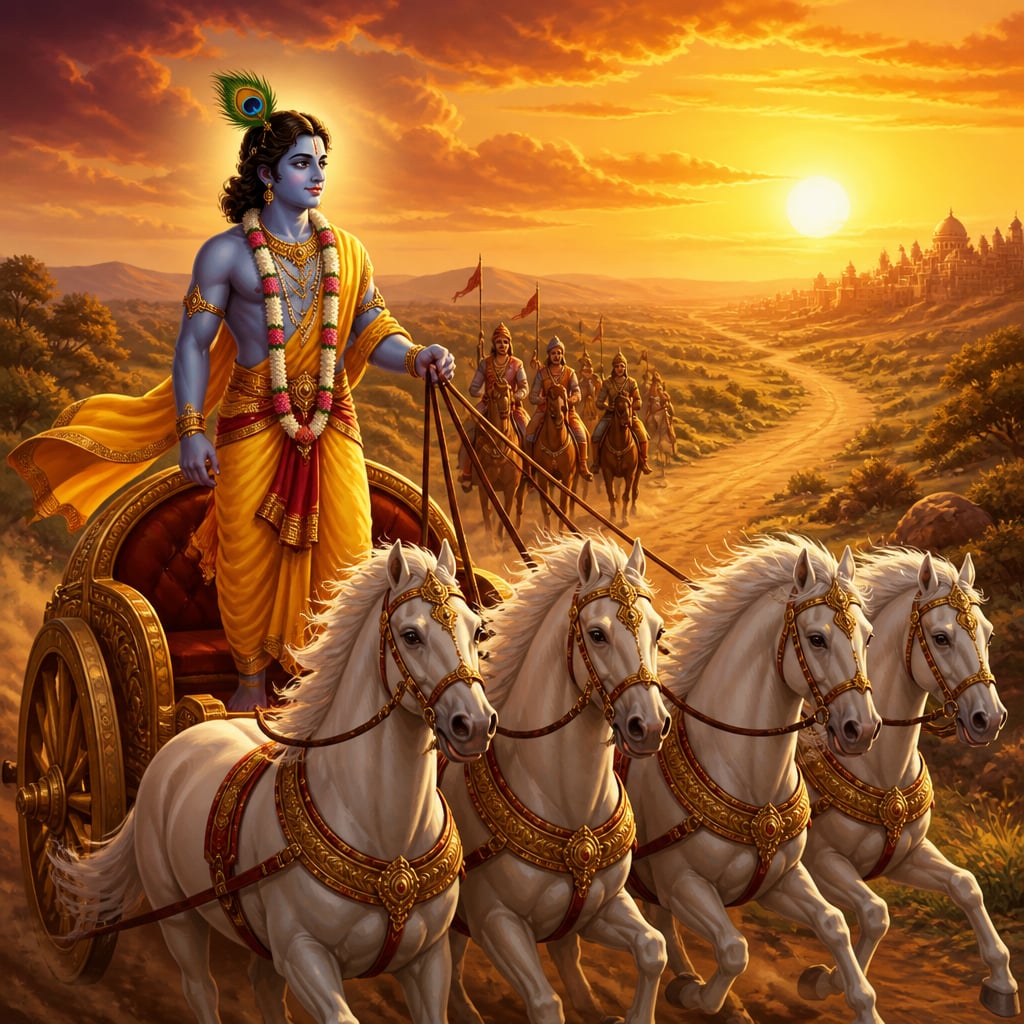
Krishna stands tall in a single open chariot drawn by four white horses at golden dawn, crossing the open plain from Upaplavya toward Hastinapura on his peace mission.

The Journey to Hastinapura

Krishna's chariot departed from Upaplavya at an auspicious hour, accompanied by a modest retinue. As they traveled, Vidura came out to meet him on the road, the wise counselor had left Hastinapura to warn Krishna of what awaited him.

"Keshava, turn back," Vidura pleaded. "You waste your time. Duryodhana will never agree to peace on any terms. Even worse, there are whispers that some in the court plan to seize you, to imprison or kill the Pandavas' greatest ally before the war begins."

Krishna smiled, that mysterious smile that suggested he knew far more than he revealed.

"Dear Vidura, do you think I am unaware of these plots? Do you imagine I fear Duryodhana's schemes? I go to Hastinapura not because I expect success, but because dharma requires that every path to peace be walked before the path of war. If they try to seize me, well, let them try."

They continued toward the city, where a very different reception awaited.

The Reception at Hastinapura

News of Krishna's arrival threw Hastinapura into confusion. Dhritarashtra, hoping to impress and perhaps placate the powerful Yadava lord, arranged an extravagant welcome, fine lodgings, magnificent gifts, elaborate feasts.

Krishna refused it all.

Krishna refuses Duryodhana's lavish hospitality at Hastinapura

"I have not come as a guest seeking hospitality," he declared. "I have come as an envoy seeking justice. I will eat only when my mission is accomplished, or when it has definitively failed. Until then, I will stay with Vidura, who has always been a friend to dharma."

This was a calculated snub. By staying with Vidura rather than in the royal palace, Krishna signaled that he did not recognize the Kaurava court as legitimate hosts. By refusing their food, he maintained the purity required of a sacred mission.

Duryodhana was furious at this rejection of his father's hospitality. But there was nothing he could do, Krishna was an envoy, protected by the laws of diplomacy, and any harm done to him would unite every kingdom in Bharatavarsha against Hastinapura.

The Assembly

The next morning, Krishna entered the great assembly hall of Hastinapura, the same hall where Draupadi had been humiliated, where the dice game had sealed the Pandavas' fate, where so much injustice had been sanctioned by silence.

The hall was packed. Dhritarashtra sat on his throne, flanked by his sons. Bhishma, Drona, Kripa, and Vidura occupied their places of honor. Duryodhana sat rigidly, his face a mask of barely concealed hostility. Karna stood nearby, ready to support his friend. Shakuni, the architect of so much misery, watched with calculating eyes.

Krishna walked to the center of the hall and began to speak. His voice was calm but carried to every corner:

"Grandsire Bhishma, Teacher Drona, King Dhritarashtra, princes of the Kuru line, I come bearing a message of peace from King Yudhishthira, who even now holds back armies that could march within days."

"The Pandavas do not seek war. They do not seek the destruction of this house, though they have suffered greatly at its hands. They seek only what was promised them: the return of their kingdom after thirteen years of exile. They have fulfilled every condition of the agreement. Now it is time for you to fulfill yours."

The Appeal to Memory

Krishna then did something remarkable: he recounted the entire history of Kaurava injustice, forcing the assembly to confront what they had done.

"Remember the lac house at Varanavata, where you tried to burn five brothers and their mother alive. Remember the dice game, where loaded dice and a master cheat stole a kingdom in a single afternoon. Remember Draupadi, dragged by her hair before this very assembly, her honor assaulted while elders sat silent."

"Remember the forest, where you sent assassins after exiles who were keeping faith with an unjust agreement. Remember how Yudhishthira, in his righteousness, kept every condition while you prepared to deny him his reward."

He looked directly at Dhritarashtra:

"O King, you have always known the truth. Your counselors have told you repeatedly. Your own conscience has spoken in the dark of night. Yet you have done nothing. Today, I offer you one final chance. Restrain your son. Return what was stolen. Choose peace, while peace is still possible."

The Responses

Bhishma spoke first, his ancient voice heavy with sorrow:

"Everything Krishna says is true. The Pandavas have been wronged beyond measure. I have counseled peace from the beginning. O Duryodhana, for the love of this family, for the honor of our house, accept this offer."

Drona added his voice:

"I taught both Pandavas and Kauravas. I know their strength. Arjuna alone is worth your entire army, and with Krishna guiding him, he cannot be defeated. Make peace, O prince, while you still can."

Even Dhritarashtra seemed moved:

"Perhaps... perhaps we could consider... some accommodation..."

But Duryodhana rose, his eyes blazing with the fire of wounded pride:

"Father, do not be swayed by this performer's words! What the Pandavas 'lost,' they wagered freely. Yudhishthira sat at that dice game of his own will. No one forced him to stake his kingdom, his brothers, his wife. He lost, and now he wants back what he gambled away?"

"I will not return a single village. I will not yield land enough to place a needle upon. If the Pandavas want what I hold, let them come and take it, if they can."

Krishna's Final Plea

Krishna had expected this response. But he tried once more, his voice dropping to a tone of almost personal appeal:

"Duryodhana, I speak to you not as an enemy but as kin. I have watched you grow from a child into a man. I have seen your strength, your determination, your loyalty to those you love. These are not small qualities."

"But they are being misused. The path you have chosen leads only to destruction, your own destruction, and that of everyone who follows you. Bhishma will die. Drona will die. Karna will die. Your brothers, your friends, your soldiers, all will die. And for what? For pride? For a kingdom you could share in peace?"

"I ask you one more time: choose differently. Not for the Pandavas' sake, for your own. For your father, who will lose all his sons. For your mother, who will weep over your body. For the future that could still be bright, if only you would let go of this madness."

The hall was silent. Even Duryodhana seemed briefly affected by the sincerity in Krishna's voice.

But the moment passed. The hardness returned to his eyes.

"Enough, Vasudeva. You have spoken well, as an advocate for your clients. But your words change nothing. The Pandavas had their chance and lost it. War is coming, and I welcome it. Now leave this assembly before I forget that you are an envoy."

The Dark Plot

What happened next revealed the depth of Kaurava desperation.

Shakuni had whispered a plan to Duryodhana: seize Krishna. Bind him. Remove the Pandavas' greatest strategist before the war even begins. Without Krishna, Arjuna would be directionless, the Pandava alliance would fracture, and victory would be assured.

As Krishna turned to leave, Duryodhana gave a signal. Guards began to move toward the divine envoy.

Satyaki and other Yadava warriors with Krishna reached for their weapons. The hall tensed for violence.

Krishna raised his hand, and smiled.

"So this is your answer, Duryodhana? This is how you treat an envoy who came in good faith? Very well. You wish to seize me? Behold then whom you would bind."

The Revelation

What followed was witnessed by every person in that assembly and would be spoken of for ages to come.

Krishna began to grow. His form expanded, filling the hall, then exceeding it. His body blazed with light that made the sun seem dim. From his form emerged visions of cosmic terror and cosmic beauty:

The assembly fell to the ground in terror. Warriors who had never known fear trembled like children. Even Bhishma and Drona, who had faced death countless times, could not bear to look directly at the form before them.

Only Duryodhana, in his blindness of spirit, tried to look away, tried to maintain his defiance.

Then, as suddenly as it had begun, the vision ended. Krishna stood before them in his normal form, smiling gently as if nothing had happened.

"I came in peace. You answered with treachery. Remember this day, O Kauravas, when the choice was still yours."

He walked out of the assembly hall, and no one dared stop him.

The Aftermath

Krishna's mission had failed, as he had known it would. But it had accomplished everything it needed to:

Purpose Achievement
Demonstrate Pandava willingness for peace Yudhishthira's offer of five villages made public
Establish moral clarity The world now knew who refused peace
Warn the Kauravas They could not claim ignorance of consequences
Fulfill dharma Every path to peace had been walked

Krishna kneels before Kunti taking her final message for her sons

Before leaving Hastinapura, Krishna met privately with Kunti, the Pandavas' mother, who had remained in the city throughout the years of exile. What passed between them would shape events yet to come.

He also met with Karna, a meeting that would be recounted in a later lesson, when Krishna revealed to the great warrior the secret of his birth.

Then Krishna mounted his chariot and returned to the Pandava camp. His report was simple:

"War is now certain. Duryodhana has chosen destruction. Let us prepare."

The Shanti Prayas, the effort for peace, was over. What remained was the preparation for the greatest war the world had ever seen.

Living traditions

Krishna's peace mission is frequently cited in Indian diplomatic circles as a model of principled negotiation. The Ministry of External Affairs' training programs reference this episode when discussing the ethics of diplomacy. The phrase 'sui ki nok bhar bhi nahin' (not even a needle's point) from Duryodhana's refusal has become a Hindi idiom for absolute intransigence. Peace studies programs in Indian universities often begin their courses with analysis of this failed mission to illustrate both the necessity and the limitations of diplomatic efforts.

Reflection

More in Udyoga Parva

All lessons in Udyoga Parva ยท The Mahabharata course