Relevance: Udyoga Parva in 2026
Diplomacy, choice, loyalty
What does a three-thousand-year-old story about failed diplomacy, tragic choices, and war preparation have to tell us today? The Udyoga Parva is not merely ancient history but a mirror reflecting our own times. Its themes of negotiation, loyalty, pride, and moral complexity speak directly to the challenges we face in 2026, from international conflicts to personal relationships, from professional ethics to the choices that define who we become.
An Ancient Story, A Present Mirror
The Udyoga Parva was composed (in its current form) roughly two thousand years ago, telling stories set perhaps a thousand years before that. Yet when we read of Krishna's peace mission, Karna's tragic loyalty, or Duryodhana's stubborn pride, we recognize ourselves.
This recognition is not accidental. The Mahabharata endures because it addresses the unchanging aspects of human nature, our capacity for wisdom and folly, our struggles with loyalty and self-interest, our attempts to negotiate our way through conflicts that seem destined for collision.
In this final lesson, we explore how the Udyoga Parva's themes illuminate our contemporary world.
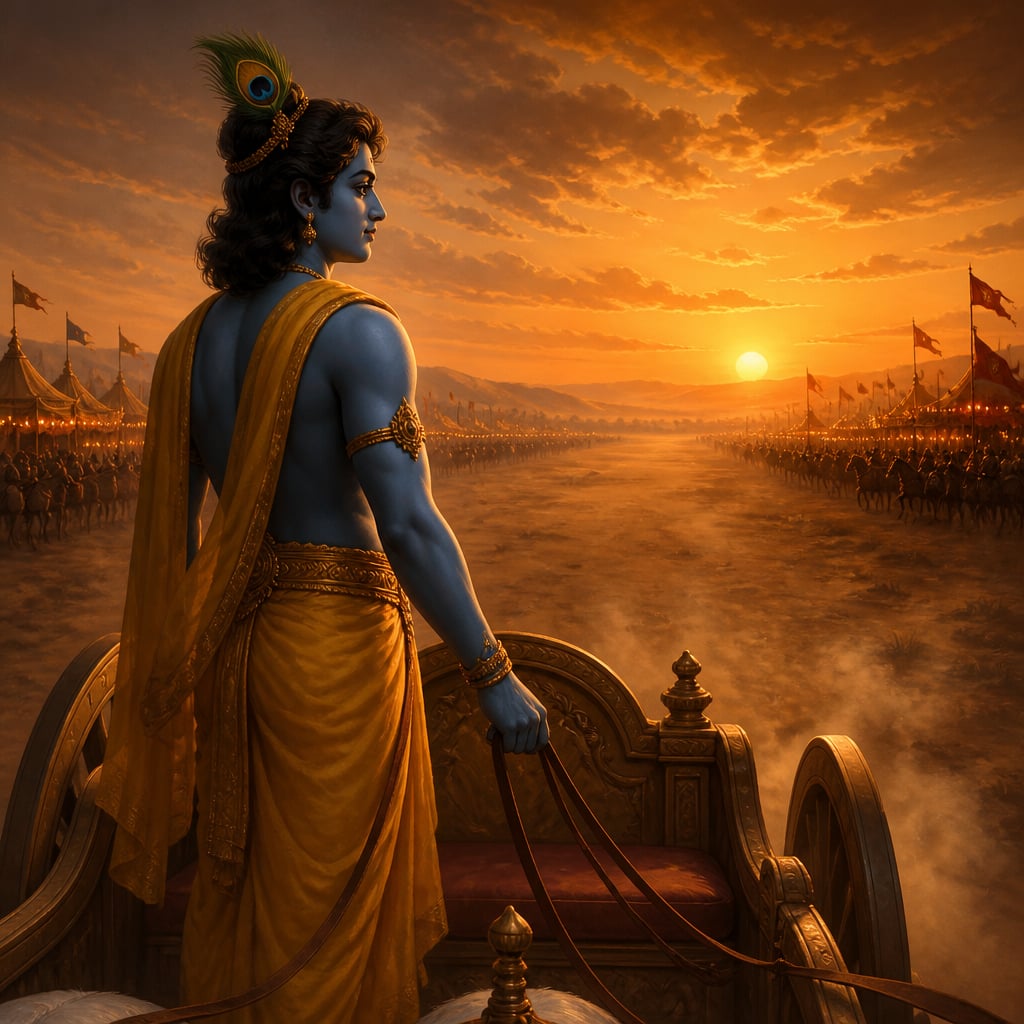
Theme 1: The Art and Limits of Diplomacy
What the Parva Teaches
Krishna's peace mission was a masterpiece of diplomatic effort. He appealed to reason, emotion, self-interest, and fear. He offered compromises that would have given both sides acceptable outcomes. He demonstrated divine power to show the consequences of refusal.
And he failed.
The Udyoga Parva teaches that diplomacy, however skillfully conducted, has limits. When dealing with someone whose identity is fused with conflict, like Duryodhana, no negotiation can succeed. Some people can only be reached by the consequences of their choices, not by words.
Modern Parallels
International Relations: The world in 2026 faces conflicts that seem impervious to diplomatic solution. The Udyoga Parva reminds us that:
- Diplomatic failure is sometimes the diplomat's fault, but often reflects the other party's unwillingness
- Offering reasonable terms does not obligate acceptance
- Sometimes conflict is inevitable despite everyone's best efforts
Workplace Dynamics: How many of us have tried to reason with a colleague or boss whose ego made negotiation impossible? The parva validates our experience: some people cannot hear reason because reason threatens their self-image.
Personal Relationships: When relationships become adversarial, we often try to "talk things out." The Udyoga Parva acknowledges that sometimes talking fails, not because we spoke poorly, but because the other person cannot or will not hear.
Theme 2: The Weight of Choices
The Architecture of Decision
The Udyoga Parva is a catalog of choices:
- Arjuna and Duryodhana's choice between Krishna's wisdom and his army
- Karna's choice to remain with Duryodhana despite knowing his true birth
- Dhritarashtra's choice to remain passive rather than command his son
- Vidura's choice to speak truth despite knowing it would be ignored
- Shalya's choice (or non-choice) to be tricked into fighting against his nephews
Each choice revealed character. Each had consequences that shaped everything that followed.
Applying This Today
Career Decisions: When choosing between jobs, partners, or paths, we often face the Arjuna-Duryodhana choice in miniature. Do we choose resources and security? Or do we choose wisdom and guidance? The parva suggests that quality of counsel often matters more than quantity of resources.
Loyalty Questions: Karna's choice resonates with anyone who has stayed in a difficult situation out of loyalty to those who helped them in the past. The parva doesn't tell us his choice was wrong, it shows us its cost. Loyalty that leads to destruction is still loyalty; we must decide what we value.
Choosing to Speak: Vidura spoke knowing he would be ignored. Was this foolish? The parva suggests otherwise, speaking truth has value independent of whether it's heard. We are responsible for our words, not others' ears.
Theme 3: Pride as Destruction
Duryodhana's Lesson
"Not even land enough for the point of a needle."
Duryodhana's refusal was not strategy, it was psychology. His identity had fused with his position so completely that any compromise felt like self-annihilation. He chose actual annihilation rather than negotiate his sense of self.
The Modern Epidemic
Pride in the Duryodhana mold is everywhere:
Political Polarization: Leaders and movements that cannot compromise because their identity depends on defeating the other side, not solving problems.
Cancel Culture and Its Opponents: Both sides sometimes become so identified with their position that dialogue becomes impossible, any concession feels like betrayal of self.
Personal Conflicts: Marriages end, friendships shatter, families break, not because problems are unsolvable, but because someone would rather lose everything than appear to yield.
The Teaching
The parva does not preach against pride through moralizing. It simply shows us what happened. Duryodhana's pride destroyed him, his brothers, his allies, and his dynasty. The evidence is in the outcome.
This is the most effective teaching method: not "you should not be proud" but "look at what pride did."
Theme 4: Loyalty's Complexity
Karna's Dilemma
Karna was offered everything he ever wanted, legitimacy, family, throne, if he would betray the friend who accepted him when no one else would. He refused.
Was this noble or foolish? The parva never answers definitively. It shows us the choice, its reasoning, and its cost. We must judge for ourselves.
Modern Loyalty Questions
Organizational Loyalty: When your company does something you believe is wrong, do you stay and try to change it? Leave? Speak out? Karna's dilemma echoes in every whistleblower's decision.
Political Loyalty: When your party or movement drifts from its ideals, what do you do? Leave and be called traitor? Stay and be complicit?
Personal Loyalty: When a friend makes choices you cannot support, how do you respond? Karna chose loyalty over agreement. Is that love or enabling?
The Insight
The Udyoga Parva suggests that loyalty is not a simple virtue. Loyalty to the wrong cause becomes complicity in destruction. But loyalty that evaporates when inconvenient was never loyalty at all.
The question is not "should I be loyal?" but "what am I loyal to?" Karna was loyal to the person who showed him kindness, arguably the wrong application of a right impulse.
Theme 5: The Rules We Make and Break
Yuddha Dharma Then and Now
The warriors of Kurukshetra established rules for combat, knowing those rules would be broken. They tried anyway. And the rules did break, one by one, as desperation mounted.
This pattern echoes everywhere:
International Law: Geneva Conventions, nuclear treaties, cyber warfare norms, we establish rules, watch them erode, and debate whether the attempt is worthwhile.
Professional Ethics: Every profession has codes of conduct. Every profession has members who violate them. The codes still matter because they establish what we aspire to.
Personal Boundaries: We set boundaries in relationships, knowing we might not maintain them perfectly. The attempt shapes behavior even when imperfect.
The Teaching
The Udyoga Parva doesn't mock the rules' failure, it honors the attempt. The warriors were trying to remain human while doing inhuman things. Their failure was inevitable; their effort was not worthless.
This may be the most important teaching for our time: Make rules. Know they will be imperfect. Make them anyway.
Theme 6: When Peace Fails
Preparing for What Comes
The Udyoga Parva ends with armies gathered and peace exhausted. The name means "effort" or "endeavor", and the central effort (preventing war) has failed.
What remains? Preparation. The parva details the gathering of forces, the establishment of rules, the appointment of commanders. When diplomacy fails, other work begins.
Application
Not Every Conflict Can Be Avoided: Some readers interpret the Mahabharata as anti-war. But it's more nuanced. War came not because warriors wanted it but because one party refused every alternative. Sometimes conflict is the consequence of another's choices, not your own.
Prepare Without Desiring: The Pandavas prepared for war while sincerely seeking peace. These are not contradictions. Hope for the best, prepare for the worst.
Face Consequences Clearly: Once war became inevitable, the parva depicts honest assessment. How strong is each side? What are the advantages and disadvantages? Clear-eyed evaluation, not wishful thinking.
Theme 7: The Truth That Cannot Be Hidden
Secrets and Their Revelation
Kunti's secret, Karna's birth, could have changed everything if revealed earlier. But she kept silent out of fear and shame. When she finally spoke, it was too late to change the course of events.
The Universal Pattern
How many families carry secrets that warp relationships for generations? How many organizations conceal information until the damage cannot be undone? How many of us keep truths hidden that, if spoken earlier, might have prevented disasters?
The parva shows us:
- Secrets do not disappear, they grow
- Truth delayed often becomes truth useless
- Fear of consequences often brings worse consequences
Making It Personal
Questions for 2026
As you complete the Udyoga Parva, consider:
In your current conflicts, are you Krishna (genuinely seeking resolution) or Duryodhana (using negotiation as performance while committed to your position)?
In your loyalties, are you Karna (loyal to the person regardless of cause) or Yuyutsu (loyal to principle, willing to change sides)?
In your choices, are you choosing the army (resources, security) or the wisdom (guidance, quality)?
In your pride, where have you become so identified with a position that compromise feels like self-destruction?
In your secrets, what truths are you delaying that might grow more damaging with time?
The Parva's Final Teaching
Effort Matters Even When It Fails

The Udyoga Parva is named for effort, udyoga. The central effort failed. War came. Millions died.
But the effort was not worthless. It established that the Pandavas had done everything possible to avoid bloodshed. It gave Duryodhana every chance to choose differently. It created a record of good faith that justified the Pandava cause.
In our own lives, we make efforts that fail. We try to reconcile, to heal, to prevent, and sometimes we fail. The Udyoga Parva suggests that the effort itself has value. We are not responsible for others' choices, only for the quality of our own attempts.
Taking It Forward
What the Udyoga Parva Offers
This parva has given us:
A model of diplomacy: Krishna's attempt shows what good-faith negotiation looks like, and its limits.
A psychology of pride: Duryodhana's refusal illuminates how ego can override self-interest.
A meditation on loyalty: Karna's choice asks us what we would die for, and whether that answer honors our best self.
A framework for rules: The yuddha dharma council shows that ethical boundaries matter even when imperfectly kept.
A map of choice: Every major character models a different approach to impossible decisions.
The Invitation
The Mahabharata does not tell us what to think. It shows us humans wrestling with the permanent questions and lets us draw our own conclusions.
As you move forward, into the Bhishma Parva and the war itself, or into your own life's conflicts, take with you the Udyoga Parva's central insight:
Make every effort to avoid destruction. Prepare for the possibility that effort will fail. And when you must act, act with as much honor as you can manage, knowing you will fall short of your ideals.
This is not despair. It is wisdom earned across three thousand years of human reflection on the permanent problems of human existence.
The Udyoga Parva ends. The war begins. The story continues, in the epic and in your life.
Living traditions
[object Object] [object Object]
Reflection
- Which character from the Udyoga Parva do you most identify with, and what does that identification reveal about your own values and struggles?
- What 'needle-points', small concessions you refuse to make, exist in your own life? What would it take to yield them?
- As you complete this parva, what single insight will you carry forward into your own life? How will you apply it?