Vyuha: The Armies Gather
Eleven akshauhinis face seven
Diplomacy has failed. Now the greatest armies ever assembled in ancient India prepare to clash. Eleven akshauhinis march for the Kauravas; seven for the Pandavas. This lesson explores the military organization of the Mahabharata war, the kingdoms and heroes who chose their sides, and the staggering scale of destruction about to unfold. Understanding the forces helps us comprehend both the strategic brilliance and the human tragedy of Kurukshetra.
The Mathematics of Destruction
As Krishna returned from Hastinapura with news of Duryodhana's refusal, both sides began the final preparations for war. Messengers rode to every ally. Oaths were called in. Ancient debts demanded payment.
The result was the largest military gathering the world had ever seen. By the time both armies faced each other across the field of Kurukshetra, the combined forces numbered in the millions, a scale of warfare that would not be seen again for millennia.
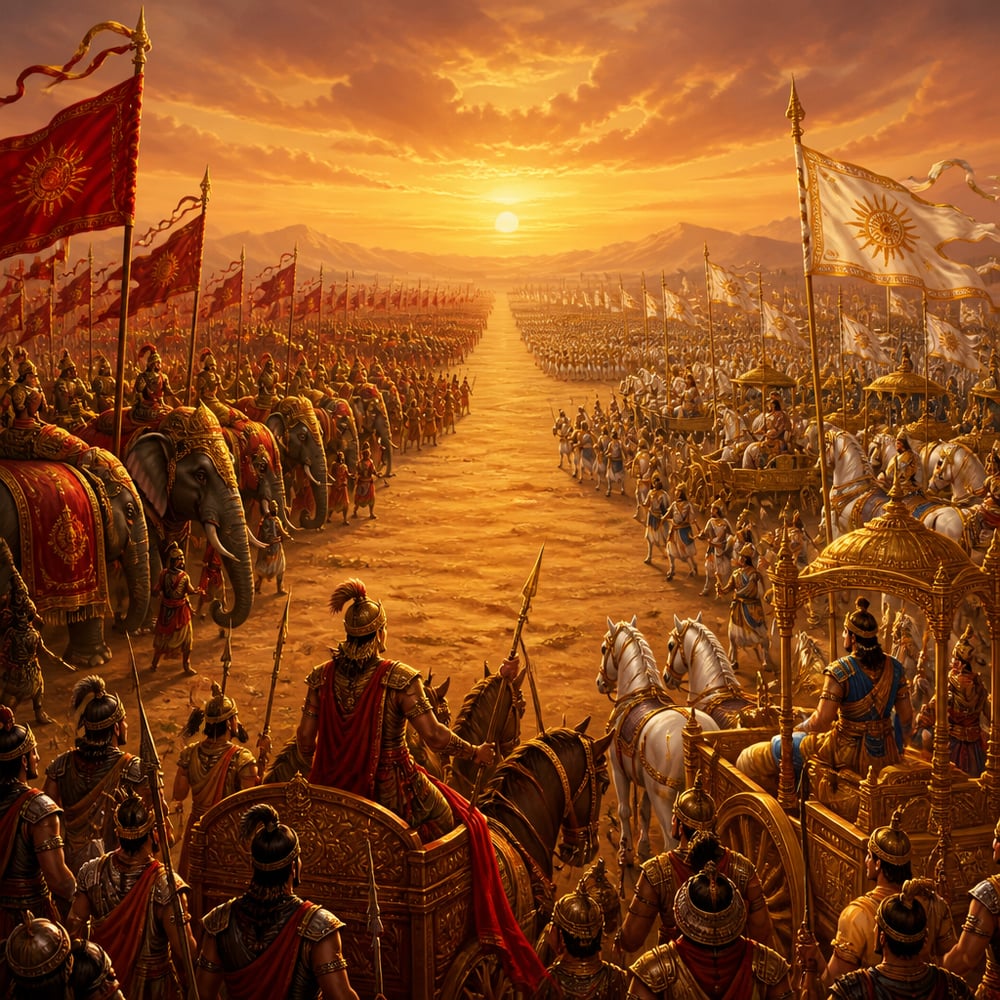
But numbers alone do not tell the story. To understand what was about to happen, we must understand how ancient Indian armies were organized, who fought for which side, and what strategic considerations shaped the coming battle.
The Akshauhini: Ancient Military Organization
The Army Division System
The armies of the Mahabharata were organized according to a precise mathematical system. The basic unit was the akshauhini, a complete army division with specified numbers of soldiers, elephants, chariots, and horses.
One Akshauhini Contained:
| Unit Type | Number |
|---|---|
| Elephants | 21,870 |
| Chariots | 21,870 |
| Cavalry | 65,610 |
| Infantry | 109,350 |
| Total Warriors | 218,700 |
But an akshauhini was more than just soldiers. Each warrior required support:
- Chariot drivers and elephant mahouts
- Horse grooms and animal handlers
- Weapon smiths and armorers
- Cooks, servants, and camp followers
- Medical personnel and priests
With support personnel, each akshauhini represented roughly half a million people.
The Balance of Power
Kaurava Forces: Eleven Akshauhinis
Duryodhana commanded the larger army, eleven complete akshauhinis, representing approximately 2.4 million warriors plus support personnel.
Major Contributors to the Kaurava Army:
- Hastinapura (Duryodhana's own forces)
- Sindhu (King Jayadratha)
- Gandhara (Shakuni and the Gandharas)
- Kalinga (Eastern coastal kingdom)
- Pragjyotisha (Bhagadatta and his elephant army)
- Kamboja (Central Asian warriors)
- Trigarta (Sworn enemies of Arjuna)
- Madra (Shalya, though reluctantly)
- Avanti (Vinda and Anuvinda)
- Bahlika (Ancient uncle of Bhishma)
- Various smaller kingdoms
Key Kaurava Warriors:
- Bhishma: Commander-in-chief for days 1-10
- Drona: Commander for days 11-15
- Karna: Commander for days 16-17
- Shalya: Commander for day 18
- Kripa and Ashwatthama: Elite warriors
- Duryodhana's 99 brothers: The Kaurava princes
The Pandava Forces
Seven Akshauhinis Against Eleven
The Pandavas commanded seven akshauhinis, approximately 1.5 million warriors. Though numerically inferior, their forces included some of the greatest individual warriors.
Major Contributors to the Pandava Army:
- Panchala (King Drupada and Dhrishtadyumna)
- Matsya (King Virata, who sheltered them)
- Kashi (Traditional allies)
- Chedi (Dhrishtaketu)
- Magadha (Eastern power)
- Kekaya (Five princes who were brothers-in-law)
- Dwaraka's Narayani Sena (Krishna's army, not Krishna himself)
Key Pandava Warriors:
- Dhrishtadyumna: Supreme Commander (destined to kill Drona)
- Arjuna: Greatest archer, with Krishna as charioteer
- Bhima: Strongest warrior, sworn to kill all Kaurava brothers
- Yudhishthira: Moral center, skilled with spear
- Nakula and Sahadeva: Master horsemen and swordsmen
- Abhimanyu: Arjuna's young son, master of the chakravyuha
- Ghatotkacha: Bhima's demon son, powerful in night warfare
- Shikhandi: The key to defeating Bhishma
The Tragedy of Divided Loyalties
Warriors on the Wrong Side
Many warriors found themselves fighting against their own hearts. The web of obligations, oaths, and relationships forced good people to fight on sides they did not believe in.
Bhishma: Bound by his oath to Hastinapura, he led the Kaurava army despite loving the Pandavas and knowing Duryodhana was wrong.
Drona: Teacher of both sides, bound to Hastinapura by employment and gratitude, though his son Dhrishtadyumna fought for the Pandavas.
Shalya: Tricked by Duryodhana into fighting against his own nephews (Nakula and Sahadeva were his sister Madri's sons).
Karna: Born a Pandava, fighting against his own brothers, bound by loyalty to the friend who accepted him.
Yuyutsu: The only Kaurava prince to defect, joining the Pandavas before battle, Dhritarashtra's one son who would survive the war.
| Warrior | Fought For | True Loyalty |
|---|---|---|
| Bhishma | Kauravas | Pandavas |
| Drona | Kauravas | Arjuna |
| Karna | Kauravas | His promise |
| Shalya | Kauravas | Nakula/Sahadeva |
| Yuyutsu | Pandavas | Righteousness |
Strategic Considerations
The Kaurava Advantages
Numbers: With 11 akshauhinis against 7, the Kauravas had a 60% numerical advantage.
Experience: Bhishma had fought wars for over a century. Drona had trained generations of warriors. The Kaurava command structure was deeply experienced.
Resources: Hastinapura controlled the richest treasury in India. They could sustain a longer campaign.
Position: As defenders of the status quo, they forced the Pandavas to attack, giving them choice of defensive ground.
Allies: Many kingdoms owed debts to Hastinapura or feared Duryodhana's power.
The Pandava Advantages
Krishna: Though not fighting, Krishna's wisdom as charioteer and strategist was invaluable. His mere presence boosted morale.
Individual Excellence: Arjuna, Bhima, and Abhimanyu were among the greatest individual warriors. Quality sometimes outweighs quantity.
Motivation: The Pandavas fought for justice and recovery of their kingdom. Such motivation sustains warriors through hardship.
Dhrishtadyumna's Destiny: Born from fire specifically to kill Drona, the Pandava commander had a divine purpose.
Moral Clarity: Most Pandava warriors believed in their cause. The Kaurava side was divided by those who knew they fought for wrong.
The Commanders and Their Styles

Kaurava Command: Bhishma's Strategy
Bhishma, the first commander, planned a war of attrition. He intended to:
- Use numerical superiority to wear down Pandava forces
- Protect key Kaurava warriors while exhausting enemy elites
- Avoid killing the Pandavas himself (his personal vow)
- Maintain defensive formations that minimized Arjuna's impact
His strategy was sound militarily but undermined by his own reluctance. A commander who will not kill his enemies' best warriors is fighting with one hand tied.
Pandava Command: Dhrishtadyumna's Challenge
Dhrishtadyumna faced the harder task, defeating a larger army. His approach:
- Focus elite warriors (Arjuna, Bhima) on specific targets
- Use Shikhandi to neutralize Bhishma
- Exploit the divided loyalties in Kaurava ranks
- Accept higher casualties while targeting enemy commanders
The Pandava strategy was essentially decapitation, kill the leaders and the army would crumble.
The Geography of War
Why Kurukshetra?
The battlefield of Kurukshetra was not chosen randomly. This was sacred ground, a place where sacrifice and dharma had ancient significance.
The Field of Dharma: Kurukshetra was known as "Dharmakshetra", the field of righteousness. Legend held that whoever died here fighting for dharma would attain liberation.
Strategic Location: Positioned between the Saraswati and Drishadvati rivers, the plain was vast enough to accommodate massive armies while providing natural boundaries.
Neutral Ground: Neither side had an advantage, this was neither Hastinapura's doorstep nor a Pandava stronghold.
Practical Considerations: The flat terrain was ideal for chariot warfare, the dominant military technology of the era.
The Human Cost
Counting the Dead Before They Fell
With roughly 4 million warriors and support personnel gathering on both sides, the scale of potential death was almost incomprehensible.
By the war's end, eighteen days later:
- Only 12 warriors would survive from the Kaurava side (the 10 who survived the night massacre + Ashwatthama and Kripacharya)
- The Pandavas would lose most of their army, including Abhimanyu and countless allies
- Nearly the entire generation of Kshatriya warriors would be wiped out
The Mahabharata war was not merely a battle, it was an extinction event for the warrior class of ancient India.
The Women Who Watched
Those Who Would Become Widows
Behind every army marched the knowledge of those left behind:
Gandhari: Mother of a hundred sons, all destined to die.
Kunti: Her eldest son fought against her acknowledged sons, all her children in mortal danger.
Draupadi: Her five husbands would face death daily. Her sons would all fall.
Subhadra: Her only son Abhimanyu would be killed in a circle of warriors.
Uttara: Pregnant with Abhimanyu's child, the sole survivor of the Pandava line.
The gathering of armies was also a gathering of future grief. Every warrior who raised his weapons was someone's son, husband, or father.
The Night Before
Contemplating the Dawn
On the night before battle began, both camps were alive with activity. Weapons were sharpened. Prayers were offered. Final messages were sent to families.
In the Kaurava camp, Bhishma made his strange declaration: he would kill 10,000 Pandava soldiers each day, but would not kill the Pandava brothers themselves. His war would be fought with divided heart.

In the Pandava camp, Arjuna grew increasingly troubled. As he looked across the field at the army he would face, he saw his teachers, his grandfather, his cousins. The weight of what he was about to do began to settle on him.
That internal conflict would lead, on the first morning of battle, to the greatest philosophical dialogue in Indian literature, the Bhagavad Gita.
But that teaching belongs to another parva. For now, as the Udyoga Parva closes, we see only the armies arranged, the warriors ready, and the dawn approaching.
The End of Effort
Why "Udyoga" Means More Than War Preparation
The word "udyoga" means effort or endeavor. We have named this parva for the efforts made to prevent war, not the preparations for fighting it.
Yudhishthira's effort to reclaim his kingdom through justice. Sanjaya's effort to convey warnings. Vidura's effort to guide his brother. Krishna's effort to make peace. Even Bhishma and Drona's efforts to dissuade Duryodhana.
All these efforts failed.
The gathering of armies represents the failure of every alternative. War comes not because anyone wanted it (except perhaps Duryodhana), but because every effort to prevent it proved insufficient against the momentum of hatred, pride, and karma.
As the warriors take their positions and the conchs prepare to blow, we stand at the end of effort and the beginning of consequence. What follows, eighteen days of slaughter that will change the world, is the fruit of seeds planted long ago.
The Udyoga Parva closes with armies facing each other across a sacred field. The Bhishma Parva will open with the first arrows flying. And between them stands one warrior's crisis of conscience, Arjuna's despair and Krishna's response, that will become the Bhagavad Gita.
The effort is over. The war begins.
Living traditions
The akshauhini military organization is studied in Indian military history courses as an example of sophisticated ancient logistics. Kurukshetra has developed as a major heritage tourism destination, with the Haryana government investing in infrastructure including the Kurukshetra Development Board. The annual Gita Jayanti celebration draws hundreds of thousands of pilgrims. Indian Army regiments trace ceremonial traditions to ancient Kshatriya codes. The concept of 'gathering forces before decisive action' from this narrative influences strategic thinking in business and military academies across India.
- Shastra Puja (Weapon Worship): The tradition of worshipping weapons before battle continues in ceremonial form during festivals like Vijayadashami. Warriors would purify and honor their weapons, recognizing them as sacred instruments of dharma. This practice connects to the preparations before Kurukshetra.
- Senani Selection: The careful selection of military commanders based on merit, divine favor, and strategic fit remains studied in Indian military history. The choice of Dhrishtadyumna over more senior warriors showed that fitness for purpose outweighed seniority, a principle still debated in modern military theory.
- Kurukshetra: The actual battlefield where the Mahabharata war was fought. The modern city preserves numerous sites connected to the epic, Brahma Sarovar, Jyotisar (where the Gita was spoken), and Bhishma Kund where the grandsire fell. Walking this ground connects visitors to the scale of what occurred.
- Sthaneshwar Mahadev Temple: Ancient temple where the Pandavas are believed to have worshipped Shiva before the battle. The site represents the spiritual preparation that accompanied military preparation, seeking divine blessing before the great ordeal.
- Jyotisar Temple: Marks the exact spot where Krishna delivered the Bhagavad Gita to Arjuna. The ancient banyan tree under which the dialogue occurred (or its successor) still stands. This is where the gathered armies waited while cosmic wisdom was transmitted.
- Sannihit Sarovar: A sacred tank where all the holy rivers are believed to gather on Amavasya (new moon) days. The armies would have drawn water from such sources. Today pilgrims bathe here, especially during solar eclipses.
Reflection
- Have you ever found yourself on the 'wrong side' of a conflict, fighting for something you didn't believe in due to obligation or circumstance? How did it affect your performance?
- When facing a challenge where you are clearly outnumbered, what resources do you draw upon? How do you maintain confidence against superior opposition?
- The gathering of armies represented the failure of every peaceful alternative. In your own conflicts, at what point did you know that peaceful resolution had failed?