Nyaya: The Just Demand

Pandavas demand their kingdom back

After thirteen years of exile and suffering, the Pandavas emerge from hiding to reclaim what is rightfully theirs. As diplomacy begins and messengers shuttle between camps, a fateful choice looms: will Duryodhana honor the agreement, or will the world burn for his refusal?

The Emergence from Shadow

Thirteen years. Four thousand, seven hundred and forty-five days of exile, humiliation, and silent endurance. The Pandavas had kept their word to the letter, twelve years in the forest, one year in disguise where discovery meant another twelve years of banishment. Now, as the final night of Virata's court gave way to dawn, Yudhishthira stood at a crossroads that would determine the fate of Bharatavarsha.

The year of incognito living at King Virata's court had ended with triumph. Arjuna, disguised as the dance teacher Brihannala, had single-handedly routed the Kaurava army that came to steal Virata's cattle. The Pandavas' identities were revealed in a blaze of glory, and now they gathered in the great hall of Upaplavya, a city gifted to them by their grateful host.

"We have fulfilled every condition," Yudhishthira declared to his brothers. "Not a day early, not a moment late. Now we must claim what was taken from us."

Draupadi sat among them, her presence a living reminder of why they could not simply walk away. The memory of her humiliation in the Sabha, dragged by her hair, her garments nearly torn away while elders sat silent, burned in every Pandava heart. Yet even she knew that war meant rivers of blood, widows beyond counting, and a grief that would not heal for generations.

The Council at Upaplavya

Word spread quickly through the kingdoms of Bharatavarsha: the Pandavas had returned. Kings and warriors who had long wondered about the exiled princes now hastened to Upaplavya. Krishna Vasudeva arrived from Dwaraka with his Narayani Sena, the vast army of the Yadavas. Drupada, Draupadi's father, came with the full might of Panchala. Virata pledged his forces unreservedly.
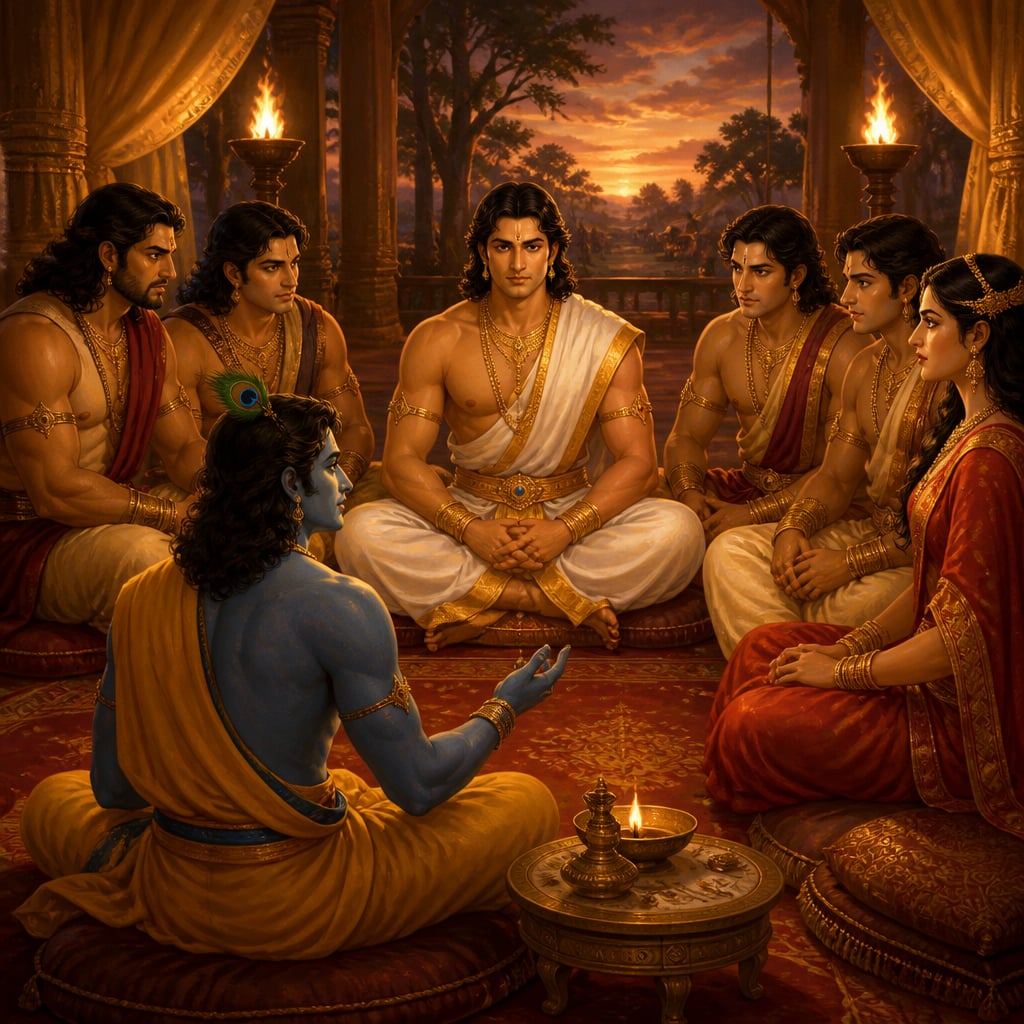
Yudhishthira and his brothers gather with Krishna and allied kings in a torchlit pavilion at Upaplavya at dusk to convene the council before sending the envoy.

But before armies could march, there was one last hope for peace.

"Dharma demands that we first seek what is ours through righteous means," Yudhishthira said. "War is the last resort, not the first. Let us send an envoy to Hastinapura."

This was not weakness speaking, it was nyaya, the principle of justice that seeks resolution before destruction. The Pandavas' claim was irrefutable: they had been cheated in a rigged dice game, forced into exile, and promised their kingdom would be returned after thirteen years. That time had passed. The question was simple: would Duryodhana honor the agreement?

The Dilemma of the Righteous

Not everyone agreed with Yudhishthira's measured approach. Bhima's eyes blazed with barely contained fury.

"Brother, you speak of envoys and negotiations while our enemies sharpen their swords! Thirteen years I have swallowed my rage. Every night in that forest, I dreamed of crushing Duhshasana's chest and drinking his blood as I swore. Now you want to ask politely for what they stole?"

Draupadi added her voice, though more quietly: "The Kauravas understand only one language, force. Duryodhana will never willingly return even a needle's worth of land. Sending messengers only gives him time to strengthen his position."

Yet Arjuna, the greatest warrior among them, supported Yudhishthira's approach. "We will have war soon enough, I fear. But let it be known throughout the world that we exhausted every peaceful path. When historians speak of this conflict, let them say the Pandavas sought peace and were refused. Our cause must be righteous not only in truth but in perception."

Krishna listened to all arguments, a faint smile playing on his lips. He knew what was to come, knew, perhaps, that this war was inevitable, written in the stars long before any of them were born. But he also understood why Yudhishthira needed to try.

"Dharmaraja speaks wisely," Krishna said at last. "The world must see that the Pandavas stood for peace. When war comes, and it will come, your conscience will be clear. You will fight not for vengeance alone, but for dharma itself."

The Stakes of Negotiation

The decision was made: Drupada's priest would travel to Hastinapura as the Pandavas' envoy. He carried a simple message, return our kingdom as promised, and there will be peace. Refuse, and face the consequences.

But what, exactly, were the Pandavas demanding? The original agreement had been clear: after thirteen years, Indraprastha and the territories ruled by Yudhishthira would be restored. But in those thirteen years, Duryodhana had absorbed these lands into his own domain. He had appointed his own governors, collected taxes, and built his power.

What Pandavas Demanded What Kauravas Held
Indraprastha and its territories Already absorbed into Kaurava domain
Return of their rightful share Duryodhana considered it "won" in the dice game
Restoration of honor No acknowledgment of past wrongs
Peace with justice Peace through submission

The fundamental conflict was not merely about land, it was about whether the treachery in the Sabha had any moral legitimacy. The Kauravas claimed that Yudhishthira had freely wagered his kingdom and lost it fairly. The Pandavas knew the dice were loaded, the invitation a trap, and the entire game a mockery of dharma.

The Shadow of Inevitability

Even as the envoy prepared to depart, both sides began marshaling their forces. This was not cynicism, it was prudence. If negotiations failed, the side caught unprepared would be destroyed.

Hastinapura was not idle. Duryodhana, informed of the Pandavas' emergence, had already begun securing alliances:

Against them, the Pandavas could field seven akshauhinis, a formidable force, but outnumbered. The mathematics were not in their favor. Yet they had something the Kauravas lacked: moral clarity, and the counsel of Krishna.

The Weight of Righteousness

As the envoy departed for Hastinapura, Yudhishthira turned to Krishna with a question that had haunted him for thirteen years:

"Madhava, I have tried to live by dharma my entire life. I never sought war, never craved power for its own sake. Yet here I stand, about to ask my brothers to risk their lives, about to send thousands of men to their deaths, for what? For a kingdom I am not even certain I want?"

Krishna sits in intimate counsel with Yudhishthira at Upaplavya

Krishna's response would echo through the ages:

"Dharmaraja, you do not fight for a kingdom. You fight because adharma cannot be allowed to triumph. If Duryodhana keeps what he stole, if treachery is rewarded and justice mocked, then every righteous person in this world will lose hope. Your battle is not for Indraprastha, it is for the principle that truth must prevail over deceit."

This was the burden of the righteous: to fight not for personal gain, but for a world where dharma could survive.

Drupada's priestly envoy rides across the plain to Hastinapura

The envoy rode toward Hastinapura. Behind him, two massive armies began to take shape. And somewhere in the cosmic order, the wheels of fate turned inexorably toward the field of Kurukshetra.

The Parva of Effort

The Udyoga Parva, the Book of Effort, takes its name from the strenuous attempts made by both sides to either prevent or prepare for war. "Udyoga" means effort, endeavor, industry. In this parva, we witness:

This is the parva of last chances. Every word spoken, every embassy sent, every alliance forged, all represent the desperate hope that somehow, the coming catastrophe might be averted. Yet even as hope flickers, the machinery of war grinds forward, unstoppable as the turning of the yugas.

The Pandavas have made their demand. Now the world waits to see if Duryodhana will choose peace, or seal his own destruction.

Living traditions

The Udyoga Parva's emphasis on exhausting diplomatic options before war has influenced Indian strategic thinking for millennia. Kautilya's Arthashastra cites the four-fold policy (sama, dana, bheda, danda) reflected in this parva. Modern Indian foreign policy explicitly references 'strategic autonomy' and 'multi-alignment', concepts that echo the careful alliance-building depicted in the Mahabharata. The Government of India's diplomatic training program includes study of the Shanti and Udyoga Parvas for insights into negotiation and statecraft.

Reflection

More in Udyoga Parva

All lessons in Udyoga Parva ยท The Mahabharata course