Vira: The Young Hero Enters
Abhimanyu enters alone
Alone inside the Chakravyuha, sixteen-year-old Abhimanyu faces the greatest warriors of the age. What unfolds is not merely a battle but a revelation: here is a boy who fights like a god, who makes legends flee, who proves that heroism is not measured in years but in the fire of the heart. For one glorious, terrible hour, he becomes the brightest star on the battlefield.
Inside the Wheel
The world spun.
Rings of warriors rotated around Abhimanyu like the coils of a great serpent, each circle moving opposite to its neighbors, creating a disorienting dance of spears and arrows and screaming faces. Behind him, the gap through which he had entered had sealed shut, his uncles blocked by Jayadratha's divine barrier.
He was alone.
Sixteen years old, inside the most deadly formation ever devised, surrounded by warriors who had been killing since before his father was born.
Good, thought Abhimanyu, and the thought surprised even him. Now there is no one to protect but myself. Now I can fight without restraint.
He raised his bow and began the dance.
The First Ring Falls
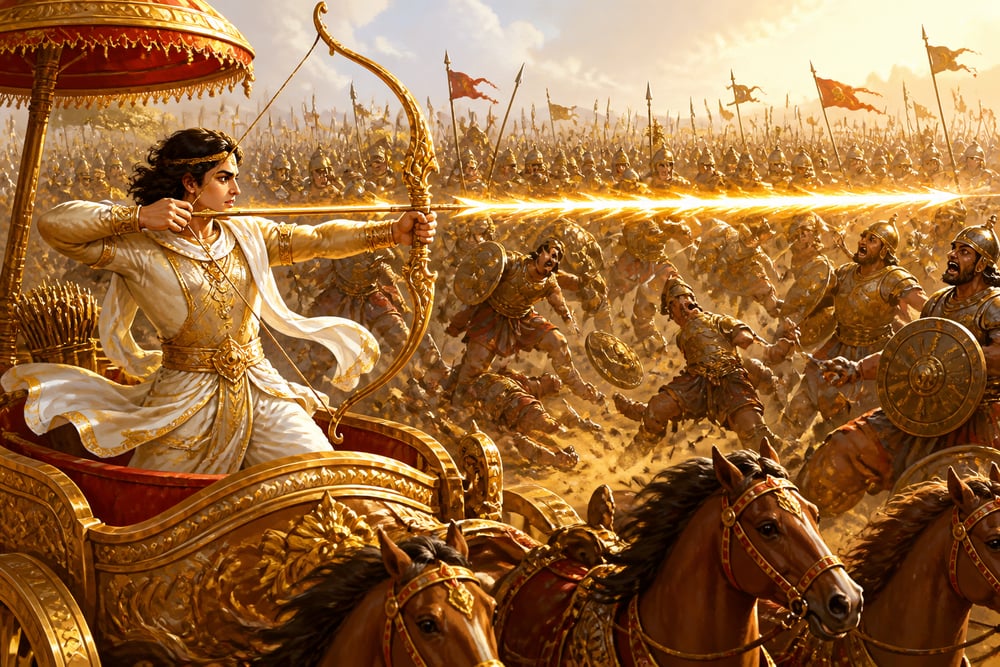
The warriors of the first circle, Duryodhana's personal guard, had expected a boy. They found a force of nature.
Abhimanyu's arrows did not simply fly; they sang. Three shafts released as one struck three warriors through the throat. Before their bodies fell, six more arrows were in the air, finding hearts, piercing armor, severing bowstrings.
"Impossible!" screamed a Kaurava commander. "He's shooting faster than Arjuna!"
Not faster. Differently. Where Arjuna's archery was precision perfected, Abhimanyu's was intuition unleashed. He did not aim, he simply knew where each arrow belonged, and they went there.
The first ring broke.
What the Kauravas Witnessed
From outside the formation, Drona watched through gaps in the spinning circles. What he saw made him grip his bow with white-knuckled intensity.
This boy fights as Arjuna did at sixteen. No, better. Arjuna was calculating at this age, careful, controlled. This child fights with abandon, as if death holds no meaning for him.
Abhimanyu punched through the second ring, leaving a trail of fallen warriors behind him. His chariot moved as if guided by divine hands, somehow always in the right place, always turning the right direction.
Karna watched from the seventh circle, his face unreadable. "He is magnificent," he murmured.
"He is the enemy," Duhshasana snarled.
"He can be both."
The Third Ring: Karna's Test
The third circle belonged to Karna himself, the Suta's son, the rival of Arjuna, perhaps the only warrior whose bow-skill matched the Pandava prince.
Abhimanyu's chariot burst through into Karna's domain. For a moment, the two warriors faced each other, the legendary archer and the teenage phenomenon.
Karna raised his bow. "Turn back, child. I have no wish to kill Arjuna's son."
"Then you will die wishing," Abhimanyu replied, and loosed.
The exchange that followed became legend. Arrow met arrow in mid-flight. Bowstrings sang in deadly harmony. For thirty heartbeats, an eternity on a battlefield, neither warrior gained advantage.
Then Abhimanyu did something unexpected.
Instead of continuing the duel, he charged directly at Karna's chariot, abandoning the safety of distance. His sword was in his hand before Karna could adjust, a blade singing toward the sun-born warrior's heart.
Karna deflected with his bow, but the impact threw him backward. In that moment of imbalance, Abhimanyu's chariot plunged past, through into the fourth circle.
He didn't try to win, Karna realized. He just needed to pass. He's not fighting us, he's racing toward death.
The Glory and the Grief
Outside the Chakravyuha, the Pandavas watched in helpless agony.
Bhima threw himself against Jayadratha's divine barrier again and again, his mace striking invisible walls that would not yield. "Let me through!" he roared. "That is my nephew dying in there!"
Yudhishthira stood frozen, his face gray with grief and guilt. I sent him. I asked him to go. He's dying because I couldn't find another way.
Krishna, returning from the Samsaptaka battle with Arjuna, heard the news. His divine sight pierced the formation, showing him what was happening within.

"Arjuna," Krishna said quietly, "your son is inside the Chakravyuha."
Arjuna's world stopped.
"He entered alone. Jayadratha blocked the others. Abhimanyu is fighting his way toward the center."
"How long, "
"He has been inside for half a ghati. He has broken through four rings."
Pride and terror warred in Arjuna's heart. My son. My boy. Fighting alone where I should be.
"Can we reach him?"
Krishna's silence was answer enough.
The Fourth Ring: Ashwatthama
Ashwatthama, son of Drona, master of celestial weapons, the warrior who would one day commit the worst atrocity of the war, waited in the fourth circle.
Unlike Karna, Ashwatthama did not offer surrender. He attacked the moment Abhimanyu appeared, unleashing a storm of arrows that would have killed any ordinary warrior.
Abhimanyu was not ordinary.
His shield caught arrows that should have pierced his heart. His sword deflected shafts aimed at his eyes. He moved through Ashwatthama's assault like a dancer through rainfall, somehow never quite where the arrows expected him to be.
"Your father taught my father," Abhimanyu called out as he fought. "But did he teach you what Arjuna learned? Did he give you the secret techniques? Or did he save those for his real student?"
The taunt struck deep. Ashwatthama had always lived in jealousy of Arjuna, the student his father loved more than his own son.
"I'll kill you for that," Ashwatthama snarled.
"Many have tried," Abhimanyu replied, and his next arrow shattered Ashwatthama's bowstring.
Before Ashwatthama could string another bow, Abhimanyu was through, into the fifth circle.
The Tide Turns
But the rings were taking their toll.
Abhimanyu's quiver was nearly empty. His chariot horses were tiring. Blood seeped from a dozen wounds, none fatal, but each draining strength he could not replenish.
The fifth circle was commanded by Shakuni, who fought not with martial skill but with cunning. He sent waves of expendable warriors against Abhimanyu, forcing the boy to spend his dwindling arrows on fodder while fresh enemies waited behind.
"Wear him down!" Shakuni commanded. "He's just a child! He cannot last forever!"
Abhimanyu's arrows ran out.
For a moment, silence fell across the fifth circle. The boy stood in his damaged chariot, quiver empty, surrounded by enemies who sensed blood.
Then Abhimanyu drew his sword.
The Sword Dance
What followed was not warfare. It was art.
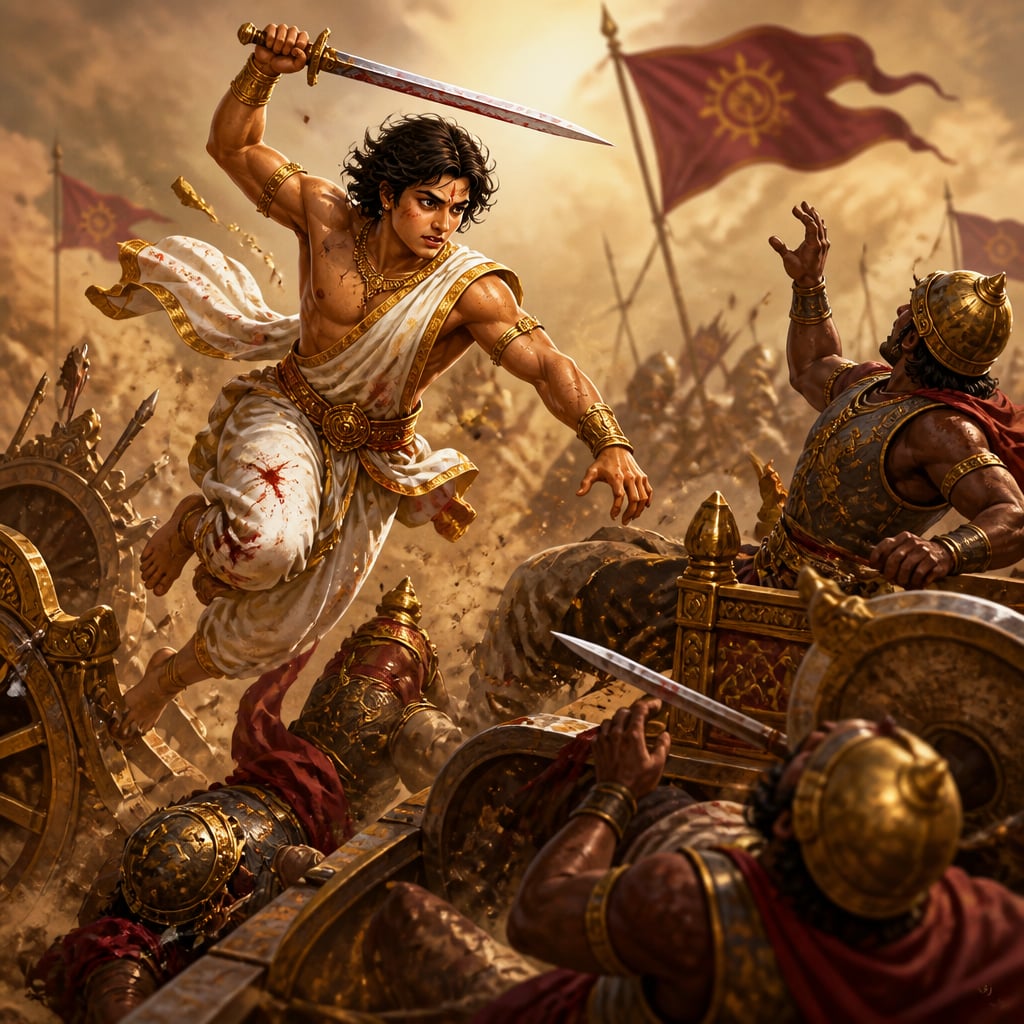
Abhimanyu leaped from his chariot onto the nearest enemy vehicle, his blade singing through the air. He killed the charioteer, killed the warrior, took the dead man's bow and quiver, and continued through the fifth ring like a comet trailing fire.
When those arrows were exhausted, he took more from the fallen. When his sword broke, he picked up a mace. When the mace was lost, he grabbed a chariot wheel and used it as both shield and weapon.
This, Drona thought watching from afar, is what happens when you teach a Kshatriya that death is not an ending. He fights without fear because he has already accepted that he may not survive. And a fearless warrior is the most dangerous thing in creation.
Through the Sixth
The sixth circle broke before Abhimanyu like waves before a divine ship. Kritavarma, its commander, would later admit that he had never seen anything like it.
"We outnumbered him a thousand to one," Kritavarma would say years later. "It didn't matter. He fought as if the gods themselves guided his hands. Every blow was perfect. Every dodge was impossible. I watched my best warriors fall before a boy who shouldn't have been able to lift a sword."
Abhimanyu burst through into the seventh circle, the heart of the Chakravyuha, and finally, finally, stopped.
His chariot was destroyed. His armor was dented and pierced. His sword was gone, his mace lost, his arrows spent. He stood on foot, bleeding from wounds beyond counting, facing six of the greatest warriors of the age.
Drona. Karna. Ashwatthama. Kritavarma. Shakuni. Duhshasana.
Six legends. One boy.
The Center
"Surrender," Drona said, and his voice held genuine respect. "You have proven your valor beyond any question. Surrender, and you will be treated with honor befitting a prince."
Abhimanyu laughed.
It was his father's laugh, the sound of a warrior who has found joy in the heart of battle, who has transcended fear and emerged into something like exultation.
"Surrender?" Abhimanyu said. "I am Arjuna's son. I am Krishna's nephew. I am the grandson of Indra himself. I entered this formation knowing I might never leave. Do you think I did not understand what I was choosing?"
He picked up a chariot wheel from the wreckage around him, a massive thing of wood and metal that should have required two men to lift, and raised it above his head.
"I chose to die fighting for dharma. I chose to prove that a Pandava, even a boy, fears nothing. I chose to show the world what our blood can do."
The chariot wheel began to spin in his hands.
"So come, great warriors. Come, legendary heroes. Show me what six of you can do against one sixteen-year-old boy. And let the ages remember what happened here today!"
The Final Stand
What happened next defied belief.
Abhimanyu, using only a chariot wheel as weapon and shield, held off six maharathas for nearly half a ghati.
The wheel spun, deflecting arrows, crushing weapons, forcing the six warriors to attack from awkward angles. When Karna tried to circle behind, Abhimanyu sensed him and whirled to block. When Ashwatthama released a volley, Abhimanyu somehow made the wheel spin fast enough to deflect every shaft.
"This is impossible," Duhshasana breathed. "No training accounts for this. No technique explains it. What is he?"
"He is his father's son," Drona replied quietly. "More, he is what his father might have been without fear, without doubt, without the hesitation that wisdom brings. He is youth and courage and skill, burning together in a flame that nothing can extinguish."
"Except death."
"Yes," Drona said. "Except death."
The Brightness Before Dark
But even flames burn out.
Exhaustion claimed what combat could not. The chariot wheel grew heavier in Abhimanyu's wounded arms. His movements, so fluid moments before, began to slow.
Still he fought.
When the wheel finally fell from his hands, he picked up a broken sword from the ground. When that shattered against Ashwatthama's mace, he grabbed a club. When the club broke, he fought with his fists.
And when his legs finally gave way and he fell to his knees, he was still swinging.
"My son," Arjuna would later say, weeping over the body, "you were brighter than all of us. Your courage shamed every warrior on that field, on both sides. You entered the Chakravyuha as a boy. You left as a legend."
The sun was past its zenith when Abhimanyu finally fell.
He had fought alone for nearly two hours.
He had killed an army.
And he had shown the world what one heart, filled with courage and love and dharma, could achieve against impossible odds.
What happened next, how they finally killed him, would damn the Kauravas forever.
Living traditions
Abhimanyu has become a symbol of youthful courage in Indian culture. When young people achieve remarkable things against odds, they are compared to Abhimanyu. The name itself remains popular for baby boys, chosen by parents hoping their children will inherit the warrior's courage. In business, 'Abhimanyu strategy' has come to mean bold, possibly risky moves made with awareness of the danger, entering a market or situation that may be difficult to exit. The teenager who held off six legends has become a permanent part of how Indians think about courage, youth, and sacrifice.
- Teej Celebrations in Rajasthan: During Teej festivals in Rajasthan, folk performances often include dramatizations of Abhimanyu's last stand. Young boys perform the role of Abhimanyu, enacting his courage with choreographed combat sequences.
- Abhimanyu Kund: A sacred tank believed to be where Abhimanyu's body was brought after his death. The site includes a small temple and attracts pilgrims who come to honor the young warrior's sacrifice.
- Narayani Mata Temple: Temple associated with the Mahabharata narrative. Local tradition holds that the goddess blessed the Pandavas here, and the temple includes iconography depicting Abhimanyu's heroism.
Reflection
- Abhimanyu chose to die fighting rather than surrender with honor. Is there a cause for which you would make the same choice? What would make something worth dying for?
- The Kauravas were forced to break dharma because they couldn't defeat Abhimanyu fairly. Have you ever seen excellence punished because it made others look bad? How should we respond when our success threatens those in power?
- Karna called Abhimanyu 'magnificent' even while helping to kill him. How do you understand people who recognize virtue but act against it anyway?