Maya: Krishna's Illusion

When God bends the rules

Did Krishna hide the sun to save Arjuna's vow? Or did clouds simply appear at the perfect moment? The Mahabharata refuses to answer directly, leaving us with one of Indian philosophy's deepest questions: What is maya? What is reality? And when the divine intervenes in human affairs, is it cheating, or is it justice operating at a level we cannot fully comprehend?

The Moment of Darkness

Let us return to that critical moment.

The sun touched the western hills. Arjuna was still fighting through the final barrier of Sindhu warriors. Jayadratha watched from behind his guards, hope rising with every passing second.

And then darkness fell.
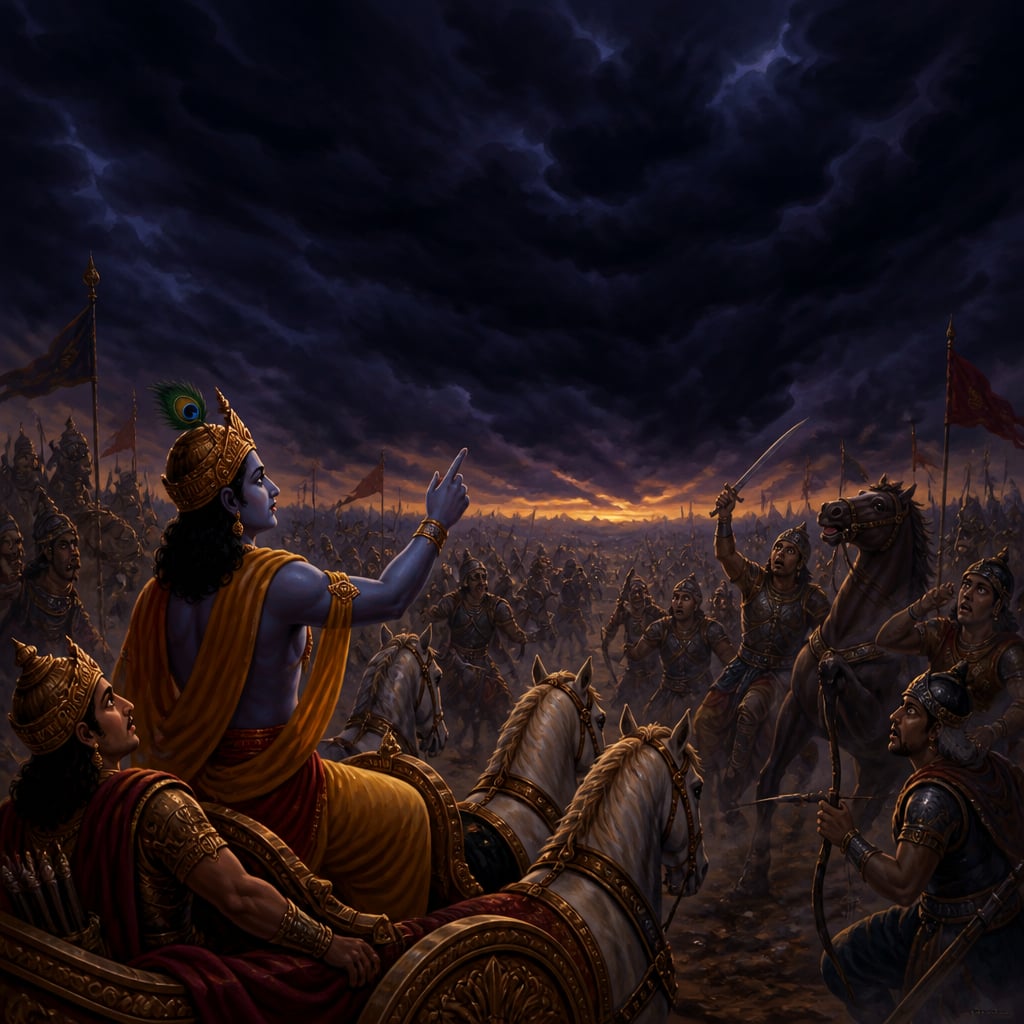
The Kurukshetra battlefield plunges into sudden uncanny darkness as dark clouds obscure the great sun just before sunset.

Not the gradual dimming of natural sunset, but sudden, complete darkness, as if someone had blown out the sun like a candle flame. The battlefield, moments before bathed in red-gold light, plunged into shadow.

What happened?

Three Explanations

The Mahabharata offers three possible explanations, depending on which verses you emphasize:

The Natural Explanation: A bank of thick clouds, moving quickly from the west, temporarily obscured the sun. Such weather phenomena occur in northern India, especially during certain seasons. The timing was coincidental, fortunate for Arjuna, unfortunate for Jayadratha.

The Divine Explanation: Krishna, as the Supreme Lord, used his power of maya to create the illusion of sunset. He darkened the sky through cosmic power, tricking Jayadratha into emerging from his protection. When the purpose was served, he removed the illusion, and the sun returned.

The Cosmic Explanation: The universe itself, governed by dharma, arranged for justice to be done. Neither random chance nor deliberate intervention, but the inherent tendency of reality to move toward righteousness. The sun was hidden because it needed to be hidden.

The text does not choose between these explanations. It presents the event and lets readers wrestle with its meaning.

What Is Maya?

To understand what Krishna may have done, we must understand what maya is.

In common usage, maya means illusion, something false that appears true. The magician's trick is maya. The mirage in the desert is maya. The dream that seems real while we're dreaming is maya.

But in Vedantic philosophy, maya is something more profound. It is the power by which the One becomes many, by which the formless takes form, by which the infinite appears finite. Maya is not falsehood, it is the creative power of the divine itself.

Krishna is called Mayin, the Lord of Maya. Not because he is a trickster, but because he is the source of all manifestation. Every form we see, every phenomenon we experience, every event that unfolds, all of it emerges from and returns to his maya.

From this perspective, Krishna hiding the sun is not a violation of natural law. It is natural law operating at a deeper level than we usually perceive.

The Ethics of Divine Intervention

But does this make it right?

The Kauravas certainly thought not. "Krishna cheated," became their refrain. "He used his divine powers to help the Pandavas. The war was unfair from the beginning because they had God on their side."

There is a logic to this complaint. If Krishna could hide the sun to save Arjuna, why didn't he simply prevent Abhimanyu's death? Why didn't he stop the war entirely? Why did he allow so much suffering if he had the power to prevent it?

The Mahabharata's answer is complex:

First: Krishna had vowed not to fight. He would drive Arjuna's chariot, offer counsel, but not take up weapons. Hiding the sun (if he did it) was not fighting, it was creating conditions. The distinction may seem technical, but it mattered to Krishna.

Second: Krishna's interventions are always minimal, just enough to tip the balance toward dharma, not enough to eliminate human choice and consequence. He doesn't give the Pandavas automatic victory; he gives them opportunities. They must still fight, suffer, and sacrifice.

Third: From the perspective of cosmic justice, the Kauravas had already broken every rule. They had used deception to steal a kingdom, attempted to burn the Pandavas alive, humiliated Draupadi, refused all peaceful settlements, and murdered Abhimanyu through group attack. If the rules were already in tatters, Krishna's action was not breaking rules but responding to their breakdown.

The Conversation We Don't Hear

Imagine, though the text doesn't show us this, what Krishna might have been thinking in those final moments:

The sun is setting. Arjuna will fail. He will walk into fire, and the Pandavas will lose their greatest warrior. Dharma will not be served.

I could stop it. I could hide the sun for a moment, long enough for Jayadratha to emerge, long enough for the arrow to fly. It would be maya, but all manifestation is maya. It would be intervention, but I am always intervening; my presence itself changes outcomes.

The Kauravas will call it cheating. But what do they call Abhimanyu's death? What do they call the game of dice? What do they call thirteen years of exile for a kingdom that was never theirs to gamble?

Dharma does not require passivity in the face of adharma. The universe is not neutral between justice and injustice. And if the universe has a preference, if I am that preference made manifest, then my action is not external interference but the cosmos correcting itself.

Let the sun be hidden. Let justice be done.

Arjuna's Doubt

After Jayadratha's death, Arjuna asked the question that readers have asked for millennia:

Krishna and Arjuna's conversation about maya

"Did you do it, Krishna? Did you hide the sun?"

Krishna's response, as recorded in the text, is deliberately ambiguous:

"The sun was hidden. Jayadratha emerged. You fulfilled your vow. Does it matter how?"

"It matters to me."

"Why?"

Arjuna struggled to articulate it. "Because if you did it, if you used your power to save me, then was it really my victory? Did I truly avenge Abhimanyu? Or was it just... you, doing what you always do, arranging things to come out right?"

Krishna's smile was gentle but carried depths. "Arjuna, you fought all day. You broke through seven layers of the greatest warriors alive. You killed tens of thousands of enemies. You endured wounds, exhaustion, despair. And in the final moment, you shot the arrow that killed Jayadratha, you, not me. The bow was in your hands. The skill was yours. The determination was yours."

"But the opportunity, "

"Is opportunity not part of life? Does the farmer who benefits from timely rain claim no credit for his harvest? Does the merchant who finds a fair wind say his voyage was meaningless? We all work within conditions we did not create. The question is not whether we had help, but whether we used it well."

"That's not the same as divine intervention."

"Isn't it?" Krishna's eyes held the light of a thousand suns. "Where do you draw the line between divine intervention and natural occurrence? Is the sun rising every day not intervention? Is your birth, your training, your very existence not arranged by forces beyond your control? You are already living in a world shaped by the divine. What happened today was no different, just more visible."

The Lesson of Maya

This lesson is different from the others in this chapter.

We have told stories of battle and death, of vows kept and broken, of heroes and villains. But here, the Mahabharata asks us to step back and consider the framework within which all these stories occur.

What is real? What is illusion? When we think we understand how the world works, are we seeing clearly or seeing maya, a version of reality shaped by our limitations?

The sun-hiding incident is, in miniature, the question the Bhagavad Gita asked in full: What is the relationship between human action and divine will? How do we act in a world where our choices matter but do not ultimately control outcomes? What does it mean to be an instrument of forces larger than ourselves?

Krishna's answer in the Gita, act without attachment to results, perform your duty and surrender the fruits to the divine, applies here too. Arjuna fought all day with everything he had. The result was not entirely in his control; it never is. But his effort, his courage, his commitment, those were his, and they were enough.

The World After Maya

The sun-hiding incident changed the war in subtle ways.

For the Pandavas, it confirmed what they had always believed: Krishna was more than human, and his presence meant that dharma would ultimately prevail. This faith would sustain them through the horrors still to come.

For the Kauravas, it deepened their sense of grievance. They were fighting not just the Pandavas but God himself. Every setback could be attributed to divine unfairness. This complaint would become their excuse for the increasingly adharmic actions they would take.

For Krishna himself, if we can speak of God being changed, it marked a point of no return. He had used his power to influence the outcome. He would do so again, more dramatically, in the days to come. The thin line he had walked between guiding and controlling was growing thinner.

And for all who have read this story since, for three thousand years and counting, the moment when the sun disappeared has been an invitation to wonder. About justice and fairness. About divine action and human effort. About the nature of a reality that may be more fluid, more responsive to righteousness, than our materialist assumptions allow.

The Question That Remains

Did Krishna hide the sun?

The Mahabharata says: perhaps.

Perhaps he did, and it was right because justice sometimes requires extraordinary measures.

Perhaps he didn't, and the clouds were simply fortunate.

Perhaps the distinction doesn't matter, because in a universe governed by dharma, "fortunate" and "divine intervention" may be two names for the same thing.

The epic doesn't resolve the question because the question itself is the teaching. We live in uncertainty. We act without knowing all the causes or consequences of our actions. We hope for justice but cannot guarantee it.

What we can do, what Arjuna did, is fight with everything we have, trust in something larger than ourselves, and accept that the outcome is not entirely ours to determine.

That may not be a satisfying answer. But it may be the truest one the Mahabharata has to offer.

Living traditions

The question of maya has entered contemporary discourse through various channels. Physicists discussing the nature of reality sometimes invoke maya; simulation theory proponents find resonance with Vedantic concepts; and discussions of 'fake news' and manipulated media often draw on the vocabulary of illusion that maya provides. The Mahabharata's ambiguity about whether Krishna's action was natural or supernatural has become a model for discussing events where the line between coincidence and design is impossible to draw.

Reflection

More in Drona Parva

All lessons in Drona Parva · The Mahabharata course