Ratri Yuddha: Battle in Darkness
When the rules of war shatter
For the first time in the history of dharmic warfare, battle continues after sunset. Duryodhana, enraged by Jayadratha's death, demands that the fighting never stop. What follows is chaos by torchlight, a night where warriors cannot distinguish friend from foe, where ancient rules crumble, and where creatures of darkness find their power doubled. In the flames and shadows, war itself transforms into something monstrous.
The Broken Boundary
The sun had set. Jayadratha was dead. By every rule of dharmic warfare, the fourteenth day should have ended.
But Duryodhana was beyond rules now.
"Light the torches," he commanded. "Bring the oil lamps. This battle does not end."
Drona stepped forward, alarm on his weathered face. "My king, night fighting is forbidden. The darkness makes it impossible to identify enemies. Warriors will kill their own brothers, their own students. It is, "
"Forbidden by whom?" Duryodhana's voice was cold. "The same sages who allowed Krishna to hide the sun? The same dharma that let six warriors murder a boy? The same rules that somehow never apply to the Pandavas?"
"The rules apply to everyone, "
"Then let them apply to darkness too. We fight. Tonight, tomorrow, until one side is destroyed. No more pauses for sunset. No more courtesies. No more pretending this is anything but war to the death."
Drona looked at his commander, this prince he had trained, now twisted by desperation and grief, and saw no room for argument.
"As you command."
The torches were lit. The night battle began.
Fighting by Firelight
Imagine the scene:
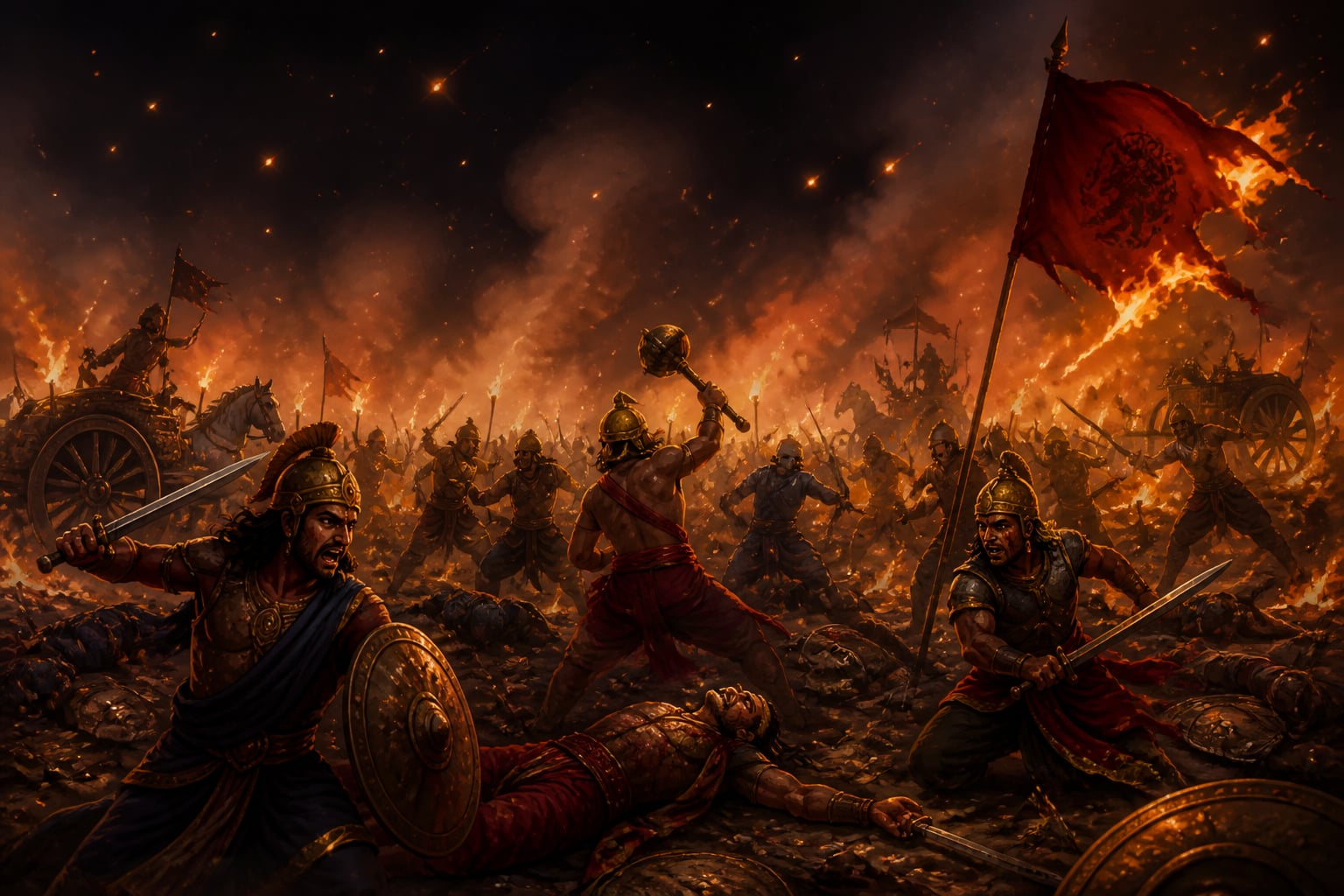
Thousands of torches, held by soldiers or mounted on chariots, created islands of flickering light across the vast battlefield. Between these islands lay pools of absolute darkness. Warriors moved in and out of visibility like ghosts, appearing suddenly in torchlight, vanishing just as quickly.
The smoke from the torches mixed with the dust of battle, creating a hellish haze that stung the eyes and choked the lungs. The familiar landscape of Kurukshetra, known now to every warrior after thirteen days of fighting, became alien and treacherous.
"I can't see the enemy banners!" a Pandava commander shouted.
"Follow the Kaurava torches!" came the reply.
"But some of those are ours, we took them from fallen enemies!"
This was the nightmare of night combat. The carefully developed systems of dharmic warfare, the identification of allies through banners, the formal challenges before combat, the ability to surrender and be recognized, all collapsed in darkness.
Men died not knowing if their killer was friend or foe. Brothers killed brothers without recognition. The war, already brutal, became apocalyptic.
The Nature of Night
In the ancient understanding, night was not simply the absence of day. It was a different realm, governed by different powers.
During the day, the sun watched over the world, and dharma held sway. The gods of light, Surya, Indra, Agni, were at their strongest. Human beings, creatures of the day, operated in their natural element.
But night belonged to other powers. The rakshasas, demons, grew stronger as darkness fell. Spirits moved freely. The boundaries between worlds grew thin. Even human beings, deprived of sight, found their other senses and their deeper fears awakened.
The prohibition against night fighting was not merely practical. It was recognition that warfare conducted in darkness invited forces that daylight kept at bay.
Duryodhana, in his desperation, had opened a door that perhaps should have remained closed.
The Pandava Response
Yudhishthira received news of the night battle with grim resignation.
"So it has come to this," he said quietly. "Every rule broken. Every boundary crossed. What are we fighting for anymore, if not dharma? And what is dharma, if it has no rules?"
Bhima was less philosophical. "If they want to fight in darkness, let them. I don't need light to crush Kaurava skulls."
"We have an advantage," Krishna observed. "One that Duryodhana may have forgotten."
"Ghatotkacha," Arjuna said, understanding immediately.
"Ghatotkacha."
The Half-Demon Prince
Ghatotkacha was Bhima's son, born of his union with the rakshasi Hidimbi during the Pandavas' exile. He was half-human, half-demon, inheriting the immense strength of his father and the magical powers of his mother's race.
During the day, Ghatotkacha was formidable. He had fought in the war from its beginning, causing significant damage to the Kaurava forces. But his powers were constrained by sunlight, which weakened his rakshasa nature.
At night, he was something else entirely.
"Call my son," Bhima said, a grim smile spreading across his face. "Let's see how the Kauravas enjoy fighting in the dark."
Ghatotkacha arrived as darkness deepened. He was massive, taller than any human warrior, with features that shifted between handsome and terrifying depending on the light. His eyes gleamed with an inner fire, and when he smiled, his teeth seemed sharper than they should be.
"Father," he greeted Bhima. "The Kauravas want to fight at night?"
"They do."
"Then they will learn why my mother's people ruled the darkness for millennia."
Terror in the Night

What Ghatotkacha did that night became the stuff of legend, and nightmare.
He grew to enormous size, towering over the battlefield like a mountain that had learned to walk. His laughter echoed across Kurukshetra, a sound that chilled the blood of every Kaurava warrior.
He used maya, rakshasa illusion, to multiply himself, appearing in a dozen places at once. Kaurava soldiers found themselves fighting shadows, striking empty air while the real demon slaughtered them from behind.
He threw boulders the size of houses. He breathed fire, actual fire, not metaphorical, that consumed chariots and elephants alike. He picked up warriors in his massive hands and dashed them against the ground.
And all of this happened in darkness, lit only by the flames he created and the scattered torches that somehow made everything more terrifying rather than less.
"It was not a battle," a surviving Kaurava would later say. "It was a hunt. And we were the prey."
Karna Steps Forward
The Kaurava army was in full rout. Ghatotkacha had killed thousands, and his rampage showed no signs of stopping. The night that Duryodhana had demanded had become his army's doom.
Karna watched the demon prince's destruction with calculating eyes.
This cannot continue. If Ghatotkacha fights through the night, there will be no Kaurava army left by dawn.
He touched the weapon at his side, the Shakti, the divine spear given to him by Indra himself. It was his most powerful weapon, guaranteed to kill whoever it was thrown at. But it could only be used once.
Karna had saved it for Arjuna. In every scenario he had imagined, the Shakti would be the weapon that finally defeated his great rival. With it, he could kill even the son of Indra.
But if there was no army left, what would that victory matter?
Duryodhana appeared beside him, his face pale in the firelight. "Karna, you must stop him. The Shakti, "
"I know what you're asking."
"We have no choice. He'll destroy everything."
Karna looked at the Shakti, then at the demon rampaging through his allies, then toward the distant Pandava lines where Arjuna waited.
I saved this for you, brother. I dreamed of our final duel, of proving once and for all who was the better archer. Now I must use it on a demon, and when we finally meet, I will have nothing special left.
But duty is duty. Dharma is dharma. And my king needs me now.
"Stand back," Karna said. "Everyone stand back."
He raised the Shakti. It blazed with divine fire, illuminating the battlefield like a second sun. Every warrior, Kaurava and Pandava alike, stopped to look.
Ghatotkacha saw it too. The demon prince paused in his rampage, recognizing the weapon for what it was.
For a moment, their eyes met across the field of death.
Then Karna threw.
The Death of Ghatotkacha

The Shakti flew like a meteor, trailing fire across the night sky. Ghatotkacha had time for one act, one final choice in the instant before the divine weapon struck.
He grew.
Using every ounce of his rakshasa power, Ghatotkacha expanded to his maximum size, so large that when he fell, his body would crush thousands of Kaurava soldiers beneath it.
The Shakti struck his chest. Divine fire consumed him from within. But even as he died, Ghatotkacha smiled.
"For the Pandavas," he whispered. "For my father."
He fell.
The impact shook the earth. An entire division of Kaurava soldiers, thousands of men, were crushed beneath the demon's massive corpse. In death, Ghatotkacha killed as many as he had in his night rampage.
And across the battlefield, Krishna smiled.
Krishna's Strange Joy
The Pandava camp was in mourning. Ghatotkacha had been family, Bhima's son, the princes' nephew, a loyal ally from the beginning. His death was a genuine loss.
But Krishna was laughing.
"Why do you laugh?" Arjuna demanded. "My nephew is dead. Bhima's son, "
"And Karna's Shakti is spent."
Arjuna stopped. "The Shakti... the weapon from Indra..."
"The weapon that was meant for you. The one weapon that could have killed you regardless of your skill or my guidance. Karna saved it for years, dreaming of the day he would use it to defeat you once and for all."
"And now..."
"Now it's gone. Used on Ghatotkacha, who was going to die in this war regardless, as were we all. But his death served a purpose. He drew the Shakti. He removed the one threat to your life that I could not have countered."
Krishna's eyes gleamed in the torchlight. "Ghatotkacha was a rakshasa, Arjuna. His soul will not travel the same paths as a human's. But he died a hero's death, fighting for dharma, saving his uncle's life. There are worse ends for a demon prince."
Arjuna looked toward the distant fire where Ghatotkacha's body still burned. "Did you know? Did you plan this?"
"I knew Karna had the Shakti. I knew it was meant for you. I knew that if Ghatotkacha fought at night, he would force Karna to use it."
"So you sacrificed him."
"He sacrificed himself. I merely... created the conditions where his sacrifice would mean something."
Arjuna had no response to that. What could he say? That he wished Ghatotkacha had lived and he had died? That would be a lie. That he was grateful? That seemed monstrous.
The night battle continued, but the worst was over. Without the Shakti threatening Arjuna, the war had tilted further toward the Pandavas.
And in the flickering firelight, Krishna's smile remained.
The Dawn
When the sun finally rose on the fifteenth day, both armies were exhausted.
The night battle had been catastrophic for both sides, but especially for the Kauravas. Ghatotkacha's rampage had killed tens of thousands. The chaos of fighting in darkness had led to countless friendly fire incidents. And the Shakti, Karna's ultimate weapon, was gone.
Drona surveyed the devastation and felt something he had not felt since the war began: despair.
We are losing. Not just this battle, but the war. Every day, we lose more than we gain. Every trick fails. Every sacrifice proves insufficient.
Duryodhana's night battle cost us more than a regular day of fighting. And still the Pandavas stand. Still Krishna smiles. Still dharma seems to favor the other side.
How much longer can this continue? How much more blood must be spilled before it ends?
He did not know that the answer was: not much longer.
His own death was coming. The half-truth that would destroy him was already being prepared.
But for now, the sun rose on another day of war, and Drona raised his bow once more.
Living traditions
The night battle has become a metaphor for situations where normal rules break down, corporate battles without ethical constraints, political campaigns that abandon decency, conflicts that escalate beyond civilized limits. Ghatotkacha's sacrifice is invoked when discussing those who give everything for a cause, knowing they won't survive to see victory. Karna's dilemma, using his best weapon on a secondary target, resonates with anyone who has had to spend resources on urgent needs rather than saving them for ideal opportunities.
- Ghatotkacha Puja in Rakshasa Tradition: Some tribal communities in eastern India worship Ghatotkacha as a protective deity, emphasizing his role as a son who died protecting his family. Rituals often occur at night, acknowledging his power in darkness.
- Hidimba Devi Temple: A 16th-century temple dedicated to Hidimbi, Ghatotkacha's mother. The temple, built in the Pagoda style, is one of the few places where a rakshasi is worshipped as a goddess.
- Bhima Temple, Kullu: Temple dedicated to Bhima, with local traditions connecting it to his relationship with Hidimbi and their son Ghatotkacha. The region has strong associations with this family.
Reflection
- Krishna seems happy about Ghatotkacha's death because it protected Arjuna. Is this calculating attitude morally acceptable? How do we evaluate someone who sacrifices others for a 'greater good'?
- The night battle represents the final breakdown of dharmic warfare. Once all rules are broken, what distinguishes 'good' fighters from 'bad' ones? Can dharma survive the absence of rules?
- Ghatotkacha was a rakshasa, a 'demon', yet he fought and died for dharma. What does this say about the nature of good and evil? Can anyone serve righteousness, regardless of their origin?