Guru Vadha: The Fallen Teacher
The death that divided brothers
This lesson covers the final moments of Acharya Drona, his meditation, his death at Dhrishtadyumna's hands, and the controversy that followed. We examine the concept of guru-vadha (killing one's teacher), the ethics of killing an unarmed meditating man, and how Dhrishtadyumna's destined purpose collided with Arjuna's love for his teacher. The death of Drona marks not just the end of a commander but the collapse of an entire generation's moral framework.
Guru Vadha: The Fallen Teacher
A Man Without Purpose
When Drona heard that Ashwatthama was dead, something in him died too.
For what had he fought? For wealth, he had it. For glory, he had earned it. For his son's future, now there was no future.
The great teacher, who had raised Arjuna and the Kauravas, who had crafted the Chakravyuha, who had led armies and wielded the Brahmastra, had no reason left to live.
He lowered his bow.
The Meditation
Drona did not surrender. He did something more profound:
He sat in his chariot and began to meditate.
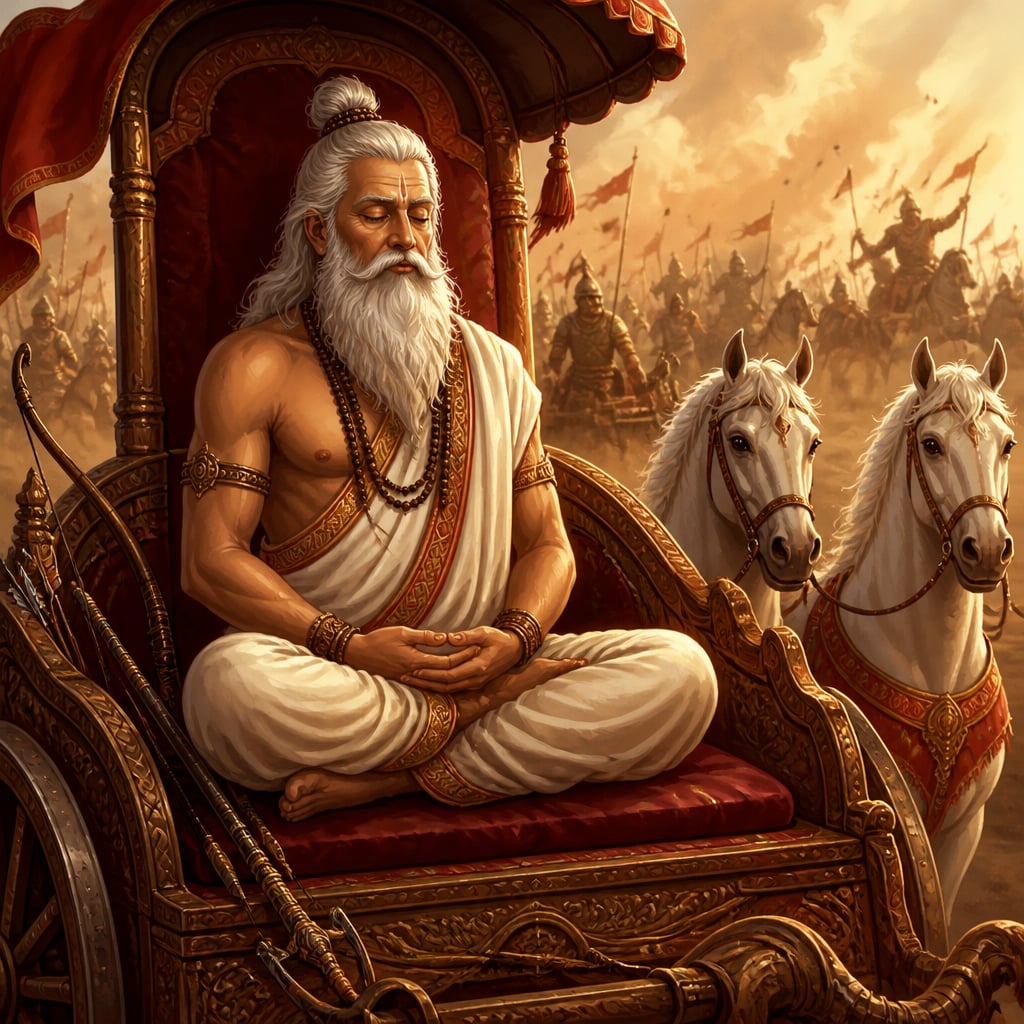
This was not escape, it was preparation. A Brahmin trained in yoga could release his soul consciously, departing the body through the crown of the head (brahmarandhra) toward liberation.
Drona closed his eyes. He withdrew his senses. He began the ancient process of yoga-mediated death.
Around him, the battle paused. Even warriors understood they were witnessing something sacred.
The Man Born for This Moment
But one person could not pause: Dhrishtadyumna.
Dhrishtadyumna was the son of King Drupada. But he was no ordinary son, he had emerged from a sacrificial fire, already grown, already armed, for a single purpose:
To kill Drona.
Years earlier, Drona had humiliated Drupada, his former friend. Burning with hatred, Drupada had performed a great sacrifice asking for a son who would slay Drona. From that fire emerged Dhrishtadyumna and his sister Draupadi.
Dhrishtadyumna's entire existence was this moment. His life had one meaning, to end Drona's life.
The Irony of Teacher and Student
Here is the tragedy that defines this parva:
Drona himself had trained Dhrishtadyumna in warfare.
Drupada had sent his son to learn from the very man the son was destined to kill. Drona accepted him as a student, knowing the prophecy, teaching him anyway.
Why? Perhaps Drona believed fate is unavoidable. Perhaps he hoped teaching would change Dhrishtadyumna's heart. Perhaps he simply could not refuse a student.
Now the student stood over his teacher, sword drawn.
The Strike
Dhrishtadyumna did not hesitate.

As Drona sat in deep meditation, as his soul was perhaps already departing, Dhrishtadyumna raised his sword and severed the teacher's head.
The act was:
- Dharmic by destiny: Dhrishtadyumna was literally born for this
- Adharmic by conduct: Killing an unarmed, meditating man violates all warrior codes
- Personal vengeance: Fulfilling his father Drupada's burning hatred
- Military necessity: Ending the Kaurava commander's threat
All these truths existed simultaneously.
Arjuna's Anguish
Arjuna screamed in protest.
"No! Not like this! He was our teacher!"
Arjuna had loved Drona. Of all the students, Arjuna was the favorite, the one who absorbed everything, who exceeded expectations, who made Drona's reputation immortal. Even fighting on opposite sides, that bond remained.
Arjuna wanted to capture Drona alive. He wanted the teacher to withdraw with honor, perhaps become a renunciant. He did not want to see his guru beheaded like a criminal.
But Dhrishtadyumna's sword was already falling.
The Division Among Brothers
This death created a rift among the Pandavas that never fully healed:
Bhima: Approved, Drona had killed countless Pandava soldiers and had to be stopped
Arjuna: Devastated, this was not dharmic war but murder of a defenseless man
Yudhishthira: Conflicted, he had enabled this through his half-truth, but had not imagined this ending
The others: Uncomfortable, victory was necessary, but at what cost?
Even in triumph, the Pandavas were divided.
What Does Dharma Say?
Hindu texts present conflicting guidance:
Arguments that the killing was wrong:
- Killing an unarmed person violates Kshatriya dharma
- Killing someone in meditation is doubly wrong
- Teachers deserve respect regardless of circumstances
- The manner of death was dishonorable
Arguments that the killing was justified:
- Drona had committed adharma throughout the war (Chakravyuha, threatening civilians)
- He was still a commander, pausing doesn't equal surrendering
- Dhrishtadyumna's destiny was divine, opposing it would be opposing the gods
- War has its own necessities
The Mahabharata presents both arguments without definitively resolving them.
The Question of Destiny
Dhrishtadyumna was born to kill Drona. Does this absolve him of moral responsibility?
Consider the implications:
- If destiny excuses action, then no one is responsible for anything
- But if we can resist destiny, then why do we call it destiny?
- Did Dhrishtadyumna have free will, or was he a divine instrument?
The Mahabharata's answer seems to be: Both.
Dhrishtadyumna fulfilled his destined purpose. But he still made the choice in that moment. The prophecy did not force his arm, he raised the sword himself. Destiny created the possibility; he actualized it.
Drona's Soul
What happened to Drona's atman?

The text describes a luminous form rising from Drona's body, his soul departing through yogic power. He was already leaving when Dhrishtadyumna struck.
Some interpretations:
- Drona achieved moksha despite the violent death, his meditation was successful
- The body's death was irrelevant; the soul had already departed
- Dhrishtadyumna killed an empty vessel, not the true Drona
Others argue:
- The violent interruption disrupted Drona's departure
- The shock of beheading attached new karma
- Drona's soul went to a warrior heaven (Vira-loka) rather than full liberation
The Aftermath
Drona's death ended Day 15. But it did not end the controversy.
Ashwatthama's reaction: When he learned the truth, that his father was killed through a lie, while meditating, by a student, his rage became apocalyptic. This rage would lead to the night massacre after the war's end, the murder of sleeping Pandava children, and a curse that haunts him still.
Arjuna's grief: He performed the funeral rites for Drona with full honors, treating him as teacher rather than enemy. This devotion continued even after death.
The Pandava victory: With Drona fallen, the Kaurava command passed to Karna, setting up the final confrontation between the two greatest archers of the age.
The Death of the Old World
Drona's death symbolizes more than the end of a commander:
End of the teacher-student bond: Throughout the war, teachers and students had killed each other, but this was the starkest example.
End of martial honor: The rules of dharmic warfare had been stretched, bent, and now broken entirely.
End of a generation: Bhishma, Drona, the great figures who had raised the Pandavas and Kauravas were gone. The war had orphaned an entire civilization.
Living with Necessity
The Mahabharata does not comfort us with easy answers about Drona's death. It shows:
- Victory required ugliness
- Destiny and choice coexist
- Honor can be sacrificed for survival
- The same act can be dharmic and adharmic simultaneously
- Those who do necessary evil still bear its weight
Dhrishtadyumna fulfilled his purpose. But the manner of fulfillment matters. Born from fire to kill, he killed, and in doing so, became something both hero and executioner.
Living traditions
The Dronacharya Award, India's highest honor for sports coaches, was established in 1985 and is presented annually by the President. The award reflects the ideal that a teacher's success is measured by students who surpass them. Drona's story is studied in ethics courses examining the tension between institutional loyalty and moral conscience, anticipating modern debates about following orders versus following conscience.
- Yoga Samadhi (Meditative Absorption): The practice of withdrawing consciousness from the body through deep meditation. Drona achieved this state in his final moments, allowing his soul to depart before the sword struck.
- Guru Purnima Remembrance: On Guru Purnima, teachers are honored, including the complex legacy of gurus like Drona who embodied both greatness and moral failure.
- Drona Sagar: Sacred tank associated with Dronacharya, marking the site where he is believed to have performed his final meditation before death. Includes a temple dedicated to the acharya.
- Dronacharya Temple (Guru Gram): Ancient temple at the site believed to be Drona's ashram. The city name 'Gurugram' derives from 'Guru Gram', village of the guru. Marks where Drona taught the princes.
Reflection
- If you were Dhrishtadyumna, would you have waited for Drona to complete his meditation and die naturally, or would you have struck as he did?
- Drona taught Dhrishtadyumna knowing the prophecy. What does this say about Drona's character, acceptance of fate, or something deeper?
- Arjuna and Bhima responded differently to Drona's death. Whose response seems more appropriate to you?