Relevance: Drona Parva Today
Ancient wisdom for modern dilemmas
In this concluding lesson, we draw the threads of the Drona Parva together and examine their relevance to our contemporary world. The questions the epic raised five thousand years ago, about teachers and students, truth and deception, the costs of victory, and the weight of moral complexity, resonate with renewed urgency in our age of information warfare, institutional distrust, and ethical uncertainty.
Relevance: Drona Parva Today
An Epic for Our Times
The Drona Parva may be humanity's oldest meditation on the costs of necessary war. Written millennia ago, it speaks to questions that still haunt us:
- When do the ends justify the means?
- What do we owe those who taught us, even when we oppose them?
- How do we live with the compromises victory requires?
- Can good people do terrible things and remain good?
These are not ancient questions. They are questions you may face tomorrow.
The Teacher Crisis
Drona was the greatest teacher of his age. He was also fighting for the wrong side.
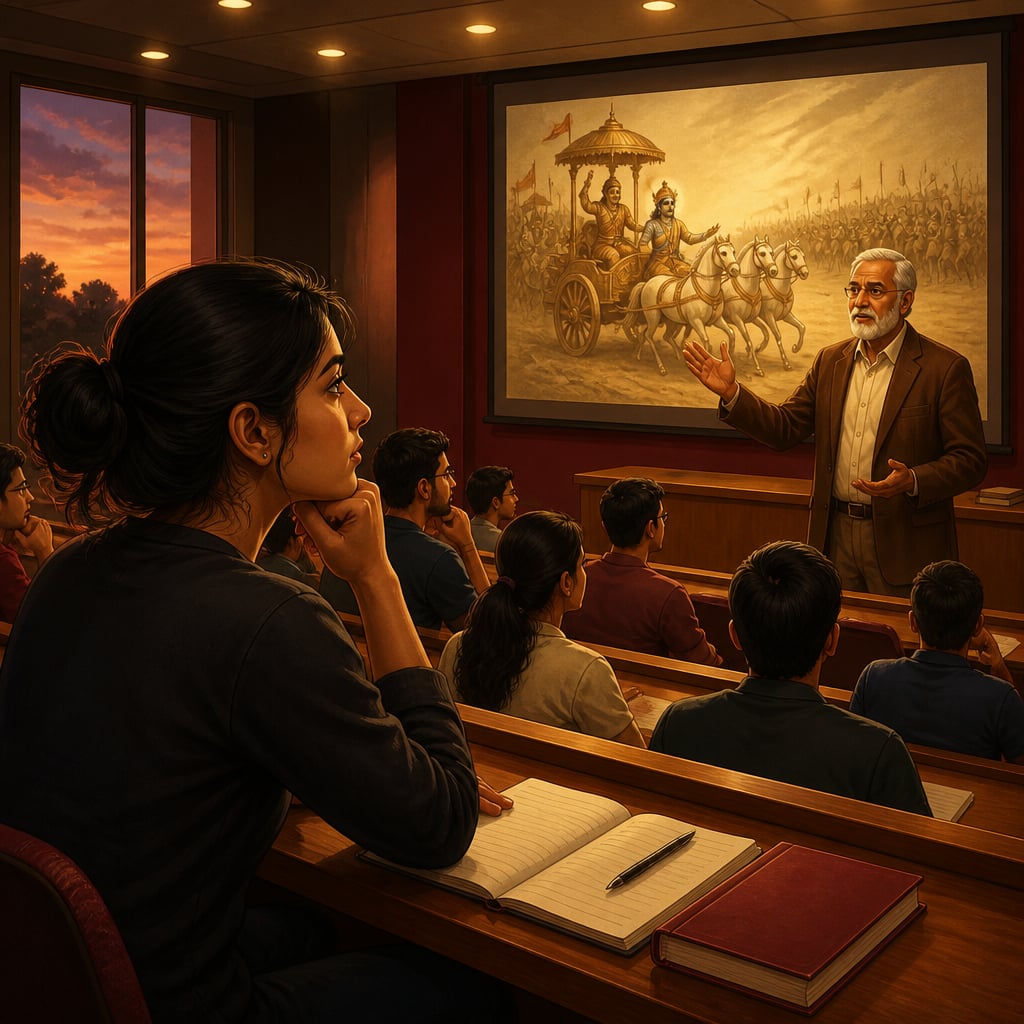
This tension, between the respect we owe teachers and the truth that teachers can be wrong, resonates powerfully today:
In education:
- What happens when a beloved teacher holds views you find harmful?
- How do you honor someone's formative influence while rejecting their conclusions?
- Can you learn from someone without endorsing everything they believe?
In institutions:
- Many people today feel betrayed by institutions (religious, educational, governmental) they once trusted
- The relationship is not unlike Arjuna fighting his teacher, necessary but painful
- How do we critique without destroying? Reform without dishonoring?
The Drona Parva's answer: You can fight your teacher and still mourn him. You can oppose what he does while honoring what he gave you. The relationship remains real even through conflict.
The Truth Problem
Yudhishthira's half-truth, "Ashwatthama is dead", has become more relevant, not less, in the age of information.
Consider modern parallels:
- Political statements that are technically accurate but designed to mislead
- Marketing claims that are true in letter but false in spirit
- Social media posts that present selective truth as whole truth
- News coverage that reports facts but frames them misleadingly
The epidemic of half-truth: We live in an era where sophisticated deception has become the norm. Yudhishthira's chariot fell because intention matters, yet our public discourse rewards those who master misleading while technically truthful.
The Drona Parva's warning: The chariot fell. There was a cost. Even when half-truth serves a larger purpose, something is lost. Our culture often pretends that clever framing has no karmic weight, the epic disagrees.
The Abhimanyu Syndrome
Abhimanyu knew how to enter the Chakravyuha but not how to exit. This has become a metaphor for a modern condition:
In careers:
- People who know how to get promoted but not how to handle the pressure of leadership
- Entrepreneurs who can launch companies but not sustain them
- Students who can get into elite institutions but struggle once there
In commitments:
- Relationships entered without understanding how to navigate conflict
- Ideological movements joined without knowing how to leave
- Online arguments entered without exit strategies
In technology:
- AI systems we've deployed without knowing how to control them
- Social media platforms we've built without understanding their effects
- Global systems of such complexity that no one fully understands them
The Drona Parva's wisdom: Partial knowledge is dangerous. Before entering anything, a battle, a commitment, a technology, ask: Do I know how to get out? What happens when this turns against me? The Chakravyuha kills those who know only the entrance.
The Night Battle
For the first time in dharmic warfare, battle continued past sunset. Rules that had held for thirteen days collapsed.

We live in a perpetual night battle:
The erosion of norms:
- Institutions that once maintained boundaries have weakened
- Rules that governed discourse have been abandoned
- The "daytime" constraints of previous eras, shared facts, common decency, institutional trust, have faded
The power of darkness:
- Night empowers certain forces, Ghatotkacha's demonic maya grew stronger
- Similarly, some voices and movements thrive in chaos, in norm-breaking, in the absence of shared daylight
- When the rules collapse, those unbound by rules gain advantage
The Drona Parva's observation: Night battles happen. When they do, different forces come to power. The question is whether you can survive until dawn, and whether dawn is even possible anymore.
Ghatotkacha's Sacrifice
The half-demon who gave everything for a father who barely knew him represents a kind of love we often overlook:
Unrequited devotion:
- Children who care for parents who abandoned them
- Employees loyal to companies that don't reciprocate
- Citizens devoted to nations that don't deserve it
- Devotees faithful to traditions that test that faith
The question of worthiness: Did Bhima deserve Ghatotkacha's sacrifice? Perhaps not. But Ghatotkacha's love was not dependent on Bhima's worthiness.
The Drona Parva's insight: Some love is given, not earned. Some devotion flows from the giver's nature, not the recipient's merit. This kind of love transforms the giver, Ghatotkacha achieved liberation through sacrifice, regardless of whether Bhima was worthy of it.
Krishna's Moral Complexity
Krishna orchestrates deception after deception in this parva. He:
- Conceals the sun (perhaps)
- Plans the half-truth
- Times the conch to drown out Yudhishthira's qualifier
- Celebrates Ghatotkacha's death
How do we understand a god who works through morally ambiguous means?
The divine pragmatist: Krishna seems to embody a truth uncomfortable to idealists: the world as it is often requires compromises that the world as it should be would not.
For modern leaders:
- Do you maintain purity and lose?
- Or do you compromise and win, and then live with what you've become?
- Is there a way to be effective without being corrupted?
The Drona Parva's complexity: Krishna does not pretend his methods are pure. He takes responsibility. He explains his reasons. He bears the karma. This is different from modern leaders who use Krishnaesque tactics while claiming moral purity.
The Cost of Victory
The Pandavas won the Drona Parva. They:
- Killed Jayadratha (at the cost of Arjuna's impossible vow)
- Killed Drona (at the cost of Yudhishthira's truthfulness)
- Neutralized Karna's Shakti (at the cost of Ghatotkacha's life)
Every victory had a price.
In our lives:
- Career victories that cost family time
- Political victories that cost principles
- Argument victories that cost relationships
- Financial victories that cost integrity
The Drona Parva's accounting: The epic never lets us forget the price. It shows Bhima weeping for Ghatotkacha. It shows Yudhishthira's chariot falling. It shows Arjuna's grief for Drona. Victory is not triumph, it is survival with wounds.
Living with Moral Injury
Modern psychology has a term, "moral injury", for the wound that comes from doing or witnessing things that violate your moral code, even when those things seem necessary.
The Drona Parva is a study in moral injury:
Yudhishthira's half-truth: He survived the war but never recovered his sense of himself as righteous
Arjuna's conflict: He killed teachers, cousins, elders, and carried that weight forever
Dhrishtadyumna's purpose: He fulfilled his destiny but became forever defined by killing a meditating man
The epic's healing: The Mahabharata does not pretend these wounds don't exist. It shows them. It sits with them. Perhaps that honesty is itself a form of healing, acknowledgment that moral complexity leaves marks, and those marks are real.
What the Drona Parva Teaches
As we conclude this chapter, let us gather the wisdom:
1. Partial knowledge is dangerous Abhimanyu's fate warns us: understand the exit before you enter.
2. Teachers can be wrong Drona's greatest students had to oppose him. Respect does not require agreement.
3. Truth has texture Yudhishthira's half-truth was technically accurate and spiritually devastating. Intention matters.
4. Love transcends worthiness Ghatotkacha loved a father who barely knew him, and was liberated through that love.
5. Victory costs The Pandavas won, but every victory required sacrifice. Count the cost before you fight.
6. Night battles happen Sometimes the rules collapse. Be prepared to fight in darkness without losing yourself.
7. Complexity is not relativism The epic shows moral ambiguity without abandoning moral judgment. Hard choices are still choices.
8. The divine works strangely Krishna's methods disturb us, but perhaps the cosmos does not operate according to human comfort.
Carrying the Parva Forward
You have walked through the Drona Parva. You have witnessed:
- A teacher become an enemy
- A boy die in a trap he couldn't escape
- A father race the sun for vengeance
- A demon sacrifice for love
- A king break his defining vow
- A student kill his guru
These stories live in you now. They are not just ancient tales but templates for understanding your own moral landscape.
When you face a teacher who has lost their way, remember Arjuna.
When you enter something you don't fully understand, remember Abhimanyu.
When you're tempted by technically-true deception, remember the falling chariot.
When you must do difficult things, remember they leave marks.
The Drona Parva does not offer comfort. It offers company. Five thousand years of humans have wrestled with these same dilemmas. You are not alone in your complexity.
Tat tvam asi, That thou art.
The struggles of Kurukshetra are your struggles. The wisdom of the ancients is your inheritance. May you carry it well.
Living traditions
The Dronacharya Award (India's highest coaching honor) commemorates the great teacher Corporate leadership programs worldwide study Mahabharata scenarios for ethical decision-making Peter Brook's nine-hour theatrical adaptation brought the epic to global audiences Numerous TV adaptations have made the Mahabharata accessible to new generations Academic departments worldwide study the epic for its literary, philosophical, and historical significance The Gita's teachings, delivered during this very parva, form the foundation of multiple spiritual movements globally
- Practice 1: Parayana (complete reading) of the Mahabharata is considered highly meritorious and is performed in many temples annually
- Practice 2: Kathakalakshepam (storytelling with moral commentary) traditions keep the epic alive through live performance across India
- Practice 3: The Mahabharata is taught in many traditional gurukulas as essential education in dharmic reasoning
Reflection
- Which character in the Drona Parva do you most identify with, and why? What does that identification reveal about your own moral landscape?
- What is your personal 'Chakravyuha', a situation you entered without fully knowing how to exit? What would it mean to learn the exit strategy now?
- Have you ever spoken a 'half-truth' like Yudhishthira, technically accurate but designed to deceive? What was the cost?
- How will you carry the wisdom of the Drona Parva forward? Who in your life might benefit from its insights?