Acharya: The Teacher Commands
Drona takes command of army
With Bhishma fallen on his bed of arrows, the Kaurava army desperately needs a new commander. Dronacharya, the teacher who trained both armies, accepts the burden of leadership, trapping himself between duty to his employers and love for his students. His first vow as commander will change the war's course forever.
The Tenth Night
The sun had barely set on the tenth day when Duryodhana stood before the arrow-pierced body of his grandsire. Bhishma lay on his shara-shayya, his bed of arrows, still alive, yet removed from the war forever. The invincible commander had fallen, and with him, Kaurava hopes seemed to drain into the blood-soaked earth of Kurukshetra.
Around Duryodhana, his army was breaking. Ten days of watching their greatest warrior systematically avoid killing the Pandavas had eroded morale. Now that warrior was gone, brought down by the very grandson he had protected, Arjuna firing from behind Shikhandi's shield.
"Who will lead us now?" The question passed from soldier to soldier, from chariot to tent, from the lowest foot soldier to the mightiest maharatha. "Who can stand where Bhishma stood?"
Duryodhana knew the answer. There was only one man whose reputation could match the grandsire's, only one warrior whose skill was legendary enough to rally the demoralized troops. But approaching him would require Duryodhana to confront an uncomfortable truth: he was about to ask a teacher to kill his own students.
The Reluctant Commander
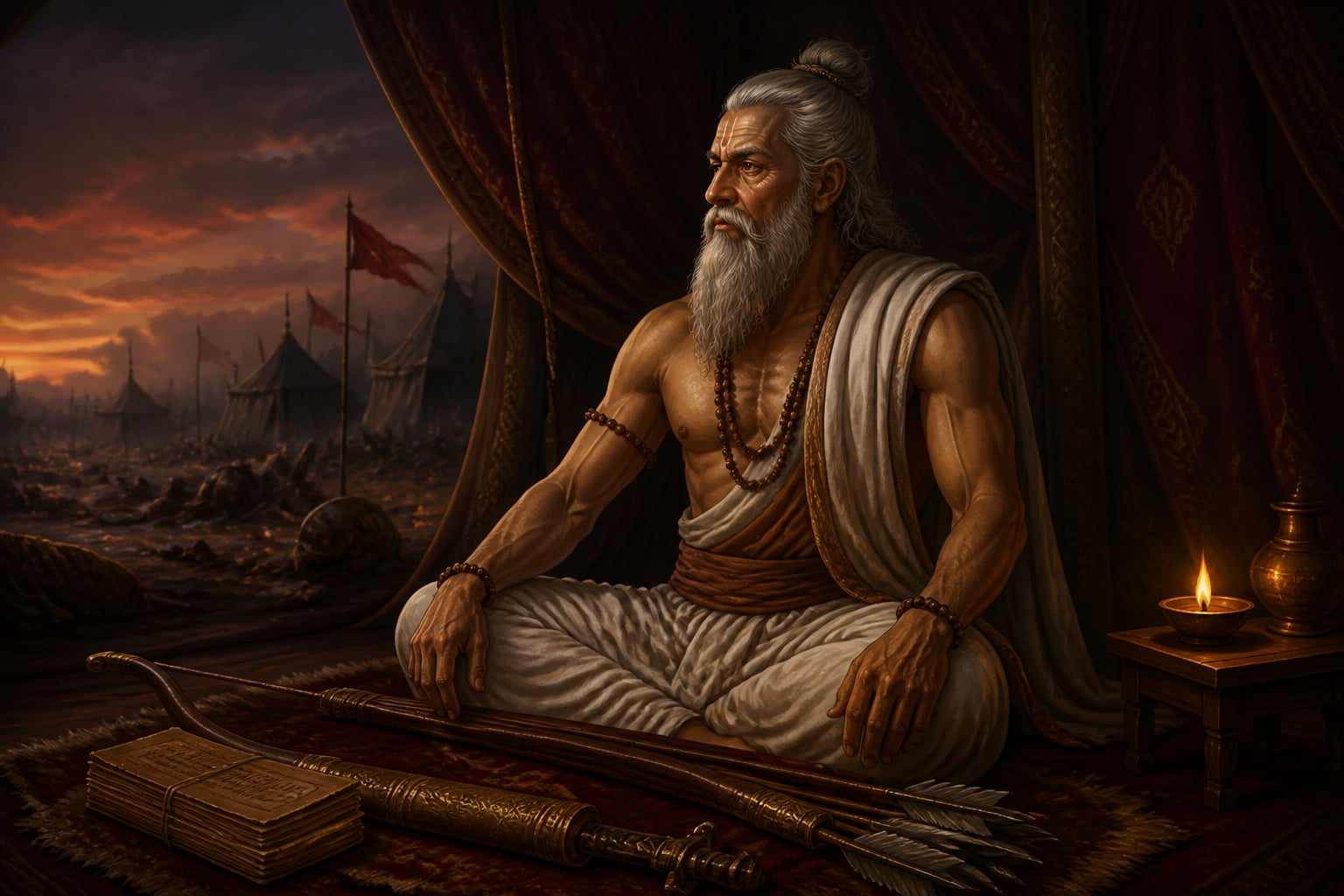
Dronacharya sat alone in his tent, his weapons laid aside, his eyes fixed on something no one else could see. For ten days, he had fought with devastating effectiveness, yet always with a hollow space in his heart where joy should have been.
Every arrow I loose, I taught them to dodge. Every formation I devise, I taught them to break.
He had trained the Pandavas and Kauravas alike in his ashram at Hastinapura. Arjuna had been his finest student, the one who had absorbed not just technique but artistry, who had inherited Drona's passion for the bow. Yudhishthira had learned wisdom at his feet. Bhima had trained with his mace under Drona's watchful eye.
And Ashwatthama, his own son, fought alongside the Kauravas. His boy, his blood, his reason for living, bound to this war by Drona's own allegiance to Hastinapura.
When Duryodhana entered the tent, Drona did not rise.
"The army needs a commander," Duryodhana said, his voice carefully controlled despite his desperation. "You are the only one they will follow."
"I trained your enemies," Drona replied quietly. "I made them what they are. Now you ask me to unmake them?"
"I ask you to honor your oath to Hastinapura."
Ah, thought Drona. There it is. The chain that binds us all.
The Weight of Gratitude
The trap was elegant in its simplicity, and Drona recognized it even as he felt it close around him.
Years ago, he had come to Hastinapura as a penniless Brahmin, humiliated by his former friend King Drupada, desperate to provide for his wife and infant son. Bhishma had seen his worth and appointed him royal teacher. Hastinapura had given Drona everything: position, wealth, purpose, the chance to raise the greatest warriors of the age.
Now Hastinapura called in its debt.
| What Drona Received | What Hastinapura Asked |
|---|---|
| Position as royal acharya | Loyalty to the throne |
| Wealth and prestige | Service against any enemy |
| The chance to teach | The duty to fight |
| A legacy through students | The destruction of that legacy |
Could he refuse? What would that make of all the years he had served? What would happen to Ashwatthama, bound by his father's choices?
A Brahmin should not be a warrior, whispered a voice in his heart. You chose this path for revenge against Drupada. Now see where it leads.
But the voice was old and tired, and Drona was already reaching for his bow.
"I will command your army," he said to Duryodhana. "But know this: I will fight the Pandavas, but I will not kill them. That is not within my power."
Duryodhana's eyes narrowed. "Then what use are you?"
"I can give you something better than their deaths. I can give you their king."
The Vow

What Drona proposed was audacious: he would capture Yudhishthira alive.
Think of what this meant. The Pandava cause rested on Yudhishthira's claim to the throne. If he were captured, not killed, but held prisoner, the war could end without further bloodshed. The Pandavas would have to negotiate. Terms could be set. Perhaps, somehow, this catastrophe could be contained.
"Grant me this," Drona told Duryodhana. "I will deploy formations so complex that even Arjuna cannot break them. I will draw Arjuna away from Yudhishthira's side. And when the moment comes, I will take your cousin captive. The war ends with his capture."
It was a plan born of desperate hope, the hope that Drona could fulfill his duty without destroying everything he loved.
But plans made in hope often die in reality.
Duryodhana accepted because he had no choice. The army accepted because they needed something to believe in. And across the field, the Pandavas heard of Drona's appointment with very different emotions.
Krishna smiled his enigmatic smile. "The teacher takes the field against his students. Now we shall see whose lessons were truly learned."
The Teacher's Paradox
Drona's appointment created a paradox that would define the next five days of war.
He was, by any measure, the second-greatest warrior on the field after Bhishma. His mastery of weapons, conventional and divine, was unmatched. He knew every secret technique, every counter-formation, every weakness in both armies because he had created those armies.
Yet that very knowledge paralyzed him.
- When he formed the Garuda Vyuha (eagle formation), he knew Arjuna would recognize it, because Drona had taught him its weakness
- When he unleashed divine astras, he knew exactly how the Pandavas would counter, because he had trained them in that defense
- When he sought to capture Yudhishthira, he knew Krishna would anticipate every strategy, because Drona understood how a truly brilliant mind thinks
I am fighting against my own teaching, Drona realized. Every success I have proves I taught them well. Every failure proves I taught them too well.
The Pandavas faced their own version of this paradox. Arjuna could not bring himself to fight his guru with full intensity. How do you raise your bow against the man who placed your first arrow on a string? How do you aim for the heart that had taught your heart to shoot?
"Acharya is not like Bhishma," Arjuna told Krishna. "Bhishma fought because of duty to the throne. Drona fights because we are the proof of his life's work. If he defeats us, he proves he taught us poorly. If we defeat him, we destroy our own teacher."
"And yet," Krishna replied gently, "the war continues."
The Eleventh Dawn
When the sun rose on the eleventh day, Drona stood at the head of the Kaurava army, a Brahmin in a warrior's chariot, scripture in one hand and bow in the other.

The sight was jarring to those who understood what they were seeing. Here was the preceptor of princes, the man who had initiated countless students into the sacred knowledge of arms, now prepared to use that knowledge for killing. The acharya had become the senapati.
His first formation was a statement of intent: the Shakata Vyuha, the cart formation, designed not for offense but for protection, with Yudhishthira identified as the target to be isolated.
The Pandavas responded with the Krauncha Vyuha, the heron formation, designed to pierce precisely such a defensive arrangement.
Then the conches sounded, and the eleventh day began.
What Changes
Under Drona's command, the war transformed.
Bhishma had been a wall, immovable, devastating, but fundamentally defensive in his restraint. He had killed thousands but protected the Pandavas from his own army's excesses.
Drona was a strategist. Where Bhishma had used overwhelming force, Drona used cunning. His formations were designed to achieve specific objectives:
- Separate Arjuna from the main army, only without Arjuna could Yudhishthira be captured
- Draw out the Pandava forces into unfavorable terrain
- Create opportunities for the Kaurava maharathas to fight the Pandavas individually
- Conserve strength for the decisive moment
The soldiers noticed the change immediately. Under Bhishma, they had been pieces on a board, moved by a master who cared little for their individual survival. Under Drona, they were students being taught a lesson in war, valued for what they could learn, not just what they could die for.
Perhaps, thought the common soldiers, this teacher will teach us how to win.
But on the Pandava side, Dhrishtadyumna, the Pandava commander, watched Drona with different eyes. He had been born from sacrificial fire for one purpose: to kill Dronacharya. Every formation Drona devised, every strategy he employed, brought Dhrishtadyumna closer to his destiny.
You taught my enemies to be warriors, Dhrishtadyumna thought. But you did not teach me. I am the one weapon against which your training provides no defense.
The Drona Parva had begun, five days that would see the death of heroes, the breaking of rules, and the fall of a teacher who could not escape the consequences of his own excellence.
The Parva Ahead
In the days that follow, Drona would:
- Deploy the legendary Chakravyuha, the spinning wheel formation that would trap and kill the young hero Abhimanyu
- Drive Arjuna to swear an impossible oath, to kill Jayadratha before sunset or die trying
- Fight through a night battle that would claim Ghatotkacha and the divine Shakti weapon
- Fall victim to a half-truth that would shatter his will to live
But all of that lay ahead. On this eleventh morning, there was only a teacher, a bow, and a choice already made.
Drona raised his arm, and the Kaurava army moved forward.
The lesson had begun.
Living traditions
Drona's story resonates in modern discussions of institutional loyalty versus ethical responsibility. His predicament, bound by gratitude to serve a cause he knows is wrong, mirrors dilemmas faced by professionals in organizations that compromise their values. Business ethicists use Drona's case to explore 'golden handcuffs', when benefits create obligations that override conscience. The Dronacharya Award ensures his name remains associated with teaching excellence, though the award notably honors coaches whose students succeed, perhaps the resolution Drona never found.
- Guru Dakshina Ceremonies: The tradition of students offering guru dakshina upon completing education continues in Indian spiritual and educational contexts. The offering acknowledges that knowledge transfer creates sacred bonds between teacher and student.
- Drona Sagar: A sacred tank associated with Dronacharya. According to tradition, Drona created this reservoir to provide water for his troops during the war. The site includes a temple dedicated to Drona and is visited by pilgrims seeking the blessings of wisdom and skill.
- Dronacharya Temple: Ancient temple dedicated to Dronacharya. The name 'Gurgaon' itself derives from 'Guru Gram', the village of the guru, believed to be land given to Drona by the Kauravas. The temple marks the site where Drona is said to have established his ashram.
Reflection
- Drona felt bound by gratitude to Hastinapura despite disagreeing with Duryodhana's cause. Have you ever felt trapped by obligation to a person or institution whose values conflicted with your own? How did you handle it?
- Drona created the warriors who now stood against him. What happens when something you built, a team, a student, a creation, becomes your opposition? Is the creator responsible for the creation?
- Is it possible to fight against someone you love? Can duty and affection coexist, or does accepting one mean betraying the other?