Vedi Nirmana: Altar Geometry as Mathematics Laboratory
How ritual requirements drove mathematical innovation
Explore how the complex requirements of Vedic altar construction, from doubling areas to transforming shapes, led to remarkable geometric discoveries.
Vedi Nirmana: Altar Geometry as Mathematics Laboratory
Around 600 BCE, on cleared ground in the Kuru-Pāñcāla country, a śulbakāra named Āpastamba is preparing to lay out a Śyenaciti, a fire altar shaped like a falcon with outstretched wings. A stack of kiln-fired bricks stands to his right. Five layers of two hundred bricks each must fit inside an outline of exactly seven and a half square puruṣas. No two layers may be arranged alike. No joint in one layer may sit directly above a joint in the layer below. The hotr priest and the ritual sponsor are waiting at the edge of the field. The kindled household fire has already been carried out in procession. The yajña has a fixed start time, set by the jyotiṣa priests against the position of the stars. If the falcon is wrong in shape or wrong in area, the sacrifice will fail by the theology of the tradition, and the patron's gold is already paid. Āpastamba has one cord, a handful of pegs, and a memorised set of rules he calls the Śulbasūtra. What he does in the next few hours is some of the most demanding applied geometry anywhere on earth in his time.
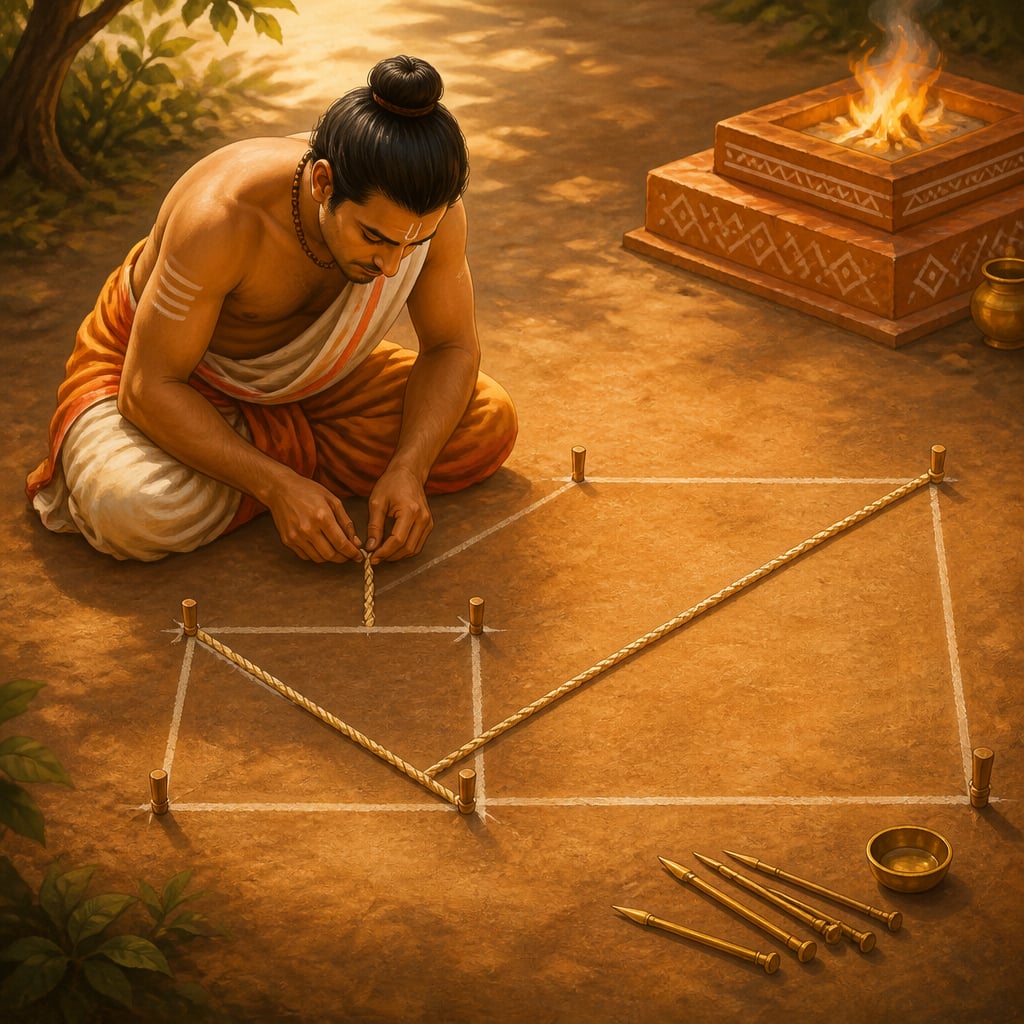
This is Vedi Nirmāṇa, the construction of the Vedic altar. It was, by any honest measure, a research laboratory. Specific problems forced specific innovations. Innovations were tested in the field. Methods that worked were preserved. Methods that failed were refined. The output was not theorems in a book but a living body of geometric knowledge, transmitted across generations and finally captured in the Śulbasūtras.
Why Ritual Needed Geometry
Vedic yajnas required dozens of altar types, each with strict specifications. The Gārhapatya altar for the household fire was circular. The Āhavanīya altar for the offering fire was square, with the two areas required to match exactly. The Dakṣiṇāgni, the southern fire, was semicircular. The Mahāvedī of the Soma sacrifice was an isosceles trapezoid, thirty padas on its western side and twenty-four on its eastern, a precisely determined shape that forced the priest to master what Greek geometers would later call area calculation of a non-rectangular figure.
Then came the transformations. A householder performing the Agnicayana ceremony to ascend to a higher ritual status had to double the area of his altar without changing its shape. A king seeking greater potency had to combine two altars into one of equal total area. A patron seeking a specific boon had to convert one altar shape into another, preserving area exactly. And crowning the whole system was the Śyenaciti, the falcon-shaped altar built in five layers of exactly a thousand bricks, each brick cut to shape, each layer patterned so no joint in one layer sat directly above a joint in the next. A priest who could construct the Śyenaciti correctly was, whatever else he might be, a practicing geometer of formidable skill.
The Śulbasūtras as Field Manuals

The Śulbasūtras, composed between roughly 800 and 200 BCE, codified these methods. Their name comes from śulba, the cord, and sūtra, a terse instructional thread. Three great recensions survive. Baudhāyana is the earliest. Āpastamba refines and extends his predecessor. Kātyāyana systematizes the whole tradition. None of these texts reads like Euclid. There are no definitions, no postulates, no deductive proofs. Each sūtra is an instruction: here is how to lay out a square, here is how to convert a square to a rectangle of equal area, here is how to double the altar, here is how to combine two squares into one. The Śulbasūtras were working manuals written for a community that already understood why the methods worked. The knowledge was embodied, passed from teacher to student, tested every time an altar was built.
Yet beneath this practical surface lies some of the earliest rigorous geometry in human history. Baudhāyana states, calmly and without flourish, that the diagonal of a square doubles the original area when used as the side of a new square. This is the recognition that the square root of two is the correct scaling factor for area doubling. He then gives a numerical approximation for this root: increase the side by its third, then by a fourth of that third, less a thirty-fourth of that fourth. This expression, called the saviśeṣa, evaluates to 1.4142156. The true value of the square root of two is 1.4142135. The error sits in the fifth decimal place. No proof is offered. None was needed. The cord was measured, the altar rose, the fire caught.
What Makes It a Laboratory
Three features mark Vedi Nirmāṇa as a genuine mathematical laboratory rather than ritual carpentry. First, the problems forced real innovation. Doubling a square is not the same as scaling it. Recognizing that difference, and solving it, demanded a working concept of incommensurable magnitude. Second, the tradition distinguished exact results from approximations. The Śulbasūtras say when a rule is precise and when it is saviśeṣa, an approximation with a stated correction. That is the posture of a working scientist. Third, the tradition iterated. Āpastamba tightens Baudhāyana. Kātyāyana generalizes rules his predecessors gave only in special cases. Each generation improved upon the last while preserving what worked.

The Śyenaciti illustrates all three features at once. Keeping a bird-shaped altar constant in area across five layers of differently arranged bricks is a combinatorial problem that modern mathematicians would recognize as nontrivial. Vedic priests solved it not as an abstract puzzle but as a task to be completed before sunset. The Śulbasūtras give the brick counts, the wing proportions, the tail length, and the assembly rules. Every detail is the output of centuries of practical experiment.
The Deeper Point
The most important insight of Vedi Nirmāṇa is not any single construction. It is the proof that mathematics can grow from the cord and the brick as readily as from the axiom and the theorem. Greek geometry proceeded from postulates downward. Śulbasūtra geometry proceeded from the altar outward. Both approaches yielded real mathematics. What Bhārat discovered first, and discovered without needing to call it by that name, was that a problem set dictated by ritual necessity could still produce universal truths. The rules of the Śulbasūtras outlived the yajnas that inspired them. The geometry beneath them is not Vedic or Greek or modern. It is mathematics itself, glimpsed for the first time in the firelight of a sacred altar. Every modern engineer who reaches for iterative refinement, every physicist who writes an error bound, every numerical analyst who declares a tolerance is doing what Āpastamba was doing when he knelt beside his pile of bricks on the Kuru-Pāñcāla plain, cord in hand, and trusted that a careful enough approximation would hold the altar up for the fire.
Key figures
Apastamba
Vedic sūtrakāra and author of the Āpastamba Śulbasūtra, a refinement and extension of the earlier Baudhāyana tradition
Katyayana
Later Vedic geometer whose Kātyāyana Śulbasūtra is the most systematic of the three great recensions of altar geometry
Manava
Author of the Mānava Śulbasūtra, the shortest and most construction-focused of the four surviving altar-geometry texts
Case studies
The Śyenaciti Falcon Altar: Thousand Bricks in Five Layers
The Agnicayana ritual required a fire altar shaped like a flying falcon, the Śyenaciti. The Āpastamba Śulbasūtra specifies its construction exactly: five layers of burnt bricks, each layer totaling exactly one thousand bricks, the whole altar measuring seven and a half square purushas in area. Each layer had to preserve that total area while using bricks in different configurations, and no brick joint in any layer could sit directly above a joint in the layer below. The wings, tail, and body of the falcon were each built from bricks cut to specific shapes, and the assembly had to be completed within a single ritual session spanning multiple days.
This is applied combinatorial geometry at a level that would not reappear in the Greek or Roman worlds. The Śulbasūtras provide the brick shapes, the layer patterns, and the count verification rules. Baudhāyana names different brick types by their function: the wing brick, the tail brick, the corner brick, each with specified proportions. The Vedic priest was not merely following a recipe. He was solving a packing problem, an area-invariance problem, and a joint-staggering problem simultaneously, and doing so with a cord, a stake, and a pile of bricks.
The Śyenaciti was built routinely for roughly a millennium and remains the most mathematically sophisticated artifact of the Vedic ritual tradition. The geometric knowledge required to build it is the seed from which much later Indian geometry grew, and the altar itself became a cultural symbol of precision under pressure.
Constraints are the most productive teachers of mathematics. A free theorem rarely drives innovation the way a practical deadline does. The falcon had to fly by sundown, and the geometry had to be correct when it did.
A complete Śyenaciti contains exactly 1,000 bricks per layer across five layers, yet the total area of each layer remains identical. Modern reconstructions confirm the feasibility of the described brick cuts.
Doubling the Altar: The Vedic Delian Problem
Vedic ritual held that greater ritual potency required a larger altar of the same shape. Doubling the linear dimensions would quadruple the area, not double it, so a different construction was needed. The priest had to find a new square whose area was exactly twice the original. Baudhāyana's Śulbasūtra solves this with a single instruction: take the diagonal of the original square as the side of the new square. He then provides the saviśeṣa, a numerical approximation for this diagonal accurate to five decimal places, for cases where the priest needed the length in numerical rather than geometric form.
This is the same problem that Greek tradition attributes to the oracle at Delos, where Apollo supposedly demanded the doubling of a cubic altar. Indian priests encountered the planar version of the problem several centuries earlier and solved it completely, both geometrically (the diagonal construction) and numerically (the saviśeṣa approximation for the square root of two). The Śulbasūtra solution does not treat the square root of two as a mystery or an impossibility. It treats it as a tool, names it, and uses it.
Doubling the altar became a standard operation in Vedic ritual, and the saviśeṣa approximation entered general use wherever a priest needed a numerical length rather than a rope-length. The same approximation would later reappear in Āryabhaṭa and Brahmagupta, a silent thread of continuity stretching nearly two thousand years.
Real problems refine tools more sharply than philosophical puzzles do. The Vedic altar forced a usable value of the square root of two centuries before any culture declared the question worth asking in the abstract.
Staal's 1975 Agnicayana: A Living Laboratory
In April 1975, the Dutch Indologist Frits Staal documented a full twelve-day Agnicayana ritual in Panjal, Kerala, performed by Nambudiri brahmins from the Kauśītaki tradition. The ritual included the construction of a falcon-shaped brick altar exactly as specified in the ancient Śulbasūtras. The priests built the altar from memory and oral tradition, using the same cord-and-stake methods described in texts composed more than two and a half thousand years earlier. Staal and his team filmed the entire ceremony, making it the first fully documented modern Agnicayana.
The 1975 performance is decisive evidence that the Śulbasūtras are not merely textual. They describe a living craft tradition. The Nambudiri priests carried the altar-geometry knowledge as embodied skill, transmitted teacher to student across generations, verified every time an altar was laid. Staal's documentation preserved this skill at a moment when it could have been lost, and it confirmed that the geometric rules of Baudhāyana and Āpastamba are still operationally correct after 2,500 years.
Staal's filmed documentation and two-volume study, Agni: The Vedic Ritual of the Fire Altar (1983), became the single most important modern record of Vedic ritual geometry in practice. The Panjal ritual has been performed again several times since, each occasion reinforcing the claim that the Śulbasūtra tradition is a living science, not a museum relic.
Mathematical knowledge does not survive only in books. Some of it survives in hands, in the tacit skill of knowing how a cord should pull and where a brick should sit. The 1975 Agnicayana reminds us that geometry can be inherited through practice as faithfully as through theorems.
The 1975 Panjal Agnicayana was the first full Vedic fire-altar ritual to be filmed in its entirety. It has been performed again in 1990, 2006, 2011, and subsequent years, each time using the same Śulbasūtra-derived altar geometry.
The Mahāvedī Trapezoid: Geometry of the Soma Altar
The grand altar of the Soma sacrifice is called the Mahāvedī, and it is not a square or a rectangle but an isosceles trapezoid. Kātyāyana specifies its dimensions exactly: thirty padas on the western side, twenty-four padas on the eastern side, and thirty-six padas from east to west. The priest had to lay out this shape on open ground using only a cord, pegs, and the sun for orientation. The construction begins with a carefully oriented east-west line, then uses the diagonal theorem to drop perpendiculars of the correct length, then adjusts the eastern and western edges to the prescribed pada counts.
The Mahāvedī is the Śulbasūtra proof that Vedic geometry was not limited to squares and circles. A precisely specified isosceles trapezoid forces the priest to handle multiple unequal sides, verify right angles at four corners, and compute an area that cannot be obtained by simple multiplication. Kātyāyana gives the rule for the trapezoid's area long before any Greek treatise formalizes the problem, and he gives it in the context of an altar that real patrons would pay for and real priests would measure out.
The Mahāvedī construction became the standard Soma altar across Vedic Bhārat and was still being laid out in this exact shape into the medieval period. The construction rules Kātyāyana gives are an early general statement of trapezoid geometry in a mathematical text, predating analogous Greek treatments.
A tradition that can handle a trapezoid with only a cord can handle any polygon. The Mahāvedī shows that Vedic geometry was not a collection of special cases but a general capability quietly embedded in the ritual manual.
Historical context
Late Vedic Period (c. 800–400 BCE), with ritual practice extending centuries earlier and textual codification continuing into the Mauryan era
The late Vedic period was an age of elaborate yajnas and settled agrarian societies spreading across the Gangetic plain. The sixteen Mahājanapadas had begun to consolidate, and ritual specialists such as the Kauśītaki and Taittirīya schools were codifying the oral knowledge accumulated over earlier centuries. It is in this setting that the Śulbasūtras were written, drawing on altar geometry that was already old by the time it reached the page.
Living traditions
Śulbasūtra altar geometry is now studied in university courses on the history of mathematics worldwide, taught at TIFR, IIT Bombay's HSS department, and reconstructed in Indian Knowledge Systems initiatives under the AICTE curriculum. Kim Plofker's Mathematics in India (Princeton, 2009) devotes a full chapter to the Śulbasūtras. The Kerala Nambudiri tradition remains the only living altar-geometry craft anywhere on earth.
- Agnicayana Ritual Revival: The twelve-day Agnicayana ceremony, which centers on the construction of the falcon-shaped Śyenaciti altar, continues to be performed at rare intervals by Nambudiri brahmins in Kerala. Each performance uses the exact Śulbasūtra geometry: a cord, staked ground, and bricks cut to traditional specifications. The altar is laid out, consecrated, used, and then ritually returned to the earth.
- Sulba Cord Training in Yajnika Lineages: Traditional yajnika families still teach young students how to use the śulba cord to lay out altars of various shapes, with the cord serving as compass, straightedge, and measuring tape in one. The student learns to recognize the dvikaraṇī (doubler) and the related altar-geometry terms by handling the cord itself, exactly as described in the Śulbasūtras.
- Panjal Agnicayana Site: The village where Frits Staal filmed the 1975 Agnicayana and where the ritual has been performed again on several later occasions. The site preserves the memory of the modern Śulbasūtra laboratory and is associated with the Kauśītaki Nambudiri tradition.
- Sringeri Sharada Peetham: One of the four mathas founded by Adi Shankaracharya and a major center for Vedic study. Visitors can see traditional yajnas performed, often with altars laid out using Śulbasūtra-derived cord geometry. The peetham also maintains a library of Vedic and Śulbasūtra manuscripts.
Reflection
- In your own life, what is a real-world constraint that has forced you to learn something you would not have learned otherwise?
- Why might the Śulbasūtra authors have been satisfied to give their geometric rules without formal proofs?
- What is the relationship between ritual precision and mathematical truth?