Baudhayana Theorem: Pythagoras, 800 Years Early
The Indian origin of the world's most famous geometric theorem
Examine the Sulbasutra verse stating the relationship between the sides of a right triangle, centuries before Pythagoras.
Baudhayana Theorem: Pythagoras, 800 Years Early
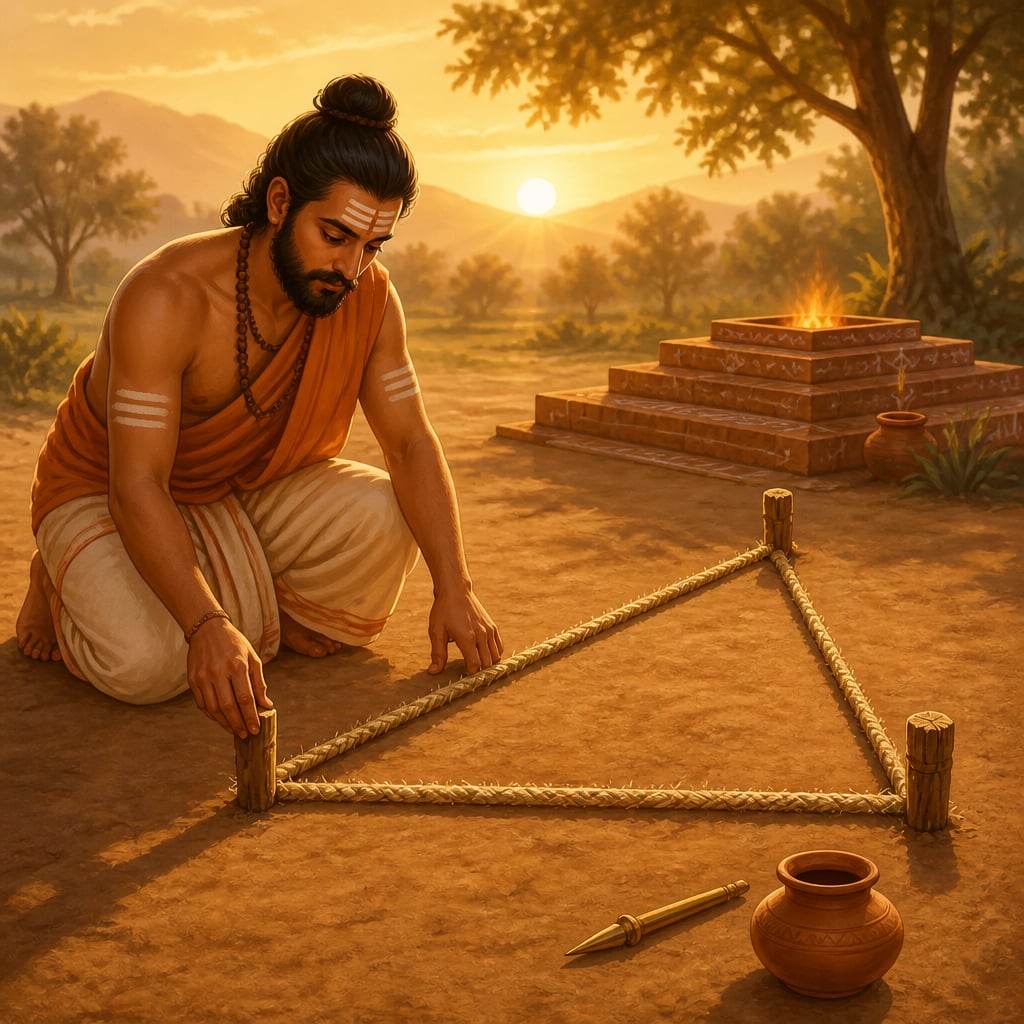
Sometime around 800 BCE, on a strip of cleared land near the banks of the Sarasvatī, a Vedic priest named Baudhāyana sits down with a stylus and a stack of palm leaves. The knot-counted cord he has been using all morning is still coiled at his side. The smell of damp earth and cattle dung from the neighbouring fields hangs in the air. Two of his students sit cross-legged in front of him, ready to memorise. What he is about to dictate is a few lines of very compressed Sanskrit, each a standing rule for how a cord behaves when you stretch it from corner to corner of a rectangle on the ground. One of those lines, Sūtra 1.48 in the text later called the Baudhāyana Śulbasūtra, will survive twenty-eight centuries. It will travel through Greek, Arabic, Latin, and English schoolrooms, acquire the name of a Greek mystic born three hundred years after Baudhāyana's death, and be taught to every schoolchild on earth as a² + b² = c². The attribution to Pythagoras of Samos is one of the most famous misattributions in the history of mathematics. This lesson is the story of what the sūtra actually says, and of who said it first.
What the Sūtra Actually Says
Baudhāyana's exact words are these: 'dīrghacaturasrasyākṣaṇayārajjuḥ pārśvamānī tiryaṅmānī ca yatpṛthagbhūte kurutas tadubhayaṃ karoti'. The rope stretched along the diagonal of a rectangle produces an area that the vertical and horizontal sides produce together. Translated into modern algebra, this is precisely a² + b² = c². It is not a hint, not a precursor, not a partial form. It is the statement. Baudhāyana then goes further. In the very next sūtra, he lists specific integer solutions so that ritual builders could lay out right angles without any computation at all: 3 and 4 and 5, 5 and 12 and 13, 8 and 15 and 17, 7 and 24 and 25, 12 and 35 and 37. These are Pythagorean triples, tabulated three hundred years before Pythagoras.
Why the Śulbasūtras Existed
The Śulbasūtras were not abstract treatises. They were ritual geometry manuals, part of the broader Kalpa literature that told Vedic priests how to perform yajña correctly. The rules had to be exact. Vedic theology held that a millimeter wrong altar would invalidate the sacrifice, so śulbakāras, the masters of the rope, needed sophisticated geometric tools. Building a falcon shaped altar of area precisely seven and a half square puruṣas, doubling a square altar without changing its shape, transforming a circle into a square of equal area, each of these tasks demanded real mathematics. The theorem the world now calls Pythagorean was Baudhāyana's everyday working tool for squaring foundations and transforming shapes. It was never discovered in the margin of speculation. It was hammered out at the altar edge where a mistake meant the fire would not rise.
Baudhāyana Was Not Alone
The Śulbasūtra tradition has at least four known authors. Baudhāyana is the earliest, usually placed between 800 and 600 BCE. Āpastamba follows, then Kātyāyana, then Mānava. Every single one of them repeats the right triangle theorem. Every single one of them lists Pythagorean triples. This is not a single text that could be dismissed as a later interpolation. It is an entire tradition, multiply attested across centuries, long before Greek systematic geometry appears. What we now call Euclidean geometry begins with Euclid's Elements around 300 BCE. Baudhāyana had already taught area preserving constructions, altar squaring, and the right triangle identity for five centuries before Euclid picked up a compass.
How the Date of 800 BCE Became Accepted in the West

The Western world did not learn of the Śulbasūtras until the 1870s. A German Sanskritist named George Thibaut, working in Banaras, published the first European translation in the journal The Pandit in 1875. Moritz Cantor, the senior German historian of mathematics, studied Thibaut's translations and was shaken by what he read. In subsequent editions of his Vorlesungen über Geschichte der Mathematik, Cantor conceded that the Indians had the theorem long before the Greeks and speculated openly about possible transmission routes. Albert Bürk followed in 1901 with a detailed study of the Āpastamba Śulbasūtra that made the priority case decisively. By the early twentieth century no serious historian of mathematics denied that the theorem had been known in India by 800 BCE at the latest.
Was It Transmitted to Greece?
Scholars remain divided on whether the Greeks inherited directly from India. A. Seidenberg, writing in the 1960s and 1970s, argued that Greek and Babylonian geometry both descended from Vedic altar mathematics. Others maintain that the discovery happened independently in multiple civilizations. What is no longer controversial is the chronological fact. The earliest written statement of the theorem, complete with a construction proof and a table of integer solutions, is Indian. Pythagoras, if he said anything about right triangles at all, said it after Baudhāyana had already written it down, handed it to his students, and watched a generation of priests use it at the altar.
The Stunning √2 Approximation
The same Baudhāyana Śulbasūtra that states the right triangle rule also contains one of the most extraordinary numerical approximations in premodern mathematics. To construct the diagonal of a unit square, Baudhāyana gives √2 as 1 + 1/3 + 1/(3×4) − 1/(3×4×34). That evaluates to 1.41421568 and change. The true value of √2 is 1.41421356 and change. Baudhāyana's formula is accurate to five decimal places, derived twenty six centuries before electronic computers, in a context where its only purpose was to help a priest lay out a square altar. A Vedic ritualist needed five decimal places of precision to satisfy a liturgical requirement, and his tradition supplied them in a single brief sūtra.
What a Correction Looks Like
Renaming the theorem is not the point. Names propagate by inertia and are not easily changed. What matters is naming the truth alongside the convention. When you write 'Pythagorean theorem' in your notes, you are writing a European honorific laid over an Indian discovery. The correction is quiet and specific. Every textbook that teaches the theorem should also mention Baudhāyana. Every teacher introducing it should know the sūtra in which it first appeared. Every student of the history of mathematics should know that the most famous equation in elementary geometry was first written in Sanskrit, for a ritual reason, on Indian soil, at least three centuries before the man whose name it still carries.
A Living Inheritance

The theorem has not retired. A Mumbai mason squaring the foundation of a new building still uses the 3-4-5 rule on a knotted rope, the exact technique Baudhāyana taught for corner construction. Every trigonometric function, every distance formula in physics, every pixel coordinate in a video game, every course correction in an ISRO spacecraft is a lineal descendant of the same sūtra. Baudhāyana's gift is not a historical curiosity. It is the single most used identity in applied mathematics, running silently behind billions of calculations per second across every working hour of the modern world. Twenty-eight centuries after he sat down with his stylus on the banks of the Sarasvatī, the sūtra he dictated to his students that morning is still doing its work.
Key figures
Baudhāyana
c. 800 BCE, Vedic India
George Thibaut
1848 to 1914 CE, Germany and British India
Bibhutibhushan Datta
1888 to 1958 CE, Bengal, India
Case studies
Yajñavalkya's Fire Altar: Ropes, Pegs, and Right Angles
A Vedic ritualist in the late eighth century BCE is commissioned to prepare a śyena or falcon shaped agni altar for a major sacrifice. The ritual prescribes a total altar area of exactly seven and a half square puruṣas, a puruṣa being the height of the sacrificer with arms raised. The altar must be laid out in five layers of two hundred bricks each, every layer oriented precisely, every corner square. A millimeter of error is not a small aesthetic flaw. It is, by the theology of the tradition, a failure that invalidates the entire yajña. The priest has a length of cord, a handful of wooden pegs, a flat patch of earth, and Baudhāyana's Śulbasūtra committed to memory.
This is the real world in which Baudhāyana's theorem was born. Not in speculation, not in a library, but on a measured patch of consecrated ground where a ritualist had to make a rectangle with provably right angles using nothing but a rope. The 3-4-5 triple from Sūtra 1.49 solved the corner problem in seconds. The priest would mark off three units on one cord, four on another, and five on a third, tie them into a closed triangle, and stretch the result on the ground. The angle between the sides of three and four was exactly ninety degrees, guaranteed by the theorem itself. Every altar corner in the Vedic world was built on this single trick.
Śyena altars built to Baudhāyana's specifications were constructed across the Indo Gangetic plain for roughly two thousand years and are still built in strict Śrauta yajña traditions today. Archaeological remains of brick altars matching Sulbasūtra proportions have been excavated in sites such as Kosambi, Purana Qila, and parts of modern Bihar and Uttar Pradesh. The precision of the surviving layouts matches Baudhāyana's written rules to within the tolerance of handmade brickwork.
Mathematics is most durable when it is built at the point of real use. Baudhāyana's theorem survived for three millennia because it was never merely an idea. It was the working rule by which a priest squared the altar on which fire would be lit.
A Śrauta yajña performed today in Kerala still uses the exact 3-4-5 corner technique Baudhāyana wrote down approximately 2,800 years ago.
Thibaut in Banaras: 1875 and the Quiet Reset of History
In 1875, George Thibaut, a thirty year old German Sanskritist recently appointed professor at the Benares Sanskrit College, published a long article titled 'On the Śulvasūtras' in a local journal called The Pandit. The article was a careful translation and mathematical analysis of the Baudhāyana, Āpastamba, and Kātyāyana Śulbasūtras, the surviving ritual geometry manuals of the late Vedic period. Thibaut's translation showed European readers, for the first time, that the right triangle theorem and a remarkably accurate √2 approximation had been written in Sanskrit at least three centuries before Pythagoras. Until that moment, the Western history of mathematics had confidently begun the story of geometry in Greece.
Thibaut did not embellish. He translated. The priority of Baudhāyana was not an argument that required rhetorical victory. It was simply what the text said when read honestly. The Baudhāyana Śulbasūtra 1.48 stated the theorem. The Āpastamba Śulbasūtra 1.4 repeated it. The Kātyāyana Śulbasūtra preserved it again. The tradition was communal, multiply attested, and unambiguous. What Thibaut did was hand the Western reading public a mirror in which their assumption of Greek priority was quietly reflected back as a historical error of several centuries. The Vedic ideal of truth telling, satya, operated in his scholarship not as a slogan but as a discipline.
Moritz Cantor, the senior German historian of mathematics, read Thibaut's work and rewrote the corresponding sections of his Vorlesungen über Geschichte der Mathematik to concede Indian priority. Albert Bürk's 1901 study of the Āpastamba Śulbasūtra completed the demolition. By the early twentieth century no serious historian of mathematics disputed that the theorem had been known in India by 800 BCE at the latest, even if popular textbooks continued to say otherwise for another century.
A single honest translation, published in a small journal in a colonial city, can reset centuries of received history. The lesson is that priority claims are won or lost in the primary sources. When you want to correct a historical record, the most powerful thing you can do is translate the original text faithfully and let it speak for itself.
Thibaut's 1875 article appeared in The Pandit, a Sanskrit studies journal printed in Banaras that rarely had a print run larger than a few hundred copies. Its scholarly influence on the Western history of mathematics has been incalculable.
The Mumbai Site Foreman: A 2,800-Year-Old Rope Trick
On a construction site in suburban Mumbai in 2024, a site foreman named Ramesh is marking out the foundation of a new four story residential building. His first priority is to establish a square corner. No theodolite is available. The digital total station is tied up on another site. What he has is a roll of sisal cord, a few wooden stakes, a meter stick, and forty years of field experience. He ties knots on the cord at distances of three meters, seven meters, and twelve meters from the starting point. The segments between the knots measure exactly three, four, and five meters. He stakes down one end, stretches the cord in a closed loop, and pulls it taut. The angle at the three to four junction is, to the precision of his rope, exactly ninety degrees. He moves on to the next corner.
Ramesh does not know the name Baudhāyana. He has never read the Śulbasūtras. He has never heard the Sanskrit phrase 'akṣaṇayā rajjuḥ'. And yet every movement of his hands is a direct inheritance from a Vedic ritual manual composed in 800 BCE. The 3-4-5 triple he is using is the very first Pythagorean triple listed in Baudhāyana Sūtra 1.49. The rope he is pulling taut is the literal translation of the word śulba. The practical technique of using a knotted cord to construct a right angle has been transmitted, hand to hand and site to site, across a hundred generations of builders, from Vedic priests who used it to square altars to modern masons who use it to square apartment buildings. The continuity is unbroken. Only the name is missing.
The foundation Ramesh lays is square to within a centimeter, well inside construction tolerance. The building rises without geometric defect. Across India and the wider world, the same 3-4-5 technique is used daily on sites that lack expensive surveying equipment. Carpenters, masons, plumbers, and tile setters use it without a trace of ceremony. It is, by a wide margin, the most used theorem in applied mathematics.
The truest measure of a mathematical idea's strength is whether it survives into the hands of people who have forgotten where it came from. Baudhāyana's theorem passes that test, daily, at scale, on every construction site on earth. The correction history owes him is small. The debt it owes him is not.
Global construction industry estimates suggest the 3-4-5 rope and stake method is used to square building corners on the order of millions of times each day, a continuous worldwide re-enactment of Baudhāyana Sūtra 1.49.
Historical context
The late Vedic period, approximately 1000 to 600 BCE
Late Vedic India was the age of the Brāhmaṇas, the Āraṇyakas, and the earliest Upaniṣads. The Kuru-Pañcāla cultural region was consolidating around the elaboration of yajña ritual, and the six Vedāṅgas, the limbs of the Veda, were being codified. The Śulbasūtras belonged to the Kalpa limb, the Vedāṅga of ritual procedure. Geometry in this setting was not a separate discipline. It was a necessary tool for a theology in which the precise construction of the altar was held to be inseparable from the efficacy of the sacrifice.
This lesson relocates the beginning of systematic geometry from Samos to the Sarasvatī region. The shift is not a point scoring exercise. It is a corrective to a genuinely wrong origin story. The right triangle theorem was first stated in India, in Sanskrit, for a ritual reason, by a named author, at least three centuries before the man whose name it still carries. Knowing this changes how we read the larger history of mathematics and restores Baudhāyana and his successors to their rightful place at the beginning of the story.
Living traditions
Baudhāyana's theorem lives on in every right angle ever constructed in the modern world. It is taught, usually under a different name, in every school on earth. It is programmed into every CAD package, every building information modeling tool, every distance calculation in every GPS receiver. The 3-4-5 rule from Sūtra 1.49 is still the fastest rope and stake construction of a right angle available to a mason with no instruments. In India, December 22, observed as National Mathematics Day on Ramanujan's birthday, increasingly features public lectures and school activities that celebrate the Śulbasūtras as the beginning of the Indian mathematical tradition. Historians of mathematics led by Kim Plofker, George Gheverghese Joseph, C.K. Raju, and others continue the work Thibaut and Datta began, steadily replacing the phrase 'Pythagorean theorem' with the more historically honest 'Baudhāyana theorem' in serious academic writing.
- Śrauta Yajña and Altar Construction: The Śrauta tradition preserves Vedic fire rituals that still require the precise altar geometries described in Baudhāyana's Śulbasūtra. A small but determined community of Nambudiri and Tamil Brahmin ritualists continue to perform rare ceremonies such as the Agnicayana, in which a falcon shaped altar is constructed layer by layer from carefully measured bricks. Every right angle in these altars is still laid out using knotted cord techniques that are direct descendants of the 3-4-5 corner construction from Sūtra 1.49.
- Traditional Masonry and the Knotted Cord Technique: Across India, traditional masons, carpenters, and stone workers continue to use the knotted cord method for laying out right angles in temple construction, home building, and land surveying. The technique requires no instruments beyond a cord and stakes, and it delivers a perfect right angle every time. The knowledge is passed from master to apprentice on the job site, rarely attributed to any written source, but unmistakably continuous with the Śulbasūtra tradition.
- Panjal Village Agnicayana Site: Panjal is the site of one of the best documented modern performances of the Agnicayana, the twelve day Vedic fire altar ritual, held in 1975 and again in several subsequent years. The śyena altar was constructed in strict accordance with Śulbasūtra rules and photographed and filmed for posterity. A visit to Panjal and the surrounding Nambudiri villages offers the closest thing to a living connection with the altar geometry of Baudhāyana's India.
- Benares Hindu University Department of Sanskrit and Mathematics: Varanasi, long known as Banaras, is the city where George Thibaut translated the Śulbasūtras in 1875 while serving at the Benares Sanskrit College. Benares Hindu University now houses substantial Sanskrit mathematical manuscript collections. The Saraswati Bhavan library at the Sampurnanand Sanskrit University and the BHU Bharat Kala Bhavan are the best places to see original manuscript traditions of Śulbasūtra and later Indian mathematical texts.
Reflection
- If a theorem was discovered in one civilization and named in another, whose theorem is it? Does the name matter, or is the mathematics the thing?
- Baudhāyana did not discover the right triangle theorem in order to be remembered for it. He discovered it in order to lay a perfect altar. What work are you currently doing whose real purpose is not fame but fitness to its task?
- Pick one thing you learned in school under a European name. Research honestly whether its origin is actually European. What did you find, and what does it change for you?