Squaring the Circle: Sulbasutra Approximations of Pi

Ancient India's practical solutions to a classical problem

Discover how the Sulbasutras provide remarkably accurate approximations of pi through geometric constructions.

Squaring the Circle: Sulbasutra Approximations of Pi

In April 1975, in the village of Panjal in Thrissur district, Kerala, a team of Nambūdiri brahmins are laying out the groundwork for a twelve-day Agnicayana ritual. The air is hot and smells of kiln-baked brick. A square altar has already been marked in the dust. It must now be transformed into a circular altar of exactly the same area so the next stage of the yajña can proceed. The senior priest walks to the centre of the square with a coil of plaited cord in his hand. At the edge of the ritual ground, the Dutch Sanskritist Frits Staal is watching with a film crew. The priest stretches the cord along the half-diagonal of the square, takes the excess over half the side, adds one-third of that excess, and uses the result as the radius of the new circle. The construction he has just performed was written down in Sanskrit by a śulbakāra named Baudhāyana around 800 BCE. It gives an implicit value of pi within 1.7 percent of the modern figure. It has been passed from teacher to student, unbroken, for twenty-eight centuries. Frits Staal's camera records the moment.
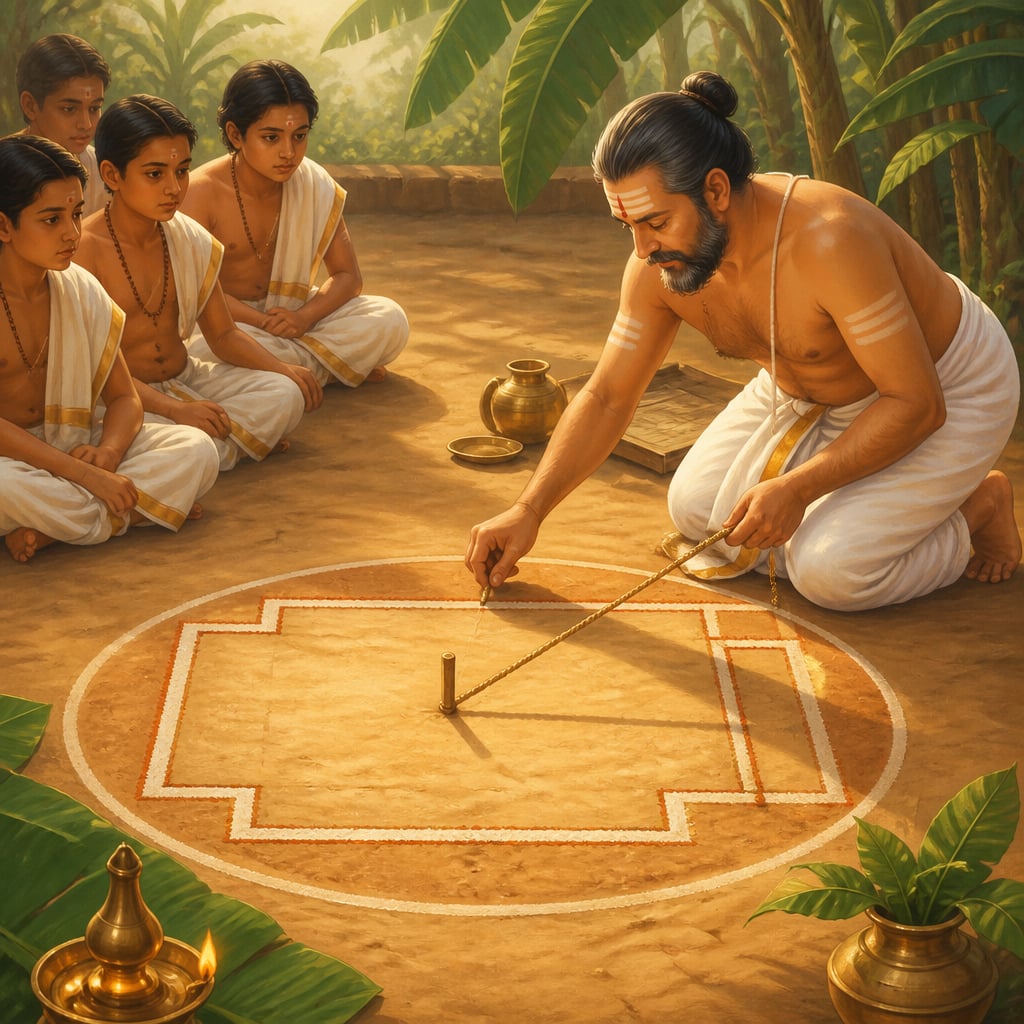
Nambudiri priest stretches a cord to convert a square altar into a circle at Panjal in 1975

The problem the Nambūdiri priest has just solved is called squaring the circle: given a circle, construct a square of equal area, or given a square, construct a circle of equal area. It looks trivial with modern tools. It is not. For two and a half millennia, European geometers from Anaxagoras in 5th century BCE Athens to professional mathematicians in 19th century Europe attempted to solve it exactly using only compass and straightedge. None of them succeeded, because none of them could. In 1882, Ferdinand von Lindemann proved that pi is a transcendental number, which means the exact construction they were chasing is mathematically impossible. The entire European effort, spanning generations, was a pursuit of something that could not exist.

India never made this mistake. When Baudhāyana composed the oldest surviving mathematical text of the Indian tradition around 800 BCE, he did not demand exactness from the circle. He solved the problem by producing approximations so good that the altars built from his rules are still, to the unaided eye, geometrically indistinguishable from the ideal figures they represent.

The Ritual That Created the Problem

The Sulbasutras are not pure mathematics texts. They are appendices to the Kalpasutras, which are the ritual manuals of the various Vedic schools. Their subject is the construction of the fire altars used in the great śrauta rituals, and their rigor comes from a theological fact that would surprise a modern mathematician. A Vedic altar had to be the right shape and had to have the right area. If a rite required a falcon-shaped altar (śyenaciti) in one stage and a circular altar of equivalent area in the next, the priest had to transform one into the other with ritual precision. An error in the construction was a ritual defect, and a ritual defect was believed to nullify the benefits of the sacrifice. There is no higher stakes environment for producing rigorous mathematics than a culture in which geometric error becomes a spiritual error.

This is why the Sulbasutras read like engineering documents and why they contain the first recorded systematic attempt to handle circle-to-square transformations. The problem existed in India not because someone was curious about pi, but because an altar had to be built.

Baudhāyana's Circling-the-Square

Baudhāyana Śulba Sūtra 2.11 gives the rule for turning a square into a circle of equal area. Take a square of side a. Draw the diagonal from the center to a corner, which has half-length (a/2)√2. Take the excess of this half-diagonal over a/2, which equals (a/2)(√2 - 1). Take one third of that excess and add it back to a/2. The result is the radius of the equal-area circle.

Worked out in modern notation, this gives a radius of (a/2)(1 + (√2 - 1)/3), which evaluates to approximately 0.5690 times a. Setting the square's area equal to the resulting circle's area yields an implied value of pi of about 3.088. The construction is geometrically elegant, physically buildable with a cord, and produces a circle whose area is within 1.7 percent of the ideal.

The More Refined Construction

Palm-leaf with Baudhayana's saviśeṣa fractional formula inked

The following sutra, Baudhāyana 2.12, addresses the reverse problem: turning a circle into a square of equal area. The method is strikingly sophisticated. Divide the diameter into eight parts. Take seven of those parts as a first approximation of the side of the square. Then refine: divide one of the eight parts into twenty-nine parts, add twenty-eight of those, subtract a sixth of one part, and add an eighth of that sixth. Each correction is a smaller-order adjustment to the previous one.

This is, in effect, a converging series written in geometric language. The final side length works out to about 0.87868 times the diameter, which implies pi is approximately 3.0883. What is extraordinary about this sutra is not only the numerical accuracy but the structure. Baudhāyana is doing what a modern numerical analyst would call iterative refinement, writing down a sequence of corrections that narrow toward the true value. He is not stumbling onto an answer. He is engineering one.

Approximation as Intellectual Maturity

The Sulbasutras use a technical term, saviśeṣa, which literally means "with remainder" or "with excess." They apply it to constructions that are known to be approximate. The most famous example is the text's remarkably accurate formula for √2, which Baudhāyana gives as 1 + 1/3 + 1/(3·4) - 1/(3·4·34), accurate to five decimal places, and which the text explicitly marks saviśeṣaḥ. The circle-square constructions sit in the same intellectual register. The Sulbasutras never claim their pi is exact, and they never demand that it be. The altar needs an area the eye cannot distinguish from the ideal, and that is the criterion the mathematics serves.

This is a philosophically enormous move. Greek geometry, following the rigor of Euclid's Elements, considered an approximate construction to be a failure. A circle that was "almost" squared was not squared at all. Greek mathematicians either succeeded exactly or they did not count it as mathematics. The Sulbasutras introduced a third category: constructions that were rigorous, reproducible, and documented as approximate, with the approximation itself named and bounded. Modern numerical analysis is built on exactly this distinction, roughly three thousand years later.

From Rope to Ramanujan

Ramanujan at Cambridge desk with pi series notebook

The continuity is real. When Srinivasa Ramanujan in 1914 published his paper "Modular Equations and Approximations to π" in the Quarterly Journal of Mathematics, he produced some of the most rapidly converging infinite series for pi ever discovered. Modern supercomputer records for pi, including the 100 trillion digit calculation completed by Google Cloud in 2022, still rely on Ramanujan-type formulas, including the Chudnovsky algorithm which descends directly from his work. Different tools, different notation, different millennium. Same problem. Same tradition. The Indian mathematician has always been willing to say: here is my best approximation, here is its error bound, here is the geometry that produces it. The Sulbasutra priest with a rope and the Cambridge scholar with a notebook are continuous lineages, not parallel ones.

The final point worth noting is the quietness of the achievement. The Sulbasutras do not announce that they have solved an impossible problem. They simply build an altar. The mathematical sophistication is embedded in the instructions, not advertised. Three thousand years later, we know the problem was impossible in the form Europe posed it. The Sulbasutra authors sidestepped that trap by asking a better question. What they wanted was not an exact square of the circle but an altar that would work. Because they knew what they were actually trying to do, they never wasted a single generation on a pursuit that could not succeed. Back on the ritual ground at Panjal in April 1975, the senior priest pegs the perimeter of his new circle, the cord goes slack against the dust, and the yajña proceeds into its next stage. Twenty-eight centuries have changed nothing about the geometry. The rope still holds.

Key figures

Baudhāyana

c. 800 BCE, Vedic India

Āpastamba

c. 600 BCE, Vedic India

Mānava

c. 500 BCE, Vedic India

Case studies

Lindemann's 1882 Impossibility Proof: The Trap India Never Fell Into

In 1882, the German mathematician Ferdinand von Lindemann published a proof that pi is a transcendental number. The consequence was devastating for one of the oldest problems in European mathematics. Lindemann's theorem implied that the exact squaring of the circle using only compass and straightedge, the task Greek geometers had bequeathed to Europe around 450 BCE, is mathematically impossible. For roughly 2,300 years, from Anaxagoras in a Greek prison to amateur geometers in Victorian London, generations of thinkers had poured their intellect into a pursuit that could not succeed. Lindemann's proof ended the quest in a single paper. Meanwhile, the Sulbasutras, composed nearly fourteen hundred years before Anaxagoras, had never claimed their circle-square constructions were exact. They produced approximations, marked them as approximations, and built altars with them.

The Indian tradition avoided the European trap not by being lucky but by being clear-eyed about what it was trying to do. A Sulbasutra priest did not need to square the circle in the Greek sense. He needed an altar whose area matched a prescribed value within the precision that rope, peg, and brick could deliver. That requirement did not demand exactness and could not benefit from it. So the Sulbasutras provided rigorous approximations, honestly labeled, and moved on. Greek geometry, by contrast, inherited from Plato a conviction that mathematical objects were eternal ideal forms and that any construction worth the name must be exact. The Platonic idealism that made Euclid's Elements possible also made the circle-square problem an impossible demand. The Indian priest and the Greek geometer were not working on the same problem. The priest was doing engineering. The geometer was doing metaphysics. Lindemann's proof finally settled the metaphysics.

Lindemann's 1882 result closed the problem in Europe as a theoretical pursuit, though amateur circle-squarers continued to submit false proofs to mathematical journals for decades. The French Academy of Sciences, overwhelmed with such submissions in the 18th century, had already announced in 1775 that it would no longer examine them. The Indian tradition never needed such an announcement because the tradition had never made the mistake. Baudhāyana's constructions were embedded in ritual practice for nearly three thousand years without anyone believing they solved the problem exactly. The saviśeṣa marker was the quiet reminder. In 2023, a typical engineering calculation of a fire altar area using Baudhāyana's rule produces an error of about 1.7 percent, which the 800 BCE priest already knew about and which was never a problem for the altar.

Ask what problem you are actually trying to solve before you demand an exact solution. Some problems have exact solutions, some do not, and some can be rigorously approximated. The mark of mathematical maturity is the ability to tell the three apart. Europe spent two and a half thousand years pursuing an exact construction of an approximation because its metaphysics would not let it distinguish them. The Sulbasutras made the distinction in one word.

Lindemann's proof was published in 1882, exactly 2,682 years after Baudhāyana composed his Sulbasutra. The interval is roughly the length of the entire European pursuit of exact circle-squaring, from Anaxagoras to Lindemann. India skipped the entire detour.

Ramanujan's Series and the 2,700-Year Indian Lineage of Pi

In 1914, Srinivasa Ramanujan published a paper titled 'Modular Equations and Approximations to π' in the Quarterly Journal of Mathematics, introducing a family of rapidly converging infinite series formulas for pi. One of his formulas yields eight additional correct decimal digits of pi with each term added, making it one of the fastest converging series known. His approach remained largely unexplored for decades until the Chudnovsky brothers, in the late 1980s, built on it to compute billions of digits of pi and produced the Chudnovsky algorithm, a direct descendant of Ramanujan's 1914 insight. In March 2024, the company Solidigm and computational mathematician Jordan Ranous used this algorithm to calculate 105 trillion digits of pi, setting the then-current world record.

The line from Baudhāyana to Ramanujan is more continuous than it looks. Baudhāyana wrote a converging sequence of corrections to the side of the equivalent square, each correction smaller than the last. That is what Sulbasutra 2.12 is, at its core. Ramanujan wrote converging infinite series, each term smaller than the last, for the same quantity. Different notation, different rigor, identical intuition. Ramanujan himself never drew the connection explicitly, and scholars are right to resist any mystical claim of a 'secret transmission.' But the intellectual habit, building a quantity through a converging sequence of corrections with honest error bounds, is an Indian mathematical habit that predates Greek geometry, outlasted European theoretical dead ends, and showed up again in Ramanujan's notebooks because the culture that produced him had been doing it for nearly three millennia.

Ramanujan's pi formulas remain the basis for modern high-precision computation. The world record as of 2024 stands at 105 trillion digits, all computed via methods that descend from his work. The Baudhāyana altar and the Solidigm server are separated by 2,800 years and by a technology gap so vast it is nearly incomprehensible. Both are doing the same thing. Both produce pi as a sequence of honest approximations, the next one tighter than the last. The tradition that thought it was building fire altars turned out to be building the foundations of numerical analysis.

When a culture spends three thousand years treating approximation as a respectable mathematical activity, the habit settles into how its minds work. Ramanujan was not imitating Baudhāyana. He was inheriting something older than imitation: a cultural reflex for honest convergence. If you want your descendants to have this reflex, treat approximation with dignity now.

Ramanujan's 1914 pi formula converges roughly 8 decimal digits per iteration. Baudhāyana's iterative correction in Sulba 2.12 converges roughly one decimal digit per correction. The ratio is a measure of how much rigor compounds across 2,700 years within a single tradition.

Baudhāyana versus Archimedes: Two Paths to Pi, 550 Years Apart

Around 250 BCE, Archimedes of Syracuse computed pi by inscribing and circumscribing regular polygons around a circle and calculating the perimeters. Starting with hexagons and doubling the number of sides repeatedly, he reached 96-gons and produced the famous bounds 3 + 10/71 < π < 3 + 1/7, or roughly 3.1408 < π < 3.1429. It was the most accurate Greek calculation of pi, and the method was a genuine breakthrough in rigorous approximation. But it came roughly 550 years after Baudhāyana's Sulba 2.12 had already produced pi approximately 3.0883 via a completely different method based on geometric construction rather than inscribed polygons. The two approaches reveal two civilizations thinking about the same quantity in two different ways.

Archimedes' method is more accurate than Baudhāyana's, but the comparison hides what really separates them. Archimedes was computing pi as a numerical quantity, approached from above and below by bounds, with a clear theoretical framework for how tight the bounds were. Baudhāyana was constructing a circle of equal area to a given square using rope and peg, embedding pi in the construction without ever isolating it as an abstract number. Both traditions produced rigorous approximations. Both knew their answers were not exact. But Archimedes approached pi as a theoretician, while Baudhāyana approached it as a builder. Greek mathematics tended to purify its questions into the abstract and then answer them with theoretical rigor. Indian mathematics tended to leave its questions embedded in practical contexts and then answer them with constructive rigor. Neither approach is superior. The difference is cultural, and the complementarity is instructive. When Indian mathematics did eventually abstract and theorize, in the Kerala school work on infinite series a thousand years later, it did so with the same honest-approximation habits it had inherited from the Sulbasutras.

Archimedes' method, using inscribed and circumscribed polygons, became the standard Greco-Roman approach to pi. Ptolemy later used a 720-gon to compute pi to 3.1416, and Liu Hui in 3rd century CE China independently refined the polygon method to achieve similar precision. Baudhāyana's construction-based approach did not directly produce more accurate numerical values, but it did seed a continuous Indian tradition of treating geometric quantities as constructible with declared error, which would culminate in Madhava's 14th century CE infinite series for pi, accurate to 11 decimal places and a full 300 years ahead of comparable European work.

There is rarely one right way to approach a mathematical object. The Greek polygon method and the Indian construction method both worked, both were rigorous, and both were honestly approximate. When you encounter two different cultures solving the same problem differently, resist the urge to pick a winner. Ask instead what each approach makes easy and what it makes hard. The answer is usually that each path uncovers something the other cannot see.

The Fire Altar Mandate: Why Ritual Precision Produced Mathematical Precision

A classical śrauta ritual, the agnicayana, required the construction of a large brick altar in the shape of a flying falcon (śyenaciti) assembled from precisely 1,000 bricks laid in five layers, each layer rotated relative to the one below it. The total area of the altar, in square purusha units, was fixed by ritual prescription. In more complex rituals, the same area had to be preserved when the altar was rebuilt in a different shape. For example, a falcon altar might need to be matched by a circular altar, or a square altar, of the identical area. If the area differed, the ritual efficacy was believed to be compromised and the sacrifice would not produce its intended fruits. The priest had no choice but to master the geometry of area-preserving shape transformations. There was no abstraction involved. The altar was being built on the ground, in front of witnesses, for a ritual whose timing was fixed by astronomical calculation and whose sponsors had already paid substantial fees. The geometry had to work, and it had to work now.

This is the crucible that produced the Sulbasutras. The texts are often called the oldest Indian mathematical works, but they were not written as mathematics. They were written as altar construction manuals for priests in a tradition where error was not merely an intellectual failure but a spiritual one. The rigor of Sulbasutra geometry is downstream of the rigor of Vedic ritual, and the rigor of Vedic ritual is downstream of a theology that believed the physical form of the sacrifice had to match its prescribed form in order to release its effects. When you understand this, the circle-square problem looks completely different. It is not an abstract puzzle. It is a logistical crisis that arises every time a rite requires the altar to change shape. The Sulbasutra authors were not amusing themselves. They were solving a recurring professional problem with the best tools available. The accuracy they reached, within 1.7 percent, was exactly the accuracy the altar needed.

The Sulbasutras became the standard reference for altar construction in śrauta ritual practice and remained in active use for roughly two and a half thousand years. Even today, when Nambudiri priests in Kerala perform the agnicayana, they construct the falcon altar according to these rules. The 1975 Panjal Atirātram, filmed and documented by Dutch scholar Frits Staal, recorded a living performance of the ritual that had been continuously transmitted since Vedic times. The geometry that the priest traces on the ground with cord and bamboo stake is Baudhāyana's geometry, used as a tool, not studied as an artifact. In parallel, the mathematical content of the Sulbasutras escaped its ritual frame and became foundational material for later Indian geometry, cited and extended by mathematicians for centuries.

Great mathematics often emerges from contexts where rigor is mandatory for non-mathematical reasons. The fire altar required precision because the ritual required precision, and the ritual required precision because the theology demanded it. Three thousand years later, the theology is optional but the geometry survives. When you see a field producing unusually rigorous work, look upstream for the reason. There is almost always a non-negotiable constraint that made the rigor unavoidable.

The śyenaciti falcon altar requires 1,000 bricks laid in five layers. The area of the first layer is fixed at 7.5 square purushas, where one purusha is the height of the sacrificer with arms raised. This specific numerical constraint means that the side length of any equivalent square altar must be calculated to within a few percent of the true value or the ritual is compromised. That is the minimum accuracy the Sulbasutra constructions had to meet, and they meet it comfortably.

Historical context

Sulbasutra Period and the Dawn of Recorded Geometry (c. 800 BCE to 200 BCE)

The Sulbasutras were composed as appendices to the Kalpasutras of the Baudhāyana, Āpastamba, Kātyāyana, and Mānava Vedic schools. Their geographic distribution suggests they circulated widely across Vedic India, from the Gangetic plain to the south. The texts sit at the intersection of ritual practice and emerging formal geometry. They are the oldest surviving mathematical works of India and contain the earliest recorded attempts anywhere to solve the circle-square problem, the Pythagorean theorem, and the approximation of √2, all of which were embedded in altar construction procedures rather than framed as abstract theorems.

The Sulbasutra approach to pi is the earliest recorded instance of what we now call applied mathematics: the honest use of rigorous approximation for practical purposes, with full disclosure of the error involved. Every modern field that relies on numerical methods, from aerospace engineering to machine learning, operates on the philosophical foundation the Sulbasutras laid down nearly three millennia ago. To understand why Europe wasted so many centuries on the exact-squaring problem, it is sometimes easier to see it through the Sulbasutra lens: the Indian tradition never made the mistake of confusing theoretical rigor with practical truth. It treated both with equal seriousness and kept them distinct.

Living traditions

Baudhāyana's iterative correction method in Sulba 2.12 is recognizably the same structural move that powers modern numerical analysis: start with an estimate, apply corrections in descending order of magnitude, declare your error, and stop when the residue falls below the tolerance your application needs. The Chudnovsky algorithm, which as of 2024 has been used to compute pi to 105 trillion digits, is a Ramanujan formula, and Ramanujan is an unbroken inheritor of the Sulbasutra habit of treating converging approximations as rigorous mathematical objects. Every GPU cluster computing pi today is a distant descendant of a Vedic priest laying brick on brick in a falcon-shaped altar, and the conceptual architecture is more continuous than the technology gap suggests.

Reflection

More in Rekhaganita: Geometry of Sacred Spaces

All lessons in Rekhaganita: Geometry of Sacred Spaces · Indian Mathematics: Ancient Genius, Modern Foundations course