Temple Geometry: Vastu and Mathematical Precision
The mathematical principles behind Hindu temple architecture
Explore how Sulbasutra geometry evolved into the sophisticated mathematical frameworks of Vastu Shastra and temple architecture.
Temple Geometry: Vastu and Mathematical Precision
When the Chola emperor Rājarāja I stood at the groundbreaking of the Brihadeeswara temple in Thanjavur in 1003 CE, the mathematics he was inheriting was already fifteen hundred years old. At his side stood the chief sthapati, Kunjaramallan Rājarāja Perunthachan, with a coil of unbleached cotton cord in his hands and a bronze pair of dividers at his belt. The ground had been cleared and levelled. Fresh granite blocks were beginning to arrive by ox cart from quarries in the Kaveri plain. The air carried the smell of sesame oil burning in ritual lamps and the chanting of the shilanyāsa foundation rite. The cords that would lay out the vimana tower, the ratios that would determine its proportions, and the grid that would govern its cosmology all descended from a tradition that began with Baudhāyana's altar builders around 800 BCE. Temple geometry is Śulbasūtra geometry grown up, and the Brihadeeswara was about to become the largest single application of it anywhere on earth.
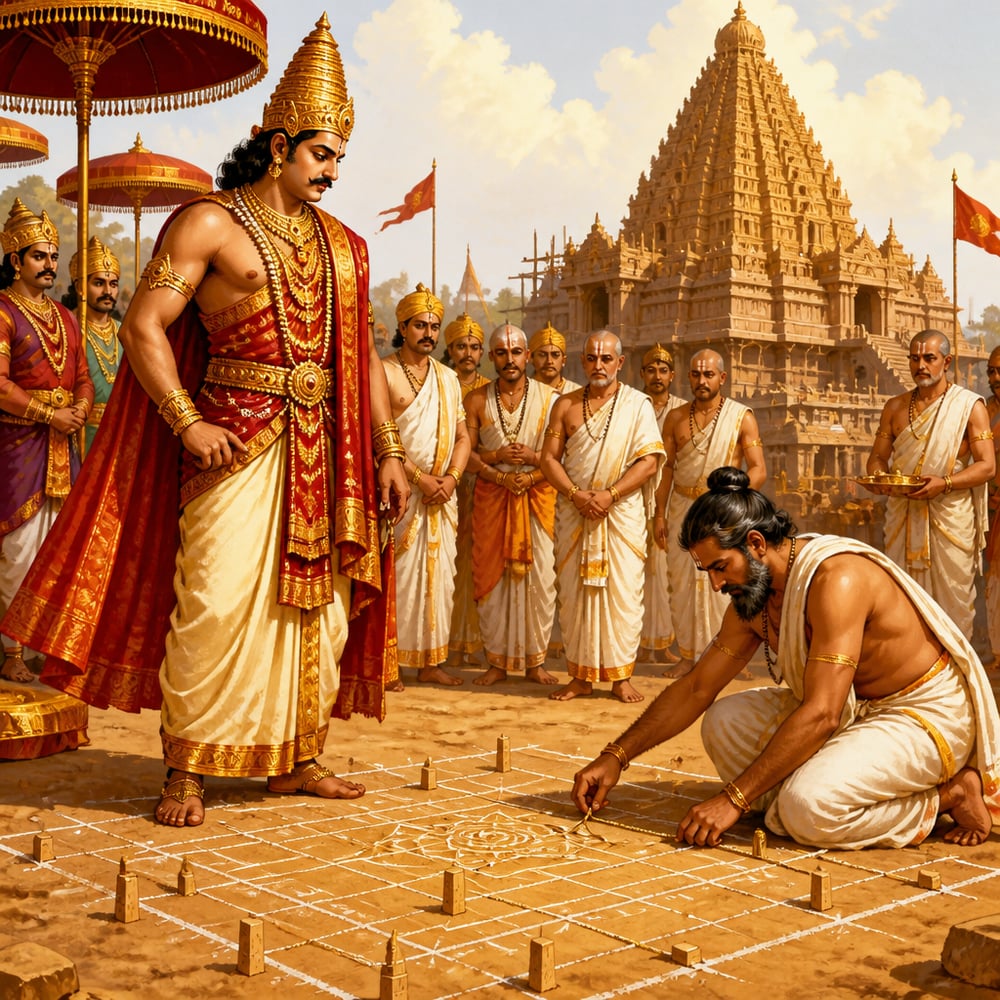
This lesson traces how the altar mathematics of the earlier Rekhaganita chapters scaled upward into the discipline that built India's great temples. The step was not small. It required a generalized theory of proportion, a formal grid system for organizing space, a catalog of measurement units tied to the human body, and a class of master builders trained in all of it. Every one of these pieces was in place by roughly the fifth century CE, and together they form what later texts would call Vastu Shastra, the science of built space.
The Textual Backbone
Two texts dominate the literature. The Manasara, composed in Sanskrit between roughly the fifth and seventh centuries CE, is the most complete surviving treatise on architectural mathematics from ancient India. It runs to seventy chapters and covers everything from site selection and soil testing to the proportions of doorways, pillar bases, sculptures, and the height ratios of tower tiers. The Mayamata, of similar date, is the companion South Indian manual and remains a living reference for traditional temple architects in Tamil Nadu and Kerala to this day.
Both texts explicitly cite the Sulbasutras as their mathematical ancestor. Where Baudhayana had shown how to construct a square altar of prescribed area, the Manasara shows how to inscribe an entire temple plan in a square and how to divide that square into a grid of smaller squares called padas. The theorem that lets an altar builder transform a square into an area equivalent rectangle is the same theorem that lets a temple builder shift the sanctum without changing the sacred footprint. One tradition solved the problem for fire altars. The other scaled the solution up by a factor of ten thousand.
The Vastu Purusha Mandala

The central innovation of temple mathematics is the Vastu Purusha Mandala, a square grid overlaid on the temple site. The grid is usually sixty-four padas (eight by eight) or eighty-one padas (nine by nine), with each pada assigned to a specific deity and a specific function. The central padas, called the Brahmasthana, hold the sanctum and the primary murti. The surrounding ring contains the circumambulatory path. The outermost ring governs entrances, subsidiary shrines, and transitions to the outside world.
This is not ornament. It is a coordinate system. Once a master builder, the sthapati, has fixed the grid to a site, every decision about where a column rises, where a door opens, where a carving sits, and where a water channel runs is mathematically determined by pada coordinates. The builder is solving a constrained optimization problem: given this site orientation, this grid count, and this ritual purpose, compute the locations of every architectural element so that the whole structure expresses a single coherent geometric idea.
Baudhayana's theorem reappears here in a new role. The diagonal of each pada sets the local unit for scaling ornament and sculpture up from the grid. The ratio of the side to the diagonal of the pada, the old Sulbasutra approximation of root two, is the same ratio that determines how a pillar's base relates to its capital. The mathematics of the altar is the mathematics of the pillar is the mathematics of the tower.
Talamana: The Human Body as Unit
A second proportional system layers on top of the grid. Talamana literally means measurement by the face. The basic unit is the tala, the distance from the hairline to the base of the chin on a standard adult face. An entire catalog of derived units, from the angula (finger width) to the hasta (cubit), is defined relative to the tala. The Manasara specifies that a dasatala (ten tala) figure is the correct proportion for a standing deity, with precise sub-ratios for every limb.
The payoff of this system is that every carved figure in a temple relates proportionally to every other figure, and all of them relate proportionally to the architecture that holds them. A sthapati who knows the tala of the principal deity can derive every other measurement on the site by pure ratio. No rulers, no calibrated tape measures, no imported standard. The mathematics is intrinsic to the body of the builder and the body of the deity, and the whole temple is built on proportion rather than on absolute length.
The Precision We Can Measure

Modern surveyors keep finding that ancient Indian temples meet standards we associate with industrial instruments. The Brihadeeswara vimana at Thanjavur is plumb to within centimeters over a height of more than sixty meters. Its eighty ton capstone was hoisted into place without iron cranes. The Kandariya Mahadeva at Khajuraho shows fractal self similarity between its main shikhara and its subsidiary towers, and the ratios match Manasara prescriptions within the limits of laser scanning. The temple complex at Angkor Wat, the largest Vastu grid structure on the planet, aligns to solar events on the spring equinox with the precision of a working observatory.
None of this is accident. It is the visible output of a mathematical tradition that started with cords, squares, and the fire altar, and that by the medieval period had become a complete engineering language for stone. When you stand in front of a Chola vimana or a Nagara shikhara, you are standing in front of applied Sulbasutra geometry. The altar learned how to become a mountain. Back on the Thanjavur ground in 1003, Rājarāja lowered the first stone into its pit, Kunjaramallan Perunthachan stretched his cord against the morning shadow, and the mountain began to rise.
Key figures
Varāhamihira
ca 505 to 587 CE, Ujjain (present-day Madhya Pradesh)
Kunjaramallan Rājarāja Perunthachan
early 11th century CE, Chola Empire (Tamil Nadu)
Dr V Ganapati Sthapati
1927 to 2011, Tamil Nadu
Case studies
The Brihadeeswara Vimana: Eighty Tons of Mathematics Made Visible
In 1010 CE, Rājarāja Chola I consecrated the Brihadeeswara temple at Thanjavur. The main vimana tower stood two hundred and sixteen feet high, the tallest in India at the time, and it still stands today. Its plan is a near perfect square ninety-six feet on a side. Its thirteen tiers rise in mathematically calibrated proportions prescribed by the Mānasāra. Its eighty ton capstone, a single block of granite, sits atop the tower and has remained plumb for a thousand years through monsoons, earthquakes, and the daily weight of pūjā. Modern surveyors have found that the tower deviates from vertical by less than a few centimeters over its entire height, a tolerance that contemporary steel frame construction considers exceptional.
The temple was designed and built by Kunjaramallan Rājarāja Perunthachan, the chief sthapati, working from the Vāstu Puruṣa Maṇḍala and the tālamāna proportional system of the Mānasāra lineage. Every block was cut to pada coordinates on a master grid. Every tier of the tower was sized as a fixed ratio of the base square. The mathematics inherited from Baudhāyana's altar builders had been compounded, refined, and scaled up by fifty generations of sthapatis until it was capable of producing something on this scale. The temple is not a miracle. It is the visible output of twelve hundred years of applied geometry carried forward through a living teaching tradition.
The Brihadeeswara has survived more than a thousand years of continuous use, three major earthquakes, and the demands of being a living temple with daily rituals. Modern engineering surveys have confirmed that its stress distribution, its foundation load, and its monsoon drainage are all consistent with what a contemporary structural engineer would design from scratch, but without a single use of iron reinforcement. The temple is a UNESCO World Heritage site, and traditional sthapatis still make pilgrimage to it to study its proportions as the finest surviving example of their own mathematics.
When mathematics is embedded in a living craft tradition for centuries, it compounds. Each generation of practitioners inherits the previous generation's solutions and adds refinements. The result, over time, is a body of engineering knowledge that a modern specialist cannot reproduce from a blank slate no matter how talented, because the knowledge was never written down in one place. It was distributed across a thousand years of master to student transmission, one corrected proportion at a time.
The Brihadeeswara vimana is two hundred and sixteen feet tall, its base is a ninety-six foot square, its capstone weighs roughly eighty tons, and its deviation from plumb is under five centimeters over its full height. It was built without iron, without cranes as we understand them, and without drawings in the modern sense. The only blueprint was the Vāstu Puruṣa Maṇḍala and the proportional formulas of the Mānasāra.
Angkor Wat: How Vāstu Geometry Crossed an Ocean
In the 12th century CE, the Khmer emperor Sūryavarman II commissioned the temple complex now called Angkor Wat in present day Cambodia. At over four hundred acres, it is the largest religious monument on Earth. It was not built by local guesswork. The craftsmen who raised it were trained in the same Indian Vāstu tradition that produced the Chola temples of Tamil Nadu. The central sanctum sits on a raised platform at the intersection of axes that run along the cardinal directions. The gallery walls are sized by Mānasāra proportions. The five central towers represent the peaks of Mount Meru in exactly the way Vāstu texts prescribe. Even the alignment of the main causeway with the spring equinox sunrise follows patterns specified in Varāhamihira's Bṛhat Saṃhitā.
Vāstu Śāstra had been traveling across the Bay of Bengal for more than a thousand years by the time Sūryavarman commissioned Angkor Wat. The transmission was not merely decorative, like a style that was copied. It was a full mathematical curriculum that moved with the people who knew it. Indian śilpins (craftsmen) and sthapatis (architects) were invited by courts in Cambodia, Java, Bali, and Burma. They brought the Mānasāra and the Mayamata with them. The resulting temples at Angkor, Prambanan, Borobudur, and Bagan are Vāstu grid constructions that could still be laid out by a modern Chennai sthapati using the same proportional mathematics his ancestors used a thousand years ago.
Angkor Wat survived the collapse of the Khmer empire and the slow reclamation of its site by the jungle. French colonial surveyors in the 19th century found it intact and were astonished by its precision. 20th century architectural studies have confirmed that its plan matches Mānasāra prescriptions to within the limits of pre-modern masonry tolerance. The temple is now the most visited World Heritage site in Southeast Asia, and it stands as the largest surviving proof that Vāstu mathematics was a portable engineering language exported from India across the ancient world.
A mathematical tradition that is embedded in a working craft culture can travel across civilizations, languages, and religions without losing its integrity. Vāstu Śāstra moved from Tamil Nadu to Cambodia intact because it was taught as a body of computable ratios, not as a style to be imitated. When you want an idea to travel, formalize it enough that it can be taught as mathematics. When you want an idea to die with its inventors, leave it in the hands of intuition and local tradition.
Angkor Wat covers roughly four hundred and two acres and contains an estimated five million tons of sandstone. Its central tower rises around two hundred and thirteen feet. Its plan is a nested set of Vāstu mandalas specified in the Mānasāra tradition, and its cardinal alignments match solar events with precision comparable to any Indian temple of the same period. The whole complex is an export of Indian mathematics into stone.
When Finite Element Analysis Confirms the Mānasāra
Over the past two decades, structural engineering groups at IIT Madras, the Indian Institute of Science, and the National Institute of Technology have run finite element analysis (FEA) simulations on several Dravidian style vimana towers, including reconstructions of the Brihadeeswara at Thanjavur. The goal was to understand how the traditional proportions handled load distribution, wind shear, and seismic stress compared to modern reinforced concrete construction. The results surprised the researchers. The Vāstu derived proportions of the vimana, drawn from ratios in the Mānasāra that are over a thousand years old, distributed load through the tower in a way that matched or exceeded modern structural engineering optima for tall stone structures.
The Mānasāra tradition developed its proportional rules empirically over centuries, by watching which temples cracked and which stood. A sthapati who violated the prescribed ratios was building a structure that might fail within a human lifetime. A sthapati who honored them was building a structure that would last a millennium. This was not mystical knowledge. It was survivorship selection compounded into an engineering tradition. The Mānasāra encoded the proportions that survived, and it pruned the ones that did not. Over fifty generations of master to student transmission, the surviving ratios converged on something close to what modern finite element analysis now tells us is structurally optimal for tall dry masonry.
The IIT Madras and IISc studies are part of a broader wave of research that has used computer aided structural analysis to test traditional Indian temple engineering. The conclusion has been consistent. The Vāstu proportional system, which modern rationalist audiences sometimes dismiss as pseudoscience, turns out to encode accurate engineering knowledge about load distribution in tall stone structures. The failure mode of Vāstu critics was to confuse its ritual vocabulary with its engineering content. Once the vocabulary was set aside and the ratios were tested on their own terms, the ancient system performed well by modern standards.
Traditional knowledge systems frequently carry accurate engineering content inside a vocabulary that looks ritualistic from the outside. If you dismiss the vocabulary, you often throw away the content along with it. The correct move is to isolate the empirical claims, the ratios, the load paths, the material selections, and test them on their own terms. When you do, as the Indian FEA studies have done, the traditional systems often vindicate themselves. Respect old craft, test it with new tools, and expect to find more signal than noise.
Finite element analysis of Dravidian vimana proportions at IIT Madras and the Indian Institute of Science has shown that the Mānasāra prescribed ratios distribute seismic and gravitational load at least as effectively as contemporary steel reinforced designs for comparable tall stone structures. The ancient ratios, derived by craft experience, match modern optima derived by numerical simulation.
Historical context
Vāstu Śāstra and Monumental Temple Mathematics (ca 500 BCE to 1300 CE)
The Gupta empire (ca 320 to 550 CE) systematized mathematical education in a way that directly fed the rise of Vāstu Śāstra as a written discipline. The Pallava, Chola, Chandela, Hoysala, and Vijayanagara dynasties between the 7th and 15th centuries commissioned temple construction on a scale that required a full engineering bureaucracy. Royal patronage turned sthapati lineages into hereditary professional classes, and the resulting transmission of knowledge continued unbroken into the 21st century through traditional schools at Mamallapuram and elsewhere in Tamil Nadu.
The global footprint of Indian temple architecture, from Tamil Nadu to Cambodia to Java, and the modern rediscovery of Vāstu Śāstra by structural engineers, both demonstrate that this tradition encoded rigorous, portable, and empirically successful engineering knowledge. Understanding Vāstu as applied Śulbasūtra geometry corrects two common errors: the mystification that treats it as purely ritual, and the dismissal that treats it as pre-scientific superstition. Neither view survives contact with the texts or the temples themselves.
Living traditions
Dr V Ganapati Sthapati (1927 to 2011) revived the living Mānasāra tradition at the Mamallapuram sthapati school, built the first traditional granite temple outside India (Iraivan Temple in Hawaii), and trained a generation of practitioners who now design temples using the same mathematical curriculum their ancestors used a thousand years ago. Research groups at IIT Madras, the Indian Institute of Science, and national heritage laboratories have published finite element analysis studies validating the structural performance of Vāstu derived proportions. Modern architects, from Charles Correa to B V Doshi, have drawn on Vāstu principles in secular projects. The eighty-one pada grid now finds its way into sustainability oriented site planning for modern Indian IT campuses and civic buildings, where the ancient mathematics of space is quietly doing the work of modern environmental design.
- Brihadeeswara Temple (Rājarājeśvaram): The apex of Chola temple mathematics, consecrated in 1010 CE under Rājarāja Chola I. The main vimana rises two hundred and sixteen feet and is capped by a single eighty ton granite block. Built from Vāstu Puruṣa Maṇḍala coordinates and tālamāna proportions prescribed in the Mānasāra, it remains plumb within centimeters after a thousand years and is still a living temple with daily pūjā. Walking its corridors is walking through the largest functional example of Indian architectural mathematics anywhere on Earth.
- Kandariya Mahādeva Temple, Khajuraho: The largest of the Khajuraho temples, built by the Chandela dynasty around 1030 CE. A canonical example of the Nāgara style, where the main śikhara is surrounded by dozens of smaller śikharas that replicate its proportions at reduced scale, producing a fractal like rising profile. The entire temple is a built Vāstu Puruṣa Maṇḍala in stone, with each pada coordinate carrying its prescribed function. Modern laser scanning has confirmed that the proportional ratios prescribed by the Mānasāra tradition are followed with remarkable precision throughout the structure.
Reflection
- When you walk into a temple, what do you notice first? The proportions of the space, the shadow of the gopuram, the feel of the pada you stand on, the path of circumambulation? Where in your own life do you currently neglect the geometry of the spaces you live and work in?
- Why did the Indian tradition insist that a temple architect must be a mathematician, a ritualist, and a sculptor all at once? What is lost when modern construction splits these roles apart?
- If mathematics is the language in which the universe is written, what does it mean that India's mathematicians used it to build houses for the divine rather than to prove theorems? What conception of mathematics allows a proportional ratio to carry both engineering and metaphysical weight?