Sacred Proportions: Geometry as Spiritual Practice

The unity of mathematics and spirituality in Indian tradition

Reflect on how geometry in India was never purely abstract but always connected to cosmic harmony and spiritual purpose.

Sacred Proportions: Geometry as Spiritual Practice

In the late 1980s, a design theorist named Kirti Trivedi arrives at the Kandariya Mahādeva temple at Khajuraho with a camera, a measuring tape, and a hypothesis he has come from IIT Bombay to test. The winter sun is low against the sandstone. His guide, a local pūjāri, waits at the porch. Trivedi has read Alice Boner and Stella Kramrisch. He has spent months measuring Nāgara shikharas and counting spire-within-spire repetitions on photographs. What he expects to find at Kandariya is a deliberate fractal, a building that encodes at every scale the same ratios it encodes at the tower's topmost āmalaka. Within a morning of measurement, he has it. Every shikhara is a fractal. Every ratio is deliberate. Every square and every circle opens into another square and circle, nested like a mantra repeated at different octaves. The paper he will publish in 1989, titled 'Hindu Temples: Models of a Fractal Universe,' shows that the Chandela śilpīs of the eleventh century were carving in stone a mathematical concept Benoît Mandelbrot would not formalise until 1975. The temple is decorative, yes. It is also a theorem. And for every one of its original builders, nine centuries before Trivedi, there was no gap between those two words. In Bharat, geometry was never merely a tool for surveying fields or raising walls. It was a contemplative discipline, a yoga of line and angle. The Śulba priest drawing an altar, the śilpī chiseling a spire, the yogi inscribing a Śrī Yantra on birchbark. Each of them was doing one thing: using precise form to make invisible order visible.
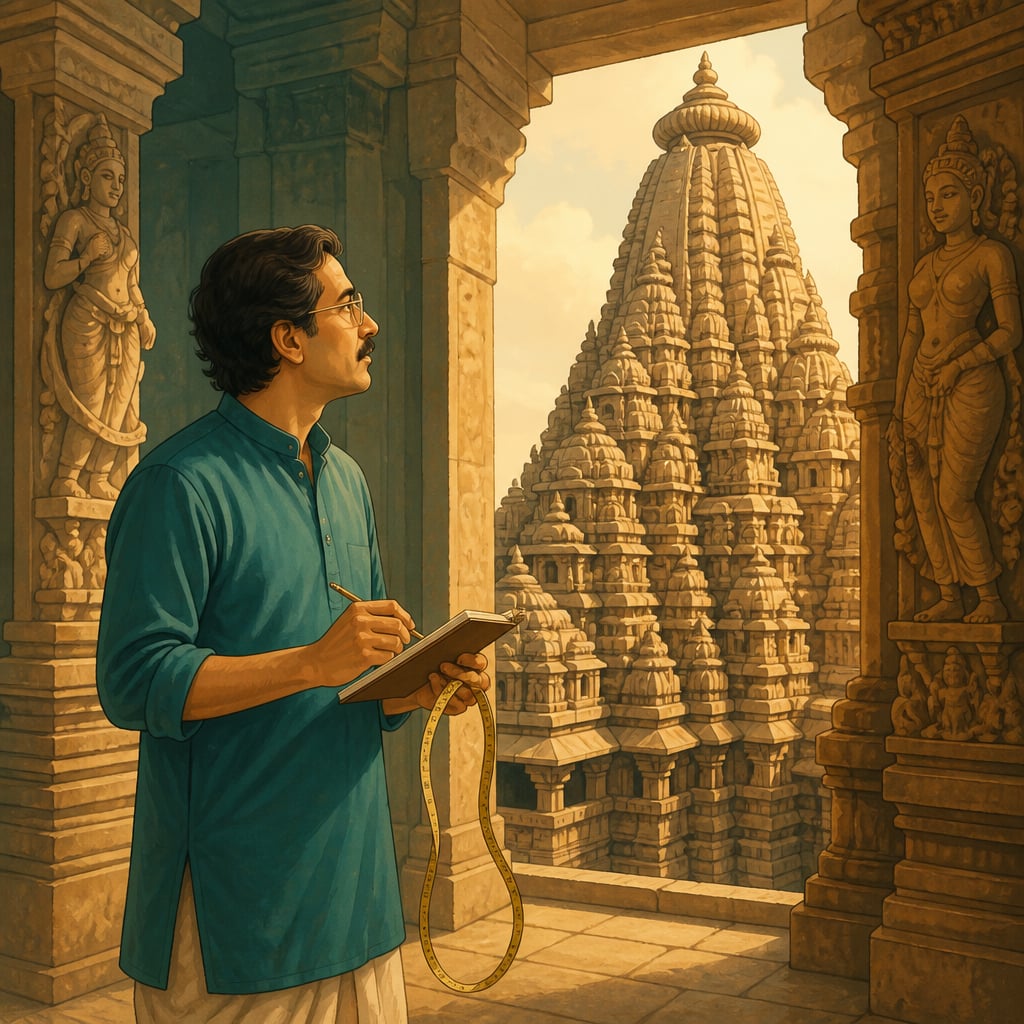
Kirti Trivedi measures the Kandariya Mahadeva temple at Khajuraho with notebook and tape

Geometry With a Direction

Greek geometry, which dominates the Western imagination, was built to prove. Euclid's Elements opens with axioms and ends with theorems, and the goal is intellectual certainty. Indian geometry, as laid down in the Śulbasūtras and extended through millennia of Śilpa Śāstra and Tantra, was built to enact. Its goal was not only to know a right angle but to build an altar with one. Not only to square a circle but to ground a temple in the act of squaring it. The Sanskrit phrase for this kind of geometry, rekhā-gaṇita, means counting by lines, but the lines are never just lines. They are directions, boundaries between the sacred and the ordinary, orientations of the cosmos brought down to earth. Every drawing is already a ritual.

This is why the Śulbasūtras open not with postulates but with instructions. Take a cord. Fix a peg. Trace a circle around it. The geometer is on his knees, hands in earth. Correctness is enforced not only by logic but also by the yajna that will happen on the finished figure. A wrong angle is not merely a mathematical error. It is a liturgical failure. For the Śulba priest, precision was devotion and devotion was precision. They could not be pulled apart even in principle.

Three Scales of the Same Practice

The same contemplative geometry scales across three sizes. The Vedic altar, perhaps a few metres across, is ritual geometry at household and community scale. Its shape, falcon, tortoise, chariot wheel, or eagle, is a symbolic body, and its area must equal a given pramāṇa even while its outline changes. Transforming one shape into another of equal area is not a pedagogical exercise. It is the very content of the ritual. Baudhāyana and his successors worked this out with cord and peg so that the cosmos would have a proper place to meet the fire.

At a larger scale, the Hindu temple carries sacred geometry into stone. Every temple begins with the Vāstu Puruṣa Maṇḍala, a grid of sixty four or eighty one squares populated by named deities. The grid is not a floor plan. It is a diagram of the cosmos and of the Puruṣa, the primordial person, lying pinned upon it. Every wall, every entrance, every shikhara rises from that grid according to canonical ratios recorded in the Mānasāra, the Mayamatam, and the Śilpa Prakāśa. The builder is, in the fullest sense, mapping the cosmos into the ground beneath his feet.

Shilpi inscribing Shri Yantra on palm-leaf

At the smallest and most intimate scale, the yantra condenses the same logic onto a palm-sized diagram. The Śrī Yantra, perhaps the most studied, layers nine interlocking triangles around a central bindu, producing forty three smaller triangles whose vertices must meet with unforgiving exactness. Drawing it is a meditation. Contemplating it is a meditation. Altar, temple, yantra. The same geometry at three resolutions, teaching the same lesson: to measure something sacred is already to worship it.

Proportion as Language

Ancient Indian art and architecture developed a rich technical vocabulary of proportion called tālamāna. The human figure in a temple niche is not a guess. It is nine times its own face in height, or eight, or ten, depending on the canon. A deity is taller in divine proportions than a king, who is taller in royal proportions than a commoner. These ratios are not Euclidean ornament. They are a grammar, a way of saying what kind of being is being shown. A figure carved to the wrong proportion is as wrong as a sentence with bad grammar. It cannot say the thing it was meant to say.

The same grammar governs the whole temple. The ratio of the garbhagriha to the shikhara, the number of bhūmis stacked on top of each other, the ascending sequence of miniature spires, all follow ratios that are not decorative preferences but theological statements. Proportion in Indian geometry is a language, and the mathematician is a poet forced to obey strict prosody. Freedom comes, as it does for any poet, through the discipline itself.

The Contemplative Mathematician

Bhaskara composing Lilavati's opening salutation to Ganesha

A reader raised on the modern split between science and spirit may ask whether this is really mathematics or merely aesthetic. The question is the wrong question. The Śulba priests computed the square root of two to five decimal places because their altar demanded it. The temple architects knew that a shikhara could only taper at a specific rate if the whole was to convey a specific cosmological vision. The yantra draftsman corrected every intersection because any slip broke the yantra's power. Precision was not in tension with devotion. It was the outer form of devotion, the only form the material world would accept.

Modern research keeps confirming what the tradition already knew. Design theorists like Kirti Trivedi of IIT Bombay and art historians like Alice Boner and Stella Kramrisch have shown genuine fractal self-similarity in Nāgara shikharas centuries before Mandelbrot formalized fractals in the West. Temples at Khajuraho, Bhubaneswar, and Kanchipuram encode mathematical ideas that twentieth century science had to reinvent from scratch.

An Invitation

This chapter has walked from the Śulbasūtra cord through the Pythagoras-before-Pythagoras theorem to a temple's Vāstu grid. The closing thought is simple. Indian geometry offers the modern practitioner something rare: a discipline where rigor and reverence are the same act. To draw a line carefully is already to pay attention. To square a circle by hand is already to learn patience. To ground a diagram in true proportion is already to honor a world that does not belong only to us. The Śulba priests, the temple śilpīs, and the yantra yogis all built from the same starting premise, that precision is prayer. If you try, even once, to draw a Śrī Yantra by hand and get the intersections right, you will understand them better than any textbook can explain. The Kandariya Mahādeva still stands in the winter sun nine centuries after the Chandela śilpīs left it. Kirti Trivedi's measurements confirmed what the builders already knew. The equation they solved in stone is the same one the yogi solves in the yantra, and the same one you can solve with a pencil and a ruler tomorrow morning. That is their gift, and fifteen centuries later, it is still on offer.

Key figures

Ādi Śaṅkarācārya

Traditional dating c. 509 to 477 BCE; Western dating c. 788 to 820 CE; Kerala and Kāñcī

Stella Kramrisch

1896 to 1993, Austria and Philadelphia

Kirti Trivedi

1946 to present, IIT Bombay, Industrial Design Centre

Case studies

The Śrī Yantra: A Construction Problem Solved by Yogis Before Computers

The Śrī Yantra is described in Saundarya Laharī verse 11 as four upward Śiva triangles and five downward Śakti triangles, intersecting to form exactly forty three smaller triangles. Every vertex must meet three lines at a perfect point. For centuries, yogis and śilpīs drew it by hand from texts alone. In the 1980s, when Western mathematicians first tried to reproduce it on a computer, they discovered that the construction is surprisingly difficult. Naive attempts produce extra tiny triangles at intersection points where three lines fail to meet at exactly one spot. Gerard Huet, a French computer scientist, needed a non-trivial optimization procedure to find an error-free solution. The problem had been a latent minor scandal in sacred geometry: textbooks routinely reproduced yantras whose intersections were slightly off, and no one had noticed for generations.

The tradition's answer is not quaint. The yantra was drawn correctly for over a thousand years because the drawing was an act of meditation, and a meditation done carelessly is not a meditation. The śilpī's hand checked the figure because the śilpī's mind checked it. Precision was enforced not by a compiler but by devotion. Saundarya Laharī 11 is not a hint toward the construction. It is the construction, provided the draftsman treats it as liturgy. The Indian tradition solved the Śrī Yantra construction problem the only way it can be solved, by refusing to separate mathematics from contemplation.

Huet and later mathematicians eventually published algorithmic solutions. The resulting yantras, drawn with computer precision, confirm that the classical descriptions are internally consistent. The traditional hand-drawn yantras, from sources like the Kāmakalāvilāsa and the living Śrīvidyā tradition, were right all along. Modern Śrīvidyā practitioners continue to draw the yantra by hand as a daily sādhanā.

Precision and devotion are not opposites. A discipline where rigor and reverence are the same act can reach correct answers that pure detachment never sees. The next time you are tempted to choose between care and meaning, remember that the yantra needed both.

Gerard Huet's 1986 computational paper on the Śrī Yantra needed a nontrivial optimization to find even one solution where all nine primary triangles meet exactly.

The Vāstu Puruṣa Maṇḍala Returns: Charles Correa's Civic Geometry

In 1986, the Rajasthan state government commissioned a cultural centre in Jaipur. It asked Charles Correa, one of India's most celebrated modern architects, to design it. Correa chose not to import any European architectural idiom. Instead he took the classical Vāstu Puruṣa Maṇḍala, the nine-square grid of sixty four or eighty one cells used by every traditional temple, and laid it out at city scale. The resulting Jawahar Kala Kendra, completed in 1992, is a square plot divided into a three-by-three grid of rotated and displaced squares, each dedicated to a different element or cardinal direction, exactly as the classical treatises prescribe. Exhibition halls, a library, a theater, and an outdoor amphitheater all occupy their canonical positions. The building is a working civic space in a modern city and a literal drawing of an ancient mandala.

Correa understood that the Vāstu Puruṣa Maṇḍala was not a religious restriction but a spatial grammar. Once learned, it generates functional buildings with meaningful geometry, the same way a poetic metre generates memorable verses. The maṇḍala's power is that it encodes cosmological orientation into every wall and courtyard, so that even a visitor who knows nothing about the Vāstu Śāstra feels that the space has been placed rather than assembled. This is precisely the effect the classical treatises promised.

Jawahar Kala Kendra won international awards and became a reference point for a generation of Indian architects seeking to recover indigenous design principles. The maṇḍala has since been revived in the Vidhan Bhavan in Bhopal, also by Correa, and in contemporary temple and residential design across India. Sacred geometry is once again a working part of Indian public architecture.

An old discipline is not dead because it stopped being used. It is waiting to be picked up again. Traditions have a half-life that can be longer than their period of dormancy. When you recover an ancestral discipline, you are not copying the past. You are continuing a conversation the past never finished.

Jawahar Kala Kendra's central courtyard, empty in classical maṇḍalas to represent Brahma, is also left empty in Correa's design, preserving the cosmological logic of the original grid.

Kandariya Mahādeva: Fractals in Stone, Centuries Before Mandelbrot

The Kandariya Mahādeva temple at Khajuraho, built around 1030 CE by the Chandela king Vidyādhara, is a sandstone tower that rises in a cascade of spires. At first glance, a visitor notices only that it is extraordinarily intricate. Closer examination, first systematically performed by Alice Boner in the 1960s and later formalized by Kirti Trivedi of IIT Bombay in 1989, reveals a deeper pattern. Each main shikhara spawns smaller urushringa spires. Each urushringa spawns still smaller ones. Every level is a miniature of the level above, scaled by a consistent ratio, down to ornamental details at the base. The temple is a three dimensional mathematical fractal carved in stone. The Chandela śilpīs built it in the eleventh century. Benoit Mandelbrot published the formal definition of fractals in 1975.

For the Chandela śilpī, what the twentieth century mathematician called a fractal was not a mathematical novelty. It was a visual theology. The doctrine that the whole is present in every part, that Brahman pervades each grain of existence as totally as it pervades the cosmos, has a natural geometric expression. If every level of the temple contains a miniature of the temple, then looking at any point is looking at the whole. The geometry is the theology made visible. The śilpīs did not need Mandelbrot's equations because they had the Upaniṣads: yathā piṇḍe tathā brahmāṇḍe, as in the body, so in the cosmos.

Modern researchers have measured the fractal dimensions of several Nāgara style temples and found consistent scaling ratios. The Kandariya Mahādeva temple is a UNESCO World Heritage site and receives roughly half a million visitors a year. Few of them are told that they are looking at the oldest known deliberate fractal structures in the world.

A civilization's mathematics is not only what it writes down. It is also what it builds. Sometimes the proof of a mathematical idea is not a theorem but a temple. Look for the mathematics inside the things your ancestors made with their hands.

Kirti Trivedi's measurements found that the fractal dimension of Kandariya Mahādeva's vertical outline is consistent to within measurement error across three nested scales, roughly eight centuries before fractals were formally defined.

Nataraja at CERN: Indian Sacred Geometry at the Edge of Particle Physics

In June 2004, the European Organization for Nuclear Research, CERN, unveiled a two metre bronze statue of Naṭarāja, Śiva as the cosmic dancer, in its Geneva campus. The statue was a gift from the Indian government. The plaque beneath it quotes the physicist Fritjof Capra, who in his 1975 book The Tao of Physics had written that the Naṭarāja was the most complete visual summary of modern physics available, because Śiva's dance is the continuous creation and destruction of the subatomic world. CERN houses the Large Hadron Collider, the most powerful particle accelerator ever built. The statue stands a short walk from the detectors that in 2012 confirmed the existence of the Higgs boson. For a generation of visiting physicists, the first thing they see on arriving is a piece of sacred Indian geometry reminding them that their deepest physics has an older cousin.

The Naṭarāja is not an abstract symbol chosen after the fact. The iconography is strictly geometric. The figure's proportions follow navatāla canon. The raised leg and lowered leg form a specific angle governed by Śilpa Śāstra. The circle of flames around the dancer is a prabhāvalī, the same mathematical ring that frames every classical icon. The drum in the upper right hand is the moment of creation. The fire in the upper left is the moment of dissolution. The raised hand promises protection. The lowered hand points to the foot raised in grace. Every element is a line, an angle, a precise ratio. Capra's parallel with particle physics is not a mystical leap. The Naṭarāja was already a diagram.

The CERN statue has become one of the most discussed intersections between Dharmic civilization and modern science. It is a frequent touchpoint in writing on the philosophy of physics and in commentary on the value of tradition in a scientific culture. The same geometric discipline that produced the Śrī Yantra stands at the door of the facility that discovered the Higgs.

The language of the deepest modern science is geometry and symmetry. India already had that language, encoded in idols, temples, and yantras, long before the twentieth century rediscovered it. The unity of mathematics and spiritual practice is not a quaint inheritance. It is a preview of a conversation the world is still catching up to.

The CERN plaque quotes Fritjof Capra: 'Modern physics has shown that the rhythm of creation and destruction is not only manifest in the turn of the seasons and in the birth and death of all living creatures, but is also the very essence of inorganic matter. According to quantum field theory, all interactions between the constituents of matter take place through the emission and absorption of virtual particles. The dance of Shiva is the dancing universe.'

Historical context

The long lineage of sacred geometry, c. 800 BCE to the present, with modern rediscovery concentrated in the twentieth and twenty first centuries

By the late twentieth century, India was recovering an intellectual self-confidence that colonial education had eroded. Modern Indian architects including Charles Correa, B. V. Doshi, and Achyut Kanvinde began to revive the Vāstu Puruṣa Maṇḍala and classical iconometry in contemporary buildings. Indian design theorists and art historians, working alongside international collaborators, produced the first rigorous quantitative studies of temple geometry. Traditional śilpīs in Mahabalipuram, Thanjavur, and Bhubaneswar continued training the next generation in classical proportion.

This lesson is the philosophical capstone of the chapter on Rekhā-gaṇita. Everything earlier in the chapter, the cord of the Śulbasūtra, the Pythagoras-before-Pythagoras theorem, the approximations of pi, the altar transformations, the Vāstu grid, builds toward a single claim: in the Indian tradition, geometry was already a spiritual discipline, and spirituality was already a geometric discipline. Understanding this unity is how a modern reader stops treating the earlier lessons as scattered historical curiosities and starts treating them as parts of a coherent contemplative science.

Living traditions

Sacred Indian geometry is currently undergoing one of the most significant revivals in its long history. A two metre Naṭarāja at CERN greets every visiting physicist with the claim that Indian iconography is already a diagram of modern physics. Contemporary architects from Charles Correa to B.V. Doshi have recovered the Vāstu Puruṣa Maṇḍala for civic and residential buildings. Śrīvidyā practitioners from Kerala to California continue to draw the Śrī Yantra as a daily sādhanā. Academic studies of temple fractals, canonical iconometry, and mandala-based design are now standard in Indian design schools, including the Industrial Design Centre at IIT Bombay. The tradition that Kirti Trivedi, Stella Kramrisch, and Alice Boner began documenting in the twentieth century is flowing forward into the twenty first without interruption.

Reflection

More in Rekhaganita: Geometry of Sacred Spaces

All lessons in Rekhaganita: Geometry of Sacred Spaces · Indian Mathematics: Ancient Genius, Modern Foundations course