Transforming Shapes: Area-Preserving Constructions

How to convert a square to a circle of equal area

Learn the sophisticated geometric techniques in Sulbasutras for transforming shapes while preserving area.

Transforming Shapes: Area-Preserving Constructions

Around 200 BCE, on a flat stretch of cleared ground in the upper Ganga basin, a śulbakāra named Kātyāyana is supervising the laying out of a Mahāvedi, the great altar of a Soma yajña. The outline must be an isosceles trapezoid. Twenty-four padas on the eastern face, thirty padas on the western, thirty-six padas from east to west. The total area is fixed by ritual rule at exactly nine hundred and seventy-two square padas. The yajamāna has already paid the fees. The hotr and the adhvaryu are standing by. At Kātyāyana's feet lie a coil of cord, a handful of peg sticks, and a strip of ground that he has just oriented against the dawn. The problem is not how to draw a trapezoid. The problem is how to guarantee that its area matches the prescribed nine hundred and seventy-two square padas, given that the trapezoid cannot be computed by simple multiplication and the cord he holds can only draw straight lines and circular arcs. He cannot compute an area. He can only build one. What he does next, and what the Śulbasūtras his predecessors wrote let him do, is the oldest recorded discipline of area-preserving transformation in human history.
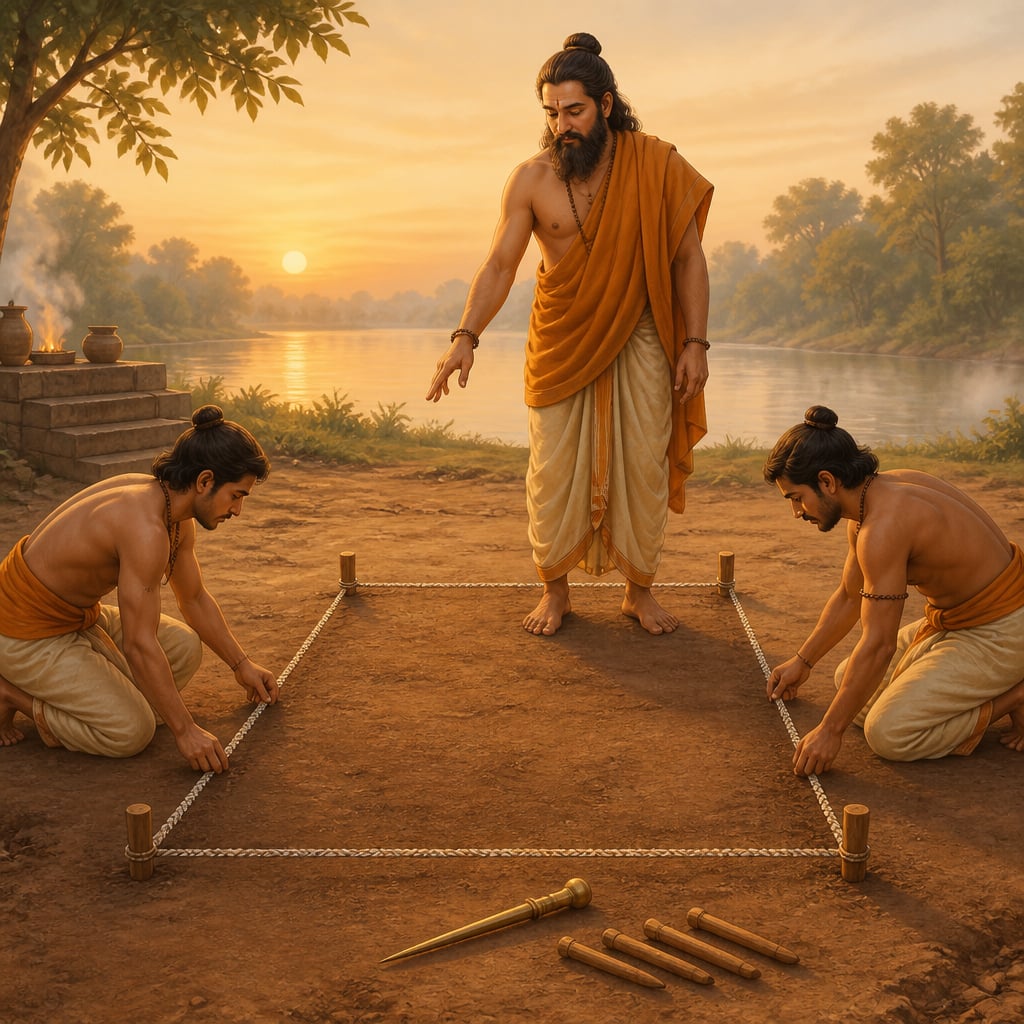
Katyayana directs the layout of a trapezoidal Mahavedi soma altar with two shulbakaras

This question sounds abstract, but it is the oldest problem in applied geometry. It is also, remarkably, the question that gave birth to Indian mathematics. Long before Greek mathematicians puzzled over 'squaring the circle' as a theoretical conundrum, Vedic ritualists had to solve it as a practical necessity. Their answers are preserved in the Śulbasūtras: the cord manuals that turned altar building into a mathematical laboratory.

Why altars demanded transformations

The Vedic yajña system was exacting. Different sacrifices required different altar shapes. The sāmitra altar was square. The mahāvedi was an isosceles trapezoid. The śyenaciti, built for the highest soma sacrifices, was a falcon spreading its wings. The rule was uncompromising. The total brick area of each altar layer had to equal a precise number of square puruṣas, the puruṣa being the height of the sacrificer with arms raised. Each of the five layers had to contain exactly 200 bricks of the prescribed total area. The shape could change. The area could not.

A priest about to rebuild a square altar as a circular one could not rebuild it larger or smaller. The gods were precise. The geometry had to be more precise still. Out of this necessity came a sophisticated vocabulary of area-preserving transformations, encoded in terse sūtras meant to be memorized and applied in the field with nothing but rope and peg.

Four transformations, one principle

Baudhāyana, the earliest Śulbasūtra author, organized the problem into four operations. Every transformation was ultimately an exercise in finding the karaṇī: the side of the square whose area matched a given figure. Once you had the karaṇī, you could build any shape with that area.

Four equal-area shapes laid out on swept earth with cord

Rectangle to square. Cut a strip from the long side of the rectangle equal to the short side. Attach it to create an L-shape. Bisect the excess and use the diagonal rule to find the side of the equivalent square. The operation is essentially what modern algebra calls completing the square.

Combining two squares. Lay the smaller square against the larger. The diagonal of the resulting rectangle is the side of a square with the combined area. Here the celebrated diagonal rule of Baudhāyana 1.48 serves not as an abstract theorem but as a working tool. 'The rope stretched along the diagonal of a rectangle produces what the length and breadth produce separately.' What we call the Pythagorean theorem was, for Baudhāyana, the engine of area addition.

Subtracting one square from another. The reverse operation works the same way. Inscribe the smaller square inside the larger and use the diagonal relation in reverse. This gave priests a way to shrink altars without violating any ratio.

Square to circle and back. The most dramatic transformation was the one our modern architect needed. Baudhāyana's recipe, preserved in sūtra 2.9, reads like an instruction card: draw half the diagonal from the center of the square along the east line, then add one-third of the excess of that half-diagonal over half the side. The resulting radius produces a circle with very nearly the same area as the square. Done correctly, this yields an implicit value of π close to 3.088. For the reverse operation, Baudhāyana gave a second formula: divide the diameter into eight parts, cut one of them into twenty-nine subparts, and take away twenty-eight of those subparts. The remainder is the side of the equivalent square. Both recipes were approximations, but they were astonishingly close and, crucially, executable with only ropes and pegs on open ground.

A hidden algebraic genius

What makes these constructions so striking is not their individual results but the system they formed. Baudhāyana, Āpastamba, and Kātyāyana were not listing tricks. They were composing a calculus of shapes. Any figure could be reduced to a square. Any square could be combined with, subtracted from, or transformed into another. The entire Śulbasūtra corpus can be read as a proof that areas behave like numbers. They add, subtract, and transform without loss.

Kātyāyana pushed the system further. His sūtra for combining any number of equal squares into one used a triangle construction that anticipated a generalized quadratic method. If you wanted to unite n squares into a single equivalent square, you built an isosceles triangle whose base was (n minus one) sides long, and whose height was the side of the original. The hypotenuse was the answer. A child who has never seen algebra could perform this with rope and stake. A modern student who has seen algebra can recognize it as the square root of n times the original side, hidden inside a geometric figure.

What the Śulbasūtras left behind

When Greek geometers inherited the 'squaring the circle' problem, it became a puzzle of theoretical impossibility under compass and straightedge alone. For Baudhāyana and his successors, it was a matter of practical approximation to whatever precision the altar demanded. The difference is instructive. Indian geometry did not separate the pure from the applied. It preserved areas because rituals demanded it, and along the way discovered how to think about space as something that could be measured, transferred, and preserved.

Punjab land surveyor consolidating chakbandi field plots

Today, when an engineer uses an area-preserving parameterization to wrap a 2D texture onto a 3D surface, or a land surveyor consolidates fragmented plots into an equivalent whole, they are solving a problem whose classical solution was first written down on the grass of a Vedic yajña ground, in verses that still begin with the same two words. Caturaśraṃ maṇḍalaṃ cikīrṣan. 'Desiring to turn a square into a circle.' Back on the upper Ganga plain in Kātyāyana's morning, the last peg of the Mahāvedi goes into the ground, the trapezoid stands in its prescribed proportions, and the yajña begins. Every area-preserving transformation performed since, in a Punjab chakbandi office in 1948 or on a 3D modelling screen in Bengaluru today, is an inheritance from that morning.

Key figures

Baudhāyana

Late Vedic Period (c. 800 BCE)

Āpastamba

Late Vedic Period (c. 600 BCE)

Kātyāyana

Post-Vedic Period (c. 200 BCE)

Case studies

Kātyāyana's Mahāvedi: A Trapezoid Built from Squares

Around 200 BCE, the Kātyāyana Śulbasūtra codified construction methods for the mahāvedi, the great sacrificial ground used in soma yajñas. The mahāvedi was an isosceles trapezoid with a fixed ratio: the eastern face 24 padas, the western face 30 padas, and the north-south axis 36 padas. Priests had to construct this precise shape on open ground while guaranteeing that its total area matched the ritual requirement of 972 square padas. They were given only ropes, pegs, and the memorized sūtras.

Kātyāyana solved this by treating the trapezoid as a composite figure. Priests reduced the required area to an equivalent square, then transformed that square into the trapezoidal outline using rectangular intermediates and the diagonal rule. The sūtra for combining equal squares into one of greater area gave them the needed calculus. Ritual correctness was guaranteed by mathematical invariance, not by measurement alone. Each step preserved the karaṇī, and because the karaṇī was preserved, the area was preserved.

The mahāvedi was rebuilt across thousands of Vedic ritual grounds over centuries with consistent geometric fidelity. The Kātyāyana Śulbasūtra remained the authoritative field manual until later commentaries supplemented it. Archaeological work on agnicayana sites in northern India has documented trapezoidal layouts that match the prescribed proportions with high accuracy.

Area preservation turns a complex shape into a sequence of simple moves. When a target feels unreachable, the Śulbasūtra method is to decompose it into operations you already know, then apply them in order.

The prescribed mahāvedi area of 972 square padas was maintained across ritual sites for over a thousand years of continuous Vedic practice.

Punjab Chakbandi: Reuniting Scattered Land by Preserving Area

In 1948, Punjab faced a land crisis. Partition had left farmers with fragmented holdings. A single farmer might hold twelve separate plots, each a kanal or two, scattered across several villages. The state launched the Consolidation of Holdings program (chakbandi). Surveyors had to convert each farmer's scattered irregular plots into a single consolidated plot of equivalent total value, often on different terrain, while preserving what each farmer actually owned.

The problem was the same one Baudhāyana solved for altars. Many irregular figures had to be combined into one figure of different shape without losing value. Surveyors used a grading system called jamabandi to record each plot's area, soil class, and irrigation access. The consolidation committee then computed a weighted equivalent and issued a new plot. The mathematics is the Śulbasūtra principle in modern dress: the karaṇī of a composite figure is invariant under transformation. Only the instruments changed. Ropes became theodolites, and bricks became survey stones.

By 1975, consolidation had been applied to tens of millions of acres across Punjab, Haryana, and western Uttar Pradesh. Average agricultural productivity in consolidated districts rose significantly within a decade. The program is still cited as one of the most successful land reforms in post-independence India, and its fundamental guarantee to farmers, that area and value would be preserved, is the same invariance principle that made Śulbasūtra altar construction trustworthy.

Bureaucratic trust rests on mathematical invariance. When people can verify that nothing was lost in a transformation, they accept the new shape. Fair change needs provable conservation.

Chakbandi reforms between 1948 and 1975 consolidated over 31 million acres of fragmented agricultural land in northern India.

Area-Preserving Texture Mapping in 3D Graphics

When a video game studio wraps a 2D texture (a stone wall, a character's skin, a painted surface) onto a curved 3D model, they face a geometry problem. A flat square texture must be mapped onto a non-flat surface such as a human face or a dragon's back. If the mapping distorts area unevenly, some parts of the texture will appear stretched and others squashed. The result looks wrong even if the shape is right. The technical name for the solution is area-preserving parameterization.

This is the Śulbasūtra problem restated in the language of modern differential geometry. A region of known area must be mapped onto a region of different shape without changing total area. Contemporary algorithms in texture mapping use a constraint identical to Baudhāyana's: preserve the karaṇī. The mathematics is vastly more general today, framed in terms of Jacobians and optimization, but the founding invariance is the one inscribed in the Śulbasūtras close to 2,800 years ago. When engineers say 'our mapping is area-preserving,' they are naming the same property that made Baudhāyana's altar geometry trustworthy.

Area-preserving parameterization is a standard technique in modern 3D software such as Blender, Maya, and Houdini, and in real-time graphics engines used for film and gaming. Major productions rely on it for realistic skin, fur, and terrain. A principle first written down for Vedic altar builders now underwrites visual effects for global cinema and entertainment.

The oldest recorded mathematical principle in Indian geometry, shape may change but area must not, turned out to be a general truth that modern computation could not improve on. When a principle survives across completely different problem domains for thousands of years, it is probably telling you something fundamental about how space works.

Every photorealistic texture map in modern film and game production respects an area-preservation constraint first written down by Baudhāyana in the Śulbasūtra tradition.

Historical context

Late Vedic and Sūtra Period (c. 800 to 200 BCE)

The Late Vedic period saw the rise of the sixteen mahājanapadas across northern India, the emergence of Buddhism and Jainism, and the crystallization of the Vedic ritual system. Yajña culture was at its height, driving unprecedented demand for precise altar construction. The Śulbasūtras were composed as ritual-geometric manuals for priestly schools of the Kṛṣṇa Yajurveda and related traditions.

The Śulbasūtra authors composed their texts centuries before the Greek Euclidean tradition reached its mature form. When Greek geometers later tackled 'squaring the circle' as a theoretical impossibility under compass and straightedge, Baudhāyana had already given a working field recipe. Indian geometry began as applied practice and developed toward abstraction, the reverse of the Greek path.

Living traditions

Vedic ritual geometry remains the mathematical foundation of traditional temple architecture and Vāstu Śāstra. The 2011 Panjal Athirātram drew international scholars from universities studying the continuity of Śulbasūtra practice. Modern temple architects still apply area-preserving transformations when consecrated spaces must change shape without losing ritual area, and the Śulbasūtra diagonal rule is the mathematical ancestor of every modern construction technique that relies on the Pythagorean relation.

Reflection

More in Rekhaganita: Geometry of Sacred Spaces

All lessons in Rekhaganita: Geometry of Sacred Spaces · Indian Mathematics: Ancient Genius, Modern Foundations course