The Statesman

The Art of Governance: Administration, Diplomacy, and Benevolent Conquest

Vikramaditya II's greatness lay not just in military conquest but in the art of governance. His administration balanced centralized control with local autonomy, his diplomacy created a network of alliances that enhanced security, and his treatment of conquered peoples set a new standard for benevolent rule. Most remarkably, his decision to preserve the temples at Kanchi rather than destroy them revealed a king who understood that true victory means winning hearts, not just battles.

Beyond the Battlefield

When Vikramaditya II's armies marched through the gates of Kanchi for the first time, his generals expected what conquerors had done for millennia, loot the temples, destroy symbols of enemy power, and humiliate the defeated. Instead, the king gave an order that would echo through history: the temples were to be preserved, the priests protected, and the sacred sites respected. This decision, more than any military victory, would define his legacy.
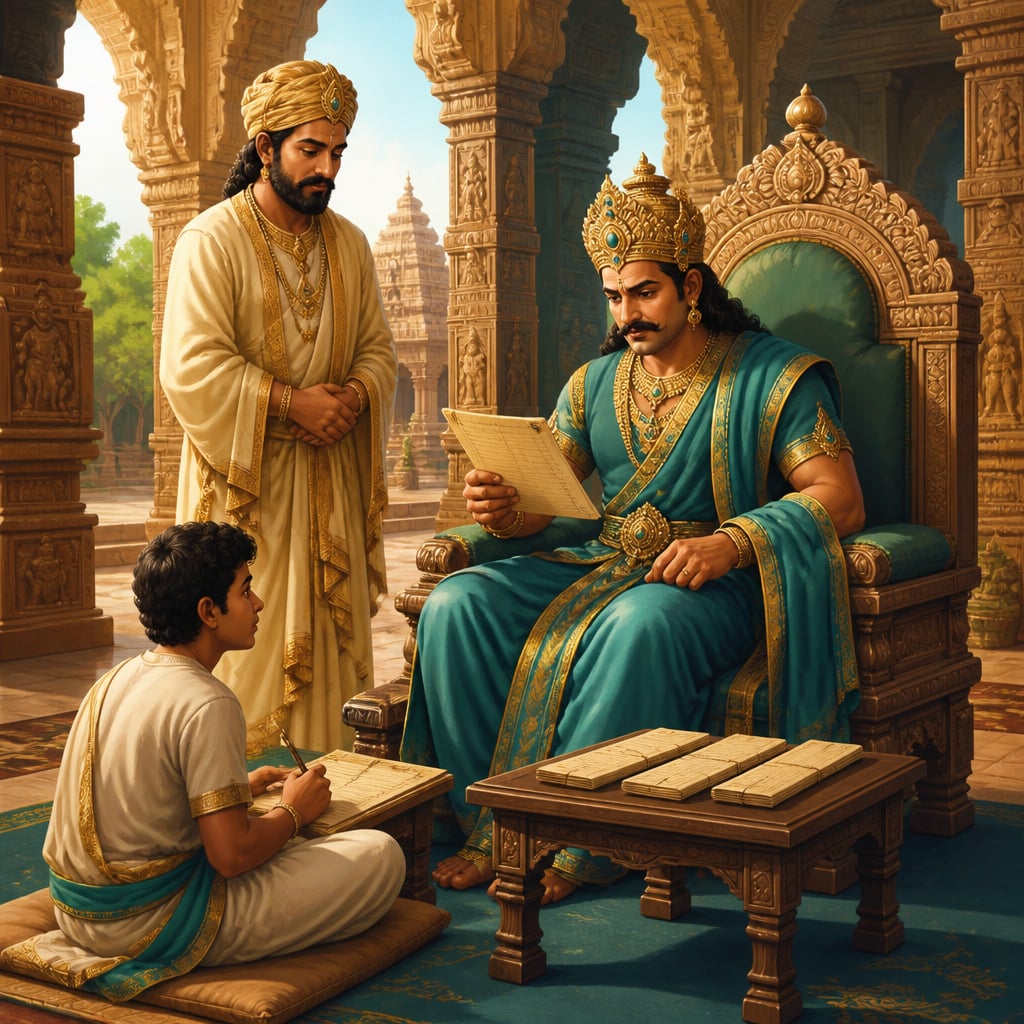
Vikramaditya II presiding over a Chalukya administrative court

But to understand this unprecedented act, we must first understand Vikramaditya II as a statesman, a ruler whose vision extended beyond conquest to the complex arts of administration, diplomacy, and governance.

The Chalukya Administrative System

The Chalukya empire under Vikramaditya II was a sophisticated administrative machine that balanced central authority with local autonomy, essential for governing a diverse empire spanning multiple linguistic and cultural regions.

At the apex stood the king himself, who held supreme executive, judicial, and military authority. But Vikramaditya II was no autocrat. He ruled through a council of ministers (mantriparishad) composed of experienced administrators, military commanders, and learned advisors. The empire was divided into provinces (vishayas) governed by appointed officials who collected revenue, maintained law and order, and commanded local forces. Below this, districts (nadus) were governed by local assemblies (sabhas) that managed village affairs, ensuring governance was responsive to local conditions.

The economic foundation rested on sophisticated revenue systems. Land revenue was the primary source, typically one-sixth of agricultural produce, with rates varying based on soil quality and irrigation. Trade revenues from the Deccan's strategic location between North and South India generated substantial income. The judicial system combined royal courts with local dispute resolution, and inscriptions praise Vikramaditya II as 'nyaya-priya' (lover of justice).

Diplomacy and Alliances

Vikramaditya II's military successes were supported by sophisticated diplomacy. He maintained alliances with the Pratiharas and other kingdoms facing the Arab threat, creating an informal defensive network that stretched across the subcontinent. His relationship with feudatory chiefs exemplified 'sama' (conciliation), cultivating loyalty through generous treatment, autonomy in local affairs, and a share in the spoils of war rather than ruling through fear alone.

Vikramaditya welcoming Dantidurga in alliance

One significant diplomatic achievement was his relationship with the Rashtrakuta family. Dantidurga, who would later found the dynasty that eventually supplanted the Chalukyas, was Vikramaditya II's son-in-law. This marriage alliance brought a powerful feudatory closer to the throne, though it would later prove a source of instability. Evidence also suggests exchanges with Sri Lankan kingdoms and Southeast Asian rulers, providing intelligence and facilitating trade.

The Conquest of Kanchi: A New Model

When Vikramaditya II conquered Kanchi in the late 730s CE, he faced a crucial decision. The city was one of India's greatest cultural centers, famous for the magnificent Kailasanatha temple built by Pallava king Rajasimha, a masterpiece of Dravidian architecture with intricate carvings depicting scenes from the Puranas.

Traditional military practice would have demanded the temple's destruction to demonstrate dominance. But Vikramaditya II chose differently. Not only did he preserve the Kailasanatha temple, he had an inscription carved on one of its pillars commemorating his conquest while explicitly stating that he protected the temple.

This was revolutionary. Here was a king proclaiming military victory while simultaneously honoring his enemy's cultural achievements, saying that what is sacred remains sacred regardless of political boundaries or military outcomes. The divine deserved reverence even when housed in structures built by enemies. It was a statement that transcended the moment, establishing principles that would influence Indian civilization for centuries.

The Philosophy Behind Preservation

Why did Vikramaditya II make this unprecedented decision? The answer lies in his understanding of dharma and kingship. As a student of dharmic texts, he knew that the duties of a king (rajadharma) included not just protecting his own people but upholding cosmic order itself.

Temples were not mere political symbols, they were abodes of the divine, sacred spaces where the eternal manifested in the temporal world. To destroy a temple was to attack not just an enemy but the sacred itself. Moreover, Vikramaditya II understood that destroying temples might demonstrate military strength, but preserving them demonstrated moral strength, showing he was secure enough in victory that he didn't need to humiliate the defeated.

This approach had practical benefits too. The population of Kanchi, seeing their sacred sites protected, had less reason for perpetual rebellion. The Pallava nobility could submit without feeling their entire civilization was threatened. Vikramaditya II was conquering territory while winning hearts, far more sustainable than mere military occupation.

The Kailasanatha Inscription

Carving the Kailasanatha inscription at Kanchi

The inscription at the Kailasanatha temple is one of the most important sources for understanding Vikramaditya II's character. Written in Sanskrit on a pillar, it commemorates his conquest while explicitly noting his protection of the temple.

The inscription is remarkable for what it emphasizes. While mentioning military victory, it gives equal prominence to dharmic conduct, describing him as one who knows the difference between what should be conquered (enemy armies) and what should be preserved (sacred sites). It frames temple preservation not as weakness but as the highest expression of dharmic kingship. Vikramaditya II was establishing a principle for future generations: that true greatness lies in knowing when not to exercise maximum force.

Governing a Multi-Cultural Empire

Governing an empire stretching from the Narmada to the Kaveri required sensitivity to regional differences. The northern realm was culturally connected to North India, while southern regions were part of the Dravidian cultural sphere with Tamil and Kannada languages.

Vikramaditya II's administration respected these differences. Royal inscriptions were issued in both Sanskrit and Kannada. Local customs and laws were generally respected. Religiously, the empire was pluralistic, while the Chalukyas were primarily Shaivite, they patronized Vaishnavite temples and respected Jain institutions, reflecting both political wisdom and genuine dharmic commitment to respecting all valid paths to the divine.

His model of governance, combining central authority with local autonomy, military strength with cultural sensitivity, conquest with preservation, would influence Indian political thought for centuries. In the end, Vikramaditya II's statesmanship demonstrated that the highest form of power is the wisdom to use it judiciously. Any king with a strong army can destroy temples; it takes a great king to preserve them.

Historical context

733-744 CE - Consolidation of Chalukya Administrative Systems

The 8th century saw sophisticated administrative systems across Indian kingdoms. The Pratiharas, Palas, and Chalukyas all employed variations of feudatory systems combined with bureaucratic administration. Revenue collection was systematized, judicial procedures were formalized, and diplomatic relationships were conducted through established protocols. This was also a period of intense temple-building and cultural patronage, with each dynasty trying to surpass others in architectural magnificence. Vikramaditya II's preservation of enemy temples was revolutionary precisely because it went against common practice of the time.

Living traditions

Vikramaditya II's preservation of enemy temples established a principle that, while not always followed, remained an ideal in Indian civilization. The inscription at Kailasanatha temple is still studied by scholars and visited by tourists as evidence that power can be exercised with moral restraint. Modern Indian administrative services still emphasize principles he exemplified: justice, cultural sensitivity, and governance for the welfare of all. His model of balancing central authority with local autonomy influenced Indian federal structures even today.

Reflection

More in Vikramaditya II

All lessons in Vikramaditya II ยท Lesser Known Guardians of Dharma course