Philosophy and Dharma
The Moral Foundation: Dharmic Warfare and Righteous Kingship
Vikramaditya II's greatest achievement was not military conquest or architectural patronage, but embodying the ideal of dharmic kingship in practice. His preservation of enemy temples was rooted in a sophisticated philosophical understanding that the sacred transcends political boundaries. His conduct of warfare according to dharmic principles, his moral restraint in the use of power, and his recognition that true kingship means serving dharma rather than personal ambition, these philosophical commitments distinguished him from ordinary conquerors and elevated him to the status of a guardian of dharma.
The Philosophical King
Most kings are remembered for what they did. Vikramaditya II is remembered for what he chose not to do. In an age when victorious armies routinely destroyed enemy temples and pursued vengeance without restraint, he charted a different course. His decisions were not arbitrary acts of kindness but expressions of a coherent philosophical worldview rooted in dharma.
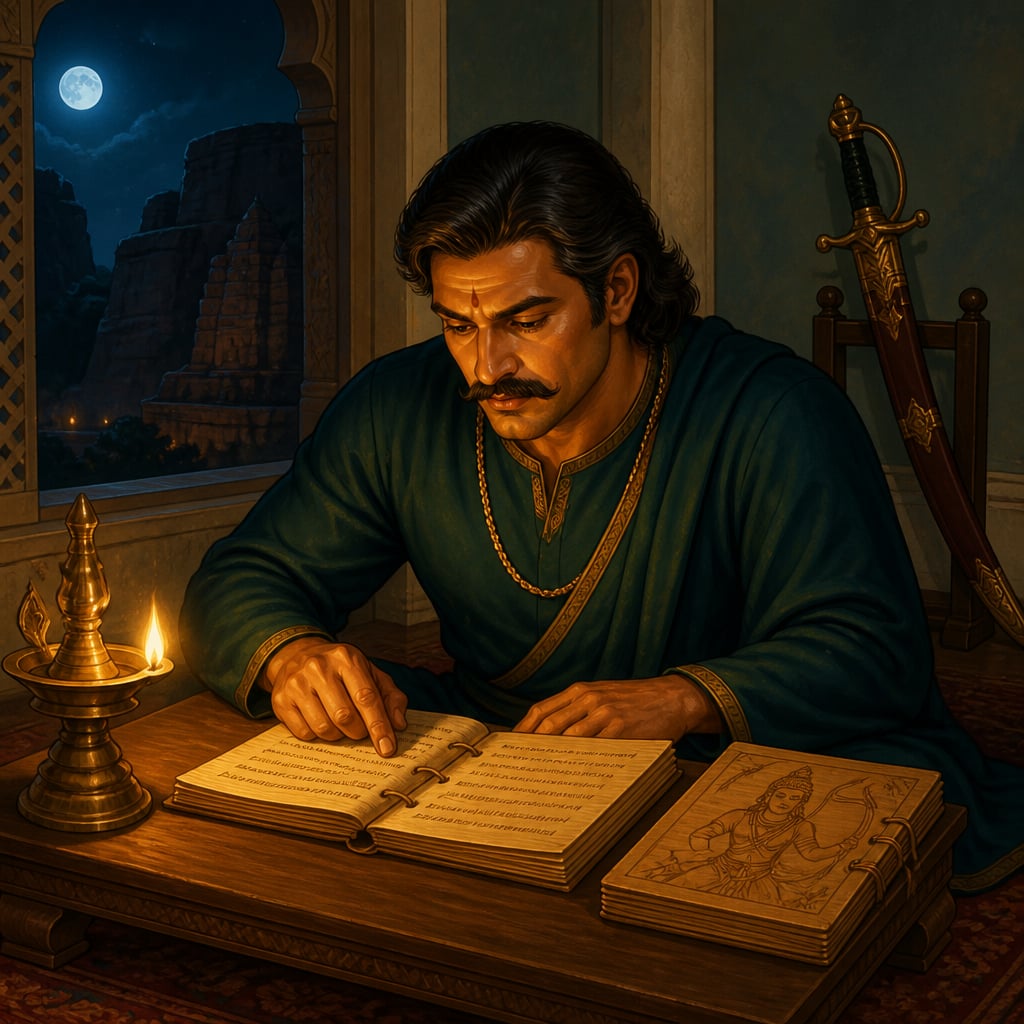
To understand Vikramaditya II's greatness, we must understand the philosophical foundation that guided his most difficult decisions.
Dharmic Warfare and Its Constraints
In the Indian tradition, warfare was never seen as merely the unrestricted application of violence. Instead, it was governed by dharma, the cosmic order that regulates all existence. The concept of dharmic warfare (dharma-yuddha) placed moral constraints on how battles were fought: don't attack unarmed opponents, don't harm civilians, priests, or sacred sites. These were dharmic obligations, not mere suggestions.
But these rules created tension. In battle, showing mercy can mean defeat. Following rules when enemies don't creates disadvantage. How does a king balance protecting his kingdom with fighting according to dharma?
Vikramaditya II's answer was that dharma defines what victory means. A king who wins by violating dharma hasn't truly won, he has failed in his fundamental duty. The goal is not mere victory but righteous victory. This requires extraordinary moral courage, willingness to accept potential disadvantage rather than violate sacred principles.
The Sacred Beyond Politics
Vikramaditya II's preservation of the Kailasanatha temple reveals sophisticated understanding: the sacred transcends political boundaries. The temple was not just a Pallava political symbol, it was an abode of the divine where Shiva manifested in the world.
This understanding rests on distinguishing the temporal from the eternal. Political borders shift, kingdoms rise and fall, all part of the changing world (samsara). But the sacred belongs to a different order of reality. Temples participate in the eternal even while existing in time.
A king who destroys a temple commits a category error, treating the sacred as merely political, allowing temporary conflict to violate eternal truth. Vikramaditya II grasped this distinction. His conflict with the Pallavas was political and temporary, but the sacred reality in their temples was eternal. He could legitimately conquer their territory but could not attack what belonged to the divine.
Rajadharma: The King's Sacred Duty
Central to Vikramaditya II's philosophy was rajadharma, the sacred duties of kingship. In Indian tradition, a king was not an autocrat who could do as he pleased. He was a servant of dharma, constrained by sacred obligations and accountable to cosmic order.
Rajadharma included protecting subjects, ensuring justice, defending the realm, and, crucially, upholding dharma itself. A king who failed these duties, even while politically successful, was failing in his essential nature.
This created a profound paradox: the king had supreme political power, yet was bound by dharmic constraints limiting how he could use it. He could command armies but couldn't order them to violate dharma. Vikramaditya II embodied this paradox. His greatness lay precisely in the gap between what he could do and what he chose to do, a gap created by commitment to rajadharma.
Lessons from the Epics
Vikramaditya II's philosophical education included deep study of the Ramayana and Mahabharata, not merely stories but philosophical treatises exploring dharma through narrative.
From the Ramayana, he learned that dharma sometimes requires personal sacrifice. Rama gave up his kingdom rather than violate his father's word, demonstrating that dharma takes precedence over personal advantage.
From the Bhagavad Gita, he absorbed Krishna's teaching: action in accordance with dharma is mandatory, but must be performed without attachment to results. A kshatriya must fight when dharma requires it, but fighting must be conducted righteously. The Mahabharata also showed that dharmic choice is often between competing goods, not between good and evil. Vikramaditya II navigated such complexity guided by dharmic principles rather than rigid rules.
Means and Ends
A fundamental philosophical question: do ends justify means? Can protecting the kingdom justify destroying enemy temples?
The Indian philosophical answer, which Vikramaditya II embodied, is no, ends do not justify means. The means themselves must be dharmic. Victory achieved through adharmic means is corrupted, creating negative consequences even if immediately successful.
This rests on karma, actions have consequences beyond immediate visible effects. A king who violates dharma to achieve victory may win the battle but loses his moral authority and spiritual standing. Vikramaditya II's preservation of temples demonstrates commitment to dharmic means regardless of consequences, trusting that righteous action ultimately produces better outcomes.
Restraint as Strength
Perhaps Vikramaditya II's most profound insight was that restraint is not weakness but the highest form of strength. Anyone with an army can destroy. It takes wisdom to preserve. Any conqueror can humiliate the defeated. It takes greatness to show mercy.
This inverts common conceptions of power. Usually we measure power by capacity for action, how much force you can apply, how thoroughly you can defeat enemies, how completely you can impose your will. But Vikramaditya II understood that the highest power is capacity for restraint, the ability to not exercise maximum force even when you could, the wisdom to distinguish between what can be conquered and what must be preserved.
This restraint requires active choice, moral courage, and confidence in your own strength. Only someone secure in victory can afford mercy. Vikramaditya II's temple preservation demonstrated strength precisely because it showed he didn't need the psychological satisfaction of destruction.
The Integration of Warrior and Sage

The ideal of Indian kingship was integrating seemingly opposite qualities: warrior and sage, action and contemplation, force and wisdom. A king needed martial virtues, courage, decisiveness, and contemplative virtues, wisdom, ethical reasoning. The complete king integrated both.
Vikramaditya II embodied this integration. He was Yuddhamalla (Battle-Wrestler), a fierce warrior who personally led campaigns. He was also Dharmavid (Knower of Dharma), understanding and applying ethical principles in difficult circumstances. He could fight when necessary and show restraint when appropriate.
This integration is challenging because the virtues seem contradictory. Warriors value decisiveness; sages value contemplation. Yet true leadership requires both, applied appropriately. Vikramaditya II's greatness lay in navigating this integration successfully, proving that you could be both fierce warrior and dharmic king, that strength and moral restraint were compatible.
Historical context
733-744 CE - Application of Dharmic Principles in Medieval Warfare
The 8th century saw philosophical developments across Indian traditions. Advaita Vedanta philosophy was being refined by pre-Shankara philosophers, emphasizing the ultimate unity of reality beyond apparent divisions, a philosophical framework consistent with recognizing the sacred transcends political boundaries. The bhakti movement was making devotional practice accessible beyond ritual specialists. Various schools debated ethics, epistemology, and metaphysics. Vikramaditya II's court participated in this intellectual ferment, with philosophical inscriptions showing engagement with current debates about dharma, power, and knowledge.
Living traditions
Vikramaditya II's philosophical legacy, that power must be constrained by dharma, that the sacred transcends politics, that restraint represents supreme strength, influenced Indian political philosophy for centuries. While subsequent history saw many violations of these principles, the ideal remained influential. Modern Indian constitutional principles about protecting religious sites regardless of which community built them, about constraints on state power, and about the relationship between might and right can be traced back through a tradition that includes exemplars like Vikramaditya II. His integration of strength and wisdom remains an aspirational model for leadership.
- Kailasanatha Temple with Vikramaditya II Inscription: The temple itself represents the philosophy Vikramaditya II embodied, sacred architecture transcending political boundaries. His inscription on the pillar articulates his philosophical commitment to protecting enemy temples, serving as a permanent testament to dharmic principles applied in practice.
Reflection
- Vikramaditya II trusted that acting according to dharma would ultimately produce better outcomes than expedient action, even when the path wasn't immediately clear. Do you believe this is true? Can you think of examples where principled action led to better results than expedient compromise, or counter-examples where principle seemed to lead to worse outcomes?
- The lesson states that restraint is not weakness but the highest form of strength. Is this actually true, or is it merely a comforting fiction that rationalizes inability to act? How do we distinguish between wise restraint and mere powerlessness or cowardice?
- Vikramaditya II integrated the roles of warrior and sage, strength and wisdom, action and restraint. In your own life or work, which side of this integration comes more naturally to you, and which requires conscious development? How might you become more complete by strengthening the underdeveloped side?