The Patron
Building for Eternity: Vikramaditya II's Cultural Legacy
While military victories fade and kingdoms crumble, great architecture and cultural patronage endure across millennia. Vikramaditya II understood this truth, becoming one of India's great royal patrons. The magnificent Virupaksha temple at Pattadakal, built by his queen, stands as testament to his reign. His patronage of scholars, poets, and artisans created a cultural flowering that defined the Chalukya golden age and influenced South Indian art for centuries.
The Measure of Greatness
Kings are remembered by future generations not for the battles they won or the territories they conquered, but for what they built. Military victories are temporary, won today, lost tomorrow. But a great temple, a magnificent sculpture, a patronized literary tradition, these endure across centuries, speaking to generations unborn about the civilization that created them.
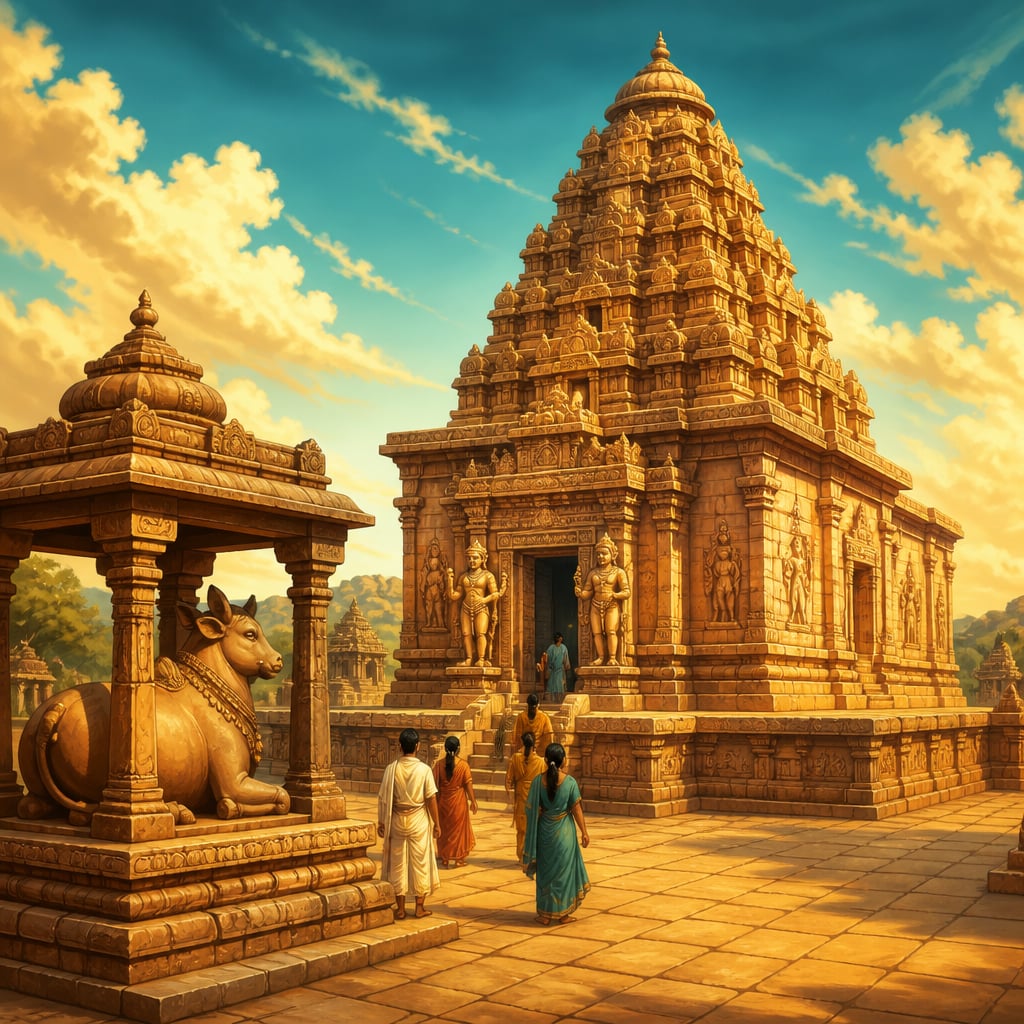
Vikramaditya II understood this profound truth. While his military campaigns demonstrated his power, his cultural patronage revealed his vision. He recognized that a king's true immortality lies not in conquering land but in creating beauty, nurturing knowledge, and elevating the human spirit through art and architecture.
The Virupaksha Temple: A Queen's Monument
The most enduring monument to Vikramaditya II's reign is the magnificent Virupaksha temple at Pattadakal, though ironically he did not commission it himself. The temple was built by his queen, Lokamahadevi, to celebrate her husband's three conquests of Kanchi. Yet her choice to honor him through architecture rather than merely through inscriptions or gifts reveals the cultural values they shared.
The Virupaksha temple represents the pinnacle of early Chalukya architecture. Completed around 740 CE, it synthesizes northern and southern Indian architectural traditions into a harmonious whole. The temple's plan follows the southern Dravidian style with its towering vimana (sanctum superstructure), while incorporating northern elements in its sculptural program and decorative motifs.
The temple sits on a raised platform, creating a sense of elevation and separation from the mundane world. As devotees approach, they pass through intricately carved pillars depicting scenes from the Ramayana, Mahabharata, and various Puranas. Each pillar is a textbook of mythology, telling stories through stone that would educate generations about their sacred traditions.
The exterior walls are adorned with sculptures of remarkable quality. Divine figures, Shiva in various forms, Vishnu, the goddess Durga, are carved with such skill that they seem to breathe. The sculptors captured not just physical forms but spiritual essence, creating images that inspire devotion. Dancing figures, celestial musicians, and mythological scenes fill every available space, yet the overall effect is harmonious rather than cluttered.
Inside the sanctum stands the lingam, the symbol of Shiva, the deity to whom the temple is dedicated. The inner chamber is relatively austere compared to the ornate exterior, reflecting the Hindu understanding that the journey toward the divine moves from complexity toward simplicity, from external beauty toward inner truth.
Pattadakal: The Chalukya Architectural Laboratory
Pattadakal, where the Virupaksha temple stands, was more than just another temple town. It was the Chalukya architectural laboratory, where builders experimented with styles and techniques. The site contains ten temples built over a century, each representing a step in architectural evolution.
Some temples at Pattadakal follow the northern Nagara style with curvilinear towers. Others, like the Virupaksha, follow the southern Dravidian style with pyramidal towers. Still others blend both traditions. This architectural experimentation was not random, it represented a deliberate attempt to create a synthesis, a uniquely Chalukya style that drew from both North and South Indian traditions.
Vikramaditya II encouraged this experimentation. He understood that great civilizations don't merely copy what came before; they innovate while respecting tradition. The Chalukya architects working under his patronage were given the freedom to experiment, the resources to attempt ambitious projects, and the time to perfect their craft.
The result was a distinctive architectural style that influenced temple building across South India for centuries. The Virupaksha temple, in particular, served as the direct model for the even more famous Kailasanatha temple at Ellora, built by the Rashtrakutas a few decades later. Ideas and techniques developed at Pattadakal spread throughout the region, shaping the visual landscape of South Indian Hinduism.
Patronage of Arts and Letters

Beyond architecture, Vikramaditya II patronized a thriving court culture of poets, scholars, and musicians. While specific names of court poets from his reign have not all survived in historical records, inscriptions make clear that his court was a center of literary activity.
Sanskrit poetry flourished under his patronage. Court poets composed prasastis (eulogistic inscriptions) that were not mere flattery but sophisticated literary works employing complex meters and poetic devices. These inscriptions served multiple purposes: recording historical events, celebrating royal achievements, demonstrating literary skill, and providing employment for learned men.
Kannada, the regional language, also received royal support. This was the period when Kannada was evolving from a spoken vernacular into a sophisticated literary language capable of expressing complex philosophical and poetic ideas. Royal patronage accelerated this development, commissioning works and supporting poets who elevated the language.
The court also patronized scholars of dharmashastra (texts on dharma and law), arthashastra (political science), and various schools of philosophy. These scholars provided both practical guidance for governance and intellectual prestige for the court. A king who surrounded himself with learned men demonstrated that his power rested on wisdom as well as force.
Music and dance, essential elements of temple worship and court entertainment, received royal support. Musicians composed works for temple rituals, while dancers performed in both sacred and courtly contexts. This patronage preserved and developed artistic traditions that might otherwise have disappeared.
Economics and Politics of Patronage
Cultural patronage on this scale required enormous resources. Building a temple like the Virupaksha consumed vast quantities of stone, required teams of skilled craftsmen working for years, and demanded sophisticated project management. These resources came primarily from successful military campaigns, the three conquests of Kanchi resulted in substantial tribute that was channeled into cultural projects. Military success literally built the cultural legacy.
Land grants (agrahara) to temples and scholars provided perpetual income for maintenance, rituals, and supporting priests. Trade revenues from the Deccan's strategic location as a corridor between North and South India provided steady income for cultural projects.
But Vikramaditya II's cultural patronage was not merely aesthetic, it was politically significant. Great temples demonstrated the kingdom's wealth and sophistication to rival kings. Patronage of learning attracted talented individuals from across India, creating a brain drain from rival kingdoms while enhancing Chalukya prestige.
Temples also served administrative functions: centers of education, banks storing wealth and lending to merchants, organizers of local labor, and adjudicators of disputes according to dharmic law. By patronizing temples, the king strengthened administrative infrastructure while connecting himself to the divine in public imagination.
Queen Lokamahadevi: Co-Patron

The fact that Queen Lokamahadevi built the Virupaksha temple reveals important aspects of gender and power in Chalukya society. Queens were not merely decorative figures confined to the inner apartments. They could own property, commission major projects, and exercise agency in public ways.
Lokamahadevi's decision to build a temple to celebrate her husband's victories was both personally devotional and politically astute. It honored Vikramaditya II while establishing her own legacy. The temple inscriptions mention her name prominently, ensuring she would be remembered alongside her husband.
This pattern of female patronage was common in Chalukya times but often overlooked in histories focused on male rulers. Women of the royal family and nobility commissioned temples, supported scholars, and participated in the cultural life of the kingdom. Their patronage helped create the cultural flowering we associate with Vikramaditya II's reign.
Preservation Through Patronage
There is a profound connection between Vikramaditya II's preservation of enemy temples and his patronage of new construction. Both stem from the same understanding: that sacred architecture transcends political boundaries and temporary rulers. Temples are not possessions of kings but gifts to the divine and future generations.
When he preserved the Kailasanatha temple at Kanchi, he was recognizing that great architecture belongs to humanity, not just to those who commissioned it. When his queen built the Virupaksha temple, she was creating a gift for future generations, not just a monument to her husband's victories.
This understanding, that we are temporary custodians of eternal truths and sacred spaces, informed both his destructive restraint and his creative patronage. He protected what previous generations built and added his own contribution, leaving more for future generations than he found.
The Legacy in Stone
Today, more than 1,200 years after Vikramaditya II's death, pilgrims still worship at the Virupaksha temple. Visitors from around the world marvel at its architecture. Scholars study its inscriptions and sculptures. The temple has outlasted the Chalukya kingdom, survived the rise and fall of subsequent empires, and continues to serve its sacred purpose.
This is the true measure of Vikramaditya II's greatness. His military victories are remembered by historians, but the temples built during his reign are experienced by millions. His conquests expanded territory temporarily, but his cultural patronage expanded human civilization permanently. In the end, the patron may be greater than the warrior, for what is built endures longer than what is conquered.
Historical context
740-744 CE - Chalukya Cultural Golden Age
The mid-8th century was a period of extraordinary cultural flowering across India. In addition to Chalukya architectural achievements, this era saw the Pallavas continuing their own building programs in the south, the Pratiharas developing their architectural style in the north, and various kingdoms competing to create more magnificent temples. This was also the period just before Adi Shankaracharya would travel across India establishing his philosophy of Advaita Vedanta, adding intellectual ferment to architectural achievement.
Living traditions
The Virupaksha temple and other monuments from Vikramaditya II's reign continue to inspire architects, artists, and devotees. The temple is an active place of worship visited by thousands annually, ensuring the traditions it represents remain living practices rather than museum pieces. The architectural principles developed during his reign influenced temple construction across South India for centuries. Modern Karnataka takes immense pride in this heritage, with the state emblem incorporating Chalukya temple architecture. The principle that rulers should be cultural patrons, not just military commanders, remains an ideal in Indian civilization.
- Virupaksha Temple, Pattadakal: The crown jewel of Chalukya architecture, built by Queen Lokamahadevi around 740 CE. This UNESCO World Heritage Site represents the peak of early Chalukya architectural achievement and served as the model for later South Indian temples. The temple remains an active place of worship and a masterpiece of stone sculpture.
- Pattadakal Temple Complex: A UNESCO World Heritage Site containing ten temples built over a century, representing an architectural laboratory where northern and southern Indian styles were synthesized. The complex demonstrates the evolution of Chalukya architecture and includes both Nagara and Dravidian style temples.
Reflection
- Why do you think Vikramaditya II's temples have outlasted his military victories in historical memory? What does this reveal about what truly endures across time?
- Queen Lokamahadevi chose to commemorate her husband's military victories through building a temple rather than a war monument. What does this choice reveal about Chalukya values and the relationship between power and culture?
- The lesson teaches that sustainable excellence requires supporting entire ecosystems, not just funding final products. In your own work or field, what ecosystem supports excellence that might be underfunded or underappreciated?