Origins and Rise
Birth of a Defender: The Making of Vikramaditya II
Vikramaditya II was born into the illustrious Chalukya dynasty of Badami during a time of great turmoil. As the grandson of the legendary Pulakeshin II, he inherited a legacy of valor and dharmic kingship. His rise to power in 733 CE marked the beginning of an era that would see the preservation of dharma against external threats and the embodiment of righteous conquest.
The Chalukya Legacy
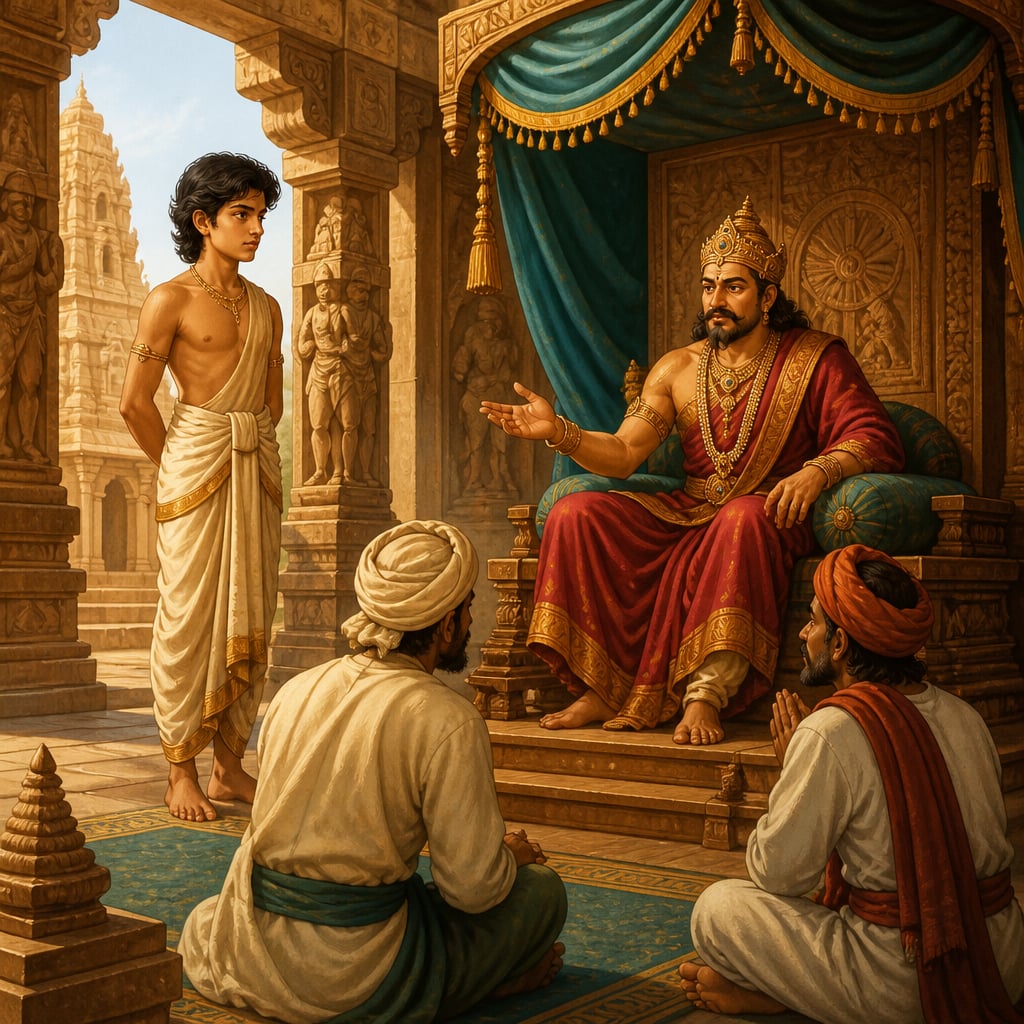
In the heart of the Deccan, where red sandstone cliffs rise majestically above the Malaprabha River, stood the fortified city of Badami. This was the capital of the Chalukyas, a dynasty that had ruled the region with valor and wisdom since the 6th century CE. It was here, in the early 8th century, that a prince was born who would become known as Vikramaditya II, a name that would echo through history as a symbol of dharmic warfare and benevolent conquest.
A Dynasty Forged in Battle
The Chalukyas were no ordinary rulers. They had risen from modest beginnings to become one of the most powerful dynasties in South India. The dynasty's founder, Pulakeshin I, had established Badami as the capital around 543 CE, carving out a kingdom from the rocky terrain of the Deccan plateau. But it was his grandson, Pulakeshin II, who would elevate the dynasty to legendary status.
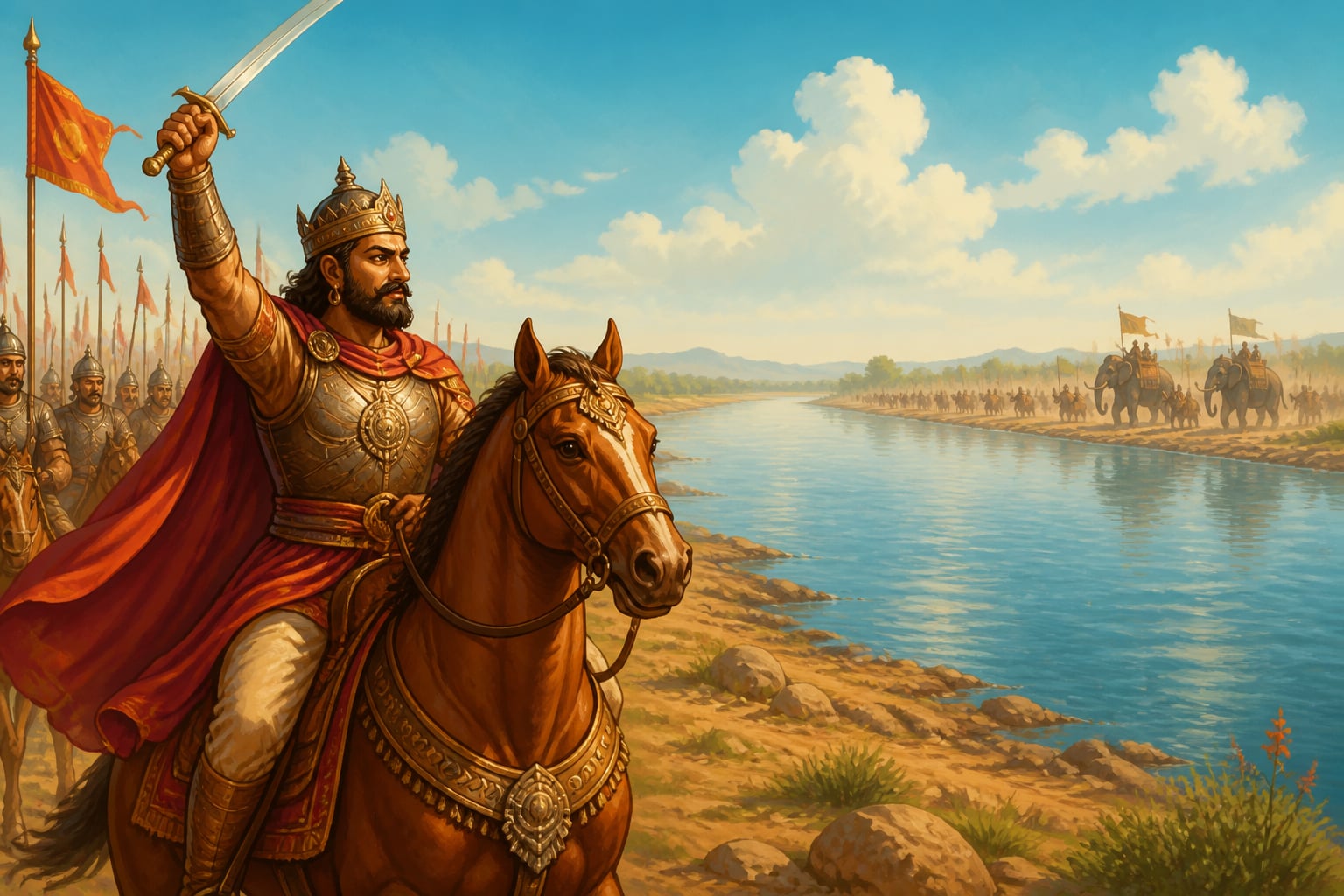
Pulakeshin II, the great-grandfather of our protagonist, was a colossus of Indian military history. He defeated Emperor Harsha of Kanauj on the banks of the Narmada, earning the title Paramesvara (Supreme Lord). The famous Chinese pilgrim Hiuen Tsang visited his court and left detailed accounts of the prosperity and military might of the Chalukya kingdom. Pulakeshin II's reign represented the golden age of Chalukya power, and his valor became the standard against which all subsequent Chalukya kings would be measured.
However, glory is often followed by tribulation. In 642 CE, Pulakeshin II was killed in battle against the Pallava king Narasimhavarman I, who invaded and temporarily occupied Badami. This defeat cast a long shadow over the dynasty. The capital was recovered by Vikramaditya I (after whom our protagonist was named), but the memory of that humiliation remained fresh in Chalukya memory.
The Prince's Education
Vikramaditya II was born to King Vijayaditya, who had successfully consolidated Chalukya power after years of instability. As a royal prince, young Vikramaditya received an education befitting his station. He was trained in the sixty-four kalas (arts and sciences), but special emphasis was placed on the four upayas (strategies): sama (conciliation), dana (gift-giving), bheda (creating dissension), and danda (punishment).
The young prince learned Sanskrit, Kannada, and possibly even Tamil and Prakrit languages. He studied the great epics, the Ramayana and Mahabharata, not merely as stories but as political and ethical treatises. The Arthashastra of Kautilya was his manual for statecraft, while the Dharmashastra texts taught him the duties of a king. Military training included not just swordsmanship and archery, but also the science of warfare: fortification, siege tactics, cavalry management, and the psychology of leadership.
But perhaps the most important aspect of his education came from observing his father's court. Vijayaditya was a capable ruler who understood the delicate balance between firmness and compassion. The young Vikramaditya witnessed diplomatic negotiations, judicial proceedings, and the complexities of maintaining a multi-ethnic, multi-religious empire. These experiences would shape his future approach to kingship.
Father and Son: Lessons in Kingship
Vijayaditya recognized something exceptional in his son from an early age. The prince asked questions that revealed a philosophical mind, not just how to defeat enemies, but why certain victories endured while others crumbled. One day, according to court tradition, the young Vikramaditya asked his father why the Pallavas had been able to recover so quickly after their defeat. Vijayaditya's answer was instructive: "Because we destroyed their armies but not their spirit. A kingdom rebuilt on humiliation breeds only vengeance."
This lesson would stay with Vikramaditya throughout his life. His father also taught him the importance of temple patronage, not merely as religious duty, but as a way of binding communities together under royal protection. When Vijayaditya commissioned repairs to temples damaged during earlier conflicts, he took his son along to witness how grateful the local populations became. "Temples," Vijayaditya explained, "outlast kings. Build them, protect them, and your memory will be honored long after your body returns to the earth."
The Path to Power
When Vikramaditya II ascended to the throne around 733 CE, the Indian subcontinent was at a crossroads. To the north and west, Arab forces had conquered Sindh and were probing deeper into India. The great kingdoms of North India, the Pratiharas, Palas, and Rashtrakutas, were emerging as major powers. In the south, the eternal rivalry between the Chalukyas and Pallavas continued unabated.
The new king understood that he had inherited not just a kingdom, but a responsibility. The Chalukyas saw themselves as defenders of dharma, protectors of the Vedic tradition, and champions of Indian civilization. Vikramaditya II bore the weight of his great-grandfather's legacy and his dynasty's reputation. But he also brought something new to the throne, a vision of conquest that emphasized preservation over destruction, a philosophy that would make him unique among medieval Indian kings.
The Times That Shaped Him
The early 8th century was a period of significant transformation in India. The classical age of the Guptas had given way to a new era of regional kingdoms, each developing distinctive cultures and administrative systems. Temple architecture was flourishing, with each dynasty trying to outdo the others in architectural magnificence. The Chalukyas themselves had developed a unique style that blended northern and southern architectural traditions.
Religiously, this was a time of both consolidation and innovation. Advaita Vedanta was being systematized by philosophers who would culminate in Adi Shankaracharya. The bhakti movement was gaining momentum, making spiritual practices accessible to all social classes. Shaivism and Vaishnavism coexisted, often within the same family. The Chalukya court patronized Jain scholars alongside Hindu ones, reflecting a pluralistic approach to religious life.
Into this complex world stepped Vikramaditya II, a young king with an ancient name, determined to prove himself worthy of his lineage while charting his own course in history.
The Challenge Ahead

As Vikramaditya II looked out from the ramparts of Badami toward the southern horizon, he knew that his greatest challenges lay ahead. The Pallavas of Kanchi remained the primary threat, and memories of Pulakeshin II's defeat demanded vindication. To the west, Arab raiders were becoming increasingly bold. Within his own realm, he needed to strengthen administration, promote prosperity, and maintain the loyalty of his feudatories.
But the young king possessed qualities that would serve him well: intelligence sharpened by study, courage inherited from his ancestors, and a moral compass that would guide him toward a unique place in Indian history. He would become known not merely for what he conquered, but for what he chose to preserve, a king who understood that true strength lies not in destruction, but in the wisdom to recognize and honor what is sacred, even in the realm of one's enemies.
Historical context
733-744 CE - Early Medieval Period, Chalukya Dominance in Deccan
The early 8th century in India was a period of significant political and cultural transformation. The classical Gupta age had given way to regional kingdoms, each developing distinctive traditions. The Arabs had conquered Sindh (711 CE) and were testing the defenses of Indian kingdoms. In response, several North Indian rulers including the Pratiharas were forming alliances to resist further Arab expansion. South India saw continued rivalry between the Chalukyas and Pallavas. This was also a time of temple-building renaissance, with each dynasty creating architectural masterpieces. Philosophically, Advaita Vedanta was being refined, and the bhakti movement was gaining momentum.
Living traditions
The Chalukya legacy, and particularly Vikramaditya II's principle of preserving enemy temples, influenced subsequent Indian military ethics. The concept that conquest should not mean cultural destruction became part of the Indian ideal of warfare. Modern Karnataka takes great pride in Chalukya heritage, the state emblem features a Chalukya-style temple. The temples they built remain active centers of worship, visited by thousands daily, ensuring their principles live on not just in history books but in lived practice.
- Badami Cave Temples: The ancient capital of the Chalukyas, featuring four magnificent cave temples carved into red sandstone cliffs. These caves date from the 6th century and represent the finest examples of early Chalukya rock-cut architecture. The site includes Hindu, Jain, and Buddhist caves, reflecting the religious pluralism of Chalukya rule.
- Pattadakal Temple Complex: A UNESCO World Heritage Site featuring ten temples built by Chalukya kings, including the magnificent Virupaksha Temple commissioned by Vikramaditya II's queen Lokamahadevi. The complex showcases the evolution of Chalukya architecture and represents the synthesis of North and South Indian temple styles.
- Aihole Temple Complex: Known as the 'Cradle of Indian Architecture,' Aihole contains over 125 temples dating from the 5th to 12th centuries. The Durga Temple and Lad Khan Temple are particularly significant. This was the experimental ground where Chalukya architects developed their distinctive style.
Reflection
- How does the legacy of ancestors both inspire and burden their descendants? Can you think of examples from your own family or community where people have grappled with living up to past greatness?
- The Chalukyas defined themselves as 'protectors of dharma.' What does it mean for a political leader to be a protector of dharma? How might this differ from simply being a successful military commander or administrator?
- Vikramaditya II received a comprehensive education that included military skills, statecraft, literature, and ethics. How does this compare to modern education, which often emphasizes narrow specialization? What would a holistic education for leadership look like today?