The Defender

Guardian Against the Storm: Vikramaditya II's Military Campaigns

As Arab forces probed into the Indian heartland after conquering Sindh, Vikramaditya II emerged as one of the key defenders of dharma. His military campaigns combined strategic brilliance with tactical innovation, defeating Arab raiders in the Deccan and later conquering the Pallava capital of Kanchi three times. His victories established the Chalukyas as the preeminent power in South India and demonstrated that strength in battle could coexist with moral conduct.

The Gathering Storm

When Vikramaditya II ascended the throne in 733 CE, the Indian subcontinent faced its gravest external threat in centuries. The Arab conquest of Sindh in 711 CE had brought Islamic armies to the doorstep of India for the first time. Under the Umayyad Caliphate, Arab commanders were testing the defenses of Indian kingdoms, probing for weaknesses, and attempting to expand their territorial control eastward.
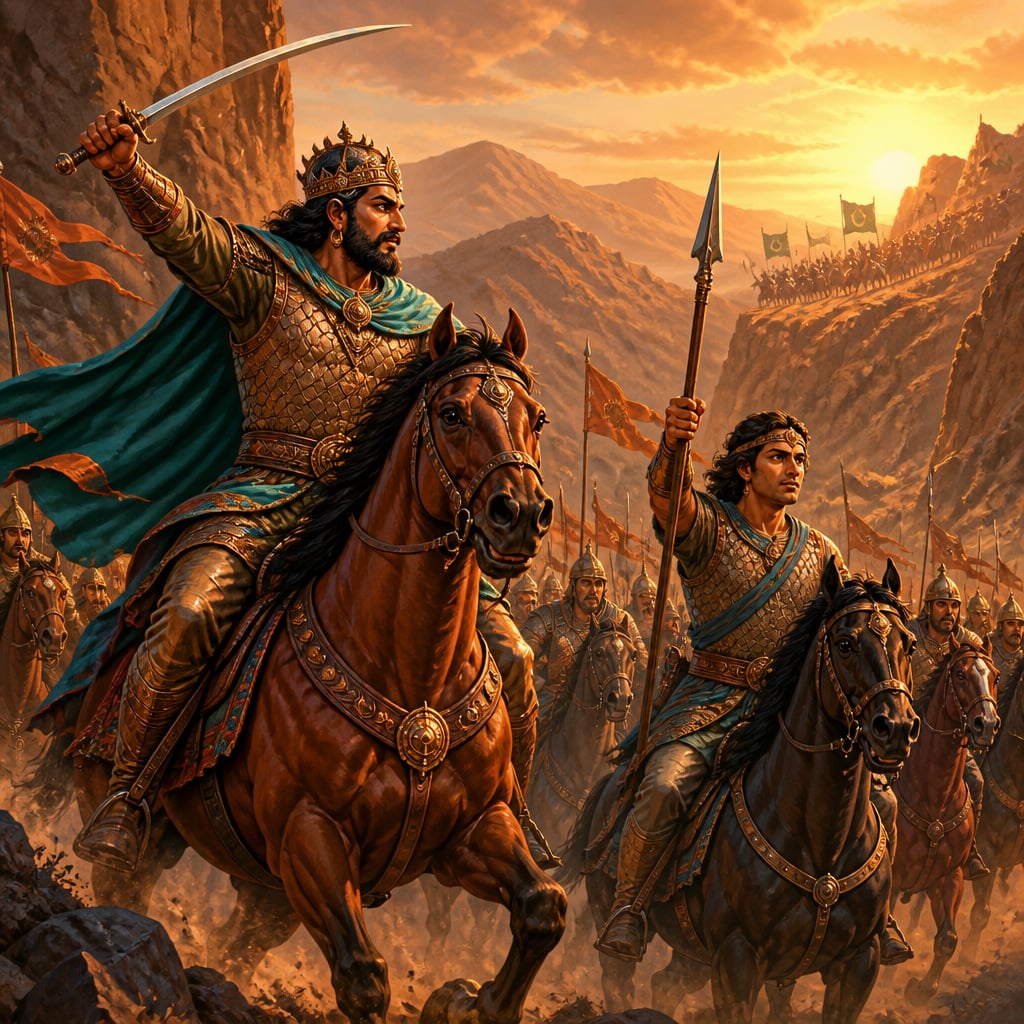
Chalukya cavalry charging in defense of the Deccan

The young Chalukya king understood that defending his kingdom meant more than protecting territorial boundaries, it meant preserving an entire civilization. The Arabs who had swept across Persia, destroyed the Sassanian Empire, and conquered much of the known world now turned their attention to India. Their military machine was formidable, battle-hardened through decades of conquest. But they had not yet faced the Chalukyas.

The Arab Threat and Vikramaditya's Response

The Arab invasion of India began with Muhammad bin Qasim's conquest of Sindh in 711 CE. The young general led a well-organized army that defeated Raja Dahir and established Arab control over the Indus Valley. By the 730s, Arab forces had made incursions into Gujarat and were testing the defenses of the Deccan. Unlike traditional Indian warfare, which followed ethical constraints and seasonal patterns, the Arab military employed different tactics, sudden raids, winter campaigns, and a ruthlessness that shocked Indian sensibilities.

However, the Arabs faced significant challenges in expanding beyond Sindh. The Pratihara dynasty in the north, the Chalukyas in the Deccan, and various Rajput kingdoms formed an informal defensive network. India would prove to be the graveyard of Arab expansion.

Vikramaditya II's response was swift and strategic. Rather than waiting for enemy forces to penetrate deep into Chalukya territory, he adopted an offensive defense strategy. He established a network of fortifications and early warning systems along likely invasion routes, enhanced with strategic forts serving as both defensive positions and staging grounds for counterattacks.

He also improved the mobility of Chalukya forces, creating rapid response cavalry units that could match the enemy's speed. His forces were trained to operate in the challenging Deccan terrain, turning geographical knowledge into military advantage. Most importantly, he forged alliances with other kingdoms facing the Arab threat, creating an informal confederacy that made further Arab penetration extremely difficult.

The Pallava Rivalry

While the Arab threat occupied the western and northern frontiers, Vikramaditya II never forgot the traditional rivalry with the Pallavas of Kanchi. This was more than mere territorial ambition, it was about avenging the death of his great-grandfather Pulakeshin II, who had been killed in battle against the Pallava king Narasimhavarman I nearly a century earlier.

The Pallavas, under Nandivarman II during Vikramaditya II's reign, were formidable opponents. They controlled much of what is now Tamil Nadu and parts of Andhra Pradesh. Kanchi (modern Kanchipuram) was their magnificent capital, famous throughout Asia as a center of learning, art, and magnificent temples.

Chalukya army entering Kanchipuram

Vikramaditya II, who bore the title Trailokyamalla (Lord of the Three Worlds), launched his first campaign against Kanchi early in his reign. The Chalukya army was led by the king himself alongside his able crown prince Avanijanashraya Pulakeshin, who proved an exceptional military commander in his own right. Together, father and son marched south through the eastern Deccan. The campaign was meticulously planned, with supply lines established and local support secured through diplomacy.

The first conquest of Kanchi was achieved through a combination of military pressure and strategic maneuvering. The Chalukya forces besieged the city, cutting off supply routes and preventing reinforcements from reaching the Pallava army. When Kanchi fell, Vikramaditya II's actions revealed his unique character.

The Three Conquests of Kanchi

Vikramaditya II conquered Kanchi not once, but three times during his reign, an unprecedented achievement that demonstrated both his military superiority and the resilience of the Pallavas. Each conquest followed a similar pattern: the Chalukya army would march south, defeat the Pallava forces, occupy Kanchi, and then eventually withdraw, allowing the Pallavas to regroup.

Why withdraw after victory? This question puzzled many military historians until they understood Vikramaditya II's strategic thinking. Total annexation of Pallava territory would have required permanent occupation, stretching Chalukya resources and creating opportunities for rebellion. Instead, by defeating the Pallavas repeatedly and then withdrawing, Vikramaditya II demonstrated overwhelming military superiority while avoiding the costs of permanent occupation.

Moreover, each conquest allowed him to impose tributary status on the Pallavas, extract wealth, and demonstrate to other southern kingdoms the futility of opposing Chalukya power. It was a strategy of dominance without destruction, superiority without annexation.

But the most remarkable aspect of these conquests was what Vikramaditya II chose not to do. In an age where victorious armies routinely destroyed enemy temples, looted sacred sites, and humiliated conquered peoples by defiling their religious symbols, Vikramaditya II took a radically different approach.

The Warrior's Code

Vikramaditya II's military success rested on several factors beyond mere numbers or equipment. His leadership style inspired fierce loyalty among his troops. He was known to share the hardships of campaigns, to reward valor generously, and to treat defeated enemies with respect.

His military organization reflected the sophisticated Chalukya administrative system. The army was divided into specialized units: heavy cavalry for shock attacks, light cavalry for reconnaissance and pursuit, infantry divisions with different weapon specializations, and elephant corps for breaking enemy formations. A well-organized supply system ensured that armies could campaign for extended periods.

The Chalukya military also employed sophisticated siege technology. Engineers accompanied the armies, capable of constructing siege towers, mining walls, and diverting water supplies. The triple conquest of Kanchi, a heavily fortified city, demonstrated this engineering expertise.

Vikramaditya halting his soldiers in a Pallava village

But perhaps the most important aspect of Vikramaditya II's military philosophy was his understanding of the limits of force. He recognized that while military power could defeat armies and capture cities, it could not win hearts or create lasting peace. This insight would guide his most famous decision, the preservation of enemy temples.

The Alliance System

Vikramaditya II's military success was supported by a sophisticated alliance system. He maintained friendly relations with the Pratiharas, who were fighting Arabs in Gujarat and Rajasthan. This prevented the possibility of facing enemies on multiple fronts.

He also cultivated relationships with various feudatory chiefs within his empire, ensuring their loyalty through a combination of firm control and generous rewards. The Chalukya feudatory system allowed local rulers considerable autonomy in exchange for military support during campaigns and regular tribute.

Interestingly, Vikramaditya II also maintained diplomatic relations with distant kingdoms. Evidence suggests contact with Sri Lankan kingdoms and possibly even with kingdoms in Southeast Asia, where Indian cultural influence was strong. These relationships provided intelligence about regional political developments and trading opportunities that funded military operations.

The Cost of Defense

Military campaigns, even successful ones, came at a cost. The repeated campaigns against Kanchi, the constant vigilance against Arab raids, and the maintenance of a standing army required enormous resources. Vikramaditya II funded these operations through a combination of agricultural taxes, trade revenues, and tribute from conquered territories.

The human cost was also significant. While specific casualty figures are unavailable, medieval warfare was brutal. Soldiers died not just in battle but from disease, exhaustion, and the hardships of long campaigns. Families were separated, villages were disrupted by recruitment, and agricultural productivity sometimes suffered when large numbers of men were mobilized.

Yet Vikramaditya II managed these costs carefully. He avoided unnecessary wars, used diplomacy when possible, and ensured that military campaigns served clear strategic objectives rather than personal glory. His three conquests of Kanchi, while militarily impressive, were ultimately in service of establishing Chalukya supremacy and securing the southern frontier.

Legacy of the Defender

By the end of his military campaigns, Vikramaditya II had fundamentally altered the balance of power in South India. The Arab threat to the Deccan had been neutralized. The Pallavas, while not destroyed, had been decisively subordinated to Chalukya power. Other southern kingdoms recognized Chalukya military superiority.

But his true legacy was demonstrating that military strength and moral conduct were not contradictory. A king could be a fierce warrior and a dharmic ruler. One could defeat enemies without destroying their sacred sites. Power could be exercised with restraint. These lessons, learned through years of campaigning, would find their fullest expression in his treatment of conquered Kanchi, particularly his preservation of the magnificent Kailasanatha temple.

Historical context

733-744 CE - Period of Arab Expansion and South Indian Dynastic Conflicts

The 730s-740s marked a critical period when Indian kingdoms faced the Arab threat most acutely. Muhammad bin Qasim's conquest of Sindh (711 CE) had established Arab control over the Indus Valley, and subsequent commanders tested Indian defenses. However, unlike Persia and Central Asia which fell relatively quickly, India mounted effective resistance. The Pratiharas in Gujarat and Rajasthan, the Chalukyas in the Deccan, and various Rajput kingdoms created an informal defensive network. Vikramaditya II's campaigns against Arab raiders in the western Deccan were part of this larger pattern of resistance. Simultaneously, traditional rivalries between Indian kingdoms continued, the Chalukya-Pallava conflict predated the Arab threat and would outlast it.

Living traditions

Vikramaditya II's military legacy influenced Indian military ethics for centuries. The principle that warfare should serve dharmic purposes rather than mere conquest, and that even enemies deserve certain treatment, became part of Indian military tradition. His successful defense against Arab expansion, achieved through coordination with other kingdoms, showed the power of strategic alliances against common threats. Modern Indian military doctrine still emphasizes restraint in the use of force and protection of civilians, principles that can be traced back to leaders like Vikramaditya II.

Reflection

More in Vikramaditya II

All lessons in Vikramaditya II ยท Lesser Known Guardians of Dharma course