The Storm from the West

The Arab Invasion and the Battle of Aror

In 711 CE, a seventeen-year-old Arab general named Muhammad bin Qasim landed on the shores of Sindh with a formidable army and siege engines, beginning an invasion that would test Raja Dahir to his limits. At the Battle of Aror in 712 CE, the aging king mounted his war elephant for the last time, choosing to die fighting rather than flee, a final stand that would echo through history as both tragedy and testament to unshakeable courage.

The Arrival and the Fall of Debal

The year was 711 CE. From his palace in Aror, Raja Dahir received disturbing reports: an Arab fleet had anchored near Debal (modern Karachi), the thriving port city at the mouth of the Indus. The commander was barely more than a boy, Muhammad bin Qasim, nephew of the powerful al-Hajjaj ibn Yusuf, governor of Iraq. He was just seventeen years old, but he commanded an army of seasoned veterans who had conquered Persia, Central Asia, and lands beyond.

But this was no ordinary raid. Previous Arab expeditions had been repulsed - in 708 CE, two successive commanders had been killed attempting to subdue Sindh. This time, the Umayyad Caliphate was committed. The Arab force came equipped with manjaniq, massive siege engines capable of hurling stones that could shatter fortress walls. Five great catapults had been assembled, brought piece by piece from Syria. The largest, called "Arus" (the Bride), required five hundred men to operate and could hurl projectiles weighing 300 pounds. Dahir understood immediately: this was not a raid for plunder. This was conquest.

Debal was Sindh's gateway to the sea, a cosmopolitan city where Arab, Persian, and Indian merchants mingled in markets. Its massive Buddhist stupa served as a landmark visible from the ocean. For days, the defenders repulsed assault after assault. Then came the catapults. "The Bride" began her terrible work. Day after day, massive stones crashed into the walls. When the Buddhist stupa finally collapsed, contemporary chronicles say the morale of the defenders collapsed with it.

"When the great temple fell, it seemed as though the gods themselves had abandoned the city."
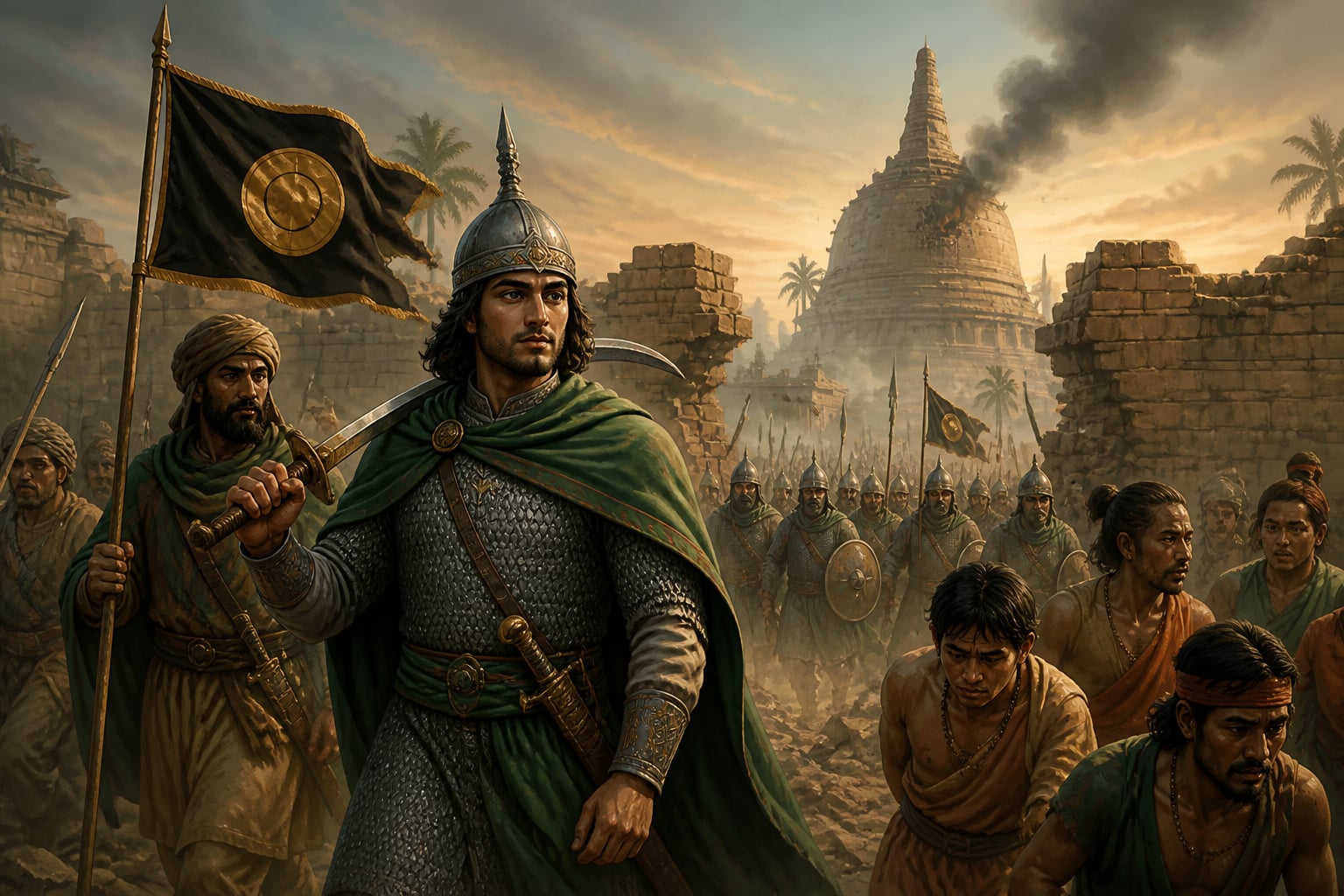
Muhammad bin Qasim entering the fallen port of Debal

After weeks of bombardment, the walls were breached. The Chachnama records that Qasim ordered three days of slaughter as punishment for resistance. Debal, the jewel of the coast, fell silent.

The Battle of Aror

With Debal captured, Muhammad bin Qasim advanced methodically up the Indus valley. Dahir faced enemies on multiple fronts - rival clans to the east, mountain tribes to the north. By the time he understood he faced a full-scale invasion, the initiative had been lost.

By spring of 712 CE, Muhammad bin Qasim had advanced to Aror (also called Raor), the fortified capital. Here, finally, Raja Dahir would make his stand. Dahir's army assembled on the plains before the city, cavalry units with pennants streaming, infantry with shields locked in formation, and at the center, the king himself mounted on his great war elephant.

According to the Chachnama, Dahir addressed his troops before the battle:

"I have ruled you not as subjects but as children. Today I ask you to fight not as soldiers but as sons defending their father. Let no man say that Dahir of Sindh fled when the enemy came."

The battle began with cavalry charges and counter-charges. For hours, the outcome hung in balance. Dahir's elephant corps pushed through Arab lines. But the Arabs had faced elephants before in Persia, they knew to target the drivers and harry the beasts with arrows. Then came the moment that sealed Sindh's fate. An Arab archer loosed an arrow that found the gap in Dahir's armor. The king swayed in his howdah. Blood soaked the royal garments.

Aging Raja Dahir on his war elephant at the Battle of Aror

The Last Stand of Dahir and His Queens

Wounded mortally, Dahir could have ordered retreat. He did not flee. The Chachnama records his final moments with grudging respect:

"Though life ebbed from him, Dahir urged his elephant forward into the thickest press of battle. He fought with the fury of a wounded lion until he fell from the howdah, his sword still in his hand."

Raja Dahir died as he had lived, a warrior defending his realm. When word spread that the king had fallen, the Sindhi forces broke. The conquerors showed no mercy to the fallen king. Dahir's head was severed and sent to al-Hajjaj ibn Yusuf in Iraq as a trophy of victory.

Rani Bai's last stand at Rawar fort

But the women of the royal household showed courage equal to the fallen king. Rani Bai, one of Dahir's queens, rallied the defenders of Rawar fort and held out for four days after her husband's death. Only when the walls were finally breached did she choose death over capture. At Raor fortress, another queen, Rani Ladi, ordered the women of the royal household to light their funeral pyres. This act, later called jauhar, would be repeated at Chittorgarh, Jaisalmer, and other fortresses in centuries to come.

The Daughters' Revenge

Not all of Dahir's family perished. His two daughters, Surya Devi and Parimal Devi, were captured and sent as tribute to the Caliph Sulaiman ibn Abd al-Malik in Damascus. Yet the daughters of Dahir had inherited their father's spirit. According to the Chachnama, when brought before the Caliph, they told him that Muhammad bin Qasim had dishonored them before sending them as gifts. The accusation was false, a calculated revenge.

The Caliph was enraged. He ordered Muhammad bin Qasim sewn into a raw hide and transported back to Damascus, a gruesome punishment that caused death through slow suffocation. The young conqueror who had destroyed Sindh at seventeen died at twenty, executed on the word of the women he had conquered. When the truth emerged, the princesses were reportedly put to death. But they had achieved their revenge.

Betrayals and the Question That Haunts History

Dahir's defeat was not solely the result of Arab military superiority. Betrayal played its part. Mokah Basayah, a king of the coastal region of Bet who was nominally Dahir's vassal, provided boats to Muhammad bin Qasim to cross the Indus River, a crucial betrayal that allowed the Arabs to outflank Sindhi defenses. The lesson was bitter: internal divisions and opportunistic betrayals weakened what military courage could not overcome.

Could Dahir have won? With different decisions, if he had marched to relieve Debal, if he had forged alliances with neighboring kingdoms, might the outcome have changed? What is beyond debate is this: Raja Dahir fought. When defeat loomed, when flight was possible, he chose to die in battle defending his kingdom. The Chachnama itself, though celebrating the Arab victory, cannot help but note:

"Never did we face a king who valued honor above life. If Dahir had possessed the strength of his courage, no army could have conquered him."

The End and the Beginning

As the sun set on Aror, Raja Dahir's body lay on the battlefield where he had made his last stand. His kingdom was lost. His dynasty was ended.

Yet something survived the slaughter. The memory of a king who chose death over dishonor. The example of a ruler who fought for his principles against impossible odds. The lesson that some things are worth dying for.

Thirteen centuries later, we still tell this story. We still debate his choices. We still learn from his example. The Guardian of Dharma fell. But in falling, he guarded something more important than territory, he guarded the idea that honor and duty are worth more than survival.

Historical context

Early 8th Century CE

In the early 8th century, India was politically fragmented. Sindh, at the northwestern edge, was relatively isolated from the major power centers. The Gurjara-Pratiharas, Palas, and Rashtrakutas would rise to prominence only after Dahir's fall.

Living traditions

Raja Dahir remains a complex and contested figure. In Pakistan, he is sometimes viewed as the last non-Muslim ruler of Sindh. In India, particularly among Sindhi Hindus, he is remembered as a tragic hero who died defending his kingdom. His story raises questions about resistance, accommodation, and the price of standing alone.

Reflection

More in Raja Dahir

All lessons in Raja Dahir · Lesser Known Guardians of Dharma course