Resistance and Awakening
How Dahir's Fall Saved India and Shaped History
With Dahir's death at Rawar, Sindh fell, but India awakened. His son led guerrilla resistance, legendary warriors rose to stop the Arab advance, and the sacrifice at Sindh became the alarm that saved a civilization. This lesson explores both the immediate aftermath and how history remembers the last Hindu king of Sindh.
The Aftermath: A Kingdom in Ruins
The news of Dahir's death at Rawar spread across Sindh like wildfire. Within hours, messengers carried the terrible word to every corner of the kingdom - the king was dead, his army scattered, the foreigners advancing. Muhammad bin Qasim's Arab army moved rapidly to exploit their victory, offering terms to cities that surrendered and promising destruction to those that resisted.
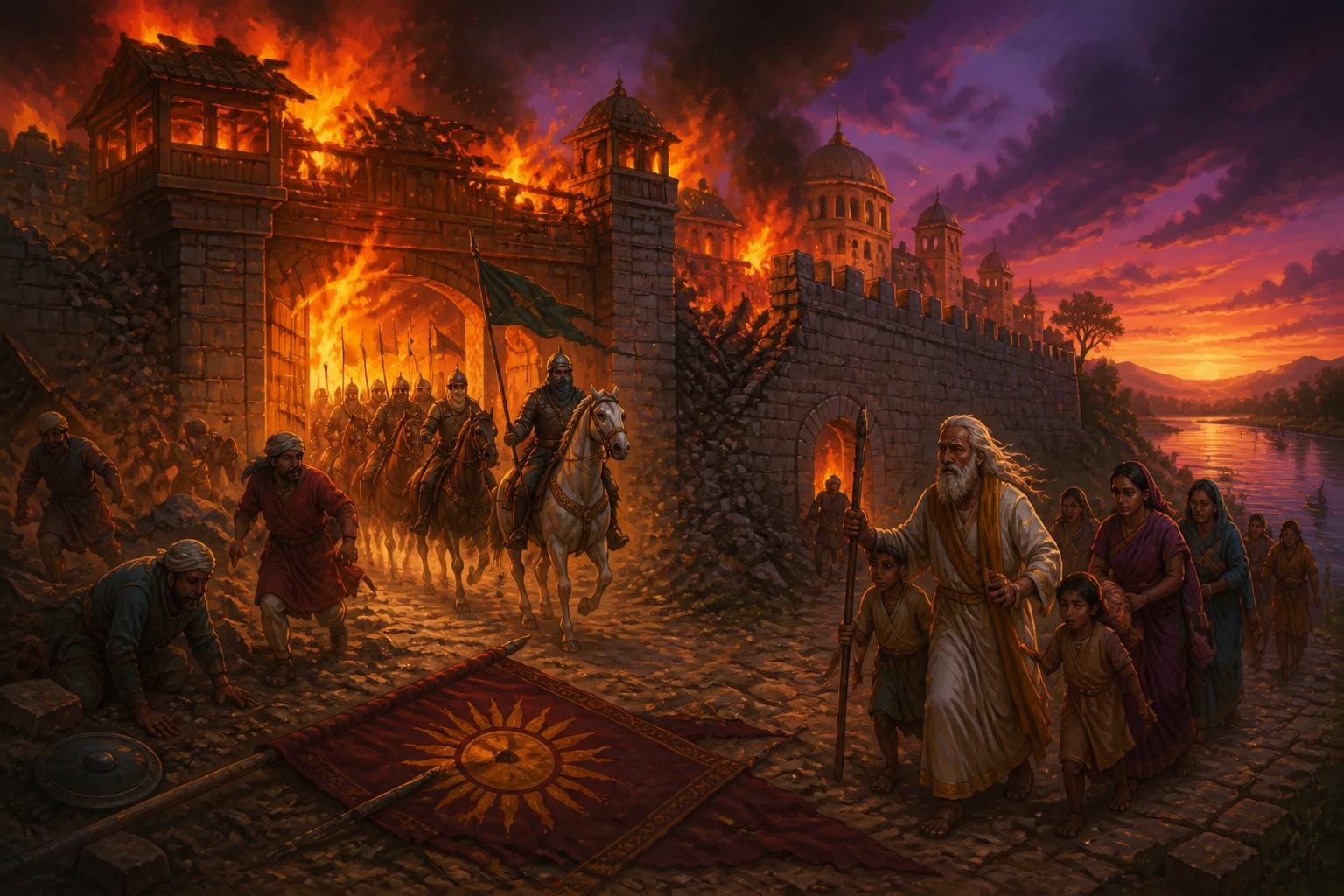
Brahmanabad fell after a brief siege when its defenders, learning of Dahir's death, lost heart. Multan, famous for its magnificent sun temple, surrendered after only token resistance - the temple's treasures were stripped, its priests scattered. City after city opened their gates, their leaders choosing survival over hopeless resistance.
The speed of the collapse testified both to the effectiveness of Arab military power and to Dahir's fatal isolation. With no ally to offer refuge, no neighboring kingdom to provide reinforcements, local leaders faced a stark choice: submit or be destroyed. Most submitted. But not everyone surrendered. In the ruins of defeat, pockets of resistance emerged.
Jaisiah's Resistance: A Legacy of Defiance
Jaisiah (Jai Singh), Dahir's eldest son, had fought at Rawar and witnessed his father's death. Unlike the nobles who made peace with the conquerors, Jaisiah refused to submit. He fled to the remote fortress of Kiraj in Sindh's northeastern hills, taking with him whatever loyal soldiers he could gather.
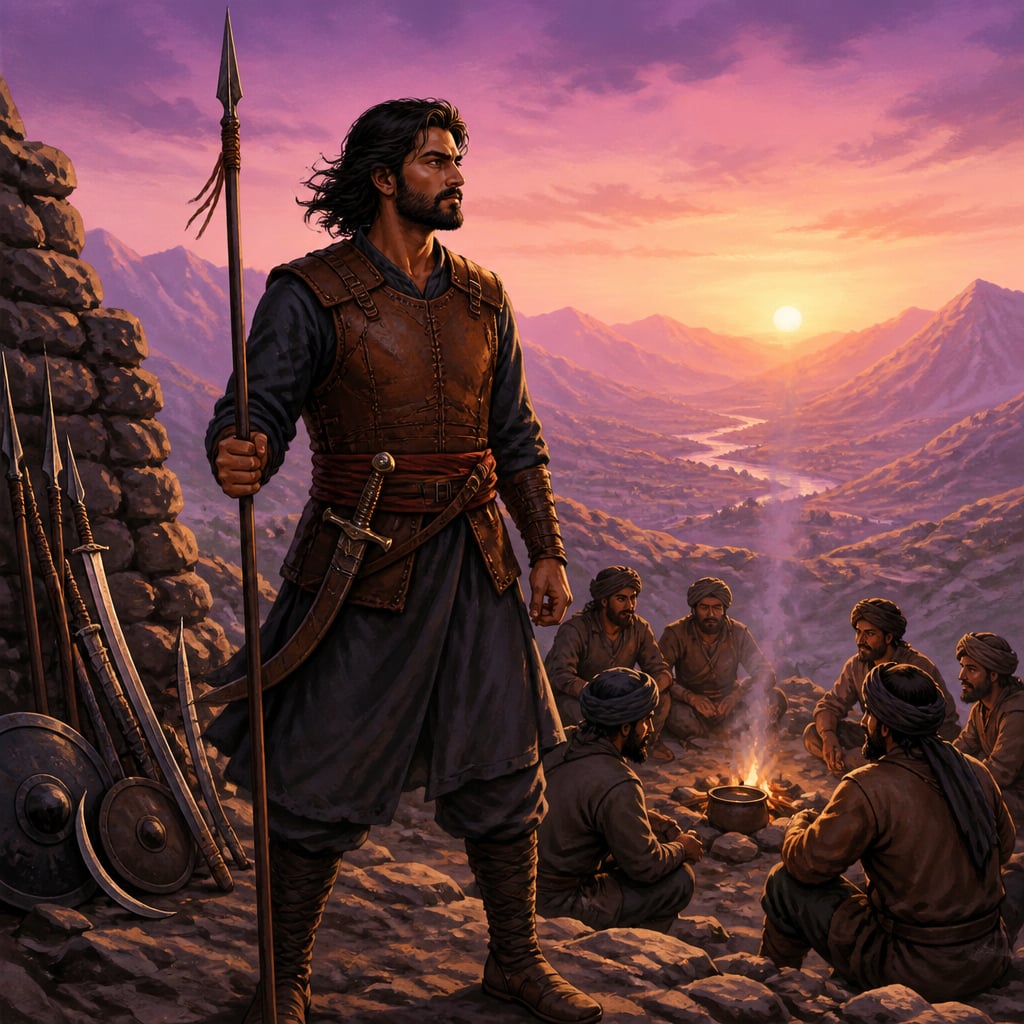
What made Jaisiah's resistance even more remarkable was that he was continuing a tradition of fighting Arab invaders that preceded Muhammad bin Qasim. Before Qasim's invasion, two earlier Arab commanders, Ubaidullah and Budail, had led expeditions against Sindh and been killed by Sindhi forces. Jaisiah now carried forward this legacy of resistance.
From this remote stronghold, Jaisiah organized a resistance movement that would harry the conquerors for years. He gathered survivors of Rawar, soldiers who had escaped capture, officers who refused to serve new masters, and common people unwilling to accept the new order. Jat tribesmen, long integrated into Dahir's army, joined his cause. The resistance employed guerrilla tactics: attacking supply convoys, raiding isolated garrisons, ambushing patrols, and disappearing into the hills before the Arabs could concentrate forces against them.
The Chachnama records that Arab governors considered Jaisiah a persistent threat. His greatest achievement came at Brahmanabad, where he mounted a siege that lasted nearly six months, an extraordinary feat of sustained resistance. Eventually, Jaisiah's armed resistance was crushed. But the spirit he represented never died. Twenty-five years after Dahir's death, around 737 CE, Jaisiah's descendants negotiated a treaty with Arab general Salim that restored a measure of Hindu autonomy in parts of Sindh.
Before his end, Jaisiah had accomplished something crucial: he had bought time. Time for the rest of India to awaken. Time for news of Sindh's fall to spread. Time for other kingdoms to prepare their defenses.
"The son continued what the father began, not conquest, but the defense of dharma against overwhelming odds."
India Awakens: Bappa Rawal and Nagabhata
With Sindh conquered by 713 CE, the Arab commanders must have thought the rest of India would fall as easily. They were catastrophically wrong. Beyond Sindh lay the great Thar Desert, a wasteland that swallowed armies. The same desert that had isolated Dahir now protected India. And India's warriors awakened.

In the hills of Mewar, a young warrior named Bappa Rawal was rising to power. Born around the time of Dahir's death, he grew up hearing tales of Sindh's fall. Around 725-730 CE, Arab forces attempted to expand beyond Sindh into Rajputana. Bappa Rawal met them in battle and inflicted a devastating defeat. He established a dynasty, the Guhilas of Mewar, that would rule for centuries and produce heroes like Rana Sanga and Maharana Pratap. The inscription at Eklingji Temple explicitly connects his victory to Dahir's fall: "Having seen Sindh fallen earlier, made a vow."
Nagabhata I founded the Gurjara-Pratihara dynasty around 730 CE and immediately faced Arab invasions from Sindh. The Arab commander Junaid launched multiple expeditions into Gujarat and southern Rajasthan. Nagabhata organized a coalition of Rajput chiefs and defeated the Arab armies. The Battle of Rajasthan (c. 738 CE) saw a unified Indian force crush the Arab invasion. Historians compare it to Charles Martel's victory at Tours (732 CE) in France. The Pratiharas would build one of medieval India's great empires, maintaining the barrier against Islamic expansion for over two centuries.
The Lessons Dahir's Fall Taught
Why did Bappa Rawal and Nagabhata succeed where Dahir failed? Unity over isolation: Dahir stood alone; Bappa and Nagabhata built coalitions. The Rajput chiefs who might have fought each other instead fought together. Preparation over surprise: Dahir faced an unprecedented threat he didn't fully understand. The later defenders had Sindh's example as a warning. Geographic advantage: Bappa and Nagabhata fought in terrain they knew, using the Thar Desert as a barrier.
Dahir's sacrifice was not wasted. Every day he held the Arabs in Sindh was another day for India to prepare.
How History Remembers Dahir
In modern India, Raja Dahir has emerged from historical obscurity to become a symbol. He appears in textbooks as the first major Hindu king to face Islamic conquest. His story is taught as a cautionary tale about the dangers of disunity. Conservative and nationalist movements have embraced Dahir as a martyr. Yet there's also nuance in how India remembers him. Historians note his administrative competence, his religious tolerance, the prosperity of his kingdom.
In Pakistan, where Sindh is now a province, Dahir's memory is complicated. Some portray him negatively, while others acknowledge the complexity. Muhammad bin Qasim is celebrated as the first Muslim conqueror of South Asian territory.
How should we measure Raja Dahir? By military success? He lost. Sindh fell. By moral integrity? Here Dahir stands tall. He refused to abandon his principles even when survival demanded it. By lasting impact? His defeat awakened India. Thirteen centuries later, we still discuss Raja Dahir. We still debate his choices. We still learn from his story. How many rulers can claim such enduring relevance?
The Guardian Who Fell
Raja Dahir stood at the banks of the Sindhu River knowing defeat was likely. He could have fled across the desert to safety. He could have negotiated surrender and preserved some shadow of power. He chose to fight. Not because he expected to win, but because dharma demanded no less.
In death, Dahir achieved what he could not in life: he awakened India. The complacent kingdoms that had ignored his pleas for alliance now recognized the threat at their borders. Bappa Rawal and Nagabhata rose because Dahir fell. The Rajput resistance that would characterize medieval Indian history for centuries began at Rawar.
Sindh was lost forever. It would never return to Hindu or Buddhist rule. But India was saved. The Arab advance that seemed unstoppable was halted at the Thar Desert. The civilization that Dahir died defending survived and flourished for centuries more.
The Guardian of Dharma failed to guard Sindh. But in failing, he guarded something more important: he guarded the idea that some things are worth dying for. That honor and duty matter more than survival. That a single man standing firm against impossible odds can inspire generations yet unborn. Thirteen centuries later, we still remember. We still learn. We still honor the last Hindu king of Sindh.
Historical context
Early 8th Century CE and Beyond
The period 713-750 CE saw India transform from fragmented complacency to organized resistance. The kingdoms that had ignored Dahir's plight now united against the common threat. The Rajput confederacies, Pratihara empire, and Rashtrakuta power created a defensive network.
Living traditions
The resistance that followed Dahir's fall established patterns that would characterize Indian response to foreign invasion for centuries. The lesson that united resistance succeeds where isolated kingdoms fall remains relevant.
- Eklingji Temple: Temple complex built by Bappa Rawal after his victory over Arab invaders. Houses inscriptions documenting the successful defense that followed Dahir's fall.
- Gwalior Fort: Houses the Gwalior Prasasti inscription celebrating Pratihara victories over Arab invaders. The inscription explicitly mentions defeating 'Turuṣkas.'
- Alor (Aror) Archaeological Site: Ruins of Dahir's capital city. Archaeological excavations reveal the sophistication of pre-Islamic Sindhi civilization.
Reflection
- Dahir failed alone, but his failure taught lessons that enabled others to succeed. Is there value in being the first to face a challenge, even if you fail, because your failure teaches others how to win?
- Dahir failed to save Sindh, yet his defeat awakened India and enabled others to succeed. Is a failure that enables later success still a failure?
- Dahir's character has been remembered for over thirteen centuries, while his kingdom lasted less than one century. What are you building that will outlast you?