The Crossroads of Faith

Hindu, Buddhist, and Jain Culture in Pre-Islamic Sindh

Before conquest transformed it forever, Sindh was a thriving center of religious pluralism and cultural sophistication. Hindu temples, Buddhist monasteries, and Jain learning centers dotted the landscape. The Sun Temple of Multan attracted pilgrims from across Asia. Raja Dahir inherited and sustained this rich tradition, becoming patron to scholars, priests, and artists who made Sindh a beacon of Dharmic civilization at the western frontier of Bharat.

The Golden Temple of Multan

Rising above the Indus plain, the Sun Temple of Multan gleamed with gold and precious stones. Pilgrims from Kashmir to Kanyakumari, from Persia to Southeast Asia, journeyed to worship Surya, the solar deity whose image dominated the sanctuary.

The temple predated Dahir by centuries - some traditions traced it to the time of Krishna himself, others to the legendary architect Samba, son of Krishna. But under Chach and Dahir's patronage, it reached unprecedented splendor. Arab chroniclers who later saw it were astonished by its magnificence. The central image of Surya, crafted in pure gold, wore a crown studded with rubies that caught the morning light; the walls were inlaid with precious metals and semi-precious stones; the daily offerings included mountains of flowers and rivers of ghee that pilgrims brought from across the subcontinent.
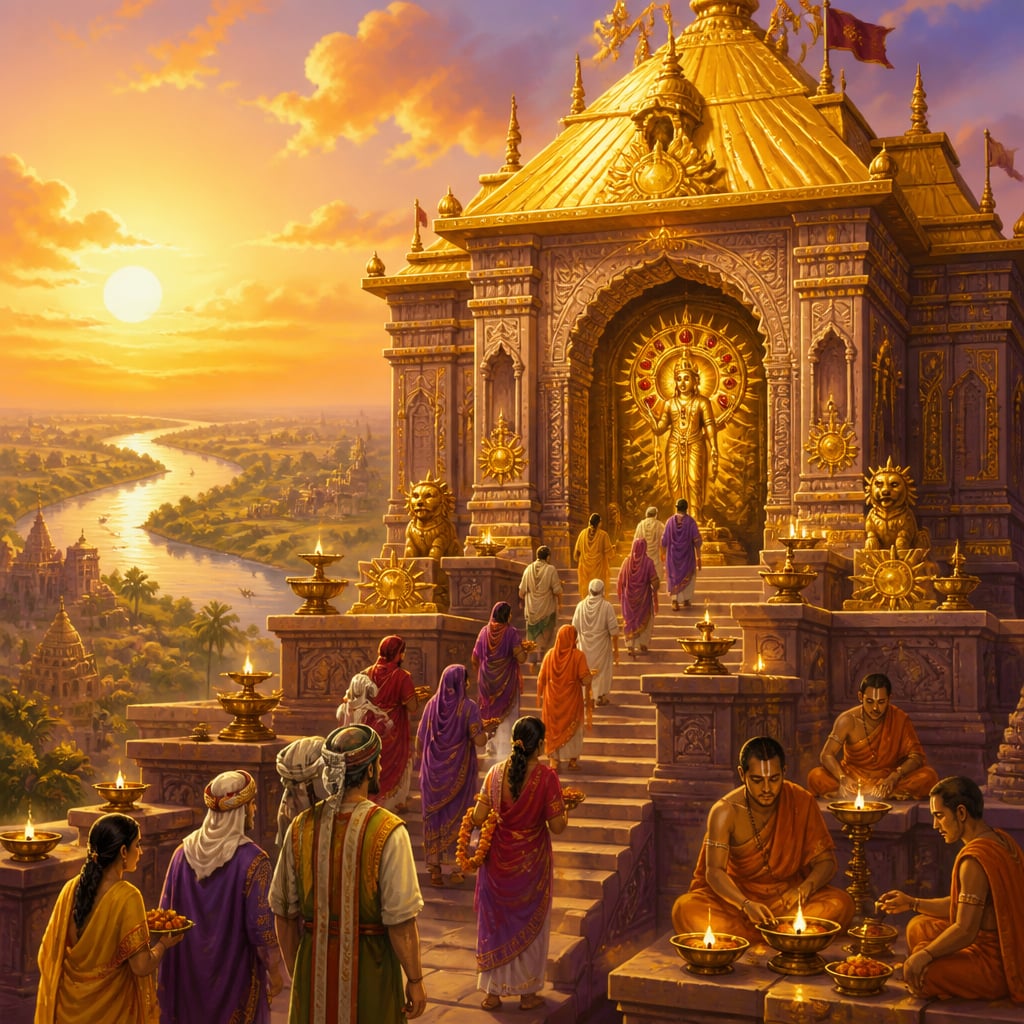
The golden Sun Temple of Multan at evening light

But the temple was more than wealth. A college of learned Brahmin priests maintained complex rituals aligned with astronomical observations - the temple functioned as an observatory where the movements of sun, moon, and stars were tracked with precision. Scholars debated Vedic cosmology and solar theology in the temple's shaded courtyards. Pilgrims came seeking healing - Surya worship was particularly associated with curing disease, and the temple priests practiced traditional medicine alongside their ritual duties.

The temple also served economic functions. The pilgrimage economy supported entire neighborhoods of Multan - merchants selling offerings, innkeepers housing travelers, artisans crafting religious souvenirs. The temple's treasury received donations from across the known world, making it one of the wealthiest institutions in South Asia.

When Muhammad bin Qasim conquered Multan in 712 CE, he stripped the temple of its treasures - gold, jewels, and precious offerings accumulated over centuries. Within a generation, the ancient shrine was destroyed and a mosque built in its place. Today, only descriptions in Arab chronicles and Hindu texts preserve the memory of what was lost.

"At the western gate of Bharat, the Sun God watched over land and people, his temple a lighthouse of dharma in the gathering darkness."

The Buddhist Heritage

Xuanzang received at a Sindhi Buddhist monastery

When the Chinese pilgrim Xuanzang visited Sindh around 641 CE - just decades before Dahir's birth - he found a flourishing Buddhist community. His account describes multiple monasteries (viharas) housing thousands of monks engaged in study, meditation, and teaching.

Sindh had been Buddhist for centuries. The Mauryan emperor Ashoka had established the faith here in the 3rd century BCE, erecting stupas and rock edicts that still stood in Dahir's time. Merchants, monks, and ideas moved along the Uttarapatha (northern trade route) that passed through Sindh, connecting Indian Buddhism to Central Asia and China.

By Dahir's time, Buddhism coexisted peacefully with resurgent Hinduism. The Brahmin dynasty were personally Shaivite, but they protected Buddhist institutions through royal grants and legal recognition. The monasteries were not just religious centers but universities where monks studied logic, medicine, astronomy, and languages alongside Buddhist philosophy. Foreign monks traveled to Sindh to study Sanskrit texts; Sindhi monks carried Buddhist teachings to Tibet and China.

The monastic libraries held irreplaceable manuscripts - sutras copied over centuries, commentaries by famous teachers, treatises on medicine and astronomy. The monks maintained hospitals serving the poor regardless of caste or creed - a practical expression of Buddhist compassion.

This world ended abruptly with the Islamic conquest. Buddhism, with its monastic institutions and easily identifiable clergy, was particularly vulnerable to conquest. The monasteries were destroyed or converted. Monks who did not flee were killed or forcibly converted. Libraries were burned, their contents forever lost. Within a century, Buddhism - which had flourished in Sindh for nearly a millennium - vanished completely from the region.

Jain Communities

Less visible than temples and monasteries, but equally important, were Sindh's Jain communities. By the 7th century, Jain merchants dominated certain sectors of trade, particularly the valuable gem and textile commerce. Their networks extended from Sindh to Gujarat, Rajasthan, and beyond.

Jain communities maintained upashrayas (lay temples) and supported itinerant monks who wandered barefoot according to ancient tradition. The Jain principle of ahimsa (non-violence) made them excellent merchants and mediators - disputes were resolved through negotiation rather than litigation. Their strict ethical codes made them trusted partners in long-distance trade. Some courtiers in Dahir's administration may have been Jain - the community produced excellent administrators known for honest record-keeping and financial acumen.

The Jains also contributed to intellectual life. Jain scholars preserved texts on logic, grammar, and mathematics. Their libraries contained not just religious texts but works on astronomy, medicine, and philosophy.

Like Buddhism, Jainism vanished from post-conquest Sindh. The merchant communities either converted or migrated eastward into Gujarat and Rajasthan, where their descendants still thrive today.

The Court of Learning

Chach, Dahir's father, was himself a Brahmin - a member of the priestly and scholarly class. Though he seized power through force, he retained pride in his intellectual heritage. His court attracted scholars, poets, and theologians. Dahir continued this patronage.

Sanskrit pandits at Dahir's court library

Sanskrit pandits (scholars) received grants to maintain and copy manuscripts. The court poet composed in both Sanskrit and the regional Sindhi language. This was not a unified system but a pluralistic landscape where different traditions coexisted.

Kings played a crucial role by patronizing learning without enforcing uniformity. Dahir, a Shaivite, supported Buddhist monasteries and employed Jain administrators while maintaining Brahmin priests. This religious pluralism was fundamental to pre-Islamic Sindhi civilization.

Arts and Culture

Sindh was not just a crossroads of religion but of cultures. Persian influences mixed with Indian, creating distinctive Sindhi artistic traditions.

Music flourished at court and temple. The veena and various drums accompanied devotional and courtly performances. Arab chroniclers later noted that Sindhi musicians were prized throughout the Islamic world.

Poetry existed in multiple languages. Courtly Sanskrit kavya followed classical models, while regional Sindhi poetry was developing, blending Sanskrit literary techniques with local themes.

All this creative ferment depended on political stability and royal patronage. When conquest shattered that stability, the cultural ecosystem collapsed.

What Was Lost

When we assess Dahir's cultural patronage, we must remember that we judge from fragments. The manuscripts are mostly gone, burned or lost. The temples are rubble or memories. The artistic traditions ceased and were forgotten.

Archaeologists working in Sindh today find traces of what was: temple foundations, Buddhist monastery ruins, inscriptions in scripts no one locally can read.

Dahir was not a great innovator in arts or learning. His significance is different: he maintained, protected, and patronized a rich cultural heritage at the moment before its destruction. He was the last guardian of a tradition that would not survive his defeat.

The Refugee Legacy

Not everything was lost. The conquest created waves of refugees - Brahmins fleeing east into Rajasthan and Gujarat, Buddhist monks scattering to Kashmir and beyond, Jain merchants relocating to safer territories. These refugees carried Sindhi traditions with them.

Some Sanskrit manuscripts survived because fleeing scholars carried them. Certain temple rituals practiced in Rajasthan preserve Sindhi forms. The diaspora preserved fragments of what was destroyed at home.

Dahir's patronage was not entirely futile. The Sindhi Brahmins who fled eastward maintained their identity for centuries - even today, there are Sindhi Hindu communities who trace their ancestry to those refugees. They are living links to the pre-Islamic Sindh that Dahir governed and lost.

Historical context

7th-8th Century CE

The 7th-8th centuries saw Indian civilization at a crossroads. In the east and center, the post-Gupta period saw regional kingdoms flourish. But in the northwest, Islamic expansion was approaching - Persia had fallen, Central Asian kingdoms were under pressure, and Sindh stood directly in the path of conquest.

Living traditions

The cultural world that Dahir patronized was so thoroughly destroyed that it survives mainly in memory and fragments. Sindhi Hindu communities in India preserve language, festivals, and cultural traditions that link back to pre-Islamic times.

Reflection

More in Raja Dahir

All lessons in Raja Dahir ยท Lesser Known Guardians of Dharma course