The Brahmin Dynasty of Sindh

Chach's Rise and Dahir's Inheritance

In the 7th century, the fertile valley of the Sindhu River witnessed a remarkable transformation. Chach, a Brahmin minister of extraordinary capability, rose to become king of Sindh and established a dynasty that would rule one of India's wealthiest regions. His son Raja Dahir inherited a prosperous kingdom at the crossroads of civilizations - unaware that he would become the last Hindu ruler to stand against the rising tide of Islamic conquest.

The Land Where Rivers Meet the Sea

The Sindhu - the mighty river that gave India its name - flows through a vast delta before emptying into the Arabian Sea. In the 7th century CE, this region known as Sindh was among the wealthiest in all of India. Its capital Alor (near modern Rohri in Pakistan) commanded the vital trade routes connecting India to Persia, Central Asia, and the Arabian Peninsula.

Geographically, Sindh occupied a position of immense strategic importance. To its west lay the mountain passes leading to Persia and beyond. To its east, the Thar Desert separated it from Rajputana and the Indian heartland. The Sindhu River itself served as both highway and barrier - boats carried goods up and down its length, while its flooding plains created rich agricultural land that supported a dense population.
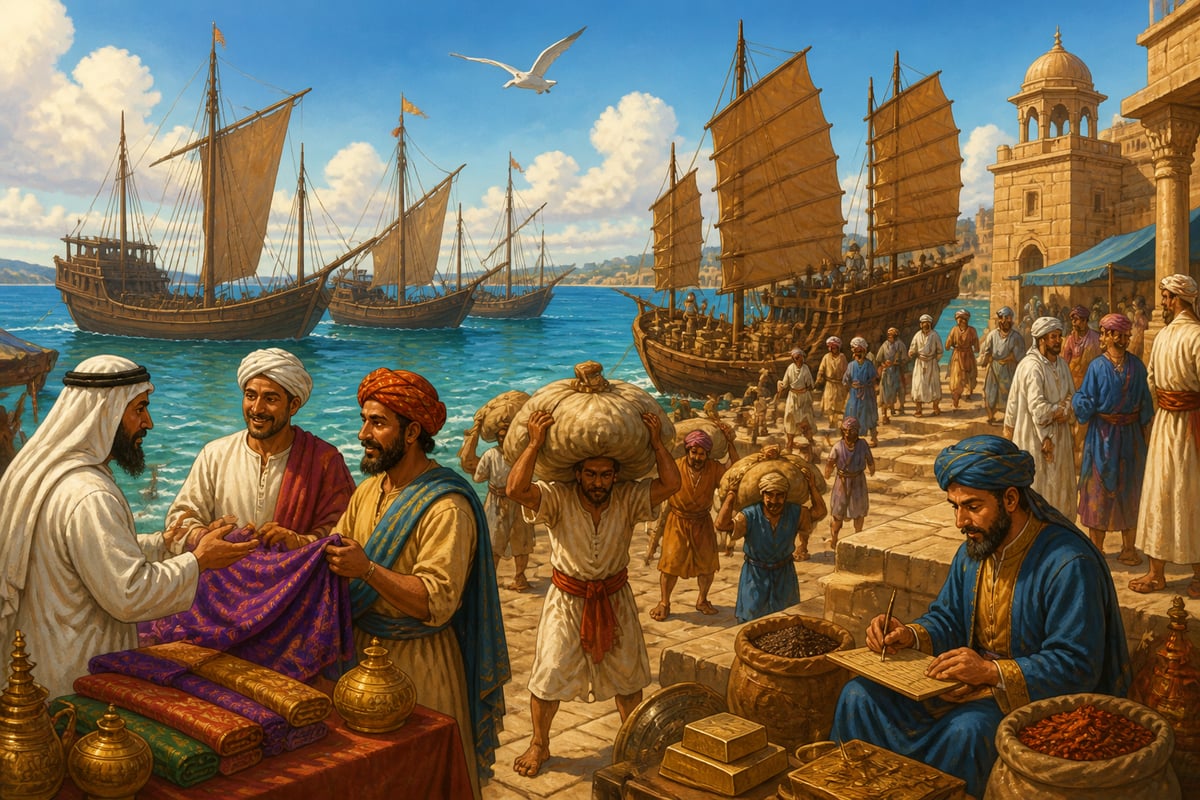
Ships unloading at the port of Debal

The port of Debal (near modern Karachi) saw ships from across the known world. Arab merchants brought gold and silver; Persian traders carried carpets and metalwork; Indian ships departed laden with spices, textiles, and the finest steel. The harbor could accommodate hundreds of vessels, and warehouses along the waterfront held goods worth fortunes. Buddhist monasteries dotted the landscape alongside Hindu temples and Jain shrines - Sindh was a land where diverse faiths coexisted in harmony.

The region's wealth derived from multiple sources. Agriculture flourished in the irrigated plains - rice, wheat, sugarcane, and cotton grew abundantly. Sindhi horses were prized across the subcontinent. The textile workers of Sindh produced cotton cloth famous from Arabia to China. And the customs duties from Debal alone generated revenues that most kingdoms could only dream of.

But political stability had proven elusive. By the early 7th century, a Rai dynasty of Buddhist rulers governed Sindh, but their hold was weakening. Local chiefs asserted independence, neighboring tribes raided with impunity, and no strong hand guided the realm. Into this uncertain world stepped a man whose brilliance would reshape the region's destiny.

The Minister Who Became King

Chach was born into a Brahmin family in Alor around 600 CE. His father had served as a minister, and young Chach inherited both his position and his formidable administrative talents. The chronicles tell us he was learned in Sanskrit scriptures, skilled in statecraft, and possessed of uncommon courage - a rare combination of vidyā (knowledge) and śaurya (valor).

When Rai Sahasi II, the Buddhist king of Sindh, died around 632 CE, he left behind a kingdom in transition and a widow, Queen Suhandi. Within a short time, Chach had married the queen and assumed the throne of Sindh. The Chachnama - a later Persian account of Sindh's history - presents it as a natural transition, with the queen recognizing Chach's superior capabilities.

Chach the Brahmin minister crowned king of Sindh at Alor

"Through wisdom and valor combined, the Brahmin minister ascended to the throne, and Sindh knew peace and prosperity once more."

Unifying the Sindhu Valley

Chach's first task was to consolidate his authority. The Buddhist aristocracy resented the change, local chiefs tested his resolve, and neighboring kingdoms sensed opportunity in Sindh's political transition.

Chach responded with a combination of diplomatic skill and military force that became his trademark. He confirmed existing land grants to Buddhist monasteries, reassuring the religious establishment. When the Jat tribes of lower Sindh rose in rebellion, Chach defeated them in a series of campaigns and - crucially - integrated them into his army rather than merely subjugating them. This policy of inclusion would strengthen his military capabilities enormously.

To the north and west, the hill tribes of Kikan and the rulers of Siwistan challenged his authority. Chach campaigned methodically, capturing fortress after fortress, until the entire Sindhu valley acknowledged his sovereignty. By 640 CE, Sindh was unified under a single ruler for the first time in generations.

The Brahmin Kshatriya

Chach's success posed a philosophical problem: how could a Brahmin, born to the priestly varna, legitimately wield royal power? The role of king - rājā - belonged to the Kshatriya varna, the warrior-rulers.

Chach declared himself a Brahma-Kshatriya - a Brahmin who had taken up the duties of a Kshatriya. Precedent existed: sage Parashurama had been a Brahmin warrior. The Manusmriti acknowledged that in times of crisis (āpad-dharma), the normal rules could be adapted.

More importantly, Chach lived the role. He performed Vedic sacrifices befitting a great king. He governed according to dharma, establishing courts and ensuring justice. The people accepted him because he fulfilled the king's fundamental duties: protection (rakṣaṇa), justice (nyāya), and prosperity (abhyudaya). In Indian political thought, legitimacy ultimately rested on performance, not birth.

The Capital at Alor

Alor became the jewel of Chach's kingdom. Situated on the east bank of the Sindhu where the river was easily fordable, it controlled both trade and military movement along the valley.

Chach expanded and fortified the city. Massive walls rose around the urban core. Temples to Surya (the sun god) and other deities proclaimed the dynasty's devotion. Markets bustled with merchants from three continents. Buddhist viharas stood near Hindu temples, testimony to Sindh's religious pluralism.

Sindh's agricultural productivity was legendary - the Sindhu's annual floods deposited rich silt, allowing multiple harvests. The region produced cotton, sugar, and rice in abundance. When Chach died around 671 CE after nearly forty years of rule, Sindh was arguably the most prosperous region between Persia and the Indian heartland.

Dahir Ascends the Throne

Chach left behind two sons: Chandar, the elder, and Dahir, the younger. Chandar inherited the throne but his reign was brief - perhaps only seven or eight years. Around 679 CE, Chandar died suddenly, leaving the throne to his younger brother.

Young Raja Dahir ascending the throne at Alor

Raja Dahir inherited a prosperous, stable kingdom at the height of its power. He was perhaps in his late twenties or early thirties - a mature man, trained in both statecraft and warfare. He also inherited Chach's most important legacy: an efficient administration staffed by capable officials, a well-trained army with strong cavalry, and a full treasury.

Dahir continued his father's policies of religious tolerance and cultural patronage. He supported both Hindu and Buddhist institutions. He maintained the trade networks that enriched Sindh. For the first two decades of his reign, Dahir ruled successfully. Arab sources acknowledge his kingdom's wealth and military strength.

The Gathering Storm

Yet even as Dahir consolidated his rule, forces beyond his control were reshaping the world. To the west, the Umayyad Caliphate was expanding in all directions. Arab armies had conquered Persia, Central Asia, North Africa, and Spain. Only India remained largely untouched.

Small-scale Arab raids on Sindh's coast had occurred since the 640s, during Chach's reign. These had been repelled relatively easily. But by the early 8th century, the nature of these incursions was changing. The raids were becoming more frequent, better organized, and increasingly backed by the Caliphate's resources.

Dahir, like most Indian rulers of his time, didn't fully grasp what was coming. He couldn't foresee that he would face not mere raiders but the vanguard of a civilization that had conquered from Spain to Central Asia in just seventy years.

As the 7th century turned to the 8th, Raja Dahir ruled from Alor over a kingdom his father had built. The Brahmin dynasty of Sindh stood at its zenith - wealthy, militarily strong, culturally vibrant, and religiously diverse. None could have known that within a decade, everything would change. The last great Hindu kingdom of northwestern India was about to face its gravest test.

Historical context

Mid-to-Late 7th Century CE

Northern India was fragmented after Harsha's empire collapsed in 647 CE. The Pratihara, Pala, and Rashtrakuta dynasties were emerging but not yet dominant. In the Deccan, the Chalukyas and Pallavas competed for supremacy. Northwestern India - including Sindh, Kashmir, and the Punjab - remained relatively independent and prosperous through trade. China's Tang Dynasty maintained contact with Indian kingdoms via the Silk Road.

Living traditions

Raja Dahir remains a complex figure in modern South Asian memory. In Pakistan, he is sometimes portrayed as a oppressive ruler justly defeated, while others see him as a tragic figure of Sindh's pre-Islamic heritage. In India, he is increasingly recognized as a brave defender of Hindu civilization against foreign invasion. The story of Chach and Dahir reminds us of Sindh's sophisticated Hindu-Buddhist culture before the Islamic conquest - a reminder that regions now identified with one civilization have often been home to others. The religious tolerance of Chach's dynasty stands as a model of pluralism worth remembering.

Reflection

More in Raja Dahir

All lessons in Raja Dahir · Lesser Known Guardians of Dharma course