The Statesman of Sindh
Governance and Diplomacy at the Gateway of India
From his capital at Alor, Raja Dahir governed one of the wealthiest kingdoms in 8th-century India. The great port of Debal connected Sindh to the maritime silk road, bringing prosperity to his realm. Yet despite his administrative achievements, Dahir remained diplomatically isolated - a vulnerability that would prove fatal when crisis came from an unexpected direction.
The Capital at Alor
The city of Alor (modern Rohri, near Sukkur) sat on the banks of the mighty Indus, commanding the river crossings that were the lifeblood of Sindhi trade and communication. Here, Raja Dahir maintained his royal court - not in the ancient style of isolated fortress-palaces, but in a capital that was both administrative center and commercial hub.
The Chachnama, our primary source for Dahir's reign, describes Alor as a prosperous city where merchants from distant lands mingled with local traders, where Buddhist monasteries stood alongside Hindu temples, and where the king's diwan (court) dispensed justice according to established law. The city's walls stretched for miles, enclosing not just the royal complex but extensive residential quarters, merchant districts, and religious precincts.
Dahir's palace complex housed not just the royal family but the machinery of government. Revenue records were maintained on palm-leaf manuscripts by trained scribes. Disputes were adjudicated by judges learned in dharmashastra law. Appointments to provincial governorships were made with careful consideration of loyalty and capability. The king was not merely a warrior who extracted tribute, but an administrator who understood that lasting power required systematic governance.
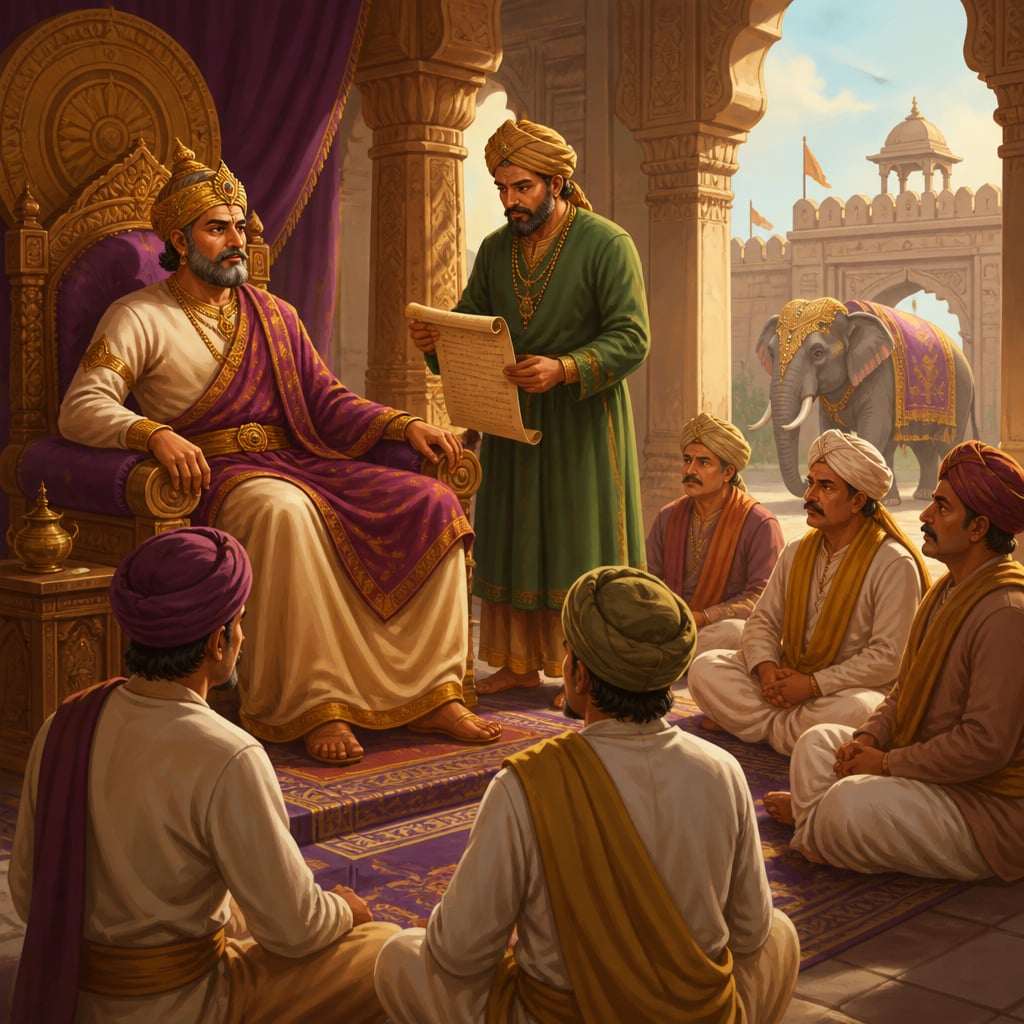
The royal court convened regularly, with officials reporting on matters ranging from crop yields to military readiness. Foreign embassies were received with appropriate ceremony. Brahmin priests performed daily rituals to ensure the realm's prosperity and the king's dharmic authority.
"Raja Dahir's realm was well-ordered, the merchants prospered, and the dharma was upheld in the land."
The Port of Debal: Gateway to the World
If Alor was Sindh's political heart, Debal (near modern Karachi) was its economic engine. This great port city handled the maritime trade that made Sindh wealthy - pepper and textiles from southern India, horses from Arabia, silk from China, and Sindhi cotton cloth prized across the Indian Ocean world.
The harbor at Debal could accommodate dozens of oceangoing vessels simultaneously. Warehouses along the waterfront stored goods worth fortunes - bolts of silk awaiting shipment to Persia, bales of cotton cloth destined for Arabia, spices from Kerala being transferred to overland caravans. The city's population was cosmopolitan: Hindu and Buddhist Sindhis, Arab and Persian merchants, traders from as far as China and East Africa.

The Chachnama records that Debal housed a magnificent Buddhist stupa and monastery that served as a landmark for sailors approaching from the Arabian Sea. The stupa's gilded spire could be seen from far out at sea, guiding ships safely to harbor. The presence of such Buddhist institutions in a Hindu-ruled kingdom testified to Dahir's inclusive governance.
The customs revenues from Debal alone filled a significant portion of the royal treasury. Arab merchants had been trading at Debal for generations, paying duties to Sindhi kings in exchange for access to Indian goods. A sophisticated system of weights, measures, and currency exchange facilitated commerce across cultural boundaries.
The Administration of Sindh
How did the Brahmin dynasty govern Sindh? The evidence suggests a sophisticated system adapted to the region's diversity.
Revenue Collection - Land revenue formed the primary income, supplemented by customs duties and taxes on trade. The system followed traditional Indian patterns: land was surveyed by royal officials, productivity assessed based on soil quality and irrigation access, and taxes collected as a share of harvest - roughly one-sixth of produce, the rate sanctioned by dharmashastra texts. This moderate rate, combined with efficient collection, ensured both royal income and peasant prosperity. Grain taxes were stored in state granaries against famine years.
Local Governance - Sindh's regions were administered through appointed governors responsible to the king. These officials maintained order, collected revenue, and commanded local militia, balancing central authority with regional autonomy. Regular reports flowed to Alor, and underperforming governors were replaced. Yet local chiefs retained substantial powers over village affairs, creating a layered system that respected tradition while ensuring central control.
Multi-Religious Society - Perhaps Dahir's most notable achievement was governing a religiously diverse realm without significant conflict. Hindus formed the ruling elite, but Buddhists were numerous and prominent in commerce. Jain merchants controlled significant portions of the textile and gem trade. Zoroastrian refugees from Persia had settled in coastal cities. This pluralism was pragmatic - Sindh's wealth depended on trade, and merchants of all faiths were welcome. Each community governed its internal affairs according to its own traditions.
Legal System - Justice was dispensed according to dharmashastra for Hindus and Buddhist vinaya for Buddhist communities. Commercial disputes between communities were resolved by royal judges applying principles of equity. The Chachnama records several instances of Dahir personally hearing cases, suggesting active royal involvement in justice. Appeals could be made to the king himself, who held regular court to address grievances.
Military Organization - Dahir maintained a substantial military force including cavalry, infantry, and war elephants. The cavalry drew heavily from the Jat tribes his father had integrated into the kingdom. Fortresses guarded key river crossings and mountain passes. However, Sindh's military was designed for defense against traditional threats - raids from tribal neighbors, not sieges by armies equipped with advanced siege technology.
The Fatal Isolation
Despite Sindh's prosperity, Dahir's diplomatic position was precarious. Sindh stood alone. When crisis came, no cavalry would ride from Kashmir to aid him. No alliance treaty bound Gujarat to his defense.
Why this isolation? Several factors converged.
First, geography. Sindh was distant from the main centers of Indian political power. The Thar Desert separated it from Rajasthan and Gujarat.
Second, the Brahmin dynasty's controversial origins. Dahir's father Chach had seized power, displacing the previous Buddhist Rai dynasty. This usurpation left some questioning the family's legitimacy.
Third, complacency born of prosperity. Sindh was wealthy and well-defended by geography. For generations, no major threat had emerged. Why invest in distant alliances when none seemed necessary?
The Arab Frontier
Yet a threat was emerging - one that Dahir recognized too late.
Arab forces had reached Sindh's western frontier by the 660s. Initial raids were repulsed. But by the early 8th century, the nature of these incursions was changing - more frequent, better organized, and increasingly backed by the Caliphate's resources.
In 711 CE, the Umayyad governor of Iraq, Al-Hajjaj ibn Yusuf, would dispatch an expedition to Sindh under the young commander Muhammad bin Qasim. The stated cause - piracy against Arab ships - may have been pretext. The real motive was likely strategic: control of Debal would give the Umayyads a foothold in the fabulously wealthy Indian trade.
Dahir prepared his defenses but sought no allies. Perhaps he believed that Sindh's natural barriers and his own military strength would suffice. By the time the true danger became clear, it was too late.
The Legacy of Administration
Dahir's administrative legacy outlasted his military defeat. When Muhammad bin Qasim conquered Sindh, he largely maintained the existing revenue system, kept many officials in place, and continued the policy of religious toleration - at least initially. Arab governors found that Dahir's tax rates were fair and his administrative structures efficient. Why change what worked?
This is perhaps the ultimate tribute to Dahir's statecraft. The system he governed - the revenue collection, the local administration, the commercial framework - proved robust enough to survive regime change and serve new masters. Good governance transcends individual rulers.
Yet we must acknowledge Dahir's strategic failure alongside his administrative success. He built a kingdom but not a coalition. He maintained prosperity but not alliances. When the storm came, Sindh faced it alone. The lesson is clear: internal excellence is no substitute for external relationships. A kingdom, like a company, needs both operational strength and strategic partnerships to survive existential threats.
Historical context
700-711 CE
Early 8th-century India was politically fragmented but culturally flourishing. Kashmir's Lalitaditya was building a northern empire. Buddhist and Hindu learning centers like Nalanda and Kanchi thrived. Maritime trade connected India to Southeast Asia, China, and the Middle East.
Living traditions
Dahir remains a complex figure in modern memory. For Sindhi Hindus, he represents the last independent Hindu ruler before the region's Islamization. Historians debate his strategic choices while acknowledging his administrative competence.
- Rohri (Ancient Alor): The site of Dahir's capital city. Archaeological excavations have revealed remains of the ancient city including fortifications, residential areas, and evidence of the thriving urban center.
- Banbhore (Ancient Debal): The archaeological site of ancient Debal, the great port city. Excavations have uncovered the Buddhist stupa mentioned in historical sources and evidence of extensive maritime trade.
- Brahmanabad Archaeological Site: Remains of one of Sindh's major cities during Dahir's reign. The site includes temple foundations and inscriptions documenting the administrative and religious life of pre-Islamic Sindh.
Reflection
- Dahir's administrative system survived his military defeat - Arab governors retained it because it worked. What does this suggest about the relationship between hard power (military strength) and soft power (effective governance)?
- Dahir practiced sarvadharma-samabhava - equal respect for all religions - in a time when religious exclusivity was common elsewhere. Was this tolerance a strength that created stability, or a weakness that prevented unified resistance?
- Dahir's diplomatic isolation proved fatal when unexpected crisis came. In your own professional or personal life, are you building relationships before you need them?