The Dharma of a King
Rajadharma, Svadharma, and the Philosophy of Noble Defeat
What philosophical framework guided Dahir's impossible choice? This lesson explores the dharmic principles of rajadharma and svadharma that shaped the last Hindu king of Sindh, revealing why death seemed preferable to compromise. It also examines the tolerant civilization he defended and the philosophy that makes noble defeat preferable to dishonorable survival.
The Question That Defines a Life
In the weeks before the Battle of Aror, Raja Dahir faced a question that would define his legacy: flee or fight?
According to the Chachnama, his vizier approached him with urgent counsel: "You should say to the neighboring kings, 'I am a wall between you and the Arab army. If I fall, nothing will stop your destruction at their hands.'" The vizier urged Dahir to seek refuge with friendly rulers in India, or at least send his family to safety. Dahir's response revealed his character: "I cannot send away my family to security while the families of my thakurs and nobles remain here." If his people must face the storm, he would face it with them.
His advisors surely laid out the options in the royal council. He could retreat eastward across the Thar Desert to the Rajput kingdoms, preserving his family and rebuilding strength for a future campaign. He could negotiate surrender - Muhammad bin Qasim had accepted the submission of other rulers who kept their territories in exchange for tribute and acknowledgment of Caliphal authority. He could even convert to Islam, as some Indian chiefs would later do, maintaining power under new masters while abandoning ancestral faith.
Each option offered survival. Each came with costs. Retreat meant abandoning his people to foreign rule. Negotiated surrender meant acknowledging the supremacy of a faith that demanded the destruction of everything he had sworn to protect. Conversion meant betraying his identity as a Brahmin king, guardian of dharma.
Dahir chose none of these paths. He chose to fight a battle he likely knew he would lose, to die defending a kingdom he could not save. To understand this choice, we must understand the philosophical framework that shaped it.
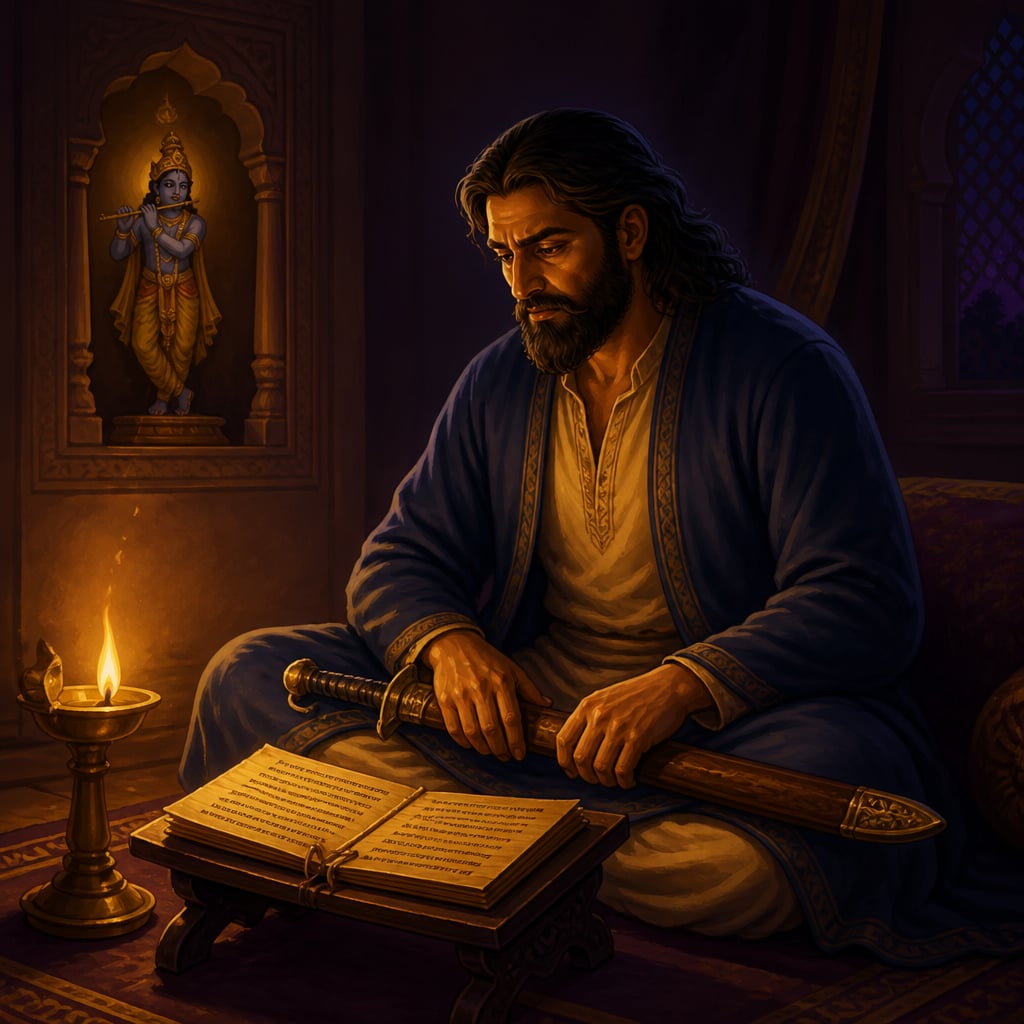
Rajadharma and Svadharma: The Dharmic Framework
At the heart of Dahir's choice lay the concept of rajadharma - the sacred duty of a king. The king's fundamental duty was rakshana - protection. The Arthashastra states: "In the happiness of his subjects lies the king's happiness; in their welfare, his welfare." But protection meant more than physical security. A king protected dharma itself - the cosmic order that sustained civilization. He protected the temples and the Brahmins who maintained Vedic rituals. He protected the very idea of Hindu kingship as a sacred institution.
When Muhammad bin Qasim offered terms, he was asking Dahir to abandon this duty. Surrender meant acknowledging Islamic authority over Hindu sacred space. Conversion meant betraying the very dharma he was sworn to protect. Flight meant abandoning the people who depended on his protection.
"The king is not merely a ruler but a guardian of the cosmic order. His crown is a burden, his throne a seat of sacrifice."
The Bhagavad Gita teaches: "Better one's own dharma, though imperfect, than another's dharma well performed. Better death in one's own dharma; another's dharma brings only danger." This is the principle of svadharma - that each person has their own path, their own nature, their own duty. To abandon it, even for apparent advantage, is to lose oneself.
Dahir was born a Brahmin, but he lived as a Kshatriya. His father Chach had declared himself a Brahma-Kshatriya - a warrior-king from the priestly class. Dahir inherited not just a kingdom but this hybrid identity, combining the Brahmin's knowledge of dharma with the Kshatriya's duty to fight. To convert or flee would be to deny his very nature.
The Tolerant Civilization He Defended
To understand what Dahir fought to preserve, we must understand the civilization he embodied - a tradition of remarkable religious tolerance. Sindh under Chach and Dahir was home to Hindus, Buddhists, and Jains living in relative harmony. What enabled this tolerance? Several dharmic principles:
Ekam sat vipra bahudha vadanti - "Truth is one; the wise call it by many names." This Rigvedic verse established that different paths could lead to the same ultimate reality. The doctrine of ishta-devata - Each person's chosen deity is valid for them. What matters is sincerity of devotion, not uniformity of belief. The principle of lokasangraha - Holding the world together. The king's duty was to maintain social cohesion, not to impose religious uniformity.
Dahir inherited and maintained this tolerant tradition. His resistance was political and cultural, not religious persecution disguised as defense.
The Problem of Certain Defeat and the Gita's Answer
But here's the troubling question: does rajadharma require a king to fight when defeat is certain? Traditional dharmic texts offer different perspectives. The heroic view: The Rigveda praises warriors who die in battle: "Those who fall in righteous combat ascend directly to the heavens." The pragmatic view: The Arthashastra counsels flexibility: "When weak, make peace; when strong, make war." The absolutist view: Some texts suggest that certain principles admit no compromise. A king who surrenders his kingdom to mlecchas (foreign invaders outside the dharmic fold) betrays his fundamental duty.
Dahir appears to have embraced the absolutist view. At the deepest level, his choice reflected the Gita's central teaching about action: "You have a right to perform your prescribed duty, but you are not entitled to the fruits of action." This is karma-yoga - the yoga of selfless action. One performs duty without attachment to outcomes. Victory or defeat - these are not within our control. What is within our control is whether we do our duty. Dahir's duty was to defend his kingdom. He could not control whether that defense would succeed. He could only control whether he would fight.
The Philosophy of Noble Defeat
Western military philosophy often quotes: "He who fights and runs away lives to fight another day." But dharmic philosophy recognizes a different kind of victory - the victory of maintaining one's integrity even in defeat. This is the idea behind dharma-yuddha, righteous warfare, where how you fight matters more than whether you win.

The Mahabharata's great war ends with the Pandavas victorious but devastated. Meanwhile, Karna dies in defeat but is remembered as one of the epic's noblest characters - a warrior who never compromised his code. Dahir's defeat was total - his kingdom lost, his dynasty ended. Yet he is remembered with respect even by his enemies. The Chachnama, written to celebrate the Arab conquest, cannot help but admire his courage.
This is the philosophy of noble defeat: that there are things worth dying for even when you cannot win. That integrity maintained in the face of overwhelming odds has its own kind of victory.
What Would You Choose?
Imagine yourself in Dahir's position. You have ruled justly for decades. Now an overwhelming force threatens everything you have built and everything you have sworn to protect.
You can flee and preserve your life - but abandon your people to conquest. You can convert and preserve your power - but betray your identity and faith. You can negotiate and preserve some autonomy - but acknowledge the supremacy of those who would destroy your temples. Or you can fight knowing you will lose - but maintain your integrity to the end.
The question admits no universal answer because it depends on what you value most: survival, power, autonomy, or principle. Each choice has costs. Each choice has consequences. Dharmic philosophy says: know your svadharma, your own nature and duty, and follow it without attachment to results. For Dahir, that meant fighting. For another person in different circumstances, it might mean something else entirely.
Dahir performed his duty. The fruits were bitter - his kingdom lost, his dynasty ended, his people conquered. But the duty was performed. And perhaps that is the only victory that ultimately matters: not whether we win, but whether we remain true to who we are.
Historical context
Early 8th Century CE
Early 8th century India was politically fragmented after Harsha's empire collapsed. Regional powers were emerging - Pratiharas in the west, Palas in the east, Rashtrakutas in the Deccan - but no unified resistance to external invasion existed. Sindh stood alone against the Arab advance.
Living traditions
The philosophical questions Dahir faced - when to stand firm, when to adapt, what principles justify ultimate sacrifice - remain relevant for anyone facing pressure to compromise core values.
- Bhagavad Gita Study Centers: To understand the philosophical framework that guided Dahir's choice, visit centers devoted to studying the Bhagavad Gita - especially the teachings on svadharma and karma-yoga.
- Kurukshetra: The battlefield where Krishna delivered the Bhagavad Gita to Arjuna. Visiting this site connects you to the philosophical tradition that shaped Dahir's understanding of duty and sacrifice.
- Chittorgarh Fort: Though built after Dahir's time, Chittorgarh represents the continuation of the resistance he began. Here, later Rajput queens chose jauhar rather than surrender, following the precedent set by Rani Ladi.
Reflection
- The Bhagavad Gita teaches 'Better death in one's own dharma than another's dharma well-performed.' How do you interpret this teaching? Is it calling for rigidity, or for authenticity?
- The Arthashastra counsels pragmatic flexibility ('When weak, make peace'), while the Gita counsels adherence to duty regardless of outcomes. These seem to conflict. How might a thoughtful leader reconcile these different wisdom traditions?
- Dahir understood his svadharma clearly enough to die for it. In your own life, how clearly do you understand your svadharma - your own unique nature, duties, and path?