The Statesman
Building an Empire Through Administration and Diplomacy
Discover how Lalitaditya transformed military conquests into effective governance. Through administrative reforms, strategic diplomacy, and the establishment of systems that transcended any single campaign, he proved himself not just a warrior but a statesman who could consolidate power and create lasting institutions across his vast empire.
From Conquest to Consolidation
A king can conquer with the sword, but only a statesman can rule with wisdom. As Lalitaditya's empire expanded from the mountains of Afghanistan to the plains of Bengal, he faced a challenge greater than any military campaign: transforming conquered territories into a functioning empire. This required skills different from those that won battles, the ability to administer, negotiate, compromise, and build systems that would outlast any individual ruler.
Lalitaditya proved equal to this challenge, demonstrating that his genius extended beyond the battlefield to the council chamber.
The Challenge of Empire
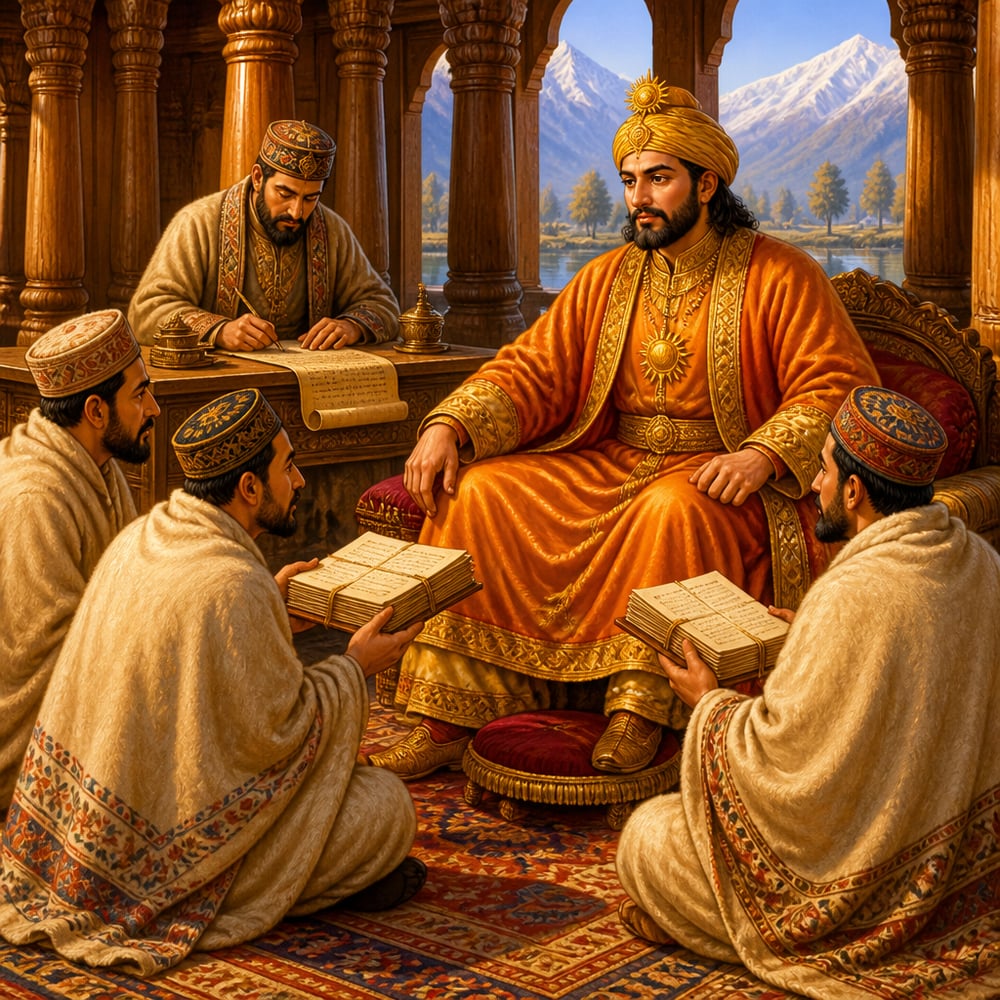
By the 740s CE, Lalitaditya ruled over territories more vast and diverse than any Kashmiri king before him. His empire encompassed multiple ethnicities, languages, and religions, mountain kingdoms and river valleys, urban centers and pastoral lands, Buddhist monasteries and Hindu temples, trading cities and military outposts.
Each region had its own traditions, its own power structures, its own expectations of governance. Simply imposing Kashmiri administration everywhere would invite rebellion. Yet allowing complete local autonomy would undermine central authority and invite fragmentation. Lalitaditya had to find a middle path, strong enough to maintain unity, flexible enough to accommodate diversity.
Administrative Innovation
Lalitaditya's administrative system reflected sophisticated political thinking. At the empire's core, Kashmir itself, he maintained direct royal administration through officials appointed by and accountable to the crown. These officials oversaw taxation, justice, public works, and military recruitment. Regular inspections and detailed record-keeping ensured accountability.
In conquered territories, Lalitaditya employed a more nuanced approach. Where he had defeated kings, he often allowed them to continue ruling as subordinate allies, acknowledging Kashmir's supremacy and paying tribute but retaining local authority. This indirect rule minimized administrative costs and local resistance while ensuring strategic loyalty.
In strategically crucial regions, particularly those controlling trade routes or border areas, he established more direct control. Kashmiri officials worked alongside local administrators, gradually integrating these territories into the imperial system. Military garrisons ensured compliance, but Lalitaditya understood that long-term stability required earning consent, not just enforcing obedience.
The Tax System
No empire can function without revenue, and Lalitaditya's military campaigns required substantial funds. Yet excessive taxation would impoverish his subjects and invite rebellion.
Kalhana describes a tax system that was demanding but not crushing. Agricultural taxes were assessed based on land quality and productivity, ensuring fairness while generating revenue. Trade was taxed at moderate rates to encourage commerce. Conquered territories paid tribute calibrated to their wealth, extracting resources without destroying the productive base.

Crucially, Lalitaditya invested tax revenues visibly in public goods: temples, irrigation works, roads, rest houses for travelers. This demonstrated that taxation served the common good, not just royal luxury, building legitimacy for the fiscal demands he made.
Diplomacy and Alliances
Lalitaditya understood that military force alone could not sustain an empire spanning such distances. He needed allies, buffer states, and diplomatic relationships that would reduce the need for constant military intervention.

He maintained relations with the Tang Dynasty of China, that era's superpower. Kashmir engaged with Chinese power as an equal rather than a subordinate. This relationship gave Lalitaditya leverage in Central Asia and signaled to other powers that Kashmir had powerful friends.
With defeated rivals like Yashovarman's successors in Kanauj, Lalitaditya transitioned from conquest to incorporation. Rather than destroying their power entirely, he brought them into his imperial system as subordinate allies, turning former enemies into stakeholders in the empire's stability. Strategic marriages forged additional networks of loyalty and mutual interest.
Justice and Managing Diversity
An empire requires consistent justice to maintain legitimacy. Kalhana portrays Lalitaditya as personally accessible to petitioners, a king who heard cases and dispensed justice. While local customs varied, fundamental principles, protection of property, punishment of violence, enforcement of contracts, applied throughout the empire.
He patronized scholars of dharmashastra, supporting their work in codifying and interpreting law. This ensured governance aligned with dharmic principles rather than mere royal whim.
Lalitaditya's empire included Buddhists and Hindus, Shaivites and Vaishnavites, speakers of diverse languages. Religious conflict could easily have torn his empire apart. Instead, he pursued religious tolerance and balanced patronage. He built Hindu temples but also supported Buddhist monasteries. He patronized Sanskrit learning but encouraged local traditions. This syncretic approach created an empire where diverse communities could coexist, where loyalty to the emperor transcended religious or ethnic identity.
Infrastructure and Communication
Governing an empire stretching from Afghanistan to Bengal required reliable communication and transportation. Lalitaditya invested heavily in roads with regular rest houses where messengers could change horses and merchants could shelter. These roads served military purposes, allowing rapid deployment of forces, but also commercial ones, facilitating trade that generated tax revenue.
He established an efficient intelligence network, with agents reporting on local conditions, potential rebellions, and foreign threats. The postal system enabled regular communication between the capital and distant provinces, ensuring imperial orders were transmitted and local reports received.
The Statesman's Achievement
Despite inherent challenges, Lalitaditya's achievement as a statesman matched his military success. He created administrative systems that functioned across vast distances and diverse populations. He balanced central authority with local autonomy, creating an empire united without being uniform. He managed religious diversity without igniting sectarian conflict.
Most impressively, there is no record of major rebellions during his reign, suggesting his rule was perceived as legitimate by those he governed. The warrior had proven himself an administrator. The emperor had demonstrated that force alone does not make an empire, it requires justice, prosperity, and systems that earn the consent of the governed.
Yet his system depended heavily on his personal capabilities. Could his successors maintain what he had built? Now Lalitaditya would turn to what would prove his most enduring legacy: the monuments and institutions of culture that would outlast even his empire.
Historical context
724-760 CE
Period of regional consolidation after Harsha's empire; multiple kingdoms competing for supremacy; extensive trade networks connecting India with Central Asia, China, and Southeast Asia; Sanskrit learning flourishing; Buddhist monasteries serving as centers of education and cultural exchange.
Living traditions
Lalitaditya's administrative principles, balancing central authority with local autonomy, religious tolerance, visible investment in public goods, remain relevant to modern governance challenges. His example shows that diversity can strengthen rather than weaken political unity when managed through inclusion rather than coercion.
- Parihasapura Archaeological Site: Ruins of Lalitaditya's capital city show sophisticated urban planning and administrative organization. The layout reveals how he organized his capital to serve both religious and governmental functions, with Buddhist monasteries alongside Hindu temples.
- Martand Sun Temple: Beyond its religious significance, the Martand Temple represents Lalitaditya's ability to marshal resources, organize labor, and create lasting monuments, all aspects of effective administration. The temple's scale reflects imperial wealth and organizational capacity.
Reflection
- How can you demonstrate that the sacrifices you ask of others serve purposes beyond your personal benefit?
- How should leaders balance efficiency (centralized control) with responsiveness (local autonomy)?
- What makes governance legitimate beyond mere power, why do people accept authority?