The Patron

Kashmir's Golden Age of Art, Architecture, and Learning

Explore Lalitaditya's magnificent cultural legacy as patron of the arts, builder of the legendary Martand Sun Temple, founder of the capital city Parihasapura, and supporter of scholars whose works enriched Sanskrit literature. His architectural achievements and cultural patronage created a golden age that transcended his military conquests.

The Imperishable Legacy

Empires fade. Borders shift. Conquest becomes distant memory. But great architecture endures, and cultural achievement outlasts any battlefield victory. Lalitaditya understood this truth. Even as he campaigned across Asia, even as he defeated enemies and expanded his realm, he devoted immense resources to creating monuments that would proclaim Kashmir's greatness long after his armies had returned home.

The result was Kashmir's golden age, an explosion of artistic, architectural, and literary achievement that would make the eighth century one of the most culturally productive periods in Indian history.

The Martand Sun Temple
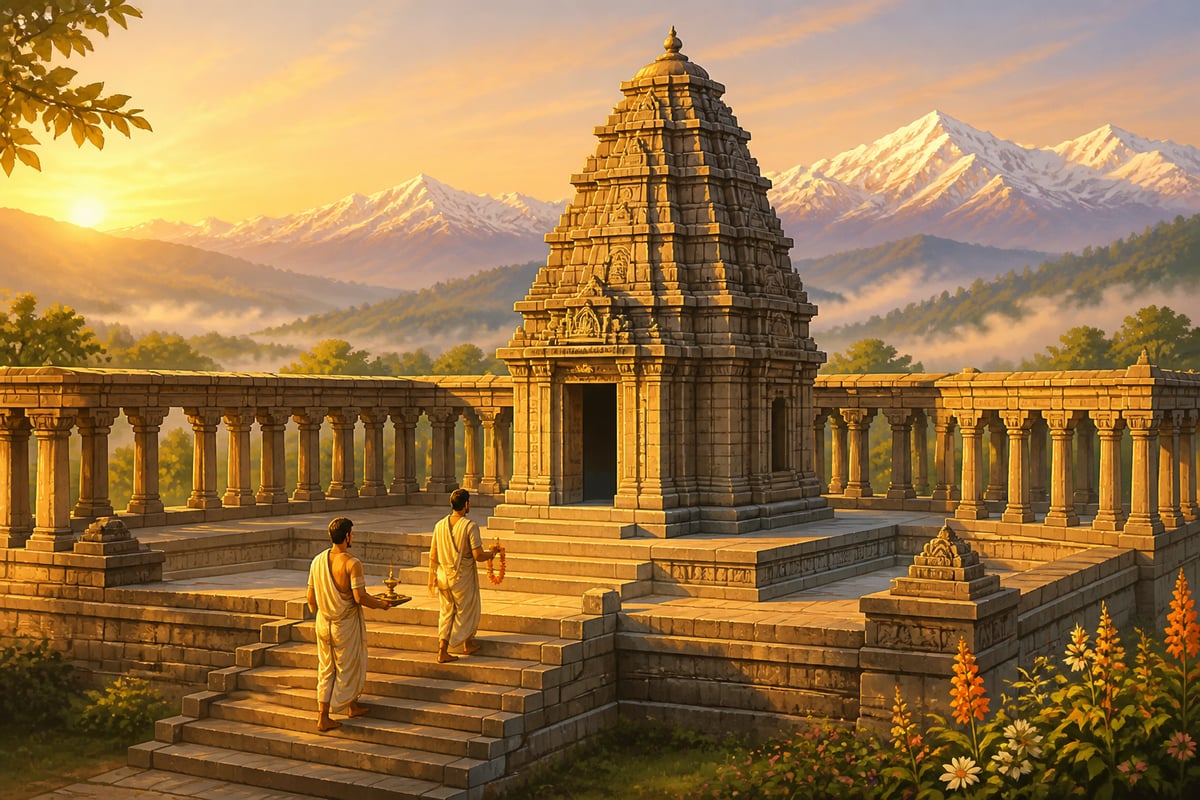
The completed Martand Sun Temple at dawn

High on a plateau overlooking the Kashmir Valley, Lalitaditya built what would become his most enduring monument: the Martand Sun Temple, dedicated to Surya, the solar deity who was his patron and protector.

The temple was magnificent beyond description. Even in ruins, destroyed by an iconoclastic Sultan centuries later, Martand remains awe-inspiring. Built of massive limestone blocks precisely fitted together without mortar, the temple complex covered a vast area. A central shrine rose on a high plinth, surrounded by a columned courtyard. Eighty-four subsidiary shrines lined the courtyard walls. The architecture combined classical Indian elements with innovations that became signature features of Kashmir style.

Kalhana describes Martand in terms of wonder. The temple's columns, he writes, seemed to support the sky itself. The sculptures adorning the walls depicted celestial beings in exquisite detail. The very scale of the project demonstrated Kashmir's wealth, organizational capacity, and aesthetic achievement.

But Martand was more than architectural vanity. As a sun temple, it embodied Lalitaditya's devotion to Surya, whom he credited with his victories. It served as a pilgrimage center, attracting devotees from across India. It proclaimed that Kashmir's ruler was not just a conqueror but a defender and patron of dharma itself.

The City of Parihasapura

Not content with building temples in the existing capital, Lalitaditya founded an entirely new city: Parihasapura, whose very name suggested grandeur and delight. Located near modern Srinagar, Parihasapura was conceived as a statement of imperial power and cultural sophistication.

The founding of the city of Parihasapura

At its center stood Buddhist viharas (monasteries) of impressive scale, with multi-story structures that housed hundreds of monks. These monasteries served not just religious functions but also as centers of learning. Alongside the Buddhist establishments stood Hindu temples, Shaivite shrines and Vaishnava sanctuaries, demonstrating his inclusive approach to religious patronage.

Archaeological excavations reveal the sophistication of Lalitaditya's urban planning: stone-lined drainage systems, wide boulevards, organized residential quarters, all suggest a city designed not just for immediate needs but for lasting grandeur.

But Parihasapura was not Lalitaditya's only urban project. He founded several other towns across his realm: Suniscatapur, Lalitapur (named after himself), Darpitapur, and Lokpunya. Each served strategic or economic purposes, connecting Kashmir's heartland to the broader empire. This systematic urban foundation was rare among Indian kings of any era.

Patronage of Scholars and Artists

Lalitaditya understood that cultural achievement requires supporting those who create it. His court became a magnet for scholars, poets, artists, and philosophers from across India.

Bhavabhuti composing verses in his Kashmir study

Most notably, he patronized the great Sanskrit poet and playwright Bhavabhuti, whose works rank among the finest in Sanskrit literature. Bhavabhuti's plays, Mahaviracharita and Uttararamacharita, explored themes of duty, love, and dharma with psychological depth and poetic beauty. His presence at Lalitaditya's court ensured that the emperor's reign would be remembered in literary as well as historical terms.

Beyond individual genius, Lalitaditya supported institutions of learning. He constructed a magnificent Buddhist vihara at Hushkapura (modern Ushkur), which became a renowned center of tantric studies.

Perhaps his most consequential cultural act was bringing the ancestors of the philosopher Abhinavgupta to Kashmir from the Gangetic plains. This migration would bear extraordinary fruit centuries later when Abhinavgupta became the greatest exponent of Kashmir Shaivism, the sophisticated philosophical tradition that would influence Indian thought for millennia. Lalitaditya planted seeds whose harvest he could never have imagined.

Architectural Innovation

The buildings constructed during Lalitaditya's reign showcased distinctive features that became hallmarks of Kashmir style. Trefoil arches, a unique Kashmir innovation, appeared in temple doorways. Elaborate pediments topped with triangular projections crowned the sanctuaries. Stone was carved with extraordinary detail, depicting divine figures, celestial beings, and geometric patterns.

These innovations represented a synthesis of influences, classical Indian temple architecture, Central Asian motifs, and local Kashmir traditions, that created something distinctly Kashmiri. This architectural synthesis mirrored Lalitaditya's political achievement: uniting diverse elements into a coherent whole.

The scale of construction demonstrated imperial capacity. Quarrying, transporting, and precisely fitting massive stone blocks required organization, engineering knowledge, and labor coordination on a vast scale.

The Economic Foundation and Religious Synthesis

Such patronage required substantial resources, tribute from conquered territories, efficient taxation, and control of trade routes connecting India with Central Asia. Kashmir's economy flourished: agricultural improvements increased productivity, trade expanded as military power secured routes, artisans produced goods commanding premium prices in distant markets.

Lalitaditya's patronage also revealed a sophisticated approach to religious diversity. He was personally devoted to Surya worship, but he patronized Buddhist, Shaivite, and Vaishnavite institutions with equal generosity. The proximity of Buddhist viharas and Hindu temples in Parihasapura physically embodied this synthesis, scholars from different traditions debated and learned from each other.

The Golden Age

Looking back centuries later, Kalhana would describe Lalitaditya's reign as Kashmir's golden age, a period when military power, efficient governance, and cultural brilliance aligned to create something extraordinary. The Martand Sun Temple still stands in ruins as physical testament to this achievement. The works of Bhavabhuti still inspire readers. The archaeological remains of Parihasapura still reveal Kashmir's urban sophistication.

Perhaps Lalitaditya's greatest cultural achievement was demonstrating that power and culture need not conflict, that a great king could be both warrior and patron, that military strength could protect rather than destroy cultural achievement. The warrior-king had become the emperor-patron, creating a legacy that would outlast any empire and inspire generations who would marvel at the magnificence of his monuments.

Historical context

724-760 CE

Period of extensive temple construction across India; Sanskrit literature flourishing in multiple centers; Buddhist monasteries serving as universities attracting international students; development of distinct regional architectural styles; patronage system connecting political power with cultural achievement.

Living traditions

The Martand Temple remains Kashmir's most iconic ancient monument and symbol of its golden age. Kashmiri architectural style influenced Himalayan temple building from Himachal to Ladakh. The tradition of syncretic religious patronage established by Lalitaditya became a model for later rulers. Modern discussions of Kashmir's heritage invariably reference his reign as the peak of its cultural achievement.

Reflection

More in Lalitaditya Muktapida

All lessons in Lalitaditya Muktapida ยท Lesser Known Guardians of Dharma course