Origins and Rise
The Birth of Kashmir's Greatest King
Discover the origins of Lalitaditya Muktapida, born into the powerful Karkota dynasty of Kashmir. Learn how he rose to power in the eighth century and began his transformation of Kashmir from a regional kingdom into a mighty empire that would challenge the greatest powers of his age.
The Dawn of a Golden Age
In the early eighth century CE, as the world witnessed the rise of new powers and the fall of ancient empires, a child was born in the mountain kingdom of Kashmir who would change the course of Indian history. This was Lalitaditya, whose very name, 'Muktapida' meaning 'freed from pain', would become synonymous with Kashmir's golden age.
The Karkota Dynasty and Royal Lineage
The Karkota dynasty had established itself as the ruling house of Kashmir through a combination of military prowess and administrative acumen. Lalitaditya was born around 699 CE to King Durlabhaka, also known as Pratapaditya, and Queen Narendraprabha, a woman of remarkable background who had previously been married to a foreign merchant before becoming royal consort. This unconventional lineage would give Lalitaditya a unique perspective on the wider world beyond Kashmir's mountains.
Lalitaditya was the youngest of three brothers. His elder brothers Chandrapida and Tarapida would both rule Kashmir before him, Chandrapida from 712 to 720 CE, and Tarapida briefly from 720 to 724 CE. Both reigns ended tragically: Chandrapida through political intrigue and Tarapida through illness. The young Lalitaditya watched and learned from both his brothers' successes and failures.
Kashmir in this era was no ordinary kingdom. Nestled in the Himalayas, it served as a crossroads between India, Central Asia, and China. The valley was renowned for its scholars, its Buddhist monasteries, and its Hindu temples. It was a land where Sanskrit learning flourished, where philosophers debated the nature of reality, and where merchants from distant lands came to trade.
The Prince's Education
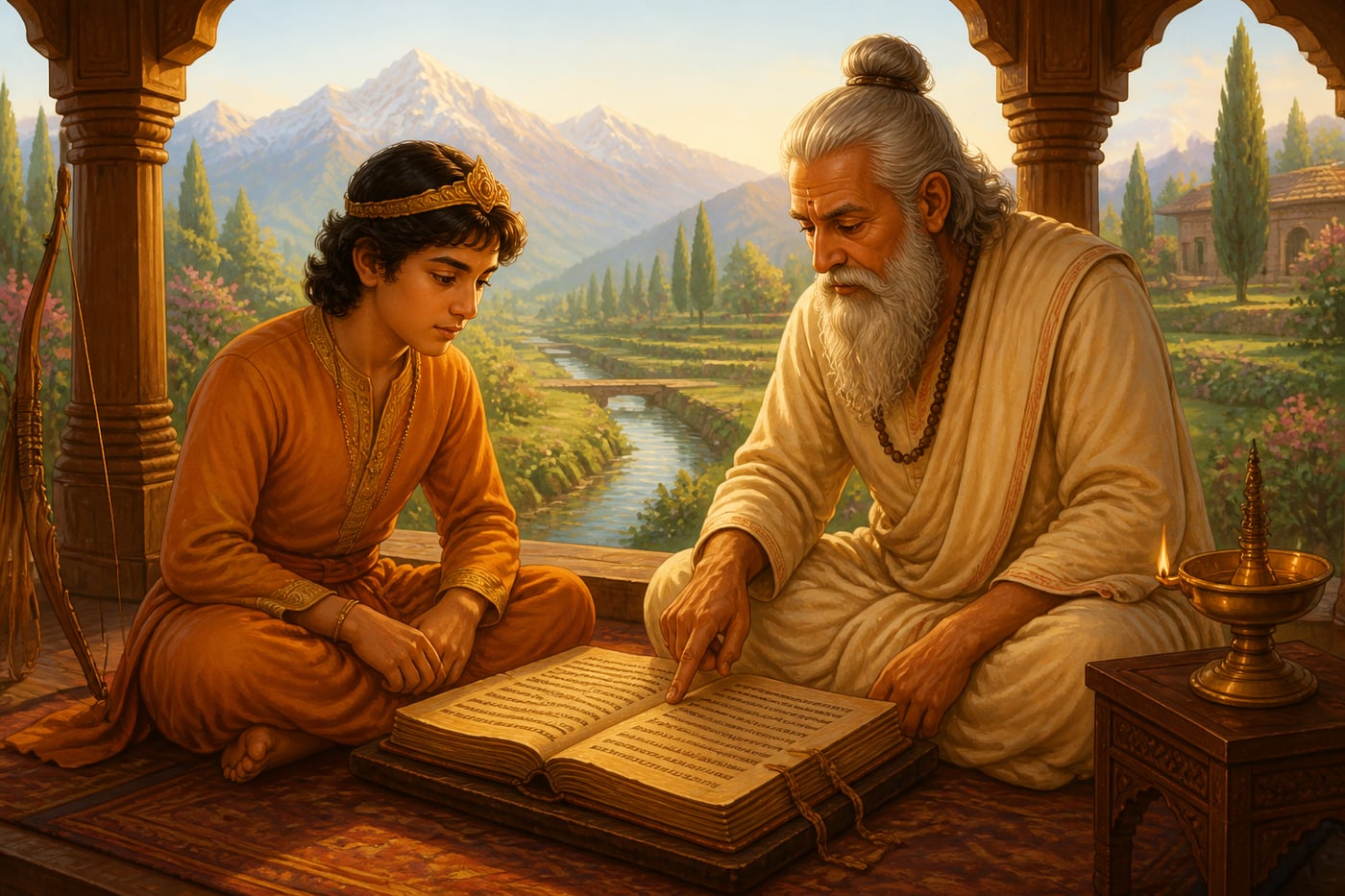
Young Lalitaditya received an education befitting a prince destined for greatness. He studied the Dharmashastra, learning the duties of a king. He mastered the Arthashastra, understanding statecraft and economics. He trained in martial arts and military strategy, preparing for the battles that would define his reign. But more importantly, he learned to see beyond Kashmir's mountain walls to the vast world beyond.
The chronicles tell us that even as a youth, Lalitaditya displayed exceptional qualities. He possessed not just intelligence but wisdom, not just courage but strategic thinking. He understood that Kashmir's geographic isolation was both its protection and its limitation. To truly secure his kingdom, he would need to project power far beyond its borders.
Path to the Throne
Lalitaditya's ascension to power around 724 CE came through unexpected circumstances. As the youngest son, he was never expected to rule. But when Tarapida died after just four years on the throne, the burden of kingship fell upon the twenty-five-year-old prince. What seemed like misfortune would prove to be destiny.

The timing was critical. The great emperor Harsha had died a century earlier, leaving North India fragmented. The Arabs, fired by religious zeal and imperial ambition, were pushing eastward through Sindh, threatening the very heartland of dharmic civilization. The Chinese Tang dynasty was at its peak, influencing events across Central Asia. Where his brothers had maintained Kashmir's independence, Lalitaditya envisioned something greater, a Kashmir that would not merely defend itself but would shape the destiny of North India.
Early Challenges
The new king faced immediate challenges. The treasury needed strengthening, the army required modernization, and the administration demanded reform. But Lalitaditya approached these tasks with characteristic vigor. He reorganized the tax system, ensuring fairness while increasing revenues. He recruited warriors from across his kingdom and beyond, building a professional army loyal to the crown rather than to local chieftains.
More significantly, he began to gather intelligence about the powers surrounding his kingdom. Who were potential allies? Who were threats? What were the weaknesses of his enemies? This systematic approach to statecraft would serve him throughout his reign.
The Vision Takes Shape

From the beginning, Lalitaditya's vision was clear: Kashmir would not be a passive observer of history but an active participant. He would defend dharma not by building walls but by taking the fight to those who threatened it. He would create an empire not through mindless conquest but through strategic expansion that secured Kashmir's interests.
The chronicler Kalhana, writing three centuries later, would look back on this period as the beginning of Kashmir's greatest age. In Lalitaditya, Kashmir had found not just a king but a leader who combined military genius with administrative skill, who understood both the sword and the scroll, who could be ruthless in war but generous in peace.
The Foundations of Empire
Before embarking on his legendary military campaigns, Lalitaditya spent his early years strengthening Kashmir's foundations. He improved irrigation systems, increasing agricultural productivity. He encouraged trade, understanding that economic strength underpinned military power. He patronized scholars and artists, recognizing that cultural achievement gave legitimacy to political power.
He also began the diplomatic outreach that would characterize his reign. He established relations with distant kingdoms, sent embassies to the Tang court, and carefully monitored the Arab advance through Sindh. Each piece of information, each alliance, each preparation was part of a grand strategy that would unfold over the coming decades.
A King Prepared
By the end of his first years on the throne, Lalitaditya had transformed Kashmir from a defensive mountain kingdom into an offensive military power. His army was trained, his treasury was full, his administration was efficient, and his strategy was clear. The stage was set for the campaigns that would make him a legend.
But perhaps his greatest preparation was mental and spiritual. Lalitaditya was a devotee of Surya, the sun god, and he saw himself as an instrument of dharma. His conquests would not be for personal glory but for the protection and propagation of the dharmic civilization that had flourished in India for millennia. This sense of higher purpose would sustain him through decades of constant warfare and would inspire his subjects to extraordinary efforts.
The boy born as Lalitaditya, freed from pain, was now ready to free Kashmir from fear and to establish it as the paramount power of North India. The age of the great conquests was about to begin.
Historical context
724-760 CE
Post-Harsha fragmentation with multiple regional powers competing for dominance; Arab invasions threatening from the west; Kashmir positioned at strategic crossroads between India, Central Asia, and China; Sanskrit learning flourishing in multiple centers; conflict between expanding Islam and established dharmic traditions.
Living traditions
Lalitaditya remains a symbol of Kashmir's golden age and its potential for greatness. His memory is invoked in discussions of Kashmiri identity and heritage. The ruins of Martand Temple serve as a powerful reminder of the valley's rich cultural past and architectural achievements.
- Martand Sun Temple: Magnificent ruins of the sun temple built by Lalitaditya, showcasing Kashmir's architectural achievements during its golden age. Despite destruction, the scale and artistry remain awe-inspiring.
- Parihasapura Archaeological Site: Remains of Lalitaditya's capital city Parihasapura, including foundations of Buddhist monasteries and Hindu temples, illustrating his syncretic approach and grand urban planning.
Reflection
- What 'foundations' do you need to strengthen in your own life before pursuing more ambitious goals?
- How does one balance defensive concerns (protecting what one has) with offensive ambitions (achieving something greater)?
- What internal qualities must a leader cultivate before they can effectively lead others toward ambitious goals?