Philosophy and Dharma

The Spiritual and Moral Foundations of Empire

Examine the philosophical and spiritual foundations that guided Lalitaditya's reign, his devotion to Surya, his understanding of rajadharma, and the moral framework that shaped his decisions through decades of warfare and governance. Discover how he balanced the demands of power with the requirements of dharma.

The Light That Guides

A king commands armies, administers justice, builds monuments. But what guides the king? What principles govern his decisions when faced with impossible choices? What spiritual foundation sustains him through decades of responsibility, warfare, and the constant moral ambiguity of power?

For Lalitaditya Muktapida, the answer was found in Surya, the sun god who illuminates all, who sees all, who represents both cosmic order and moral clarity. But his philosophy extended beyond personal devotion to encompass a sophisticated understanding of rajadharma, the duties and moral obligations of kingship.

Surya Bhakti: Devotion to the Sun

Lalitaditya's devotion to Surya was not mere conventional piety. The sun represented multiple dimensions of meaning that resonated with his imperial vision. Surya is the source of light that dispels darkness, as Lalitaditya saw himself dispelling the darkness of foreign invasion. Surya sees all things, as a king must have knowledge of all affairs. Surya follows an unwavering path, embodying the consistency good governance requires.
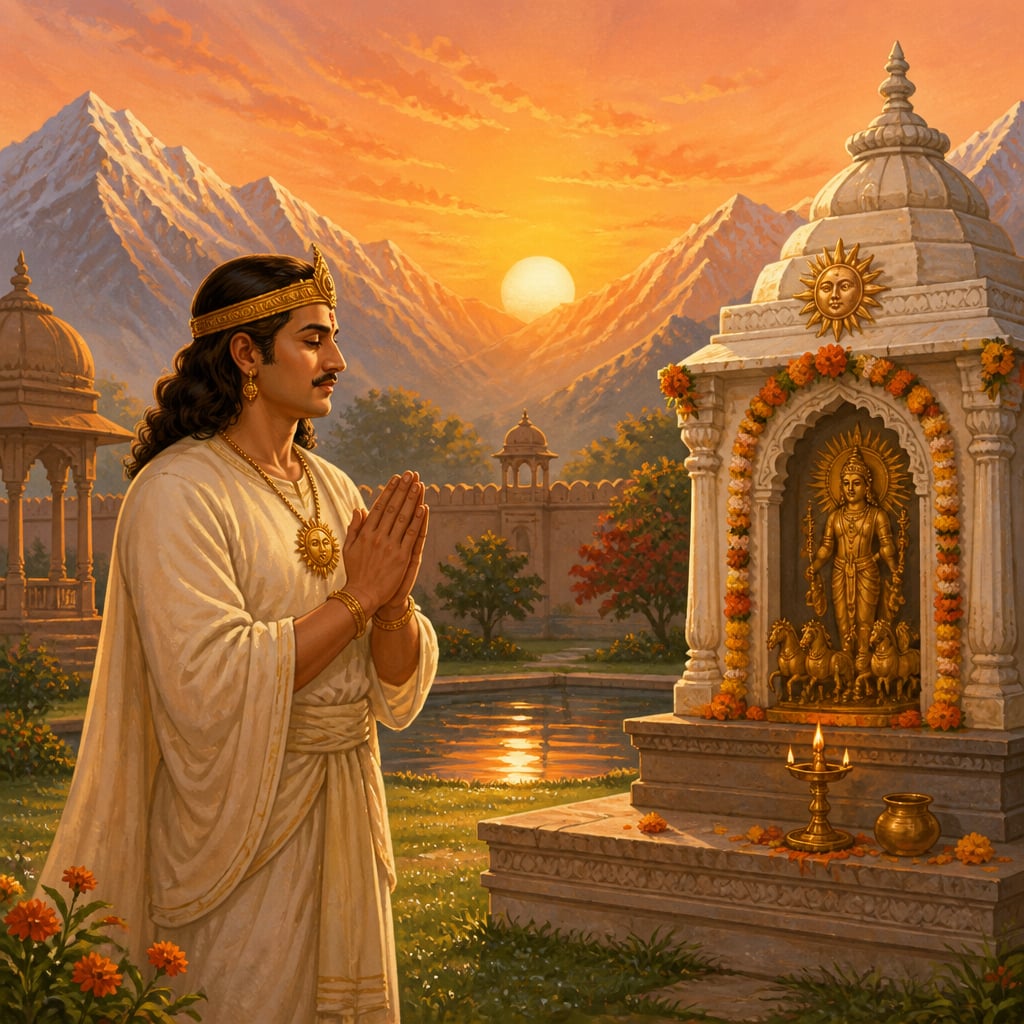
Lalitaditya at dawn worship of Surya

By making Surya his patron deity, Lalitaditya aligned himself with truthfulness, justice, and unwavering commitment. The Martand Temple embodied this devotion in stone. But more importantly, Surya worship influenced his conduct. Ancient texts prescribe that devotees of Surya should be truthful, just, and reliable, qualities sources attribute to Lalitaditya's governance.

Understanding Rajadharma

Rajadharma, as articulated in the Mahabharata, Manusmriti, and Arthashastra, is complex and sometimes contradictory. A king must protect his subjects but sometimes demand their sacrifice in war. He must be compassionate but also stern. He must expand his realm but not be unjustly aggressive.

Lalitaditya navigated these contradictions with remarkable consistency. His military campaigns were aggressive but framed as defensive, protecting dharma against foreign threats. His taxation was demanding but visibly benefited subjects through public works. His religious patronage balanced personal devotion with inclusive support for multiple traditions.

He understood that rajadharma requires situational wisdom rather than rigid rule-following. The dharma of a king is to protect and prosper his realm, how that is achieved depends on circumstances.

The Moral Challenges of Power

Lalitaditya weighing a dharmic case in his audience hall

But dharma in the abstract is easier than dharma in practice. Every military campaign meant death, of soldiers, enemies, and civilians. Could such killing be reconciled with dharma? The ancient answer was yes, if warfare served righteous purposes and was conducted according to dharmic principles.

Yet this answer must have weighed on him. Constant warfare over decades takes its toll not just on treasuries but on the soul. Similarly, his administration required harsh decisions, rebellious officials punished, conquered peoples subdued, resources extracted.

The sources suggest Lalitaditya maintained moral certainty through spiritual practice and philosophical conviction. His devotion to Surya provided spiritual sustenance. His visible success provided empirical validation that he was fulfilling his dharmic obligations.

The Syncretic Vision

One of Lalitaditya's most philosophically sophisticated achievements was his approach to religious diversity. In an age of often-rigid sectarianism, he maintained a syncretic vision that honored multiple paths to truth.

A Karkota official granting royal patronage to monks of three traditions

His personal devotion to Surya didn't prevent him from patronizing Buddhist monasteries, Shaivite temples, and Vaishnavite shrines. This wasn't inconsistent from classical Indian philosophy, which recognizes that different deities represent different aspects of ultimate reality, that different spiritual paths serve different temperaments, that diversity in religious expression can coexist with unity in ultimate truth.

Lalitaditya believed his role as king was to protect all dharmic traditions, not impose a single sectarian vision. The emperor as protector of dharma meant protecting the entire dharmic ecosystem, allowing different traditions to flourish under royal patronage.

This approach contrasted sharply with the Arab Caliphate, which enforced religious uniformity. Lalitaditya's inclusive approach represented a distinctive vision of how diversity could strengthen rather than weaken political unity.

Karma and Consequence

The doctrine of karma, that actions have consequences extending beyond immediate effects, likely influenced Lalitaditya's decision-making. A king's karma is particularly weighty because his decisions affect millions.

This belief encouraged righteous conduct even when unrighteous actions might be more immediately advantageous. It suggested that short-term gains achieved through adharma would ultimately prove costly. Temple building, support for scholars, and just administration all generated merit while also serving political purposes.

Dharma as Civilizational Defense

Ultimately, Lalitaditya understood his primary dharmic duty as defending dharmic civilization itself. The Arab invasions threatened not just territorial loss but the replacement of one civilizational order with another. Military resistance became not just political necessity but dharmic obligation.

This framing elevated his campaigns from imperial expansion to sacred duty. He was not just a king seeking glory but a defender of dharma, a warrior in a cosmic struggle between order and chaos, light and darkness. This sense of higher purpose sustained him through decades of warfare.

The Philosophical Legacy

Lalitaditya's approach, combining personal devotion with inclusive patronage, embracing kshatriya dharma while trying to minimize unnecessary violence, framing political actions in terms of dharmic duty, became a model for later Indian rulers.

His example suggested that power and principle need not conflict, that effective governance could align with dharmic ideals, that a king could be both warrior and patron, both feared and loved, both powerful and pious.

The sun that Lalitaditya worshipped continues to rise and set, constant in its path, illuminating all without favoritism. In his best moments, Lalitaditya tried to rule like Surya, bringing light and order to his realm, following the path of dharma with unwavering commitment. That he sometimes fell short confirms his humanity. That he aspired to it, and often achieved it, confirms his greatness.

Historical context

724-760 CE

Period of sophisticated philosophical development across multiple traditions; Kashmir emerging as center of Shaiva philosophy; Buddhist universities like Nalanda at their peak; extensive debates between different schools on metaphysics, epistemology, and ethics; political philosophy well-developed in texts like Arthashastra.

Living traditions

Lalitaditya's model of religious tolerance and inclusive governance remains relevant to discussions of how diverse societies can maintain unity while respecting differences. His integration of spiritual devotion with effective statecraft challenges false dichotomies between religion and politics, suggesting they can strengthen rather than undermine each other when properly balanced.

Reflection

More in Lalitaditya Muktapida

All lessons in Lalitaditya Muktapida · Lesser Known Guardians of Dharma course