The Defender

The Hammer of the Arabs and Conqueror of Empires

Follow Lalitaditya's transformation into one of history's greatest military commanders as he defeats Arab invasions four times, expands Kashmir's borders from Afghanistan to Bengal, and establishes himself as the paramount power in eighth-century India. His campaigns not only defended dharma but reshaped the political map of Asia.

The Sword of Dharma

The morning sun rose over the Indus River, its light glinting off thousands of spears and swords. Two armies faced each other across the ancient boundary between India and the western lands. On one side stood the forces of the Caliphate, the most powerful military machine of the age, which had conquered from Spain to Persia in a single century. On the other stood the army of Kashmir, led by a king who believed that protecting dharma meant taking the fight to its enemies.
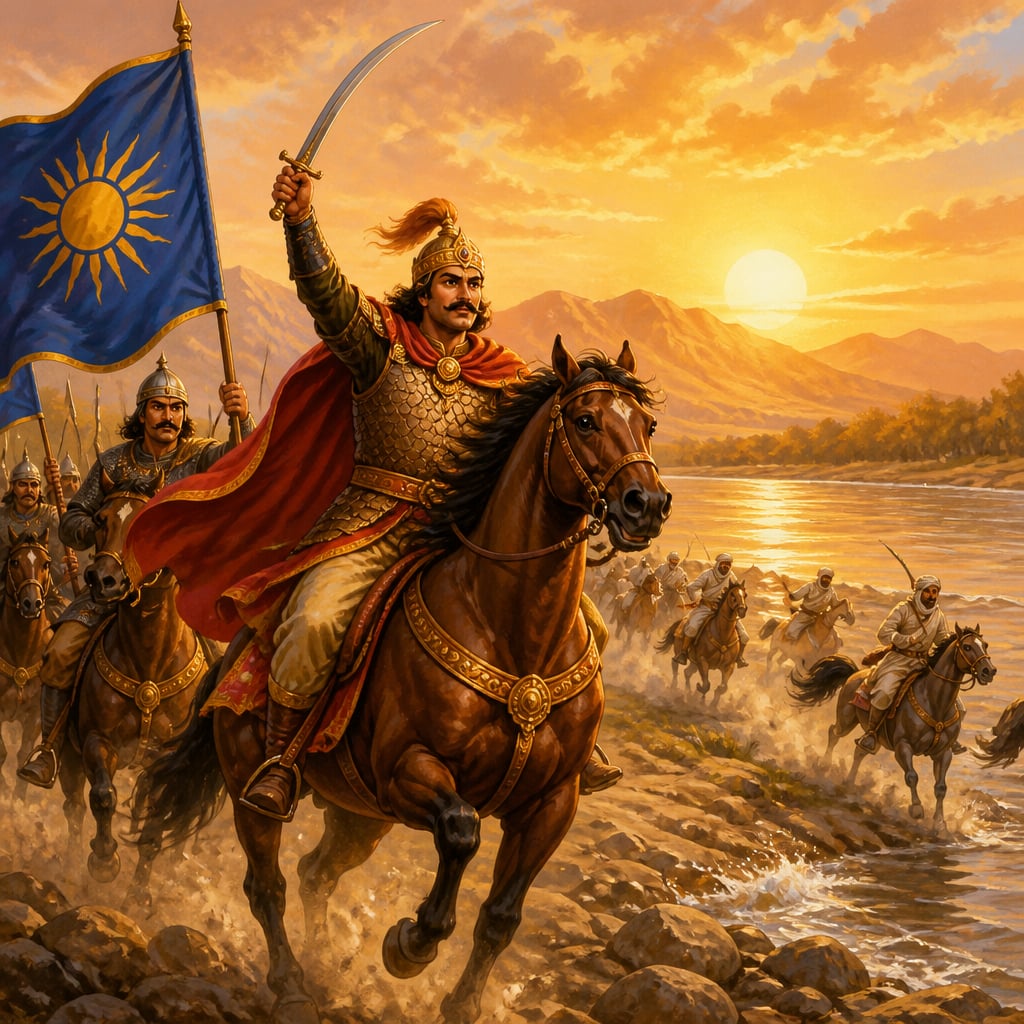
Lalitaditya's army facing the Caliphate across the Indus

This was Lalitaditya Muktapida, and this was the first of his four victories against the Arab invasions that threatened to sweep across India.

The Arab Threat

To understand Lalitaditya's achievement, we must grasp the magnitude of the threat he faced. The Arab conquests of the seventh and eighth centuries represented one of history's most dramatic military expansions. In just decades, Arab armies had destroyed the Persian Sasanian Empire, stripped away half of the Byzantine Empire, conquered Egypt and North Africa, and pushed into Spain and Central Asia.

By 711 CE, Arab forces under Muhammad bin Qasim had conquered Sindh, establishing Islam's first foothold in India. They looked eastward with hungry eyes, seeing the wealthy kingdoms of northern India as their next conquest. Previous Arab raids had tested Indian defenses, and local rulers often paid tribute rather than fight. The conventional wisdom was that the Arabs were invincible, that resistance was futile.

Lalitaditya thought otherwise.

Four Victories Against the Arabs

Kalhana's chronicle confirms Lalitaditya defeated Arab forces on at least four separate occasions. The first came early in his reign, when Arab forces attempted to expand beyond Sindh into the northern territories.

Lalitaditya's strategy was audacious. Rather than wait for the Arabs to reach Kashmir's borders, he marched his army west to meet them in the frontier regions. This preemptive strategy surprised Arab commanders, who expected to face defensive warfare from fortified positions, not open battle against a professional army eager for combat.

Lalitaditya studied Arab tactics, their cavalry charges, their use of archery, their psychological warfare, and countered each. Kashmir's mountain warriors, trained in difficult terrain, proved more than a match for Arab cavalry. With each victory, his reputation grew while Arab chroniclers fell silent about these campaigns, a silence more telling than any words.

These were not merely defensive victories. Lalitaditya pushed the Arabs back beyond the Indus, liberating territories they had occupied. By the time his campaigns concluded, the Arab advance into northern India had been permanently checked. While other regions faced periodic Arab raids, Kashmir under Lalitaditya had decisively demonstrated that disciplined resistance could succeed.

The Eastern Campaigns

With the western frontier secured, Lalitaditya turned his attention eastward. His primary target was Yashovarman of Kanauj, who ruled much of the Gangetic plain. Yashovarman was a formidable ruler, having expanded his kingdom through conquest. Some sources suggest they were initially allies, but rivalry was inevitable between two expanding powers.

Yashovarman of Kanauj surrendering to Lalitaditya

The clash came, and Lalitaditya's superior strategy won decisively. He didn't merely defeat Yashovarman's army; he broke his power permanently. Kanauj, which had been emerging as a major force, fell under Kashmir's sphere of influence. The Gangetic plain, heartland of ancient Indian civilization, acknowledged Kashmir's supremacy.

With Yashovarman subdued, Lalitaditya pushed further east, campaigning against Jivitagupta II of Gauda (Bengal and Bihar). His armies marched all the way to the seacoast of Orissa, an astonishing distance from Kashmir's mountain valleys. For the first time, a king from the Himalayas had touched the eastern ocean.

The Tibet Campaign and Chinese Alliance

Lalitaditya conferring with a Tang Chinese envoy on the Karakoram pass

Perhaps Lalitaditya's most audacious campaign was his joint expedition against Tibet. He established a diplomatic alliance with Tang Dynasty China, then at its zenith under Emperor Xuanzong. Together, the allies assembled a massive force, Chinese sources suggest approximately 200,000 men, to challenge Tibetan power in Central Asia.

This campaign secured control over the Karakoram range and the vital caravan routes connecting India to China. The victory was celebrated in Kashmir on the 2nd of Chaitra, which became a festival day commemorating Lalitaditya's triumph. Control of these mountain passes gave Kashmir enormous strategic advantage, as all trade between India and China now flowed through territories under Lalitaditya's authority.

Military Innovation

Lalitaditya's success rested on more than personal bravery. He was a military innovator who transformed warfare in his time. He professionalized Kashmir's army, ensuring soldiers owed loyalty to the crown rather than local chiefs. He established systematic logistics that allowed his army to campaign far from home. He gathered intelligence about enemy capabilities and strategies.

He understood combined arms warfare, coordinating infantry, cavalry, and elephants effectively. Kashmir's mountainous terrain trained hardy soldiers who could fight in any conditions. He personally led his troops, sharing their hardships and inspiring their loyalty.

Perhaps most importantly, he understood that military power ultimately rests on economic and administrative foundations. His campaigns were funded by efficient taxation. His soldiers were supplied by organized logistics. His conquests were secured by establishing effective administration in conquered territories.

The Defender's Legacy

By the height of his power, Lalitaditya had achieved what seemed impossible when he took the throne. The Arab advance had been stopped. Rival Indian powers had been subdued. Kashmir's borders extended from Afghanistan to Bengal, from the Himalayas to the Gangetic plain. Trade flowed securely along protected routes. Tribute arrived from distant territories.

More than territory, he had changed the psychology of his age. Kashmir was no longer a mountain kingdom to be ignored. It was a major power whose friendship was sought and whose enmity was feared. A king from the periphery had moved to the center of the Asian political stage.

Yet these triumphs came at a cost. Lalitaditya spent much of his thirty-six-year reign in military camps rather than palaces. The treasury was strained by constant campaigning. Lalitaditya understood that military power alone could not sustain an empire, conquest had to be followed by consolidation, the sword by the scroll. His attention would now turn to administration, architecture, and the arts, transforming his military empire into a cultural beacon that would outlast any battlefield victory.

Historical context

724-760 CE

Arab forces controlling Sindh and periodically raiding into northern India; Pratiharas emerging as major power in western India; Buddhist monasteries in Bengal and Kashmir flourishing; Kashmir positioned as gateway between India and Central Asia; constant competition among regional powers for supremacy.

Living traditions

Lalitaditya's military achievements remain a source of pride in Kashmir and broader Indian consciousness as an example of successful resistance to foreign invasion. His campaigns are studied in military history courses, and his strategic principles remain relevant to understanding asymmetric warfare and the projection of power from a smaller base.

Reflection

More in Lalitaditya Muktapida

All lessons in Lalitaditya Muktapida ยท Lesser Known Guardians of Dharma course