Wars on Every Frontier

The Multi-Front Struggle

Throughout his reign, Bhoja fought wars on multiple fronts simultaneously. Against the Chaulukyas of Gujarat, the Kalachuris of Tripuri, the Chalukyas of Kalyani, and the Chandellas, he waged campaigns that ranged from decisive victories to bitter stalemates. His military career shows both his capabilities and the limits of even the most talented ruler.

The Strategic Nightmare and Early Diplomacy

Bhoja's kingdom of Malwa sat at the center of the Indian subcontinent - geographically advantageous for trade, but a nightmare for defense. Enemies could attack from any direction, and they did.
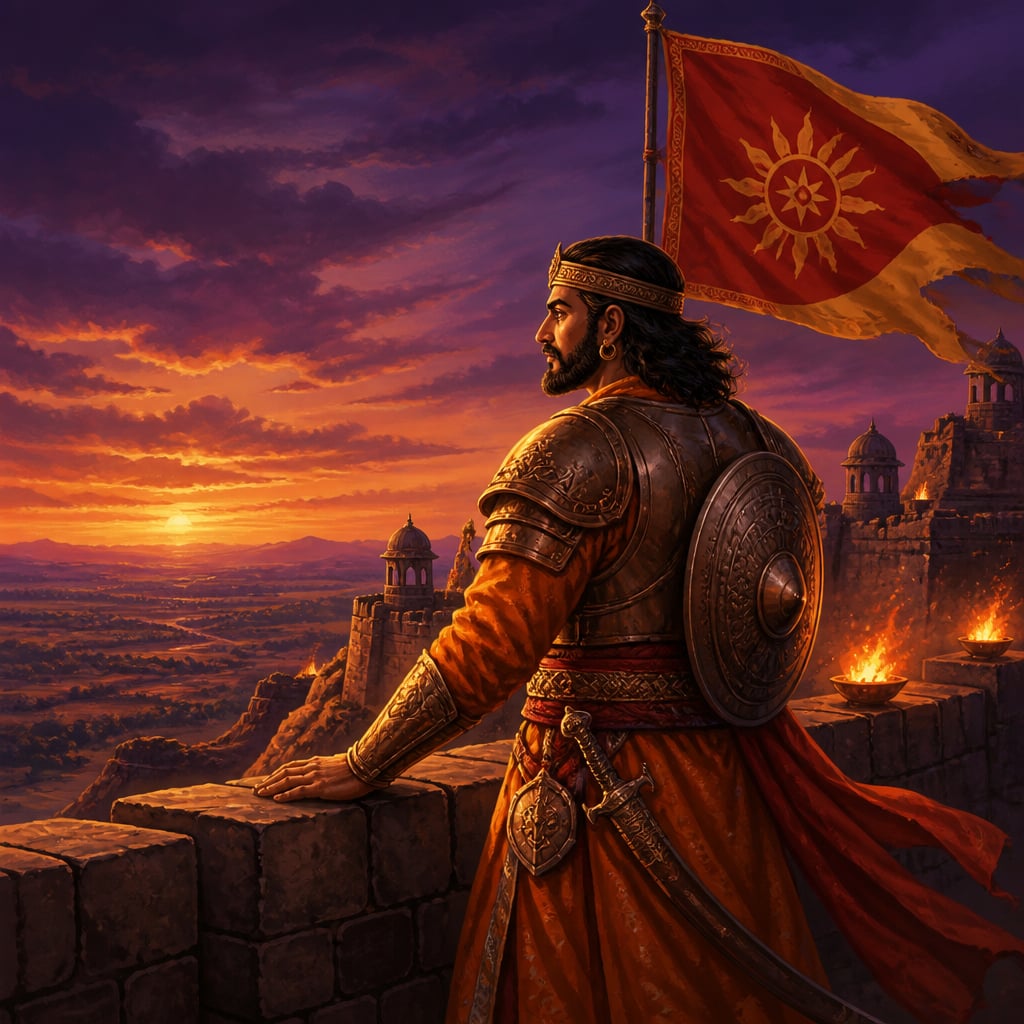
Bhoja on the rampart of a Malwa hill-fort watching the western horizon

The major powers surrounding Malwa were:

West: The Chaulukyas (Solankis) of Gujarat, wealthy from maritime trade and aggressive in expansion

East: The Kalachuris of Tripuri (near modern Jabalpur), an ancient dynasty seeking to expand westward

North: The Chandellas of Bundelkhand, builders of the Khajuraho temples, periodically hostile

South: Various smaller dynasties and the distant but powerful Cholas

No single enemy could destroy Bhoja, but their combined pressure was relentless.

Before his wars with Gujarat intensified, Bhoja demonstrated diplomatic sophistication. Around 1019 CE, he formed a triple alliance with Rajendra Chola of the south and Gangeyadeva Kalachuri of Tripuri against the Chalukyas of Kalyani (distinct from the Gujarat Chaulukyas). This coalition aimed to check Chalukya expansion from the Deccan.

The irony is striking: Gangeyadeva, Bhoja's ally in this early pact, would later become his bitter enemy. His son Lakshmi-Karna would eventually join the coalition that destroyed Bhoja. Medieval Indian diplomacy had no permanent friends - only permanent interests.

Wars on All Fronts: Gujarat, South, and East

Bhoja's most persistent conflict was with the Chaulukyas (Solankis) of Gujarat. The two dynasties had been rivals for generations, and the stakes were high: control of the wealthy trade routes connecting the Arabian Sea ports to the interior.

In the 1020s and 1030s, Bhoja clashed repeatedly with Gujarat. The Chaulukya king Bhima I (r. 1022-1064) was himself a formidable ruler who would reign almost as long as Bhoja.

Key conflicts:

"The Paramara and the Solanki fought like two lions over the same territory. Neither could kill the other, so both grew tired."

In 1025 CE, Mahmud of Ghazni attacked and destroyed the great temple of Somnath in Gujarat. This catastrophe affected Bhoja's wars in complex ways - Gujarat was temporarily weakened, but the common threat also sometimes led to informal truces. Some sources suggest Bhoja supported efforts to rebuild Somnath after Mahmud's destruction.

Beyond the Gujarat Chaulukyas, Bhoja faced another powerful enemy to the south: the Chalukyas of Kalyani (Western Chalukyas). After 1042 CE, their king Someshvara I launched a devastating invasion that sacked Dhara itself and pushed Bhoja's southern boundary from the Godavari river back to the Narmada - a significant territorial loss.

To the east, the Kalachuris of Tripuri under kings like Gangeyadeva (r. 1019-1041) and his son Karna (r. 1041-1073) were constant rivals. The Paramaras and Kalachuris contested the fertile lands between their capitals. Gangeyadeva was himself a patron of learning - his court produced important Sanskrit works. The war between Bhoja and Gangeyadeva was partly a contest between two learned kings, each claiming cultural superiority.

The Chandellas of Bundelkhand - builders of the famous Khajuraho temples - had complex relations with Bhoja. Sometimes allies, sometimes enemies, they were always important. This shifting pattern meant Bhoja could never fully trust his northern frontier, even during periods of formal peace.

The Art of Multi-Front War and Eternal Vigilance

Bhoja in war council planning multi-front defense

Fighting on multiple fronts simultaneously requires specific skills that Bhoja demonstrated:

Intelligence: Knowing what each enemy was planning

Speed: Moving armies quickly to threatened sectors

Economy of Force: Allocating resources efficiently across fronts

Diplomacy: Preventing enemies from coordinating attacks

Fortification: Strong defensive positions to delay attacks

Local Alliances: Using smaller kingdoms as buffers

Bhoja employed all these methods. His survival for 45 years against such odds testifies to his skill.

The most dangerous moments came when enemies coordinated. According to later tradition, there was a period when Bhoja faced a grand coalition from multiple directions. Whether this was a single coordinated attack or a series of simultaneous but independent threats, it pushed Bhoja to the limit. Tradition says he had to fight desperate defensive battles, but ultimately survived.

Bhoja's military career illustrates a fundamental reality of medieval Indian politics: there was no final victory. Unlike modern wars with treaties and permanent borders, medieval conflicts were ongoing. Every victory was temporary. Every peace was a pause. Every enemy defeated would return when circumstances changed.

Bhoja understood this. His strategy was not to win once but to keep winning - or at least not losing - indefinitely. It was exhausting, but for 45 years, he succeeded.

The Warrior's Code and Integration of War and Culture

Bhoja's military conduct followed the traditional kshatriya dharma - the warrior's code:

Inscriptions suggest that even his enemies respected Bhoja's adherence to dharmic warfare. This reputation for honor was itself a strategic asset.

Bhoja writing in his campaign tent at twilight

Remarkably, Bhoja's military campaigns didn't prevent his scholarly work. He seems to have:

For Bhoja, war and culture were not opposites but complementary aspects of royal duty.

Bhoja achieved significant victories - at various points, he held territories in Gujarat, Konkan, and eastern regions, and he maintained his kingdom intact for over four decades. But there were limits: he never permanently conquered his major rivals, and constant war strained even Malwa's prosperity.

Legacy of the Wars

Bhoja's military career left several legacies:

Fortifications: Improved defenses throughout Malwa

Military Texts: Sections of his writings discuss military science

Strategic Doctrine: His multi-front approach influenced later rulers

Reputation: He became a model of the warrior-scholar king

The wars consumed much of Bhoja's reign. But they also proved that a philosopher-king could hold his own against purely military rulers.

Historical context

Paramara Military Campaigns, 1020-1050 CE

India was a battleground of regional powers. The Cholas dominated the south, the Palas held Bengal, the Chandellas built Khajuraho, and multiple dynasties competed in central India. Mahmud of Ghazni's raids had weakened the north.

Living traditions

Bhoja is remembered as a warrior-scholar who proved that intellectual pursuits need not compromise military effectiveness. His multi-front defense offers lessons still studied in discussions of strategic challenges.

Reflection

More in Bhoja Paramara

All lessons in Bhoja Paramara ยท Lesser Known Guardians of Dharma course