The Fall of the Philosopher-King

Coalition, Defeat, and Death

After 45 years of brilliant rule, Bhoja faced a devastating coalition of his longtime enemies - the Chaulukyas of Gujarat and the Kalachuris of Tripuri. Around 1055 CE, this alliance overwhelmed even the polymath king. Bhoja's death - whether in battle or shortly after - marked the end of Malwa's golden age.

The Final Crisis and Coalition

By the 1050s, Bhoja was an aging king. He had ruled for over four decades, written scores of books, built monuments, and fought countless battles. But the enemies who had opposed him throughout his reign had not given up.

Two powers had particularly long grudges:

The Chaulukyas (Solankis) of Gujarat: Under King Bhima I (r. 1022-1064), they had fought Bhoja for decades. Bhima I was a survivor of many campaigns and knew Bhoja's tactics intimately.

The Kalachuris of Tripuri: Under King Lakshmi-Karna (r. 1041-1073), son of Gangeyadeva, they sought revenge for earlier Paramara victories and expansion into Kalachuri territory. The same dynasty that had once allied with Bhoja against the Chalukyas now turned against him.

These two powers, east and west, found common cause in destroying the king who had frustrated them both.
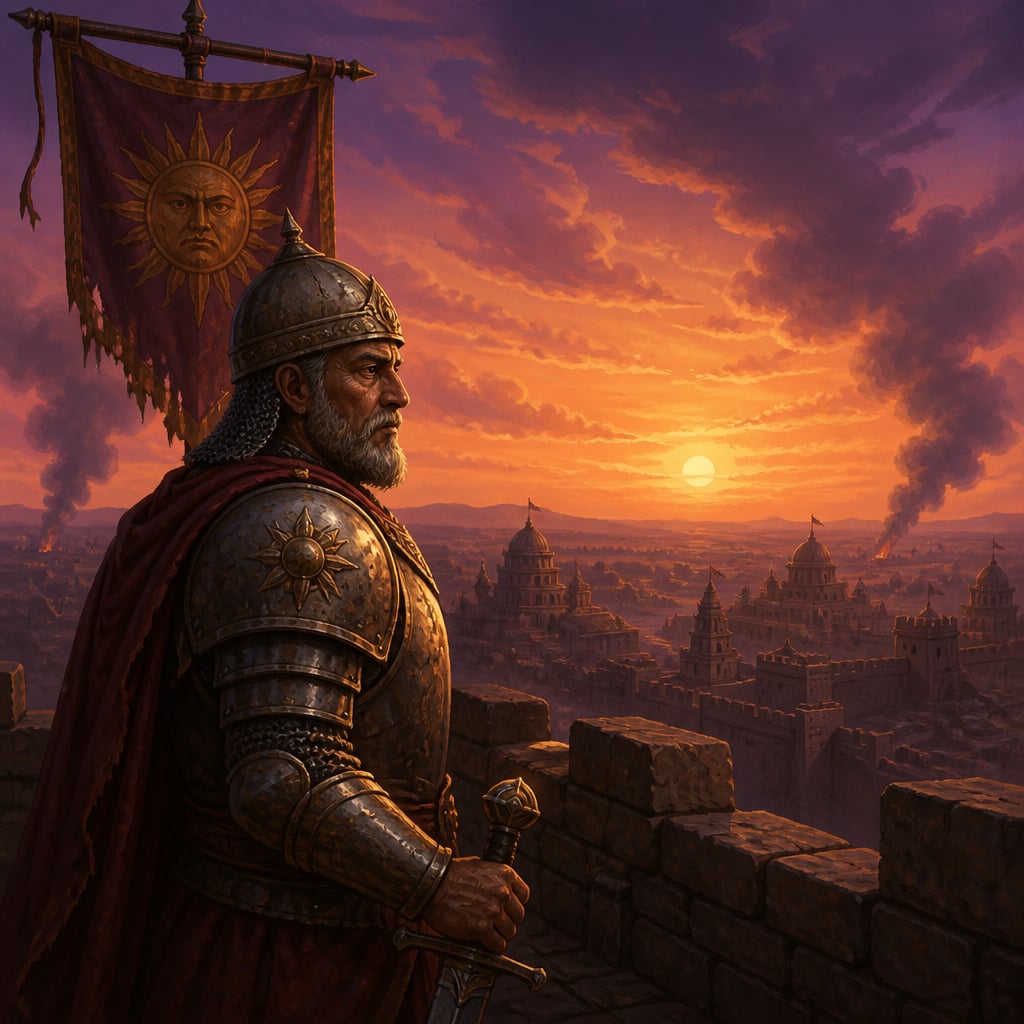
Aged Bhoja on the rampart of Dhara at dawn as smoke rises east and west

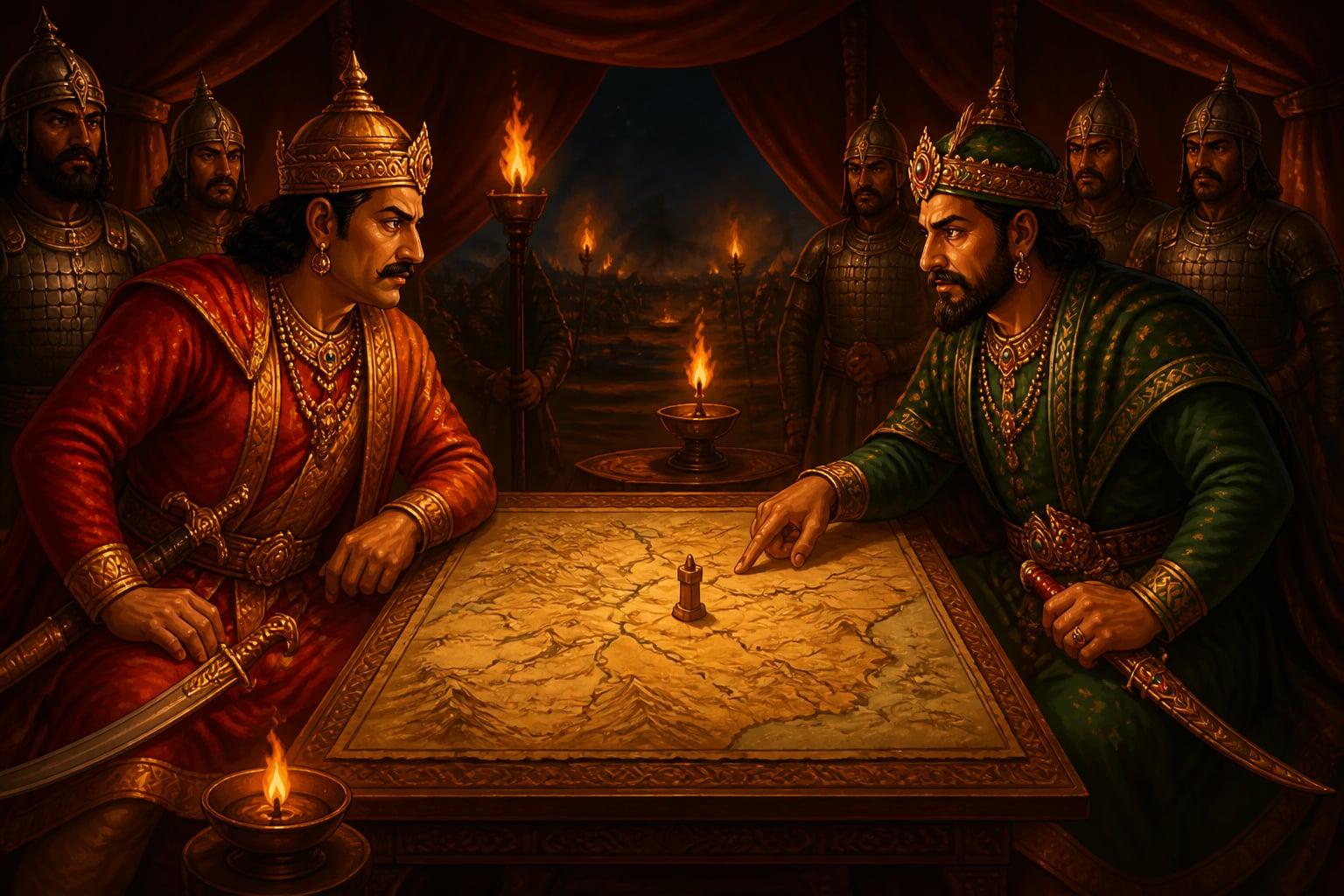
Bhima I of Gujarat and Lakshmi-Karna of Tripuri planning the coalition against Bhoja

The exact circumstances of the coalition are debated, but the outline is clear:

"The vultures that had circled for forty years finally descended together."

This was the nightmare scenario that Bhoja had successfully prevented throughout his reign - until now.

The Campaign, Death, and Fall of Dhara

The coordinated invasion came around 1055 CE. What followed was catastrophic:

Western Front: Bhima I's Gujarat forces invaded from the west, possibly targeting Malwa's wealthy cities and trade routes

Eastern Front: Karna's Kalachuri forces attacked from the east, cutting off any possibility of retreat or reinforcement from that direction

Paramara Response: Bhoja's forces were stretched thin, unable to effectively defend both fronts

Strategic Collapse: The military situation deteriorated rapidly

How exactly Bhoja died is uncertain. Later traditions offer several accounts - some sources suggest he died fighting, the warrior-scholar falling with sword in hand; other sources indicate he died of illness or despair shortly after his army's defeat; less reliable traditions speak of capture by enemies; it's possible age simply caught up with him during the crisis. The most likely scenario is that Bhoja died around 1055 CE, either during the invasion or very shortly after, with his realm collapsing around him.

Scholars of the Bhojshala fleeing Dhara at dusk carrying their manuscripts

With Bhoja's death, his capital Dhara fell to the invaders. The consequences were severe: the wealth accumulated over decades was looted, the brilliant circle at the Bhojshala dispersed, temples were damaged (though not systematically destroyed), manuscripts may have been destroyed or scattered, and the sophisticated governance Bhoja had built fell apart. The golden age of Malwa ended abruptly.

After Bhoja's death, his kingdom was divided. Gujarat seized western territories, Tripuri took eastern regions, and a reduced Paramara state survived in core Malwa under Jayasimha I, probably Bhoja's son. Jayasimha inherited chaos and struggled to hold together what remained. Bhoja's successors would briefly restore some power, but the Paramaras never regained their former glory.

Why the Coalition Succeeded and The Pathos of the Scholar's Fall

Bhoja had fended off attacks for decades. Why did this one succeed?

Age: Bhoja was in his 60s or older, perhaps losing the energy for intensive campaigning

Coordination: The simultaneous attack from two directions was unprecedented

Long Rivalry: Both enemies knew Bhoja's tactics and had adapted

Resource Exhaustion: Decades of war may have depleted Malwa's resources

Succession Uncertainty: There may have been doubts about who would follow Bhoja

Bhoja's end has a tragic quality that has captured imagination:

"He who had understood so much could not understand why the gods had abandoned him."

Later poets would elaborate on Bhoja's final days, imagining his reflections on mortality and the transience of even the greatest achievements.

The Irony of Survival and Legacy

Yet in another sense, Bhoja did not fall:

His Books Survived: The 84 works attributed to him remained

His Monuments Endured: The Bhojeshwar Temple still stands

His Lake Persists: Bhoj Tal continues to exist

His Legend Grew: Stories about him multiplied after his death

His Name Lived On: "Bhoja" became almost a title for learned kings

The political defeat was complete, but the cultural legacy was indestructible.

Bhoja's end was among the most tragic of the Guardians, yet his cultural survival was among the most complete. After Bhoja's death, his memory evolved - from immediate mourning among those who remembered his glory, to legendary status in later medieval times, to acknowledgment even in non-Hindu sources during the Muslim period, to modern scholarly recovery of his writings, to contemporary recognition as one of India's greatest polymath kings.

Lessons and The Persistence of Memory

Bhoja's end teaches several lessons:

No Defense is Permanent: Even the most skilled defender eventually faces overwhelming odds

Culture Outlasts Power: Political defeat did not destroy cultural achievement

Enemies Combine: Those who cannot win alone may coordinate

Age Matters: Even great kings face the limits of mortality

Legacy is Multiple: A king can fail politically while succeeding culturally

Centuries after the coalition armies sacked Dhara, people still read Bhoja's books. They still visit his temple. They still tell stories about him.

The Chaulukya and Kalachuri dynasties that destroyed him are largely forgotten except by specialists. But Bhoja remains famous.

In this sense, the polymath had the last word. His enemies won the battle; he won the centuries.

Historical context

Fall of the Paramara Golden Age, c. 1055 CE

India was entering a period of increased fragmentation and vulnerability. The Ghaznavid raids had weakened the north, regional powers were exhausting each other in constant warfare, and the stage was being set for further invasions.

Living traditions

Bhoja's fall is remembered as both tragedy and triumph - political defeat accompanied by cultural immortality. His story is told as an example of how cultural investments can outlast political achievements.

Reflection

More in Bhoja Paramara

All lessons in Bhoja Paramara ยท Lesser Known Guardians of Dharma course