The Eighty-Four Works

A Polymath's Extraordinary Output

Tradition credits Bhoja with authoring 84 works spanning an astonishing range of subjects: Sanskrit grammar, poetics, architecture, medicine, astronomy, yoga, and philosophy. While scholars debate how many he personally wrote, the corpus associated with his name represents a unique achievement in intellectual history.

The Scale of Achievement and Question of Authorship

When we speak of Bhoja as an author, we encounter something without parallel in world history. Consider what tradition claims: 84 complete treatises covering nearly every field of knowledge known to Sanskrit civilization.

To put this in perspective:

How could a ruling king, constantly at war, produce such an output?
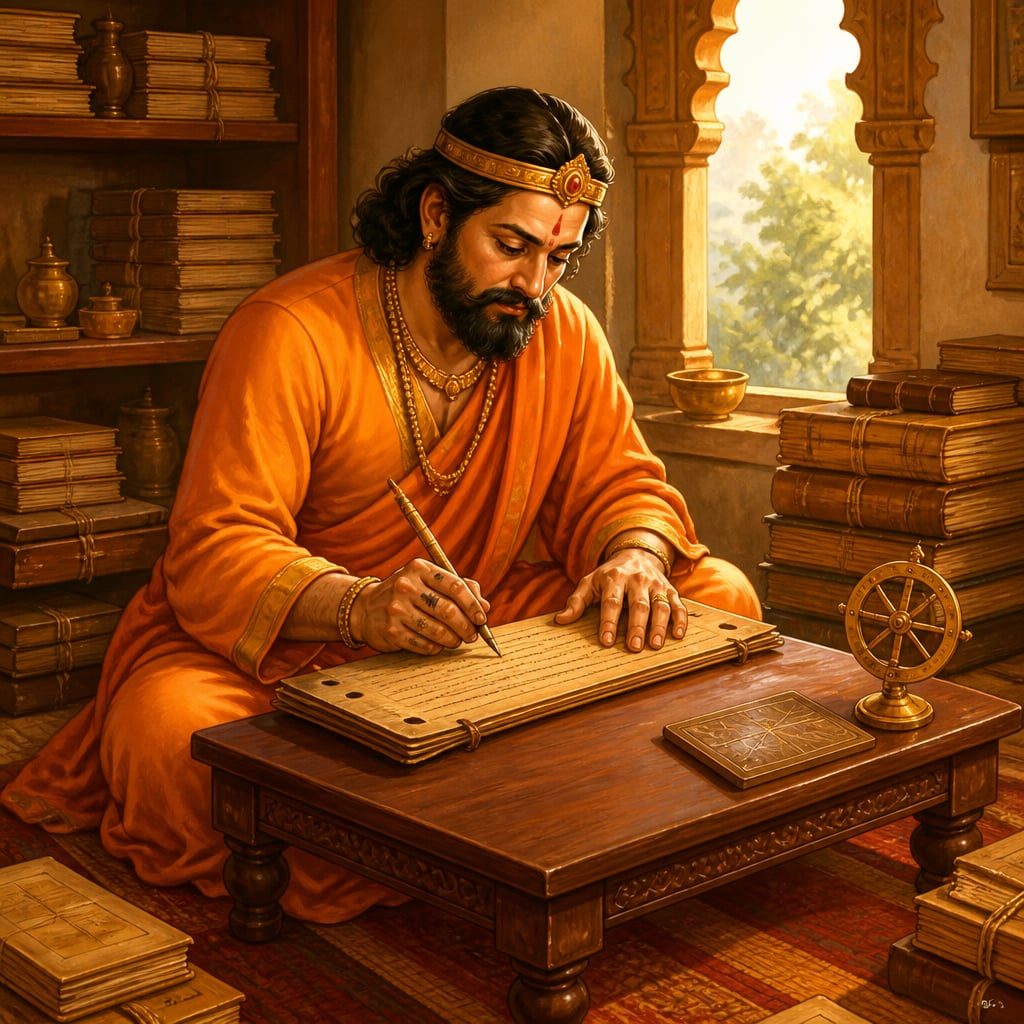
King Bhoja writing at his desk surrounded by manuscripts on every science

Modern scholars approach Bhoja's claimed authorship with nuance. Several possibilities exist:

Personal Authorship: Bhoja wrote some works entirely himself, especially shorter treatises and poetry

Royal Supervision: Bhoja directed teams of scholars who wrote under his guidance, with the work attributed to him as patron and overseer

Compilation: Some works may compile existing knowledge under royal authority

Later Attribution: A few works may have been attributed to Bhoja after his death to enhance their prestige

Most likely, Bhoja's corpus represents a combination of all these. The remarkable thing is that even partial personal authorship of this range would be extraordinary.

The Major Works: Grammar, Poetics, and Architecture

Bhoja's Sarasvatikanthabharana is a massive work on Sanskrit grammar that rivals the greatest grammatical treatises. It analyzes the structure of Sanskrit sounds and words, rules of word formation and sentence construction, comparison with earlier grammatical traditions, and practical applications for correct usage. The title means "Ornament for Sarasvati's Throat" - Sarasvati being the goddess of learning and speech. The work positions Sanskrit grammar as sacred knowledge.

His treatise Shringara Prakasha on poetics and aesthetics examines the nature of rasa (emotional essence) in literature, how poets create beauty through language, analysis of figures of speech, and the relationship between sound and meaning. It builds on earlier theorists like Bharata and Anandavardhana while offering Bhoja's own insights.

Samarangana Sutradhara is perhaps Bhoja's most famous work - a comprehensive treatise on architecture and engineering covering:

Town Planning: How to design cities, select sites, orient buildings

Temple Architecture: Detailed rules for temple construction, proportions, decorations

Palace Design: Royal residences, gardens, water features

Mechanical Devices: Remarkably, chapters on automata and mechanical devices

Military Engineering: Fortifications, siege engines, defensive architecture

A craftsman adjusting a wooden yantra automaton from the Samarangana Sutradhara

The section on yantras (mechanical devices) has attracted particular attention. Bhoja describes mechanical servants (robots), flying machines (vimanas), and automated guards. While scholars debate whether these were actual devices, theoretical designs, or literary imagination, their inclusion shows Bhoja's interest in technology.

"Architecture is frozen philosophy. The building speaks what the builder believes."

Medicine, Astronomy, and Philosophy

Bhoja contemplating the Yoga Sutras at dawn with his Raja Martanda commentary

Bhoja's commentary on the Yoga Sutras of Patanjali is called Raja Martanda ("The Royal Sun"). It provides clear explanations of yogic philosophy, practical guidance for practitioners, integration of yoga with royal duties, and a king's perspective on spiritual practice.

His Ayurveda Sarvasva medical treatise compiles diagnoses and treatments for various diseases, pharmacology and drug preparation, surgical procedures, dietary recommendations, and preventive medicine. Bhoja saw medicine as part of royal responsibility - a king should understand how to keep his people healthy.

The Rajamriganka astronomical treatise covers calculation of planetary positions, eclipse prediction, calendar computation, and astrological applications. The work shows familiarity with both Indian astronomical traditions and influences from Arabic astronomy, which had advanced significantly by Bhoja's time.

The Tattvaprakasha philosophical work examines the nature of reality (tattvas), the relationship between individual soul and universal consciousness, paths to liberation, and integration of different philosophical schools. Bhoja's philosophical works show him attempting to synthesize various Hindu traditions rather than advocating for one school alone.

The Method of Mastery and Role of the Bhojshala

How did Bhoja achieve expertise in so many fields? Several factors likely contributed:

Early Education: Intense training from childhood with the best teachers

Royal Resources: Access to manuscripts, scholars, and facilities unavailable to others

Organizational Skill: Ability to direct research teams effectively

Genuine Intellect: An exceptional mind capable of rapid learning

Time Management: Efficient use of time even during campaigns

The Bhojshala (center of learning) was essential to Bhoja's scholarly output. It provided:

Research Teams: Scholars who could gather information and draft sections

Library Resources: Manuscripts from across India for reference

Debate Forums: Discussions that refined ideas before writing

Scribal Support: Trained scribes to produce final versions

Peer Review: Scholars who could critique and improve works

The Bhojshala functioned almost like a modern research institute, with the king as both chief patron and lead researcher.

Of the 84 claimed works, only some survive complete. Others exist in fragments, are known only from quotations in later works, or may never have existed. Surviving works include Samarangana Sutradhara, Sarasvatikanthabharana, Raja Martanda, and portions of others.

The Integration of Knowledge and Legacy

What makes Bhoja's corpus remarkable is not just its range but its integration. The same mind that analyzed grammar also designed buildings. The same person who studied astronomy practiced medicine.

This integration reflected an ancient Indian ideal: that knowledge is ultimately one, and the truly educated person should understand how different fields connect.

Bhoja's writings influenced centuries of later scholars. The Samarangana Sutradhara became a standard reference for temple builders, his grammatical work influenced later Sanskrit studies, his commentary remains important for Yoga Sutra interpretation, and his astronomical methods were used by later calculators. Even where later scholars disagreed with Bhoja, they engaged with his works seriously.

Bhoja established a model of the scholar-king that influenced later rulers:

In this sense, Bhoja's 84 works were not just scholarly achievements but statements about the nature of kingship itself.

Historical context

Golden Age of Paramara Scholarship, 1020-1050 CE

Sanskrit scholarship was flourishing across India. The Cholas patronized Tamil and Sanskrit literature, the Chandellas built temple libraries, and multiple centers competed for scholarly prestige. It was a peak of medieval Indian learning.

Living traditions

Bhoja's works remain important in multiple fields. The Samarangana Sutradhara is consulted by architectural historians, the Raja Martanda by yoga scholars, and his grammatical works by Sanskrit students. He exemplifies the possibility of encyclopedic achievement.

Reflection

More in Bhoja Paramara

All lessons in Bhoja Paramara ยท Lesser Known Guardians of Dharma course