The Polymath King

Ascending the Throne of Malwa

In 1010 CE, Bhoja Paramara ascended the throne of Malwa at Dhara, inheriting a kingdom surrounded by rivals. Yet this young king would become medieval India's greatest polymath - authoring 84 works on subjects from grammar to astronomy, building the legendary Bhojshala, and defending his realm on all fronts for 45 years.

Origins: The Paramara Legacy and the Boy Scholar

The Paramaras rose to power in the 9th century as feudatories of the Rashtrakutas. When that great empire collapsed around 973 CE, the Paramaras emerged as independent rulers of Malwa - the central Indian plateau that had been a cradle of civilization since the days of the Mauryas.

Their capital was Dhara (modern Dhar in Madhya Pradesh), strategically located at the intersection of trade routes connecting north India to the Deccan. From here, the Paramaras controlled fertile lands, prosperous cities, and ancient pilgrimage sites.

Bhoja was born around 990-1000 CE to King Sindhuraja (also called Vakpati II). From his earliest years, he showed an unusual combination of qualities: the martial skills expected of a prince, but also an insatiable curiosity about everything - poetry, philosophy, architecture, medicine, astronomy, grammar.

Legend says that as a child, Bhoja would slip away from weapons training to study manuscripts in the royal library. His tutors were astonished by his questions, which ranged far beyond the usual curriculum for princes.
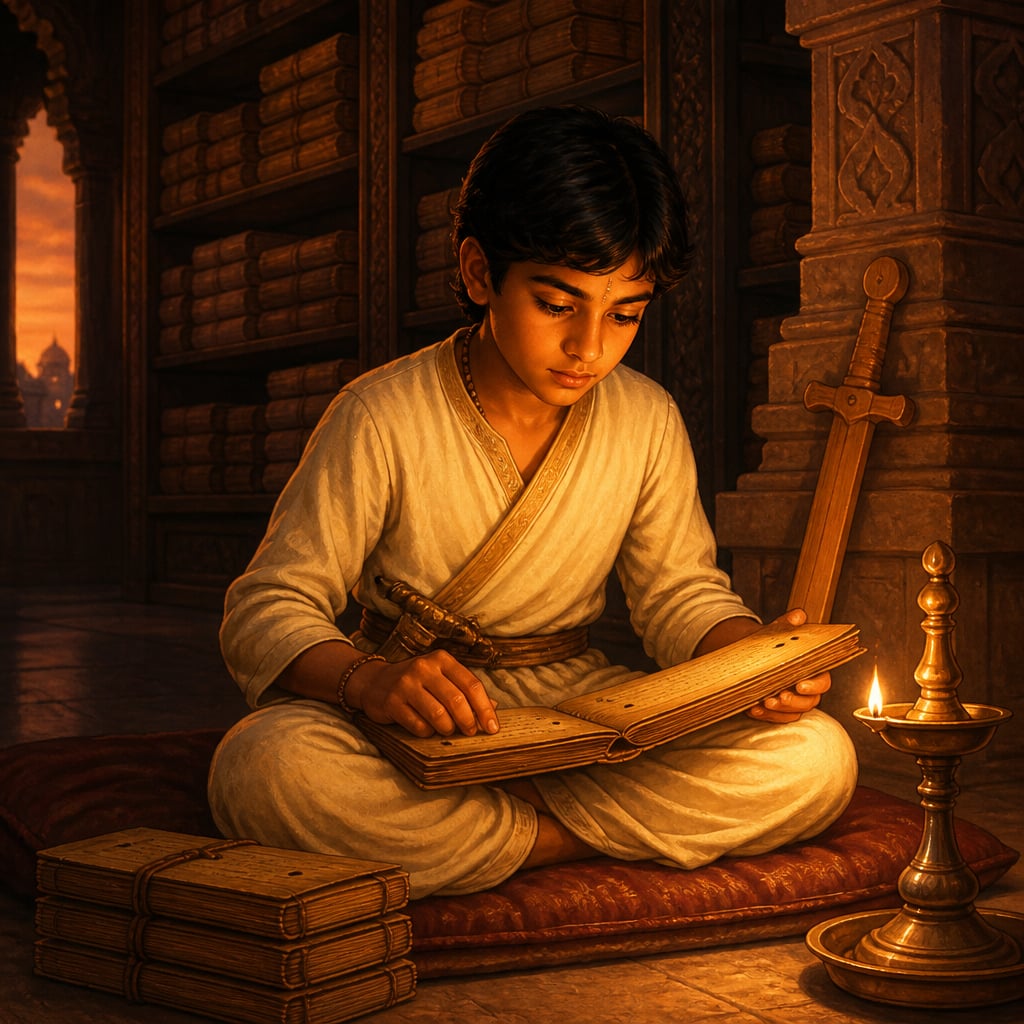
Young Bhoja absorbed in palm-leaf manuscripts in the royal library of Dhara

"A king who knows only warfare is half a king. A king who knows only books is no king at all. The true king masters both."

Ascending the Throne: Strategic Vision Amid Encirclement
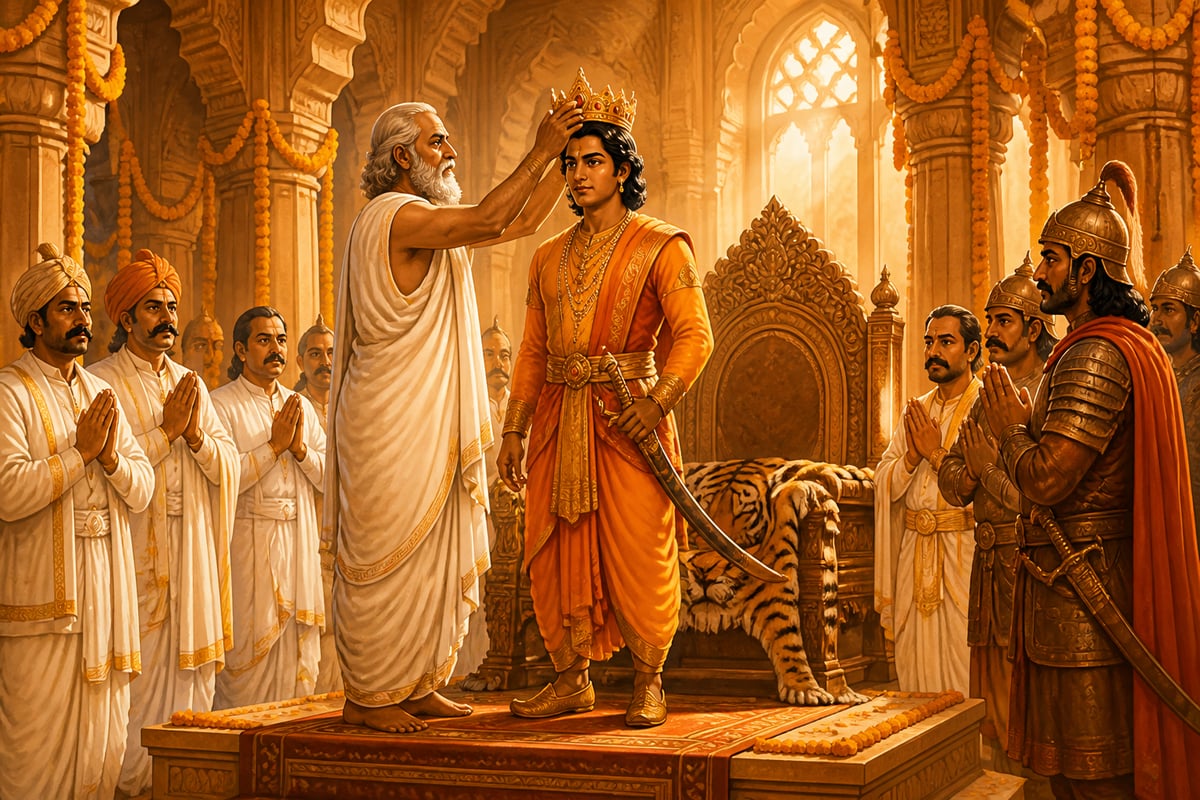
Young Bhoja receiving the crown of Malwa at Dhara

When Bhoja became king around 1010 CE (the exact date is debated), he inherited both opportunities and dangers:

Opportunities:

Dangers:

The young king faced a strategic nightmare: enemies on all sides, each waiting for a sign of weakness.

Bhoja's response to this encirclement would define his reign. Unlike rulers who focused on one front at a time, Bhoja developed a multi-dimensional strategy:

Military Strength: Building and maintaining armies capable of fighting on multiple fronts

Diplomatic Skill: Creating shifting alliances that prevented his enemies from uniting

Economic Power: Developing agriculture, trade, and crafts to fund his ambitions

Cultural Prestige: Making Dhara so famous for learning that other kings sought his recognition

This combination of hard and soft power would sustain Bhoja through four decades of rule.

Dhara and the Bhojshala: Transforming a Capital Into a Center of Learning

Bhoja transformed Dhara from a prosperous provincial capital into one of India's greatest centers of learning. He gathered scholars from across the subcontinent:

King Bhoja walking among the scholars of his Bhojshala

The king didn't merely patronize these scholars - he worked alongside them, often contributing to their projects.

Bhoja's most famous creation was the Bhojshala - a center of learning that combined the functions of a university, library, and royal court. Here, scholars could:

The Bhojshala represented Bhoja's vision that knowledge was not a luxury but essential to civilization. A kingdom that stopped learning would eventually stop existing.

The Author-King and Warrior Scholar

What set Bhoja apart from other learned kings was that he didn't just patronize scholars - he was one himself. Tradition credits him with authoring 84 works covering:

Modern scholars debate how many of these Bhoja wrote personally versus supervised. But even if he only authored a fraction directly, the breadth is astonishing.

Bhoja never forgot that he was a king, not merely a scholar. Throughout his reign, he led armies in person, fought battles, and defended his realm. The same hands that wrote poetry also wielded swords.

This combination was central to his self-image. In his own works, Bhoja presents the ideal king as one who:

Among the Guardians: Culmination and Historical Context

Bhoja comes last in the Guardians of Dharma narrative, not because he was least important, but because he represents the culmination of themes we've traced:

But Bhoja combined all these qualities more completely than any other figure. He was the Renaissance king before there was a Renaissance.

By Bhoja's time (early 11th century), the stakes for Dharmic civilization had changed. The Arab invasions of the 8th century had been repelled. But now a new threat was emerging from the northwest:

Mahmud of Ghazni had begun his devastating raids into India. In 1018, just years after Bhoja took power, Mahmud sacked Mathura. In 1025, he would destroy the great temple of Somnath.

Bhoja's realm was not directly in Mahmud's path, but the invasions reshaped the political landscape. The old powers - Pratiharas, Palas, Rashtrakutas - were fading. New dynasties were rising. In this fluid environment, Bhoja would need all his skills to survive.

The Beginning of a Legacy

As Bhoja consolidated his rule in the 1010s and 1020s, he was laying foundations that would last:

The young ruler of a mid-sized kingdom was becoming a legend. But the real tests - military, intellectual, and spiritual - still lay ahead.

Historical context

Early Paramara Period, c. 1010 CE

India was fragmented among competing dynasties - Chaulukyas in Gujarat, Kalachuris in Tripuri, Chandellas in Bundelkhand, Cholas in the South. The Pratiharas and Palas were declining. Mahmud of Ghazni's raids had begun reshaping the political landscape.

Living traditions

Bhoja is celebrated in Madhya Pradesh as a regional hero and model of learned kingship. His name appears in institution names, his works are studied in Sanskrit programs, and his story is told as an example of combining scholarship with rulership.

Reflection

More in Bhoja Paramara

All lessons in Bhoja Paramara ยท Lesser Known Guardians of Dharma course