The Culmination

Bhoja as the Synthesis of the Guardians

Bhoja stands as the culmination of the Guardians of Dharma narrative - synthesizing military defense, cultural patronage, scholarly achievement, and spiritual devotion into a single extraordinary life. His legacy demonstrates that protecting dharma means both defending civilization and advancing it.

The Last of the Guardians: Synthesis of the Tradition

As we complete the story of Bhoja Paramara, we complete the Guardians of Dharma narrative. From Bappa Rawal's founding of Mewar's resistance to Bhoja's polymath kingship, we have traced how different rulers defended Dharmic civilization through the crucial 8th-11th centuries.

Bhoja comes last not by chronological accident but because he represents the synthesis of all that came before. In him, the various strands of guardianship unite.
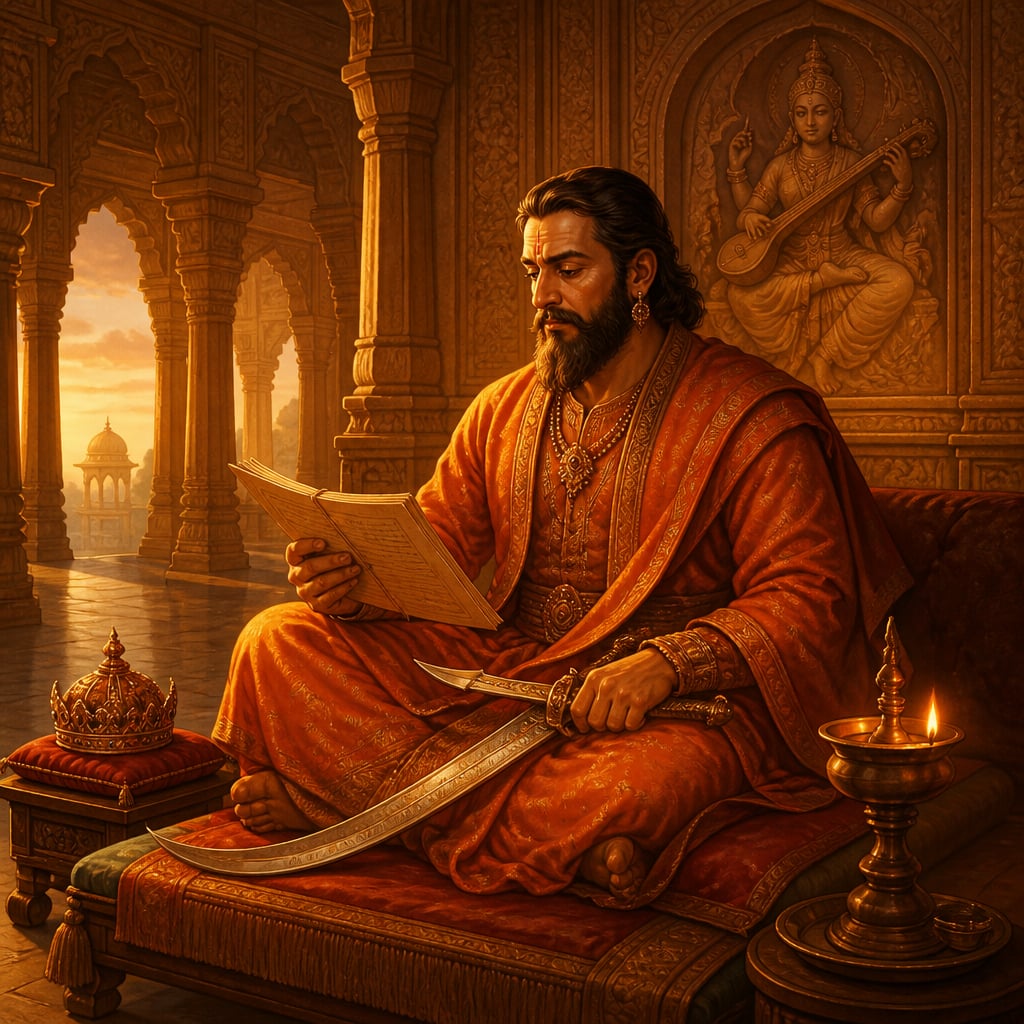
Bhoja seated in the great hall of Dhara with sword on his knees and manuscript in hand

Like Bappa Rawal who defended Mewar against Arab incursions and Nagabhata I who repelled the Umayyad advance at Ujjain, Bhoja was fundamentally a defender. His multi-front wars against Gujarat, Tripuri, and others were extensions of the same civilizational defense. But Bhoja added sophistication: diplomatic maneuvering, strategic depth, the ability to fight on multiple fronts. He showed that defense could be intelligent, not merely brave.

Like Lalitaditya who conquered from Tibet to the Deccan, Bhoja was no mere defender but also a conqueror. His campaigns extended Paramara influence into Gujarat, Konkan, and eastern territories. But unlike Lalitaditya, whose conquests were largely ephemeral, Bhoja focused on consolidation. He understood that lasting power came from governance, not just victory.

Like Yashovarman whose court hosted Bhavabhuti and Vakpati, Bhoja was a supreme patron of culture. The Bhojshala rivaled any court of the past. But Bhoja went further: he was not merely a patron but a participant. The 84 works attributed to him show active intellectual engagement, not just passive support.

Like Amoghavarsha the "Ashoka of the South" who prioritized wisdom over conquest, Bhoja embodied the philosopher-king ideal. His yoga commentary, his Jain and Hindu temple patronage, his emphasis on dharmic rule - all echo Amoghavarsha. But where Amoghavarsha often avoided war, Bhoja showed that philosophy and warfare could coexist. One could think deeply and fight effectively.

Like Dantidurga who founded the Rashtrakuta dynasty from feudatory origins, Bhoja was an institution builder. The Bhojshala, his administrative systems, his architectural projects - all created lasting structures. But Bhoja's institutions were primarily cultural rather than political. The Paramara state did not long survive him, but his intellectual institutions influenced generations.

Beyond synthesizing these qualities, Bhoja added something entirely his own: encyclopedic intellect. No other ruler in Indian history - perhaps world history - combined active military leadership, direct scholarly production, architectural vision, religious devotion, and administrative competence. The 84 works, whether all personally written or not, represent an intellectual range unmatched by any other monarch.

The Philosophy of Integrated Guardianship and Measuring Success

Bhoja's life embodied a philosophy of guardianship that integrated different dimensions:

Sword and Pen: The protector must also be a thinker; the thinker must be willing to fight

Temple and Fortress: Sacred architecture and military engineering serve the same purpose - civilization's preservation

Scholar and King: The ruler who doesn't understand doesn't truly rule

Devotion and Action: Spiritual seeking doesn't mean avoiding worldly duty

"To protect dharma, one must understand dharma. To understand dharma, one must study. To study properly, one must have protection. Thus the warrior and the scholar are one."

Was Bhoja successful? The answer depends on what we measure:

By Political Standards - Mixed: He maintained his kingdom for 45 years but ultimately fell to a coalition. The Paramara state never recovered. By purely political measures, Bhoja's reign ended in failure.

By Military Standards - Respectable: He won many battles, defended against multiple enemies, and survived longer than most kings in such exposed positions. His military record was creditable if not legendary.

By Cultural Standards - Outstanding: The Bhojshala, the 84 works, the temples, the engineering projects - by cultural measures, Bhoja was spectacularly successful. His intellectual legacy has lasted a millennium.

By Historical Memory - Exceptional: Bhoja is remembered as one of India's greatest kings. His name became almost synonymous with learned kingship. Centuries later, lesser kings adopted "Bhoja" as a title. By memory's measure, he triumphed completely.

The Pattern Completed and Lessons from Bhoja

With Bhoja, we see the pattern of guardianship completed:

  1. Defense against external threats (Arab invasions, later Ghaznavid raids)
  2. Assertion of Hindu power through conquest and diplomacy
  3. Preservation of culture through patronage and personal scholarship
  4. Advancement of knowledge through original contributions
  5. Integration of all these into a coherent philosophy of rule

No single Guardian embodied all these perfectly. Together, they created a mosaic of how civilization could be protected and advanced.

Bhoja demonstrated that knowledge enhances rather than detracts from power. The king who understands architecture builds better fortifications. The king who studies medicine keeps healthier armies. The king who knows literature inspires greater loyalty. He faced enemies on all sides and threats of every kind, developing capabilities across all domains - military, diplomatic, economic, cultural.

Bhoja's political legacy was brief; his cultural legacy endures. This suggests that what leaders build may matter more than what they conquer. The temple lasts longer than the empire. His greatest lesson is integration: the refusal to compartmentalize life into separate domains. The same person who designed temples also fought battles. The same mind that analyzed grammar also managed a kingdom.

Bhoja and Dharma: The Comprehensive Understanding

What does Bhoja's story tell us about dharma - the cosmic order, righteous duty, and proper conduct that the Guardians protected?

For Bhoja, dharma was not just preserved temples or defeated enemies. Dharma included:

Intellectual Dharma: The duty to seek and preserve knowledge

Royal Dharma: The obligation to protect and nurture subjects

Creative Dharma: The calling to build and create

Spiritual Dharma: The quest for ultimate truth

Cultural Dharma: The responsibility to advance civilization

By this comprehensive understanding, protecting dharma meant living fully - fighting when necessary, thinking always, building constantly, praying regularly.

The End of an Era and The Guardians' Legacy

Bhoja's death around 1055 CE marked more than the fall of a king. It marked the end of an era:

An empty Bhojshala teaching courtyard at twilight after Bhoja's time

After Bhoja, there would be other defenders, other patrons, other scholars. But the integrated greatness he represented would rarely be matched.

As we conclude with Bhoja, we conclude the Guardians narrative. What did these figures - from Bappa Rawal to Bhoja - collectively achieve?

Civilization Survived: Despite invasions and disruptions, Dharmic civilization continued

Culture Advanced: The 8th-11th centuries saw remarkable literary, artistic, and intellectual achievement

Institutions Formed: Dynasties, temples, universities established lasting structures

Memory Preserved: The Guardians became models for later generations

Identity Maintained: Hindu civilization retained its distinctive character

Final Reflection

Bhoja the Polymath. Bhoja the Temple-Builder. Bhoja the Warrior. Bhoja the Philosopher.

He was all of these, and in being all, he showed that they need not be separate. The defender of civilization is most effective when deeply civilized. The scholar is most valuable when willing to defend what scholarship preserves.

The unfinished Bhojeshwar Temple a thousand years after Bhoja's fall

The Bhojeshwar Temple stands unfinished. The Bhojshala changed hands over centuries. The Paramara dynasty faded. But Bhoja's books are still read, his lake still holds water, his name still inspires.

He was the culmination of the Guardians. And in understanding him, we understand what it truly meant to guard dharma.

"A king may lose his kingdom. A builder's temple may crumble. But he who writes truth into books plants seeds that sprout in every century."

Thus ends the story of Bhoja Paramara, the Renaissance King, the last and greatest of our Guardians of Dharma.

Historical context

End of the Guardian Era, c. 1055 CE and Beyond

With Bhoja's death, a certain kind of Hindu political-cultural achievement reached its end. The Guardians had defended and advanced dharma for three centuries. What came after would face different challenges with different tools.

Living traditions

Bhoja is remembered as the ultimate Renaissance king - before Europe had its Renaissance. His example of integrated excellence inspires discussions of leadership, learning, and legacy. The Guardians collectively are invoked as models of civilizational defense.

Reflection

More in Bhoja Paramara

All lessons in Bhoja Paramara ยท Lesser Known Guardians of Dharma course