The Temple Builder

Sacred Architecture and Divine Devotion

Bhoja was not just an architectural theorist but a prolific temple builder. The temples he commissioned across Malwa represented his vision of sacred architecture as a form of worship. His greatest project, the Bhojeshwar Temple, remains unfinished but stands as a testament to ambitions that reached toward heaven.

The Builder-King and Bhojeshwar Temple

For Bhoja, architecture was not merely construction - it was frozen philosophy, a way of making spiritual truths visible in stone. As he wrote in his Samarangana Sutradhara:

"The temple is the dwelling of the divine. Its every proportion speaks of cosmic order. To build a temple is to participate in creation itself."

This vision drove Bhoja to become one of medieval India's greatest patrons of temple architecture. His projects ranged from small shrines to monuments of unprecedented ambition.
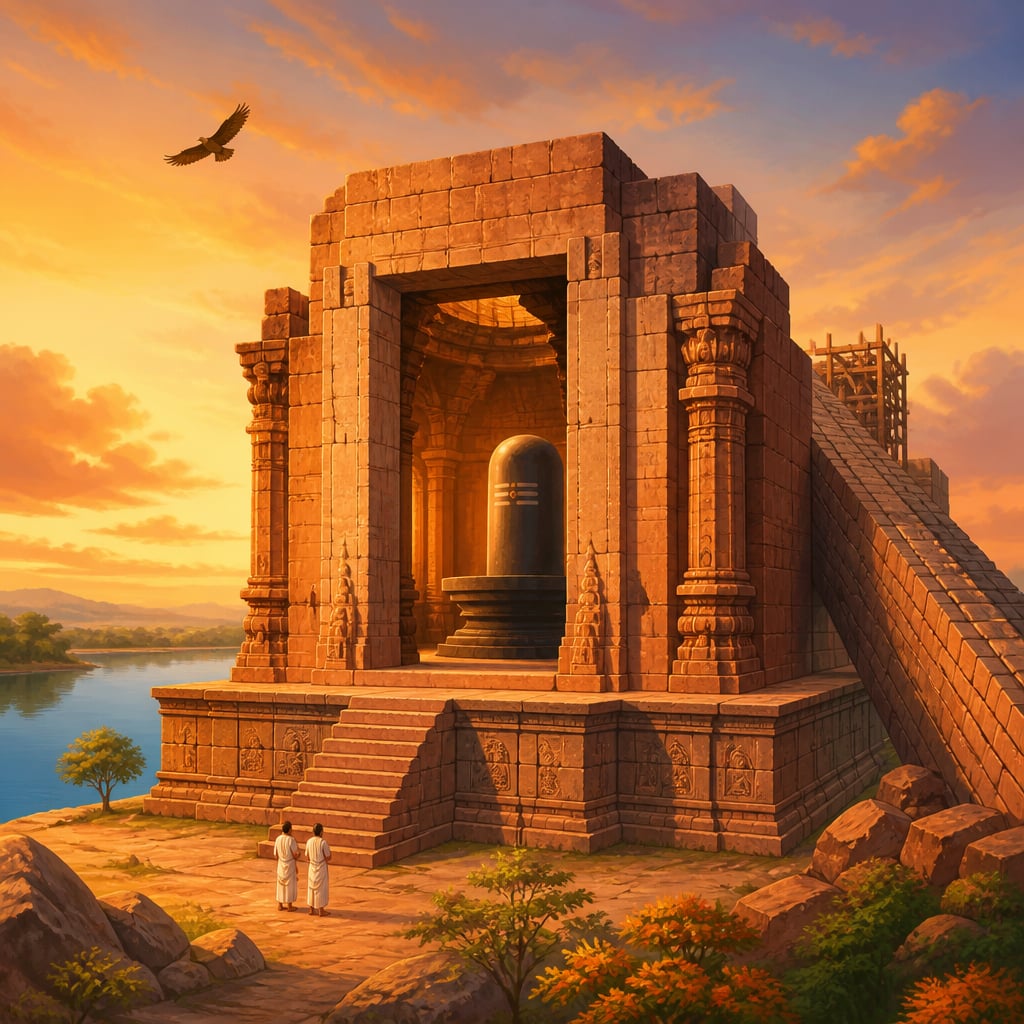
The massive Bhojeshwar Temple at Bhojpur rising over its lake at golden hour

Bhoja's most famous architectural project was the Bhojeshwar Temple at Bhojpur, near modern Bhopal. This temple to Shiva was conceived on a colossal scale:

The Shiva Lingam: The lingam (sacred symbol of Shiva) is among the largest monolithic lingams in India, rising over 7 feet tall and nearly 18 feet in circumference

The Temple Plan: The design called for a massive superstructure that would have rivaled the greatest temples of South India

The Platform: The temple sits on an enormous raised platform overlooking a lake

The Craftsmanship: The quality of stone carving is exceptional, even in the unfinished state

Remarkably, the Bhojeshwar Temple was never completed. The superstructure above the sanctum was never built. Several theories exist - construction may have stopped when Bhoja died in 1055 CE, constant wars may have diverted funds, the ambitious design may have exceeded available engineering capabilities, or his successors may have faced crises preventing completion. Today, the unfinished temple stands as both achievement and reminder of ambitions that exceeded what one lifetime could accomplish.
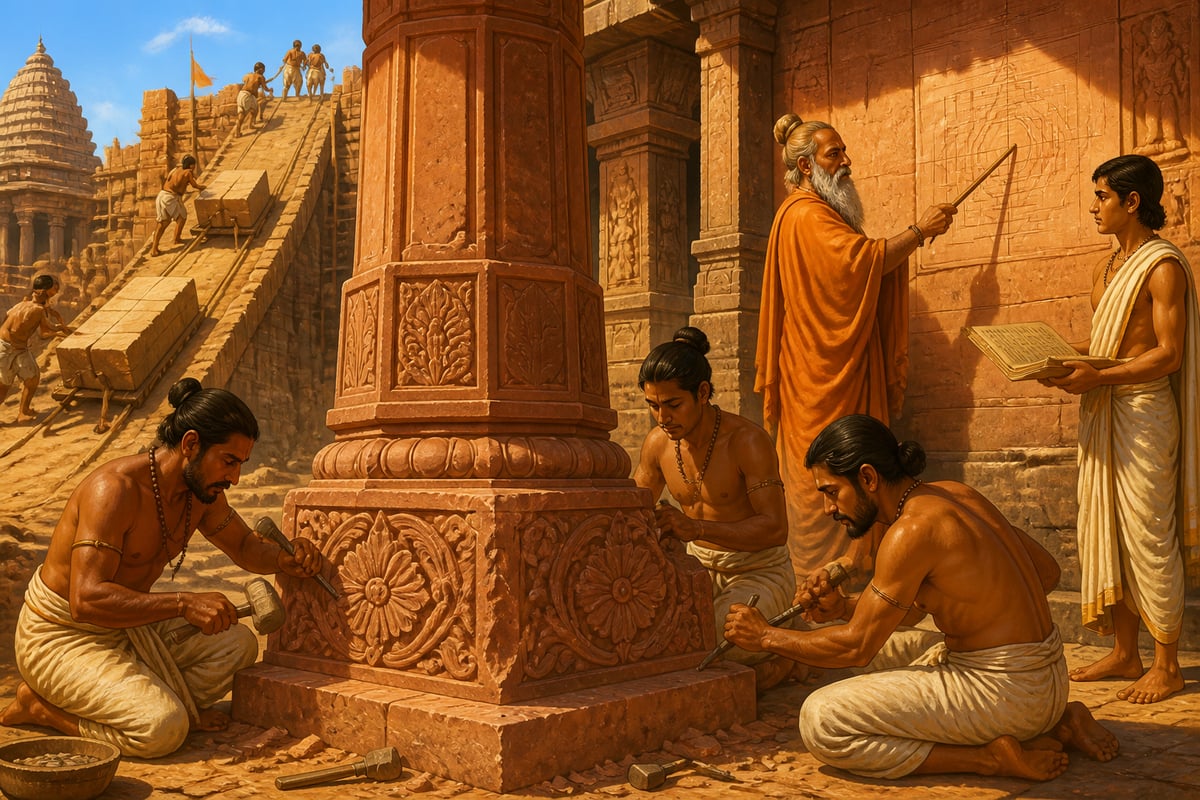
Craftsmen carving the Bhojeshwar Temple pillars with the architect's plan on the wall

The temple reveals sophisticated engineering: a massive earthen ramp to transport heavy stone blocks, lines on the walls showing plans for an enormous dome that was never built, carefully chosen stone, and foundations designed to support enormous weight. The site is sometimes called an "open air museum" of medieval construction techniques.

The Bhoj Tal Lake: A Marvel of Hydraulic Engineering

Workers and bullock carts completing the great earthen dam of Bhoj Tal at sunset

As part of the Bhojeshwar Temple complex, Bhoja commissioned the creation of Bhoj Tal (also called Upper Lake) - one of the largest man-made lakes in India. This massive reservoir:

The lake survives today as the Upper Lake of Bhopal, though much reduced from its original size. It is one of the oldest man-made lakes still in use in India.

"Bhoja created not just a temple but a landscape - a fusion of architecture, water, and devotion."

Other Temple Projects and the Bhojshala

Beyond Bhojeshwar, Bhoja commissioned numerous temples across his kingdom - temples at Dhara (his capital), temples at Mandu, rural shrines throughout Malwa, and renovation projects restoring older temples. Not all can be confidently attributed to Bhoja himself versus other Paramara kings, but the pattern of temple-building was consistent with his documented priorities.

The Bhojshala at Dhar (Dhara) was unique in combining educational and religious functions. This complex included a Sarasvati temple, study halls, a library, and Sanskrit verses inscribed on the walls. The Bhojshala represents Bhoja's philosophy that learning and worship were inseparable. To study was to worship Sarasvati; to worship Sarasvati was to commit to learning.

Architectural Philosophy and Spiritual Vision

Bhoja's temple-building reflected principles from his Samarangana Sutradhara:

Cosmic Symbolism: The temple represents the universe in miniature

Sacred Geometry: Proportions follow mathematical ratios with spiritual meaning

Orientation: Careful alignment with cardinal directions and astronomical phenomena

Hierarchy of Spaces: Progressive movement from mundane to sacred

Material Selection: Stones chosen for their associations and properties

Bhoja's temple-building occurred during a golden age of Hindu architecture. The Chandellas built Khajuraho Temples, the Cholas built Brihadeshwara Temple, and the Solankis built Modhera Sun Temple. Bhoja's contemporary rivals were also great builders. The 11th century was a peak of temple architecture across India.

For Bhoja, temple-building was an act of spiritual merit. The construction process was itself a form of worship, temples established points where heaven and earth connected, kings had an obligation to build temples for their people, and temples would continue to serve after the king's death. This understanding of architecture as spiritual practice unified Bhoja's interests in engineering and religion.

Bhoja's building projects supported extensive communities of craftsmen - stone carvers, architects, engineers, laborers, painters, metalworkers, and other artisans. The Paramara court became a center of architectural knowledge, with techniques and traditions passed down through generations.

Temples as Guardianship and the Unfinished Legacy

For Bhoja, building temples was part of his role as a Guardian of Dharma:

In an era when temples in other regions were being destroyed by invaders, Bhoja's temple-building was an act of cultural affirmation.

Bhoja's architectural legacy includes standing monuments like the Bhojeshwar Temple and Bhoj Tal, the Bhojshala (though altered over centuries), textual knowledge preserved in the Samarangana Sutradhara, and craft traditions that influenced later builders.

The incompleteness of the Bhojeshwar Temple is paradoxically part of its power. It shows:

Sometimes what we attempt matters as much as what we complete. Bhoja reached for heaven; that he didn't quite grasp it does not diminish the reach.

Historical context

Golden Age of Hindu Temple Architecture, c. 1000-1050 CE

India was experiencing a peak of temple architecture. The Chandellas were building Khajuraho, the Cholas were completing the Brihadeshwara Temple, and the Solankis were constructing Modhera. Competition drove excellence.

Living traditions

The Bhojeshwar Temple is an ASI-protected monument and tourist destination. The Upper Lake of Bhopal remains a vital water source and recreational area. Bhoja's architectural vision continues to inspire discussions of sacred architecture.

Reflection

More in Bhoja Paramara

All lessons in Bhoja Paramara ยท Lesser Known Guardians of Dharma course