The Patron of Learning

Manyakheta: Center of Knowledge

Under Amoghavarsha, Manyakheta became one of the great intellectual centers of the medieval world. Scholars in mathematics, astronomy, philosophy, and literature gathered at his court. The achievements in algebra, the Jain philosophical texts, and the literary works produced during his reign contributed to India's golden age of learning.

The Court of Learning

Medieval Indian courts were expected to patronize scholars - it was part of a king's dharma. But Amoghavarsha's court at Manyakheta (modern Malkhed in Karnataka) went far beyond conventional patronage. It became a genuine center of research and creativity, attracting minds from across India.
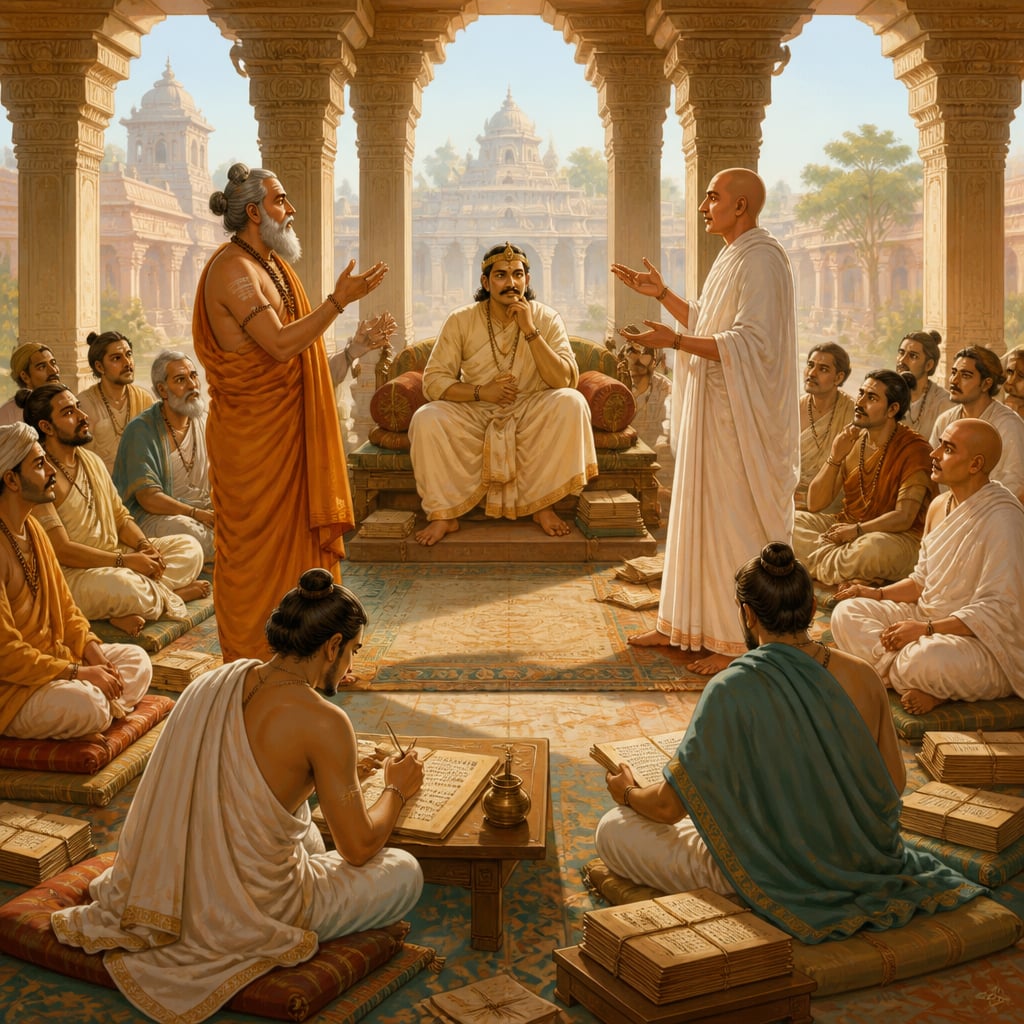
Scholars debating in the Manyakheta court of Amoghavarsha

The emperor's personal interest made the difference. Amoghavarsha didn't simply fund scholars; he engaged with their work, studied their disciplines, and created an environment where learning flourished.

Mathematical and Scientific Scholarship

The 9th century saw remarkable advances in Indian mathematics, and several key figures worked under Rashtrakuta patronage.
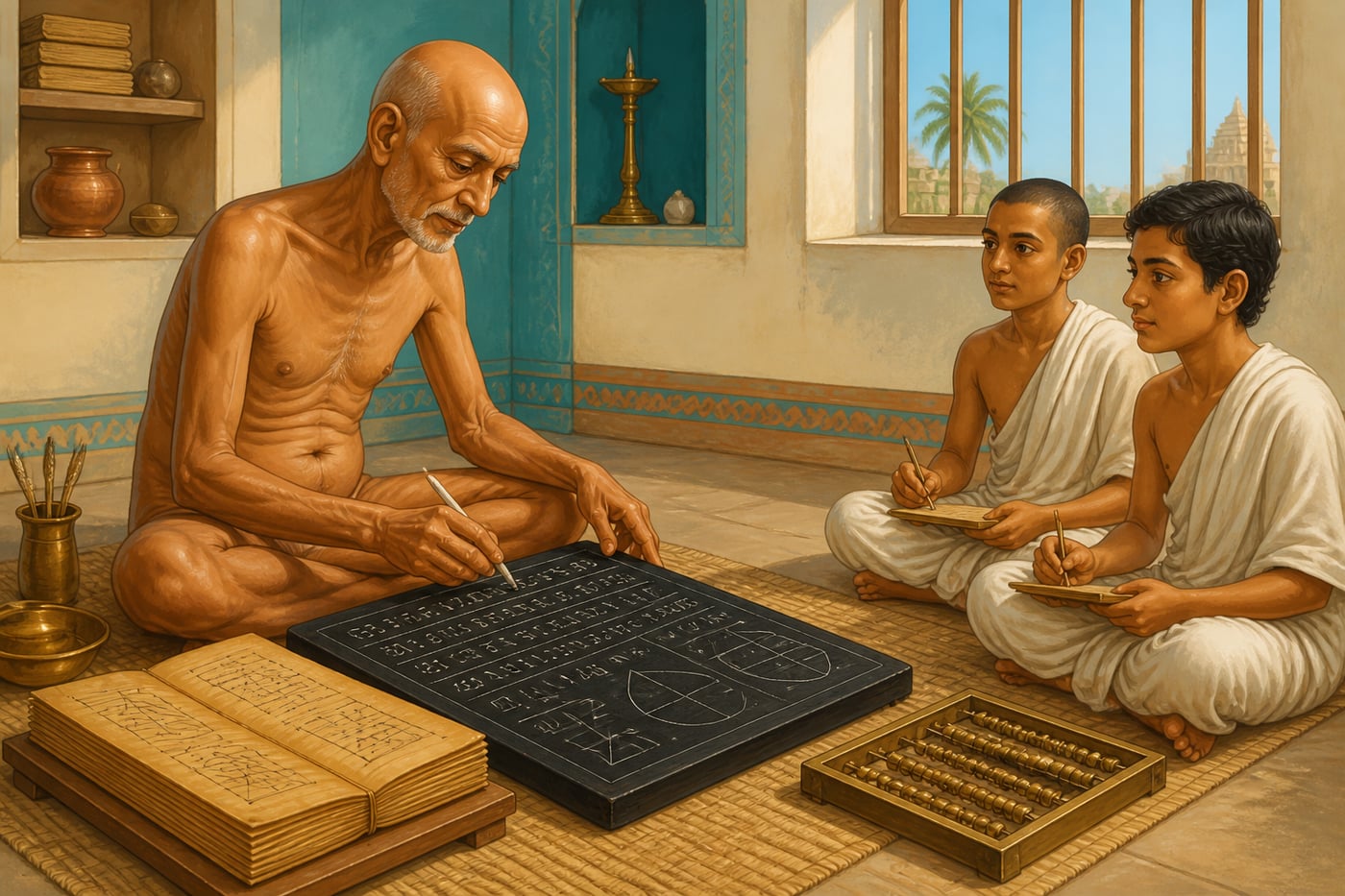
Mahaviracharya calculating Ganitasarasangraha on wooden tablet

Mahaviracharya, whom we met earlier as a Jain monk, produced the Ganitasarasangraha around 850 CE. This comprehensive mathematical text advanced:

Mahaviracharya's work built on earlier mathematicians like Brahmagupta but made original contributions. His text was used as a standard reference for centuries.

Astronomy was closely linked to both religious practice (determining auspicious times) and practical governance (creating calendars). The Rashtrakuta court supported astronomical research.

Scholars at Manyakheta:

These weren't merely abstract pursuits. Accurate astronomy affected everything from agricultural planning to religious festivals.

The Jain and Sanskrit Traditions

Amoghavarsha's personal devotion to Jainism attracted leading Jain scholars to his court. Beyond Jinasena and Mahaviracharya, other important figures included:

Gunabhadra: A co-author of the Adipurana who continued the work after Jinasena's death. He completed this massive text around 879 CE.

Shakatayana: Author of the Shabdanushasana, a work on Prakrit grammar that helped standardize the language used in Jain texts.

These scholars worked on:

"Where the king honors wisdom, scholars gather like bees to a flowering tree."

Though personally inclined toward Jainism, Amoghavarsha maintained traditional Sanskrit learning. His court included:

Sanskrit Grammarians: Continuing the tradition of Panini and his commentators

Vedic Scholars: Maintaining Brahminical learning and ritual expertise

Poets: Composing kavya (ornate poetry) in the classical tradition

Dramatists: Writing for performance at court festivals

The coexistence of Sanskrit and Kannada scholarship was notable. Amoghavarsha promoted both, seeing them as complementary rather than competing.

Institutions and Cultural Development

Medieval Indian learning required institutional support:

Temple Libraries: Major temples maintained collections of manuscripts and employed scholars to copy and preserve texts

Matha (Monasteries): Both Hindu and Jain mathas served as educational institutions, training young scholars

Royal Archives: The court maintained records and accumulated scholarly works

Manyakheta temple library scriptorium at dawn

Copying Centers: Scribes worked continuously to reproduce texts, ensuring their survival

Amoghavarsha supported all these institutions. Land grants to temples and mathas often specifically mentioned support for learning.

The Kavirajamarga was just the beginning. Under Amoghavarsha's patronage, Kannada literature began its classical period:

Religious Poetry: Devotional verses in Kannada made spiritual themes accessible to non-Sanskrit speakers

Inscriptional Poetry: Even administrative inscriptions were composed with literary care

Early Champu: The mixed prose-poetry form that would characterize later Kannada literature began to develop

The legitimization Amoghavarsha provided encouraged subsequent poets. By the 10th century, masters like Pampa and Ranna would produce Kannada works rivaling Sanskrit classics.

Manyakheta was connected to broader networks of learning:

The South: Scholars moved between Rashtrakuta territory and the Tamil and Telugu regions, exchanging ideas

The North: Despite political rivalry, intellectual exchange continued with Pratihara and Pala territories

International: Arab and Persian traders brought knowledge of developments in the Islamic world, including advances in mathematics and astronomy

Amoghavarsha's court was a node in this network, receiving and transmitting knowledge across vast distances.

Indian courts traditionally hosted debates between scholars of different schools. These weren't merely entertainment but served important functions:

Amoghavarsha is said to have personally attended and sometimes participated in such debates, unusual for a king more accustomed to battlefield reports than philosophical arguments.

Not all scholarship was abstract. The Rashtrakuta court also valued practical knowledge:

Medicine: Ayurvedic physicians served the court and compiled medical texts

Architecture: Temple building required sophisticated knowledge of engineering and mathematics

Agriculture: Texts on farming, irrigation, and land management supported the agrarian economy

Metallurgy: South India was known for high-quality steel; the knowledge to produce it was carefully preserved

Legacy and Impact

Amoghavarsha's patronage had lasting effects:

Survival of Texts: Many works from this period survived because royal support ensured they were copied and preserved

Institutional Continuity: The temples and mathas he endowed continued as centers of learning long after his death

Cultural Confidence: His example encouraged later rulers to support learning, creating a tradition of royal patronage

Linguistic Development: Both Sanskrit and Kannada scholarship reached new heights, each enriching the other

The learning patronized at Manyakheta spread throughout the Rashtrakuta realm:

Regional Centers: Subsidiary courts and major temples became local centers of scholarship

Educational Networks: Students trained at Manyakheta carried knowledge back to their home regions

Textual Diffusion: Copies of texts produced at the capital spread throughout southern and central India

A King Among Scholars

What set Amoghavarsha apart from merely generous patrons was his personal engagement. He:

This wasn't a king who threw money at scholars and ignored their work. He was a genuine intellectual who happened to wear a crown.

The Cost and Value of Learning

Maintaining such an establishment wasn't cheap. Some might have argued that money spent on scholars could better fund armies. Amoghavarsha clearly disagreed.

For him, learning was not a luxury but essential to good governance and righteous kingship. A king who ignored wisdom governed in darkness. The wealth spent on scholars was an investment in dharma itself.

The works produced under his patronage - in mathematics, philosophy, and literature - would outlast his empire by a thousand years. In that sense, his investment paid off beyond all calculation.

Historical context

Golden Age of Rashtrakuta Learning, 850-878 CE

Indian scholarship was flourishing across multiple traditions. Jain, Hindu, and Buddhist scholars produced major works. Mathematical and astronomical knowledge was being systematized. Regional languages were developing literary traditions.

Living traditions

Mahaviracharya's mathematical work influenced subsequent Indian mathematicians and reached the Islamic world. The model of royal patronage for diverse learning influenced later Indian kingdoms. Universities today continue traditions he supported.

Reflection

More in Amoghavarsha I

All lessons in Amoghavarsha I ยท Lesser Known Guardians of Dharma course