Legacy of the Philosopher-King

The Meaning of Amoghavarsha

As Amoghavarsha's life drew to a close, he left behind a transformed vision of kingship. He showed that an Indian king could be scholar, devotee, and pragmatic ruler all at once. His legacy lives on in Kannada literature, Jain philosophy, and the ideal of the dharmic sovereign who places wisdom above warfare.

The Twilight and Succession

By the mid-870s, Amoghavarsha I was an old man who had reigned for over sixty years. He had seen empires rise and fall, had buried friends and outlived enemies, had watched his own empire both flourish and contract. The young boy who had inherited a throne in 814 CE was now among the longest-reigning monarchs in Indian history.
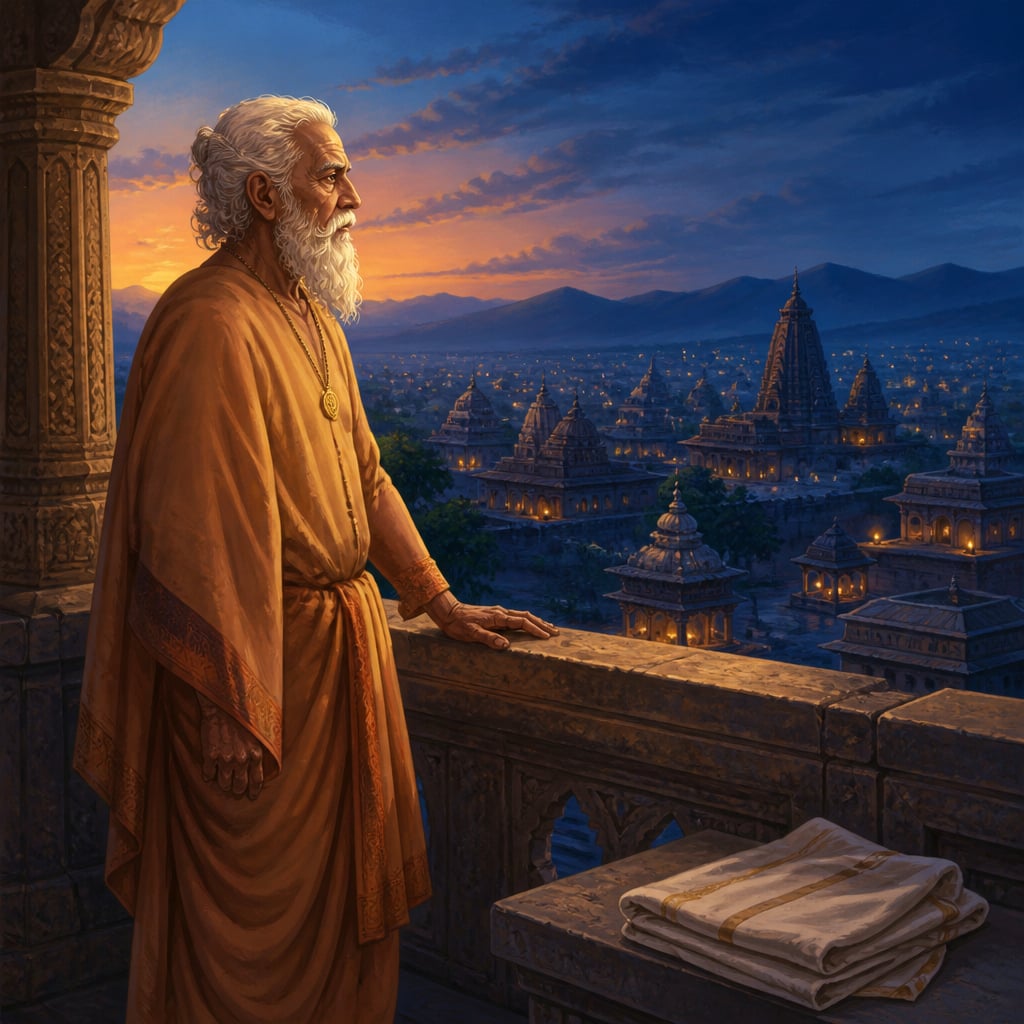
Aged Amoghavarsha on a palace terrace at twilight

The final years brought familiar challenges: ambitious feudatories, external threats, and the perennial tension with his son Krishna II. But there were also moments of peace - time for scholarship, prayer, and reflection on a life lived at the intersection of power and principle.
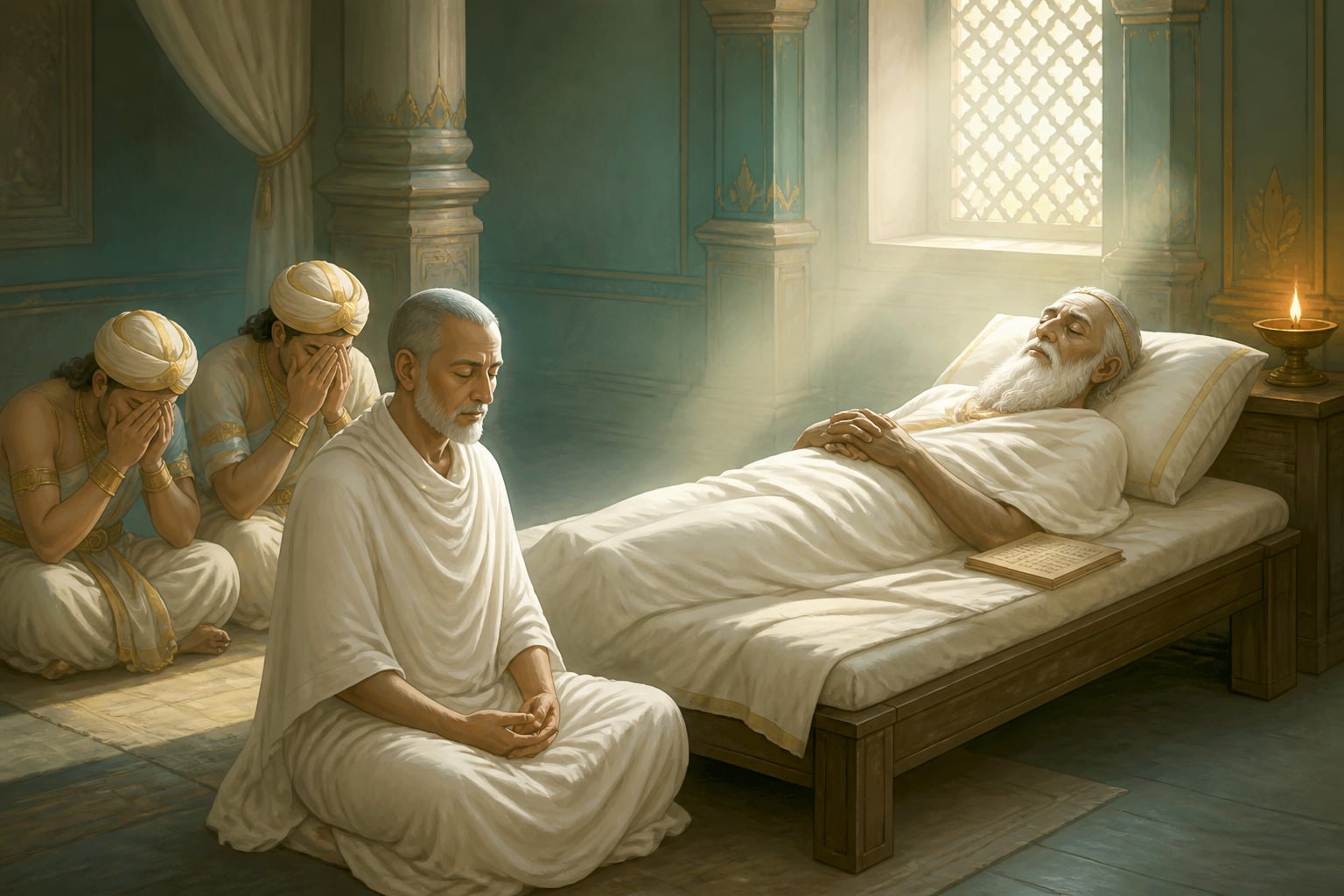
Dying Amoghavarsha attended by Jain acharya

Amoghavarsha died around 878 CE. The exact circumstances are unclear, but some traditions suggest he may have voluntarily embraced death through the Jain practice of sallekhana - ritual fasting to death. Given his lifelong devotion to Jainism and his expressed desire for renunciation, this is plausible.

Other accounts suggest a natural death. What is certain is that after sixty-four years, the throne passed to his son Krishna II, who would rule for about thirty-six years and pursue more aggressive policies.

"The king who longed for renunciation finally found release. Whether through sacred fasting or natural death, his soul sought the liberation he had craved."

The Empire and His Place in History

Krishna II and his successors would restore some of the empire's military prestige. They won victories against the Pratiharas and reasserted control over wayward feudatories. The Rashtrakuta dynasty would continue for another century.

But the empire Amoghavarsha left was structurally different from the one he inherited. More power had devolved to regional lords. The era of unchallenged Rashtrakuta supremacy was over. The dynasty would eventually fall to a feudatory revolt around 973 CE.

Some historians blame Amoghavarsha's peaceful policies for the decline. Others argue that decline was inevitable after the overextension of earlier reigns, and that Amoghavarsha's management actually prolonged the dynasty's life.

Among the Guardians of Dharma, Amoghavarsha occupies a unique position. Unlike warriors like Bappa Rawal or Nagabhata who turned back invaders through military victory, Amoghavarsha's contribution was different.

He showed that guarding dharma wasn't only about defeating enemies on battlefields. It also meant:

In the long arc of resistance to external threats, such cultural preservation was essential. Armies could be rebuilt, territories reconquered - but if the civilization itself was lost, what would there be to fight for?

The Threefold Legacy

Amoghavarsha's cultural contributions endured:

Kannada Literature: The Kavirajamarga established Kannada as a literary language. Within a century, great poets like Pampa and Ranna were producing masterpieces. This tradition continues to the present day - Kannada has produced multiple Jnanpith Award winners.

Jain Textual Tradition: The works composed under his patronage, especially the Adipurana, became foundational texts for Digambara Jainism in South India.

Mathematical Heritage: Mahaviracharya's work influenced subsequent Indian mathematicians and eventually reached the Islamic world, contributing to the global development of algebra.

Amoghavarsha's approach to statecraft also left its mark:

Diplomacy Over Warfare: His emphasis on negotiation and pragmatic compromise influenced later rulers in the region.

Religious Tolerance: His support for multiple religious traditions set an example that many successors followed.

Cultural Investment: His demonstration that cultural patronage was a legitimate use of royal resources encouraged later dynasties to similar efforts.

For Jains especially, Amoghavarsha remains an exemplary figure:

Ancient Jain basadi inscription honoring Amoghavarsha

Jain temples in Karnataka still honor his memory. The institutions he supported survived for centuries.

Comparisons and Enduring Questions

The title "Ashoka of the South" - popularized by modern historian Dr. R.S. Panchamukhi - invites comparison between these two remarkable kings:

Aspect Ashoka Amoghavarsha
Conversion Dramatic turn from violence after Kalinga Gradual deepening of faith throughout life
Religion Buddhism Jainism
Territory Expanded then stopped Inherited vast, lost some
Violence Early wars, then renunciation Always uncomfortable with warfare
Legacy Edicts, dhamma Literature, scholarship
Duration ~40 years 64 years

Both demonstrated that dharmic governance was possible. Both struggled with the tension between spiritual ideals and political necessities. Both invested heavily in religious and cultural institutions.

Amoghavarsha's life raises questions that remain relevant:

Can a ruler be truly righteous? He tried harder than most, yet he could never fully escape the compromises power requires.

Is peace a viable strategy? His empire survived but contracted. Was this the inevitable result of peaceful policies, or would aggressive warfare have caused worse damage?

How should leaders balance personal spiritual aspirations with public duty? He never achieved the renunciation he craved, remaining chained to responsibility until death.

What is the role of culture in civilization's survival? His cultural investments outlasted his military achievements. Was he right to prioritize learning over warfare?

Final Assessment

Amoghavarsha I defies easy categorization. He was:

Perhaps this complexity is what makes him interesting. He was fully human in a role that often demanded superhuman qualities.

The Message for Today

What can Amoghavarsha teach us across twelve centuries?

Learning matters: His investment in scholarship produced works that shaped civilizations. Knowledge is never wasted.

Leadership styles vary: Not all effective leaders are warriors. Wisdom, patience, and diplomacy have their place.

Cultural preservation is defense: In the long run, protecting a civilization's intellectual and spiritual heritage matters as much as protecting its borders.

Duty and aspiration coexist uneasily: Most of us, like Amoghavarsha, must balance what we must do with what we wish we could do.

The Philosopher-King

Plato dreamed of philosopher-kings who would rule with wisdom. India's tradition had the concept of the rajarshi - the royal sage who combined temporal power with spiritual insight.

Amoghavarsha came as close to this ideal as any historical king. He was not perfect - no one who wields power can be. But he genuinely tried to rule according to dharma, to place wisdom above ambition, to serve his people as a father serves his children.

For sixty-four years, a philosopher sat on one of the world's great thrones. That this was possible at all is remarkable. That he is remembered with honor twelve centuries later suggests he achieved something lasting.

The child who inherited an empire in 814 CE became the Ashoka of the South - not through conquest, but through wisdom, learning, and dharma.

Historical context

End of Amoghavarsha's Reign, c. 878 CE

India was entering a period of regional consolidation. The great tripartite powers were all past their peaks. Regional dynasties and cultures were strengthening. The Cholas were rising in the south.

Living traditions

Amoghavarsha remains a cultural hero in Karnataka, honored as founder of Kannada literary tradition. His model of the philosopher-king continues to inspire discussions of ideal governance. The works he patronized are still studied and celebrated.

Reflection

More in Amoghavarsha I

All lessons in Amoghavarsha I ยท Lesser Known Guardians of Dharma course