The Jain Devotee

Finding Dharma Amidst Empire

While managing the vast Rashtrakuta empire, Amoghavarsha found spiritual guidance in Jainism. Under the mentorship of the great Acharya Jinasena, he embraced ahimsa and dharmic governance. His devotion was so profound that he reportedly offered his own finger to the goddess Mahalakshmi during a famine - a story that encapsulates his philosophy of sacrifice for his people.

The Spiritual Quest and Acharya Jinasena

For a king ruling one of the world's largest empires, Amoghavarsha showed a remarkable preoccupation with questions that had nothing to do with power: What is the nature of the soul? How should one live righteously? What happens after death? These questions, usually the domain of monks and philosophers, consumed the emperor's thoughts.

The Rashtrakuta court was ecumenical. Shaivism, Vaishnavism, Buddhism, and Jainism all found patronage. But Amoghavarsha's personal faith increasingly drew him toward Jainism, with its emphasis on non-violence, self-discipline, and the liberation of the soul from karmic bondage.

The pivotal figure in Amoghavarsha's spiritual development was Jinasena, one of the most important Digambara Jain scholars of the medieval period. Jinasena was not merely a religious teacher but a polymath who wrote on philosophy, cosmology, and ethics.
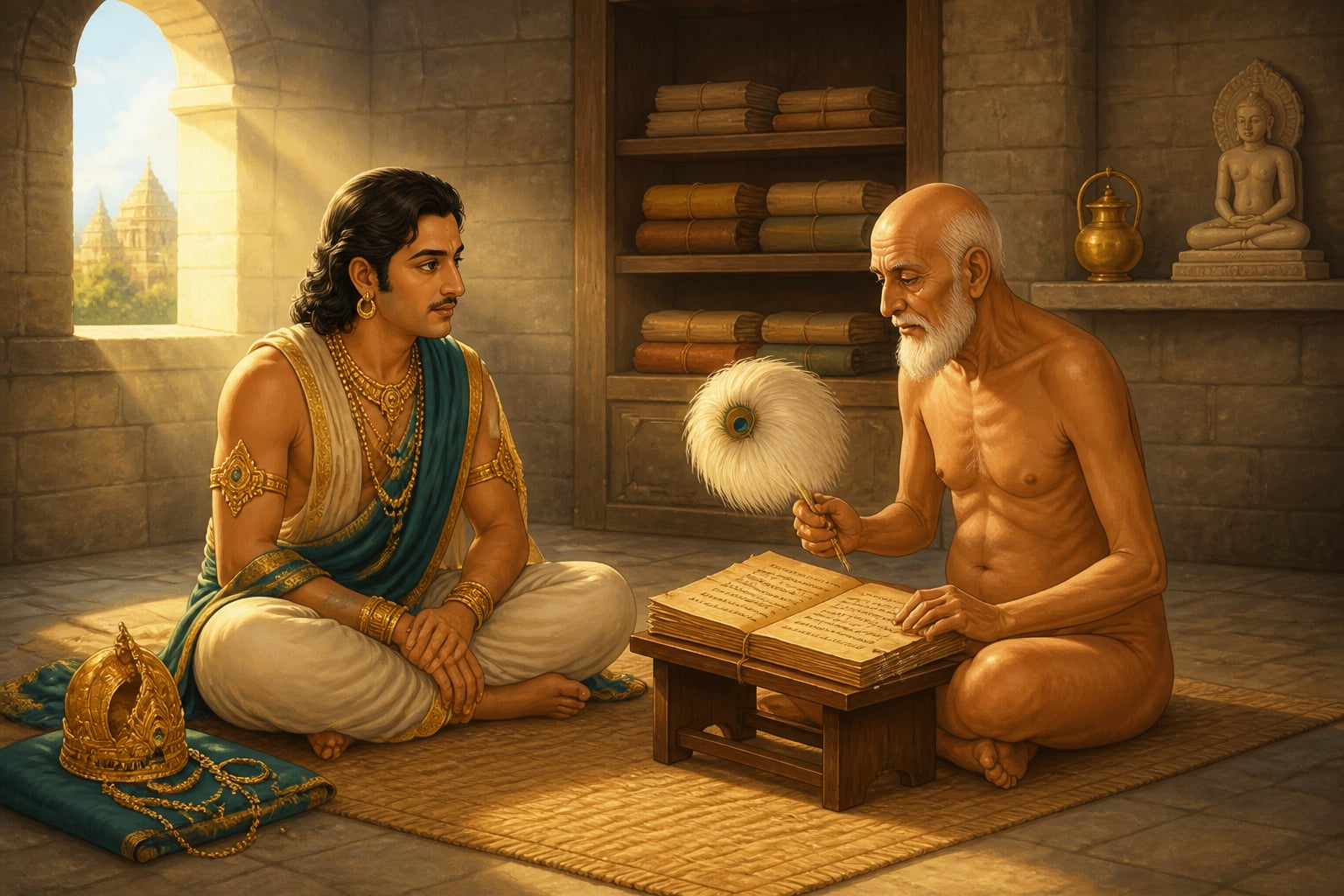
King studying Adipurana with Jinasena in Jain monastery

His masterwork, the Adipurana, was composed under Amoghavarsha's patronage. This vast text retold the life of the first Tirthankara, Rishabhadeva, but was really a comprehensive exposition of Jain philosophy, ethics, and worldview. Jinasena dedicated the work to his royal patron.

"The king who seeks wisdom from sages becomes himself a sage upon the throne."

Under Jinasena's guidance, Amoghavarsha studied:

The Philosophy of Non-Violence

For a king, ahimsa presented obvious challenges. How could one practice non-violence while commanding armies and punishing criminals? Amoghavarsha wrestled with this tension throughout his life.

His solution was nuanced. He could not entirely avoid violence - no king could - but he could minimize it. His reign saw fewer aggressive wars than his predecessors. When conflicts arose, he often sought diplomatic solutions. He reportedly felt genuine anguish when warfare was unavoidable.

Amoghavarsha offering his finger at the Mahalakshmi temple

The inscriptions of his reign show a gradual shift in royal rhetoric. Where earlier Rashtrakuta kings boasted of enemies slain and kingdoms conquered, Amoghavarsha's later inscriptions emphasized temples built, charities endowed, and learning promoted.

The Sacrifice of the Finger

The most famous - and most debated - story about Amoghavarsha's devotion involves an extraordinary act of self-sacrifice. According to tradition, a severe famine struck his kingdom. The people suffered terribly, and all efforts at relief seemed inadequate.

In desperation, Amoghavarsha went to the temple of Mahalakshmi at Kolhapur. There, he cut off one of his own fingers and offered it to the goddess, praying for relief for his people. Shortly after, the rains came and the famine ended.

Historians debate whether this story is literally true. Some point to inscriptions that seem to reference the event. Others consider it a later legend illustrating Amoghavarsha's character. Whether historical fact or pious legend, the story captures something essential about how his contemporaries viewed him: a king willing to sacrifice his own body for his subjects.

Jain Influences on Governance and Scholarship

Amoghavarsha's Jain beliefs influenced his approach to governance in concrete ways:

Religious Tolerance: Following the Jain principle that truth has many aspects, Amoghavarsha patronized all religions. Hindu temples received royal grants alongside Jain establishments. Buddhist monasteries were not neglected.

Charity and Welfare: Jainism emphasizes dana (giving) as essential for spiritual progress. Amoghavarsha established numerous charitable institutions - rest houses for travelers, feeding centers during famines, hospitals for humans and animals.

Animal Welfare: The Jain emphasis on ahimsa extended to all living beings. Amoghavarsha reportedly reduced the scale of animal sacrifices at royal rituals and promoted vegetarianism at court.

Judicial Restraint: Capital punishment, while not abolished, was reportedly used sparingly. The king preferred exile or fines to execution when possible.

Another brilliant mind at Amoghavarsha's court was Mahaviracharya, a mathematician whose work Ganitasarasangraha (Compendium of Mathematics) remains influential. This text advanced algebra, geometry, and arithmetic, including early work on permutations and combinations.

Mahaviracharya was a Jain monk, and his mathematical work was partly motivated by Jain cosmological interests - calculating the vast time cycles and spatial dimensions that Jain cosmology described. Amoghavarsha's patronage allowed him to complete this groundbreaking work.

The connection between Jain philosophy and mathematical advancement was not coincidental. Jainism's emphasis on precise analysis and systematic categorization fostered intellectual rigor that benefited both spiritual and secular learning.

The Renunciation That Never Came

Throughout his reign, Amoghavarsha expressed a desire to renounce his throne and become a Jain monk. The sallekhana - the Jain practice of voluntary death through fasting - reportedly attracted him as the ultimate spiritual achievement.

In his own writings and in inscriptions commissioned during his reign, Amoghavarsha lamented the worldly attachments that kingship required. He saw himself as trapped by duty, unable to pursue the spiritual liberation he craved.

"The throne is a golden cage. The king who sits upon it may command millions, yet he is less free than the wandering monk who owns nothing."

Yet he never renounced. Year after year, decade after decade, he remained on the throne. Some see this as failure - a man unable to follow through on his convictions. Others see it as a deeper understanding of dharma: that his duty to his people outweighed his personal spiritual aspirations.

The Inner Tension

This tension - between worldly duty and spiritual aspiration - defines Amoghavarsha's life. He was neither a conquering emperor like his father nor a renouncing monk like his guru. He was something rarer: a philosopher struggling to rule justly in an unjust world.

His inscriptions reveal this struggle. They speak of battles he fought without glorifying them. They praise dharma while acknowledging the compromises power requires. They express longing for liberation while accepting the chains of responsibility.

Legacy of a Spiritual King

Amoghavarsha's Jain devotion left lasting marks:

Consecration of Jain Narayana temple at Pattadakal

More importantly, he demonstrated that spiritual seeking and effective governance need not be incompatible. A king could study philosophy, patronize monks, practice restraint, and still maintain a great empire. The "Ashoka of the South" had earned his title not through conquest but through the harder path of righteous rule.

Historical context

Mid-Rashtrakuta Period, 830-860 CE

Jainism was experiencing a golden age in South India under Rashtrakuta patronage. The Digambara tradition produced major philosophical and literary works. Multiple religious traditions coexisted and competed peacefully.

Living traditions

Amoghavarsha remains a revered figure in Jain tradition as an exemplary lay devotee who integrated spiritual practice with worldly responsibilities. His patronage helped establish Karnataka as a center of Jain culture.

Reflection

More in Amoghavarsha I

All lessons in Amoghavarsha I ยท Lesser Known Guardians of Dharma course