A Child Inherits an Empire
The Boy Who Would Be Philosopher-King
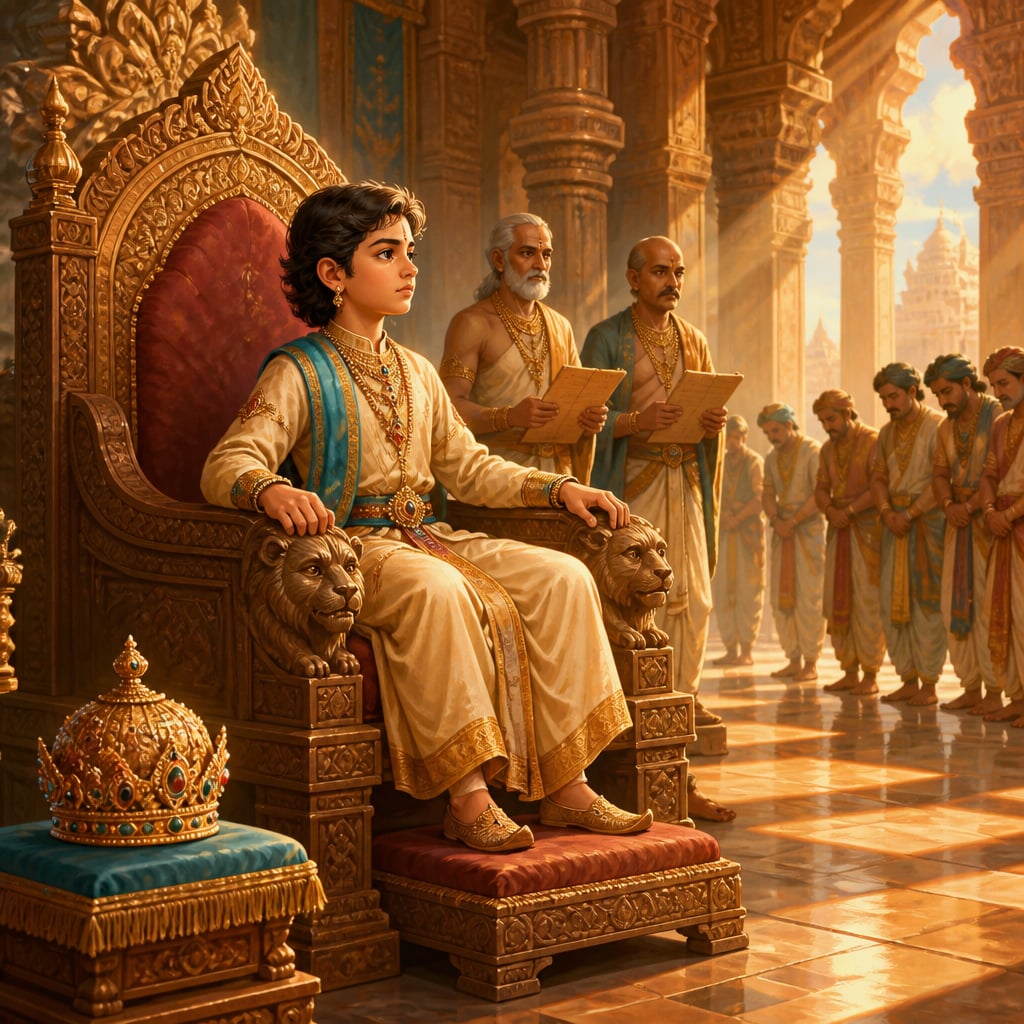
In 814 CE, a child named Amoghavarsha inherited the mightiest empire in India - the Rashtrakuta dominion stretching from the Ganges to Cape Comorin. At just 14 years old, he faced rebellions, invasions, and ambitious nobles who saw opportunity in his youth. Yet this boy would reign for 64 years and earn the title 'Ashoka of the South' - not through conquest, but through wisdom, literature, and devotion.
The Rashtrakuta Inheritance
When Govinda III died in 814 CE, he left behind an empire that stretched across most of the Indian subcontinent. The Rashtrakutas had humiliated the Pratiharas in the north and the Palas in the east, reducing both to vassalage. The Cholas and Pandyas in the south paid tribute. The Arab traveler Sulaiman, writing in 851 CE, described this empire as one of the four greatest in the world, alongside the Abbasid Caliphate, Byzantine Empire, and Tang China.
But Govinda III also left behind a problem: his heir, Amoghavarsha I, was merely a boy of fourteen. In an age when kingdoms rose and fell on the strength of their rulers' swords, a child king was an invitation to disaster. Courtiers whispered. Generals calculated. Neighboring kings sharpened their ambitions.
The Young King's Challenges
The young emperor's full name was Sharva (also called Sarva), but he is known to history by his royal title: Amoghavarsha, meaning "one whose blessings (or arrows) never fail." It was an aspirational name for a boy who had yet to prove himself.
The Rashtrakuta succession had never been smooth. The dynasty had risen through a coup when Dantidurga overthrew his Chalukya overlords around 753 CE. Power struggles among princes were common, and blood had been spilled more than once in the race for the throne. Now, with a child on the throne, every ambitious feudatory and relative saw opportunity.
"A throne surrounded by vultures requires either a sword or wisdom. The young king would ultimately choose wisdom."
The first test came almost immediately. Karka, a powerful noble from the Gujarat branch of the Rashtrakutas, refused to accept the boy's authority. He raised an army and declared himself the rightful emperor.
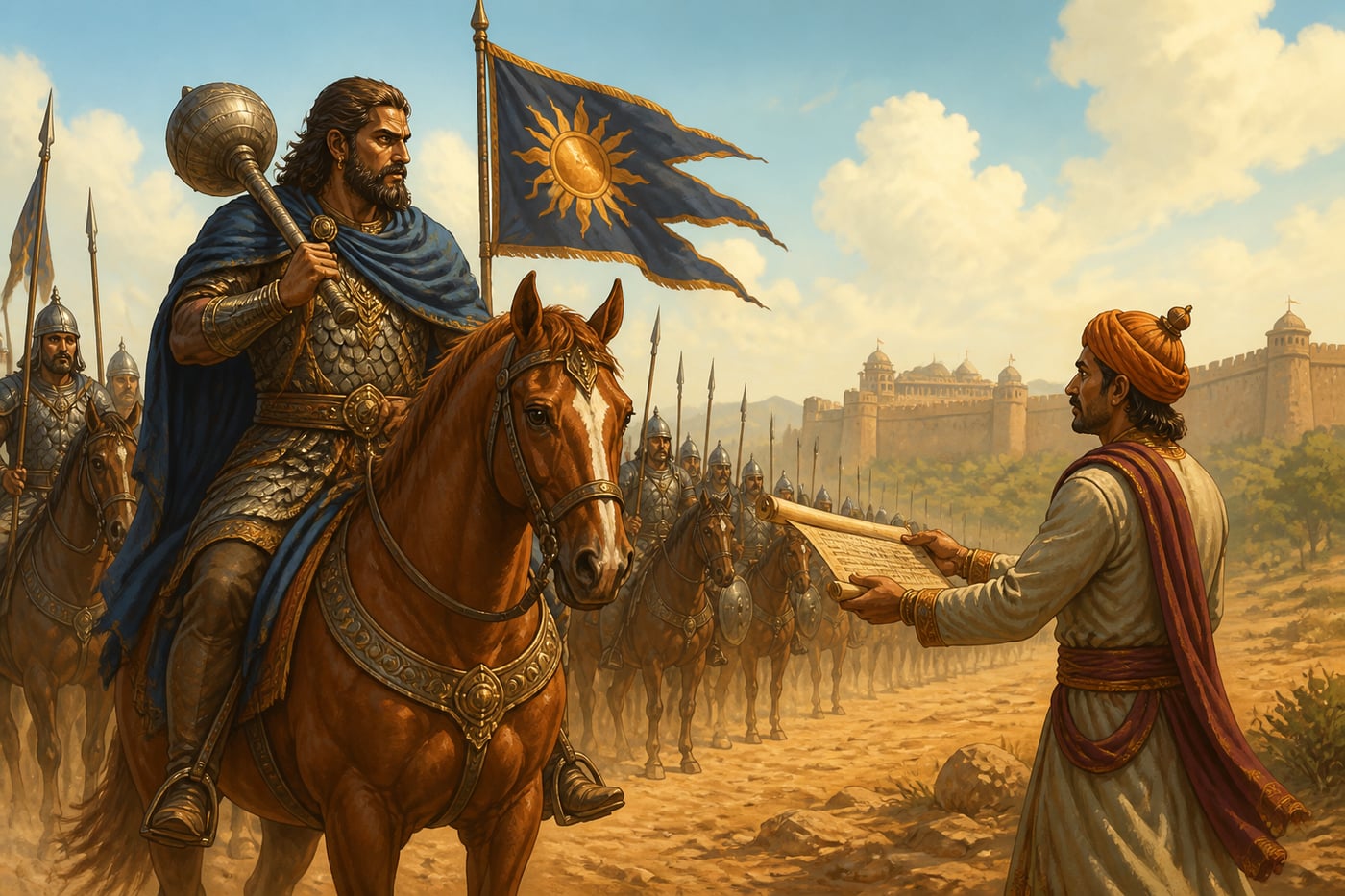
Karka was no minor threat. The Gujarat branch controlled wealthy trading ports along the Arabian Sea coast and had their own network of alliances with local chiefs and merchants. Their treasury was deep, their soldiers battle-hardened. For a few years, the empire seemed on the verge of splitting apart.
Amoghavarsha - or more likely, his regents acting in his name - faced a difficult choice. They could fight a destructive civil war that might shatter what remained of imperial unity, or they could negotiate from a position of weakness. The path chosen revealed a characteristic that would define the young king's entire reign: pragmatism over pride.
Rather than wage total war, Amoghavarsha's government negotiated. Karka was given recognition and semi-autonomous status. The empire remained nominally unified, though weakened. It was not a glorious victory, but it preserved the kingdom to fight another day.
External Threats and Early Struggles
While dealing with internal rebellion, the young emperor also faced external aggression. The Pala dynasty of Bengal, recently humiliated by Govinda III, saw a chance for revenge. Under their king Dharmapala and later Devapala, the Palas probed Rashtrakuta territories, testing the young ruler's resolve.
The Gangas of Kalinga (modern Odisha) also tested the new emperor, raiding the eastern frontiers and carrying off plunder. On multiple fronts, the vast empire that Amoghavarsha had inherited seemed to be crumbling. Lesser men might have despaired. Amoghavarsha endured.
What makes Amoghavarsha remarkable is not that he faced these challenges - many kings did - but how he responded to them. Where his predecessors had sought glory through endless warfare, Amoghavarsha gradually shifted toward a different vision of what it meant to be a great king.
This didn't happen overnight. In his early reign, Amoghavarsha fought wars and defended his borders like any other king. But as he matured, influenced by Jain teachers and his own philosophical temperament, he began to question the endless cycle of conquest and revenge that had consumed Indian kings for centuries.
The inscriptions from his reign show a gradual transformation. Early records speak of battles and victories. Later inscriptions increasingly emphasize dharma, charity, and learning. The warrior-king was becoming a philosopher-king.
The Court at Manyakheta
Manyakheta (modern Malkhed in Karnataka) served as the Rashtrakuta capital. Amoghavarsha moved the court here from the earlier capital at Mayurkhandi, recognizing Manyakheta's more central location and strategic advantages. Under his guidance, it became one of medieval India's greatest centers of learning and culture. The young king gathered scholars, poets, mathematicians, and philosophers from across the subcontinent.

Unlike many royal courts where learning served merely as entertainment between hunts and feasts, at Manyakheta scholarship was taken seriously. Amoghavarsha himself studied Sanskrit grammar, Jain philosophy, and the arts of governance. He didn't merely patronize scholars - he became one, composing works that would outlast his dynasty.
The diversity of his court was remarkable. Hindu Brahmins, Jain monks, Buddhist scholars, and even foreign visitors found welcome. This ecumenical spirit, rare in any age, became a hallmark of his reign and distinguished him from rulers who demanded religious conformity.
The Weight of the Crown
Despite his growing inclination toward philosophy and peace, Amoghavarsha could not entirely escape the duties of kingship. Throughout his long reign, he had to manage:
- Feudatories who needed careful handling to prevent rebellion
- Neighboring kingdoms that constantly probed for weakness
- His own nobles who sometimes preferred war to peace
- Succession questions that would eventually involve his own son
The tension between his spiritual aspirations and political necessities would define his life. He famously wrote that he wished he could renounce his throne and become a monk, but duty to his people prevented it. This inner conflict between the saint and the sovereign never fully resolved.
The 64-Year Reign Begins
As Amoghavarsha moved from adolescence to adulthood, he consolidated his position. The Karka rebellion was settled. The Palas were contained. The empire, though somewhat reduced from its peak under Govinda III, remained formidable and wealthy.
More importantly, the young king was developing a vision that would make his reign unique in Indian history. He would not be remembered for conquering new territories or humiliating rivals. Instead, he would be remembered for:
- Authoring Kavirajamarga, the first work on Kannada poetics
- Patronizing mathematicians who advanced algebra and astronomy
- Building temples and charitable institutions across his realm
- Practicing a form of kingship that prioritized wisdom over war
The Foundations of Legend
Amoghavarsha's early struggles - the child inheriting an empire, the rebellions, the threats from all sides - form the necessary backdrop to understanding his later achievements. He did not become the "Ashoka of the South" by accident or in easy circumstances.
He earned that title by surviving the crucible of early kingship, by learning that brute force alone could not solve all problems, and by gradually developing a philosophy of rule that valued dharma, learning, and the welfare of his subjects over mere territorial expansion.
The boy who trembled on his father's throne in 814 CE would, over the next six decades, transform not just himself but the very idea of what an Indian king could be. His story had only just begun.
Historical context
Early Rashtrakuta Period, 814-830 CE
India was dominated by the tripartite struggle between Rashtrakutas, Pratiharas, and Palas for control of the north. The Cholas were rising in the south. The Rashtrakutas under Govinda III had just achieved paramount status.
Living traditions
Amoghavarsha is celebrated in Karnataka as a founding figure of Kannada literature. His reign established the Deccan as a center of learning and culture that influenced subsequent dynasties for centuries.
- Malkhed (Ancient Manyakheta): The Rashtrakuta capital where the boy-king Amoghavarsha was crowned and later transformed it into a center of learning
- Ellora Caves: The Kailasa Temple and surrounding caves flourished under Rashtrakuta patronage during Amoghavarsha's time
Reflection
- What challenges did Amoghavarsha face as a teenage emperor, and how might you have responded differently?
- Was Amoghavarsha's decision to negotiate with Karka rather than fight a sign of wisdom or weakness?
- What does it mean to be called 'Ashoka of the South' and why was this the highest honor for an Indian king?