The Kavirajamarga

Birth of Kannada Literature

Amoghavarsha was not merely a patron of scholars - he was himself an author. His Kavirajamarga, the first extant work on Kannada poetics, established the theoretical foundations of Kannada literature. This royal treatise declared Kannada a language worthy of great poetry, equal to Sanskrit in its capacity for beauty and meaning.

A King Who Wrote and the State of Kannada

Many kings have patronized poets. Few have written treatises themselves. Amoghavarsha I was that rare ruler who combined political power with genuine scholarly achievement. His Kavirajamarga ("The Royal Path of Poets") stands as a landmark in Indian literary history - the first extant work on Kannada poetics.

The title itself is significant: kaviraja means "king of poets" or "royal poet," and marga means "path" or "way." It was a guide for poets, written by a king who considered poetic excellence a noble pursuit worthy of royal attention.

By the 9th century, Kannada had been a spoken language for millennia, but its written literature was only beginning to develop. Sanskrit remained the prestige language of the courts, used for religious texts, royal inscriptions, and high literature.

Kannada inscriptions existed - the earliest date to the 5th century - but sustained literary works in Kannada were rare. The language was associated with common speech, not courtly elegance. To write poetry in Kannada was considered less prestigious than writing in Sanskrit.

Amoghavarsha's Kavirajamarga challenged this hierarchy.
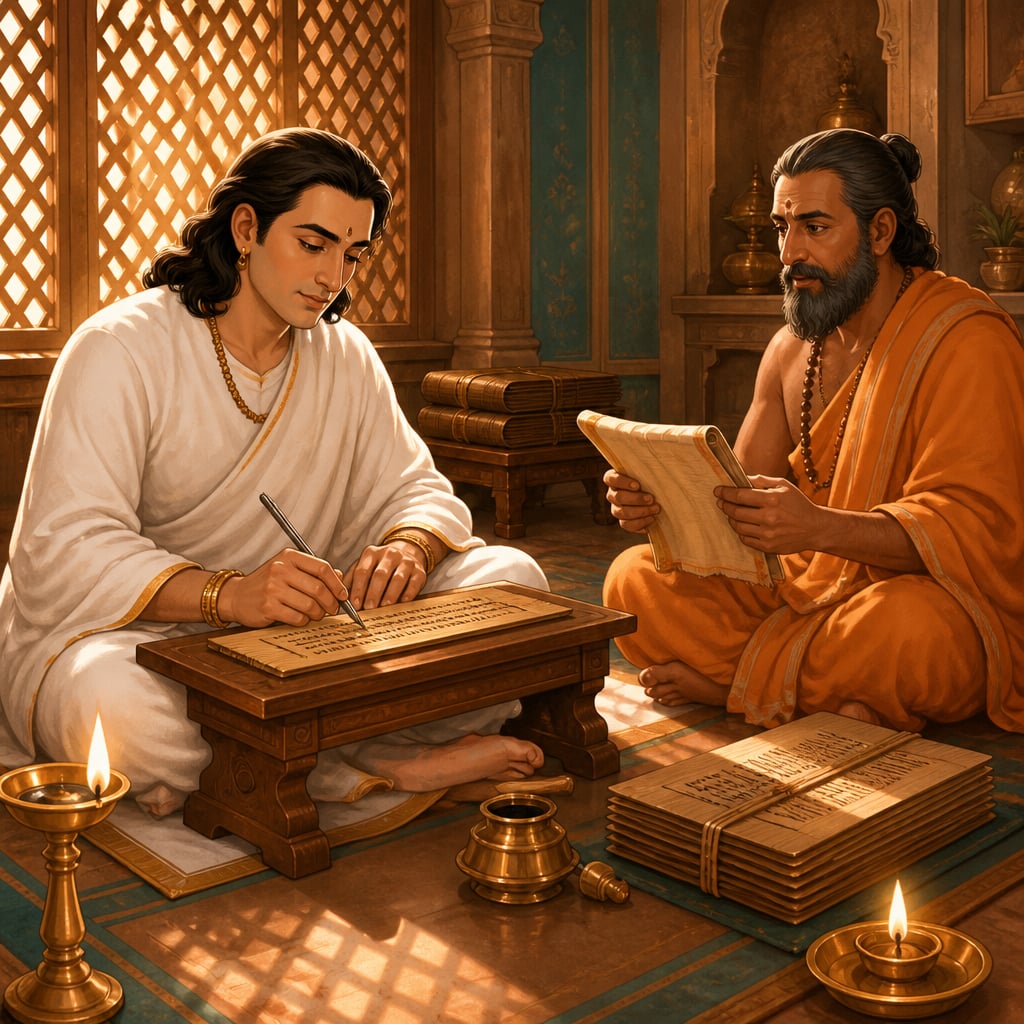
Amoghavarsha composing the Kavirajamarga at his writing desk

The Structure and Vision of Kavirajamarga

The Kavirajamarga is a work of alamkara shastra (poetics/rhetoric) - the Indian science of literary aesthetics. It systematically addresses:

Language and Diction

Meters and Prosody

Literary Ornaments (Alamkaras)

Rasa Theory

"Just as Sanskrit has its Natya Shastra and Kavyadarsha, so Kannada now has its Kavirajamarga - a royal gift to the language of the people."

The most revolutionary aspect of Kavirajamarga was its assertion that Kannada was a fit vehicle for high literature. In one famous passage, the text declares that the region between the Kaveri and Godavari rivers speaks a Kannada "as sweet as nectar."

This wasn't merely linguistic observation - it was political statement. By writing a formal poetics for Kannada, the emperor was declaring that his subjects' mother tongue deserved the same scholarly attention as Sanskrit. He was dignifying the language of the common people.

The text argues that good poetry can be written in any language if the poet understands the principles of composition. Sanskrit had no monopoly on beauty or meaning. Kannada, properly cultivated, could achieve equal heights.

Collaboration and Technical Innovations

While tradition credits Amoghavarsha as the author, the Kavirajamarga was likely a collaborative effort. The text mentions Sri Vijaya as a co-author or primary contributor. This was common practice - kings often lent their names to works produced by court scholars.

However, Amoghavarsha's involvement was clearly more than nominal. His personal interest in literature and philosophy is well-documented. He studied Sanskrit grammar formally and engaged seriously with literary questions. Whether he wrote every word or guided the project, the Kavirajamarga reflects his vision.

The collaboration between royal patron and professional scholar was itself significant. It showed that Kannada literature was now worthy of organized, institutional support.

The Kavirajamarga made several important technical contributions:

Chandas (Meter) Classification: It classified Kannada meters into indigenous forms and those adapted from Sanskrit, providing rules for both.

Sabdalankara: Detailed treatment of sound-based ornaments (alliteration, rhyme) appropriate to Kannada's phonetic character.

Regional Standardization: It helped establish a literary standard for Kannada, defining which usages were considered refined.

Bilingual Framework: It created a framework for understanding how Sanskrit poetic theory could be adapted to Kannada while preserving what was unique to the regional language.

Impact and Political Dimension

The Kavirajamarga's influence was immense:

Immediate Effect: It inspired a flowering of Kannada literature in subsequent centuries. Poets had a theoretical framework to work within and against.

Pampa reciting Kannada verses in tenth-century court

Pampa and Ranna: The great Kannada poets of the 10th century, Pampa and Ranna, built on the foundations Kavirajamarga established.

Critical Tradition: It established that Kannada deserved critical analysis, not just creative production. Literature could be studied, not just enjoyed.

Royal Precedent: Other kings in the region followed Amoghavarsha's example, patronizing Kannada alongside Sanskrit.

There was also a political dimension to this literary work. By elevating Kannada, Amoghavarsha strengthened the cultural identity of his empire. The Rashtrakutas ruled over a diverse population speaking many languages. Promoting Kannada helped create a sense of shared culture.

It also distinguished his court from northern kingdoms where Sanskrit dominated exclusively. The Rashtrakuta realm would be known for both Sanskrit and Kannada achievement.

Preservation and Legacy

The Kavirajamarga survived because it was useful. Subsequent poets studied it. Scholars copied it. It became a reference work for anyone serious about Kannada literature.

Today, it is celebrated as a foundational text of Kannada literary tradition. Every year, events commemorate its contribution to the language. Amoghavarsha is honored not just as a king but as a literateur - a rare honor for any ruler.

The Writer-King

What motivated a busy emperor to engage so deeply with literary theory? The answer lies in Amoghavarsha's broader philosophy. For him, culture and governance were not separate domains. A true king cultivated his realm in all dimensions - military, economic, spiritual, and cultural.

The Kavirajamarga was an act of governance as much as scholarship. It shaped how millions of people thought about their own language. It created institutions and traditions that outlasted the empire itself.

Beyond the Text

Amoghavarsha's literary interests extended beyond the Kavirajamarga. Inscriptions credit him with other works, including the Prashnottara Ratnamalika ("Garland of Question-and-Answer Gems"), a Sanskrit work on ethics and philosophy written in an accessible question-and-answer format. This text explored fundamental questions about righteous conduct, the nature of the good life, and the duties of various social roles - making philosophical wisdom available to educated readers beyond specialist circles.

He is also said to have written:

Whether all these attributions are accurate, they reflect how his contemporaries viewed him: as a scholar-king who saw learning as integral to rule.

The emperor who could have spent his time conquering neighbors instead chose to write about poetry. In doing so, he made a contribution that outlasted all his military achievements.

Historical context

Kannada Literary Renaissance, c. 850 CE

Sanskrit remained the prestige language, but regional languages were gaining literary sophistication. Tamil had its Sangam heritage; Kannada was now making its bid for literary respectability through the Kavirajamarga.

Living traditions

The Kavirajamarga is studied in every Kannada literature program. It established principles that still influence Kannada poetry. Amoghavarsha is honored as the father of Kannada literary theory.

Reflection

More in Amoghavarsha I

All lessons in Amoghavarsha I ยท Lesser Known Guardians of Dharma course