Managing the Empire

Pragmatism Over Glory

While his father and grandfather expanded the Rashtrakuta empire through aggressive conquest, Amoghavarsha practiced a different style of statecraft. He maintained the empire through diplomacy, strategic retreats, and careful management of feudatories. Though he lost territories, he preserved the core of the empire for sixty-four years through wisdom rather than warfare.

The Inheritance and Pragmatic Approach

The empire Amoghavarsha inherited in 814 CE was vast but overstretched. His father Govinda III had defeated the Pratiharas and Palas, forced tributes from the south, and made the Rashtrakutas the paramount power in India. But these conquests were expensive to maintain.

Every vassal state required watching. Every frontier needed garrisoning. The treasury, despite all the tribute flowing in, was strained. And a child king could not command the same fear as a proven warrior.
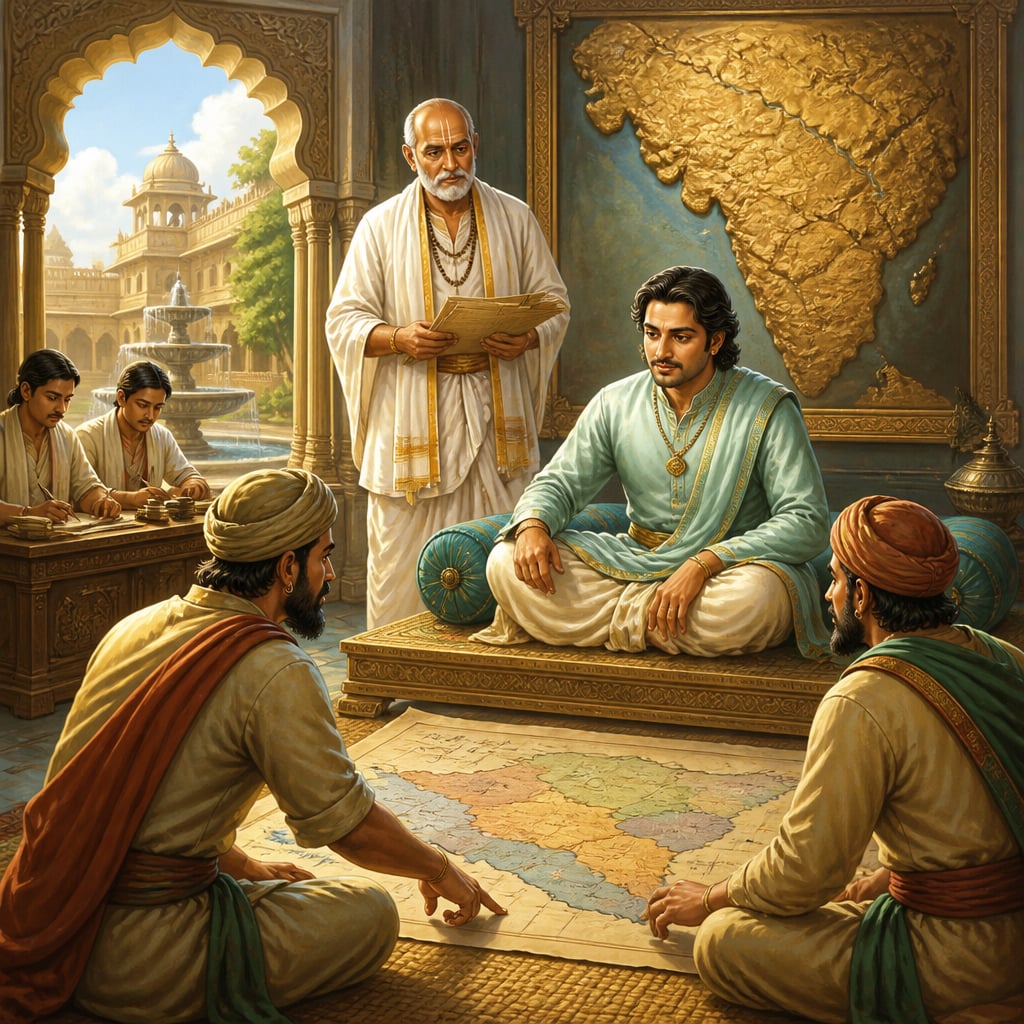
Amoghavarsha consulting his council and visiting envoys

Amoghavarsha's long reign can be understood as a continuous effort to manage these challenges with limited resources and a temperament unsuited to endless warfare.

Unlike his predecessors, Amoghavarsha did not measure success by territory conquered. His approach was fundamentally different:

Prioritization: Focus on holding the core territories rather than distant conquests

Diplomacy First: Negotiate before fighting when possible

Flexible Alliances: Form and reform alliances as circumstances changed

Controlled Retreat: Accept losses in peripheral areas to preserve strength

This was not cowardice but realism. The Rashtrakuta empire was too large to defend everywhere. Choices had to be made.

"The wise king knows when to fight and when to wait. Not every challenge requires a sword."

Managing the Political Landscape

The great contest for dominance over northern India - involving the Rashtrakutas, Pratiharas, and Palas - continued throughout Amoghavarsha's reign, but with reduced Rashtrakuta involvement.

The Pratiharas under Bhoja I (not to be confused with the later Paramara Bhoja) recovered from their earlier defeats and became increasingly powerful. The Palas under Devapala remained formidable in the east.

Amoghavarsha chose not to compete for Kannauj and the Gangetic plains as aggressively as his predecessors had. He accepted that the empire could not dominate everywhere and concentrated on the Deccan.

The Rashtrakuta empire was a network of feudatories owing allegiance to the central power. These included:

Keeping these feudatories loyal required constant attention. Amoghavarsha used:

Royal marriage alliance with Chalukya feudatory prince

Marriage Alliances: His daughters married into important feudatory families

Grants and Honors: Generous land grants and titles kept nobles content

Religious Patronage: Supporting the religious institutions favored by various feudatories

Personal Relationships: The king's reputation for fairness and learning earned respect

The eastern Chalukyas of Vengi (coastal Andhra) posed a persistent challenge. They were nominally Rashtrakuta feudatories but often pursued independent policies. Their strategic location between the Rashtrakutas and their eastern enemies made them important.

Amoghavarsha dealt with Vengi through a combination of pressure and accommodation. When the Vengis grew too independent, punitive expeditions reminded them of Rashtrakuta power. When they complied, they received favorable treatment.

This back-and-forth continued for decades. It was exhausting and inconclusive but prevented the complete loss of eastern influence.

In the far south, the Cholas were beginning their rise to power. During Amoghavarsha's reign, they were not yet the dominant force they would become, but they were growing stronger.

Amoghavarsha maintained generally peaceful relations with the emerging Chola power. Trade continued. There were no major wars. This peaceful coexistence allowed both powers to focus on other challenges.

Whether this was deliberate strategy or simply mutual disinterest, the result was a stable southern frontier during most of Amoghavarsha's reign.

Economic Management

Maintaining an empire required money. Amoghavarsha's government continued the Rashtrakuta tradition of:

Supporting Trade: The Rashtrakuta ports on the western coast conducted profitable maritime commerce with Arabs, Persians, and Southeast Asians

Agricultural Development: Land grants to temples and Brahmins often came with expectations of bringing new land under cultivation

Taxation Systems: A complex hierarchy of taxes on land, trade, and professions funded the state

Monetary Stability: The Rashtrakutas maintained a respected coinage that facilitated commerce

Arab travelers noted the wealth of the Rashtrakuta realm. Despite military setbacks, the empire remained economically robust throughout Amoghavarsha's reign.

The Late Reign and Succession

The final years of Amoghavarsha's reign saw new challenges. His own son, Krishna II, grew impatient for power. The relationship between father and son became strained.

There were also renewed attacks from the north. The Pratiharas, now at their peak under Bhoja I, pressed southward. Territories that had been securely Rashtrakuta came under threat.

Aged Amoghavarsha and impatient son Krishna II

By the 870s, Amoghavarsha was old and his grip on power was weakening. The empire he had preserved for six decades was beginning to fray at the edges.

Amoghavarsha died around 878 CE, having reigned for sixty-four years. He was succeeded by his son Krishna II, who would pursue more aggressive policies.

The transition was not smooth. There had been tensions between father and son. Some accounts suggest Amoghavarsha considered abdicating to pursue spiritual liberation but was dissuaded by his advisors.

In the end, death made the decision for him. The philosopher-king passed his crown to a son more inclined to warfare.

Assessment: Success or Failure?

How should we evaluate Amoghavarsha's statecraft? The answers vary:

By territorial standards: He was a failure. The empire was smaller at his death than at his accession. Territories in the north were lost. Feudatories gained independence.

By survival standards: He was a success. The empire endured for sixty-four years under his rule. No catastrophic defeats occurred. The dynasty continued.

By his own standards: He would probably have seen his reign as a spiritual failure - he never achieved the renunciation he desired - but a dharmic success in protecting his people.

The Limits of Peace

Amoghavarsha's reign demonstrates both the possibilities and limits of peaceful governance. He showed that an empire could be maintained without constant aggression, that diplomacy could substitute for warfare, that a philosopher-king could survive.

But he also showed the costs. Without military success, prestige ebbed. Ambitious feudatories grew restive. External enemies sensed weakness. The empire he preserved was smaller and less feared than the one he inherited.

Perhaps this was inevitable. Perhaps any ruler would have faced decline after Govinda III's overstretched conquests. Or perhaps a more martial king could have sustained Rashtrakuta dominance longer.

History offers no certain answers, only the record of what one remarkable king attempted.

Historical context

Late Rashtrakuta Period, 850-878 CE

The Pratiharas were rising under Bhoja I while the Palas remained powerful in the east. The tripartite struggle continued, but all three powers were more focused on consolidation than expansion. Regional identities were strengthening.

Living traditions

Amoghavarsha's statecraft is studied in courses on Indian political history. His pragmatic approach offers an alternative model to the conquering emperor, showing that empires can be sustained through wisdom as well as warfare.

Reflection

More in Amoghavarsha I

All lessons in Amoghavarsha I ยท Lesser Known Guardians of Dharma course