Talapatram

What Crosses Over

The list that inverts every modern metric.

What travels with you, the residue of action and the shape of character, and what does not: name, wealth, body, titles. Philosophy still puzzles over what persists when cells replace themselves and memories fade; the text’s one-line answer is the shape of your choices.

An Old Puzzle About a Ship
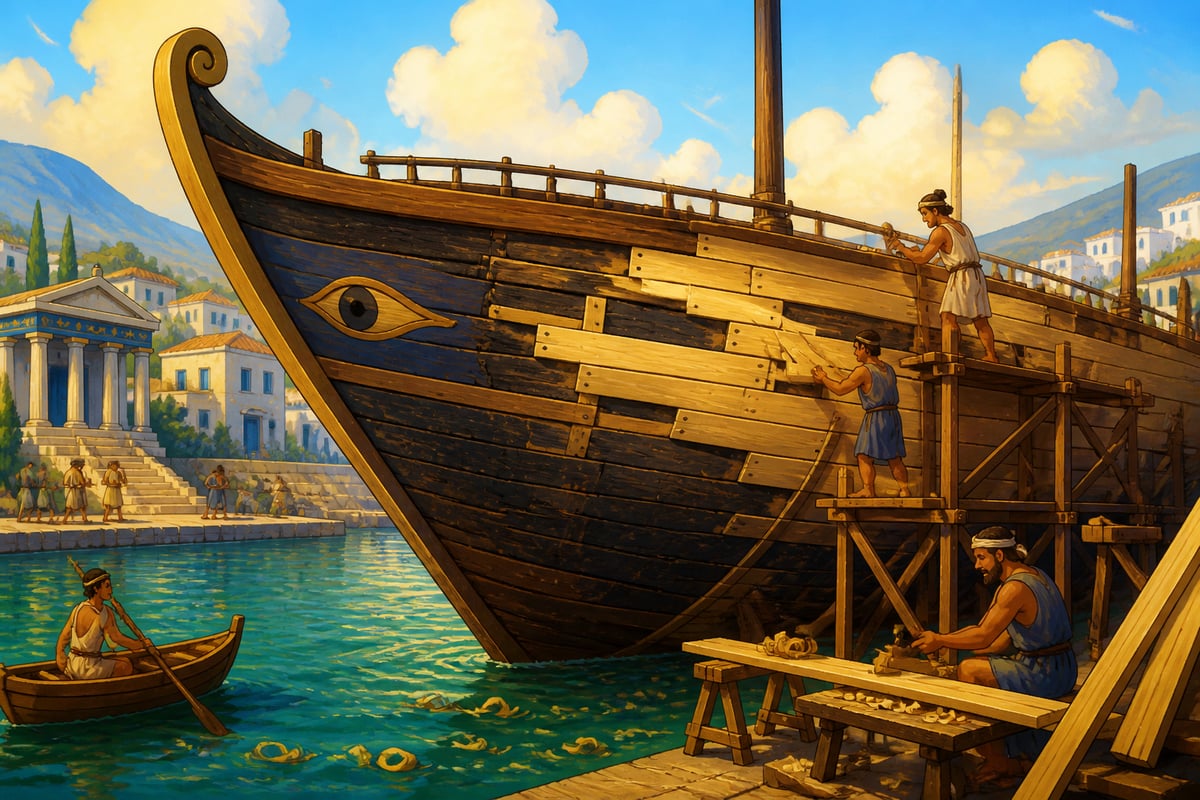
The ship whose every plank was replaced

Philosophy has worried at the same puzzle for over two thousand years. The ship of Theseus is preserved in harbour; plank by plank, as timbers rot, they are replaced; after enough years, not one original plank remains. Is it the same ship?

The puzzle is really about you. The cells of your body replace themselves continuously; the face in your childhood photographs shares almost no matter with the face in the mirror. Your memories fade and rewrite themselves; the convictions you held at twenty embarrass you at forty. Matter changes, mind changes, and yet something persists, something that makes it your childhood in those photographs, your embarrassment at your own past. Philosophy calls it the problem of personal identity and has filled libraries without settling it: what, exactly, continues?

The Garuda Purana has been answering this question for six chapters, and this lesson assembles its answer into a single inventory. The forgetting of the last lesson makes the question urgent: if memory itself is erased at every birth, then memory cannot be the carrier. Something survives the amnesia. The text is precise about what.

The Inventory

Begin with what does not cross, because the course has already watched each item stop at its barrier. The name stops at the lips of the people who used it. The body, wood and clay once the winds depart, stops at the fire, its elements repossessed. The wealth stops at the house, confiscated at the border in full. The titles, the offices, the reputation, the followers: all of it stays behind in the world that issued it, like a uniform returned at the end of a posting. The text has repeated this half of the inventory so often it amounts to a chorus: everything you can put on a business card is non-transferable.

Now the half that crosses. The text's verse for it is blunt about the mechanism:

एकः करोति पापानि फलं भुङ्क्ते महाजनः । भोक्तारो विप्रमुच्यन्ते कर्ता दोषेण लिप्यते ॥

ekaḥ karoti pāpāni phalaṃ bhuṅkte mahājanaḥ bhoktāro vipramucyante kartā doṣeṇa lipyate

One alone commits the wrongs while the many enjoy their fruit. The enjoyers walk free; the doer alone is stained by the deed.

Garuda Purana, Preta Khanda 12.21

Lipyate: is stained, is smeared. The verse's image is of action as a substance that adheres to its doer, and to its doer only. The family that enjoyed the corrupt fortune walks free of it; the stain travels with the hand that took it. This is the first cargo: the residue of action, the accumulated deposit of everything done and how, which the tradition calls the karmashaya, the store of karma. Chapter 2 met it as the ledger; Chapter 3 watched it cross the border when everything else was confiscated; here it is named as the continuity itself: the thread the amnesia cannot cut, because it was never stored in memory.

And with it travels the second cargo, subtler and more intimate: the shape of character. Every repeated thought, this course learned in Chapter 3, wears a groove; every practiced act builds a reflex. The grooves and reflexes, the vasanas and samskaras of the tradition's psychology, are not memories, and so they survive the erasure: the new life arrives with no recollection and yet with inclinations, aptitudes, fears, and pulls it never learned in this body. In the text's model, that is the old shape arriving in new clay. You do not carry what you knew. You carry what you became.

The Inversion

Now hold the two halves of the inventory side by side, and watch what happens to the modern definition of a successful life.

Every metric the age optimizes is in the left column. Net worth: stays. Title: stays. Follower count: stays. The name on the building, the awards on the wall, the body sculpted in the gym's mirrors: stays, stays, stays. And the right column, the only column that travels, holds precisely the things no dashboard tracks: what you did, how you did it, and what the doing made of you. The text's inventory is not a mystical curiosity. It is an audit that inverts the entire scoreboard. And you do not need to hold the text's cosmology to feel its force, because the inversion holds within a single lifetime too. Whatever persists of you, into your old age, into your children, into the world after you, it was never the possessions. It was always the residue and the shape.

Bhamashah offers his whole fortune at the darkest hour

History keeps running the experiment. In the sixteenth century, Bhamashah, minister of Mewar, stood before Maharana Pratap at the kingdom's lowest hour after Haldighati: the treasury gone, the Maharana close to abandoning the struggle. And he gave: his accumulated wealth, offered whole, enough by the chronicles to sustain the army for years. The fortune stopped being his at that moment, exactly as the inventory predicts. Four and a half centuries later, every schoolchild in Rajasthan knows his name. Not as a rich man, for his riches stayed behind and dissolved, but as the shape of the act itself: Bhamashah, the giver at the darkest hour. His wealth did not cross even into the next decade. His character has crossed into its fifth century.

Mister Rogers builds the column that crosses

And in the modern West, a soft-spoken television host spent forty years with no empire, no chain of properties, no fortune to speak of: Fred Rogers, in the same cardigan, on the same modest set, telling children they were valued. He optimized nothing in the left column. What he built was entirely in the right one: patience practiced into character, kindness repeated into shape. He has been dead since 2003, and his presence, measured in the people who cite him at their own thresholds of decency, crosses further every year. The estates of his wealthier contemporaries are already forgotten litigation.

Building for the Right Column

The practical force of the inventory is that it converts every day into a packing decision. Each hour of effort goes to one column or the other: polishing what will be confiscated, or forming what will cross. The text does not ask you to abandon the left column; the householder needs the name, the wage, the working body, and Chapter 5 honoured all three. It asks only that you know which column is luggage and which is you, and invest with the border in view.

And the inventory sharpens the chapter's remaining question to a point. If what crosses is the shape of the traveler, then everything depends on where the shaping can happen. The text's answer is the tradition's most repeated claim about the cosmos: the shaping happens here, in this form, on this platform, almost nowhere else. Why a human birth is the rarest ticket in existence, and what that rarity demands of the one holding it, is the final lesson of the chapter.

Case studies

The Fortune That Dissolved, the Name That Did Not

After the battle of Haldighati in 1576, Mewar's position was desperate: treasury exhausted, territory lost, and by the chronicles Maharana Pratap close to abandoning the struggle. His minister Bhamashah came forward with his accumulated wealth, offered whole, recorded in the tradition as sufficient to maintain twenty-five thousand men for years. The Maharana accepted, the resistance was refinanced, and the reconquest of much of Mewar followed.

The inventory ran in real time: at the moment of giving, the fortune ceased to be Bhamashah's, exactly as the border would have taken it anyway. What he kept was what the giving formed and revealed: the shape of a man who could hand over everything at the hour it mattered. The wealth dissolved within a generation. The shila has crossed five centuries and is still crossing.

Bhamashah is remembered across Rajasthan as the exemplar of wealth rightly deployed; his name is carried today by state welfare schemes, and his samadhi at Chittorgarh remains honoured, a five-hundred-year receipt for the right column.

History keeps no ledgers of retained fortunes; it keeps the shapes of deeds. What a person is remembered as, and what by the text's map they travel as, is decided by the same investments.

The Mewar chronicles record Bhamashah's 1578 offering as sufficient to sustain 25,000 soldiers for twelve years; a major Rajasthan financial-inclusion scheme carried his name into the twenty-first century.

The Cardigan Estate

For over three decades on public television, Fred Rogers ran the least optimized program in the medium's history: one modest set, hand puppets, long silences, the same ritual of shoes and cardigan, and a single message delivered without variation: you are valued as you are. He took no merchandising empire from it and built no fortune of note; a Presbyterian minister by training, he treated the studio as his parish and repetition as his method.

Rogers invested a whole career in the column that crosses: kindness repeated until it was character, patience practiced until it was nature. The verse's mechanism worked in its bright direction: the conduct adhered to the doer, and what the amnesia of death cannot touch, the shape of the man, is precisely what still radiates from every surviving frame.

Two decades after his death, Rogers's standing has only risen: films, biographies, and a phrase, look for the helpers, that resurfaces at every public tragedy. He is cited as a threshold of decency by people born after his program ended.

The age's scoreboard cannot see the right column, but time can. Lives invested in formation compound after death; lives invested in the confiscated column stop at the border, exactly as the text said.

Mister Rogers' Neighborhood ran from 1968 to 2001, nearly 900 episodes on public television; Rogers died in 2003, and his cultural presence has measurably grown since.

Living traditions

The two-column instinct survives in the tradition's ordinary speech: elders still ask what a person will take with them, and the answer, punya, character, blessings, never includes the house. The prodigy explained by past-life samskaras, the insistence that a family's real inheritance is its sanskara rather than its property, and the annual honouring of givers like Bhamashah over hoarders of any century: each keeps the inventory current, one generation of packing decisions at a time.

Reflection

  • Write your own two columns honestly: what are you building that stays at the border, and what are you forming that crosses? What is the current ratio of your best hours between them?
  • The ship's planks have all been replaced: your cells, your convictions, your memories. What in you has persisted through every replacement, and does it match what the text says the carrier is: the shape your choices have built?
  • The verse says the enjoyers walk free and the doer alone is stained. What are you currently doing, or being asked to do, for beneficiaries who will not carry it? Does the deed survive the knowledge that the stain is yours alone?

More in Why Does This Life Feel Urgent?

All lessons in Why Does This Life Feel Urgent? · Garuda Purana ebook course