The Rarest Ticket
Eternity is real. This seat is not.
The tradition’s most repeated claim: human birth is achingly rare, and it is the only platform from which liberation can be reached. The improbability of your existence turned from trivia into obligation: the strongest anti-drift lesson on the platform.
The Climb That Should Not Have Happened
In 2011, a young national-level volleyball player named Arunima Sinha was thrown from a moving train by robbers she resisted. She spent the night on the tracks, gravely injured; by morning her left leg was gone below the knee. She was twenty-four, an athlete, and the life she had trained for was over.
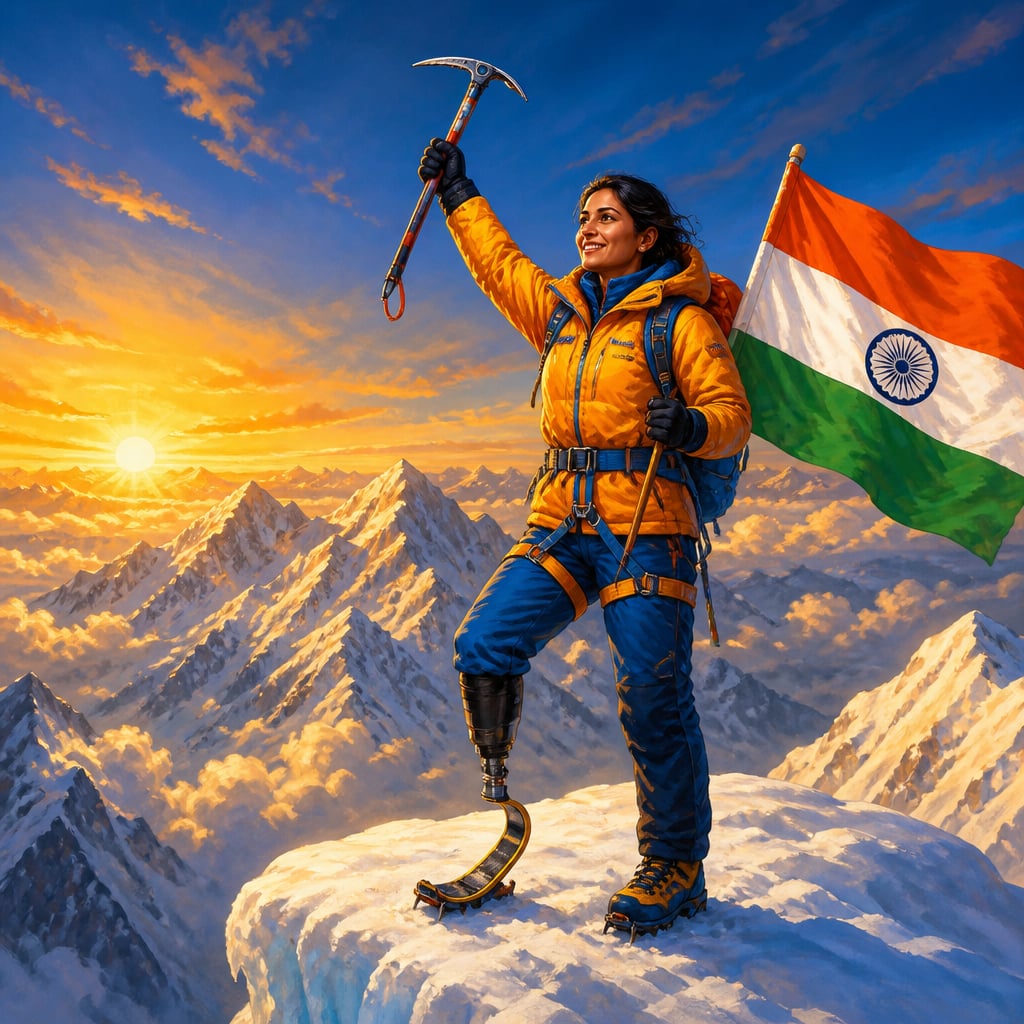
What she decided in the hospital bed is why she opens this lesson. Lying with a prosthetic where her sport had been, she did not reach for a smaller life. She reached for the largest one she could name: Everest. Two years of training followed, under Bachendri Pal, India's first woman to summit. And in May 2013 Arunima Sinha stood on the summit of Everest: the first female amputee in the world to do so. Her stated logic was arithmetic, not bravado: she had been given a second life that by every probability she should not have, and a gift that improbable is not spent on drift.
Hold that arithmetic. The Garuda Purana's final teaching of this chapter is that Arunima's situation is not exceptional. It is, precisely and literally, everyone's. You are all holding a seat you should not, by the odds, be holding. The text has been waiting six chapters to tell you what it is worth.
The Hardest Seat in the Cosmos
The tradition's claim is stated in this text with the flatness of a fact:
जरायुजास्तथा प्रोक्ता मनुष्याद्यास्तथा परे । सर्वेषामेव जन्तूनां मानुषत्वं हि दुर्लभम् ॥
jarāyujās tathā proktā manuṣyādyās tathā pare sarveṣām eva jantūnāṃ mānuṣatvaṃ hi durlabham
Among the born are counted humans and the rest. But of all living beings, the human state is the hardest to attain.
Garuda Purana, Preta Khanda 12.4

Durlabha: hard to obtain, achingly rare. The text has already given the scale: the tradition counts 8.4 million forms of embodied life, and the wheel of the last lesson turns through them without hurry. The next verse adds that this vehicle of five senses is reached only through great accumulations of merit. And the Saroddhara, the digest recited over the thirteen days, returns to the claim so often it is nearly a refrain. The human birth is won with difficulty, like a jewel surfacing in a vast churning sea. And it is squandered, the texts say with visible grief, by the millions who win it.
Why does the tradition rank this seat above every other, including the seats of the gods? The answer is the chapter's final piece, and it is structural. Below the human platform, in the tradition's map, the animal births lack viveka: the discernment of Chapter 5's keynote verse, the rarest thing alive, without which no being can see the wheel it turns on. And above the human platform, the celestial births lack friction: the devas enjoy the accumulated fruit of merit in realms engineered for enjoyment, and enjoyment, the tradition observes drily, teaches nothing; when the merit is spent, the seat expires, and the wheel resumes. The course met this clause in Chapter 3: heaven and hell alike, in this map, are waiting rooms where karma is exhausted, not places where anything is built.
Only the human seat has both instruments at once: enough discernment to see the wheel, and enough friction to act against it. Enough suffering to ask the questions, enough freedom to answer them. It is the only platform in the whole cosmology where the shaping of the last lesson can be chosen: where vows can be made and kept, and dharma gathered. Only here can the road off the wheel, next chapter's subject, even be attempted. The gods themselves, say the texts, must descend to a human birth to reach for liberation. The seat you are drifting in, this ordinary Wednesday, is the one the cosmos itself considers the springboard.
Improbability, Turned Into Obligation
Modern arithmetic, run from entirely secular premises, lands in the same staggering territory. Consider the odds of your particular existence: the one ancestral line unbroken across every famine and epidemic, the one meeting of your parents, the one cell among millions. They multiply into a number indistinguishable from impossibility. The observation has become a genre of internet wonder: you are statistically a miracle. And there, as trivia, it dies: a warm feeling, scrolled past, spending nothing.
The tradition's move is to take the same improbability and refuse to let it remain trivia. If the seat is that rare, then holding it is not a curiosity. It is a responsibility: the improbability converts directly into obligation, the way a rare inheritance converts into stewardship. This is the engine of the tradition's urgency, and it answers the chapter's opening question in full. If the soul is eternal, why does this life feel urgent? Because eternity is real and the seat is not. The jiva has forever; the platform has this one lease, of unknown and shrinking length. And every capability the whole map cares about, the seeing, the choosing, the shaping, the crossing, lives only on the platform. Eternity without this seat is just the wheel, turning.

A small Himalayan kingdom has built this awareness into its ordinary culture. In Bhutan, contemplating death several times daily is traditional counsel; folk wisdom holds that thinking of death five times a day is the road to happiness. The culture surrounds the practice with visible reminders, from cremation-ground iconography to the annual rhythm of rituals for the dead. Visitors keep reporting the paradox this whole course has been dismantling: the culture that thinks about death most is conspicuously unmorbid, present, and warm. The mechanism is exactly the text's: awareness of the seat's expiry is what makes the seat vivid. The forgetting of Lesson 2 numbs; the remembering wakes.
The Anti-Drift Lesson
So the chapter closes its arc. You arrived mid-vow (Lesson 1). The vow was erased, and the drift is amnesia, not laziness (Lesson 2). What travels is the shape your choices build (Lesson 3). And the building can happen only here, on the rarest platform in the cosmos, currently leased to you and expiring on a date you are not shown (this lesson). Assemble the four and the conclusion is not gloom. It is the sharpest wake-up the tradition knows how to write: you are holding the jewel from the churning sea, in the only hands that can use it.
Arunima's hospital-bed arithmetic is therefore everyone's honest arithmetic, run one improbability deeper. The question is no longer whether the seat is precious. The question is the one Garuda now asks Vishnu on the reader's behalf, the last question of the whole dialogue: if this platform is the springboard, is there really a way off the wheel, and what is it? The text's answer, the chapter it ends in light, begins next.
Case studies
From the Tracks to the Summit
In April 2011, Arunima Sinha, a national-level volleyball player, was thrown from a moving train near Bareilly by robbers whose snatching she resisted. She lay on the tracks through the night as trains passed; her left leg was amputated below the knee. In the hospital, national attention on her as a victim, she announced an intention widely dismissed as trauma speaking: she would climb Everest. She trained under Bachendri Pal's mentorship, and on 21 May 2013 summited, the first female amputee in the world to do so, later completing the highest peaks of every continent.
Her hospital-bed logic was the durlabha conversion performed under the harshest lights: a life held against all probability is an obligation, not a consolation, and its rarity dictates its use. The text claims every reader's seat carries the same arithmetic one improbability deeper; Arunima is what the arithmetic looks like when someone actually runs it.
She received the Padma Shri in 2015, completed the Seven Summits including Antarctica's Mount Vinson in 2019, and founded a sports academy for the disabled: the second life spent, deliberately, on the largest available purpose.
The rare seat does not announce its worth; it waits to be valued. The difference between a life of drift and a life of summits is often nothing but the arithmetic, honestly run.
Arunima Sinha summited Everest on 21 May 2013, two years after her amputation, and completed the Seven Summits with Mount Vinson in January 2019.
The Country That Remembers Daily
In Bhutan, awareness of mortality is woven into ordinary culture rather than quarantined to funerals: traditional counsel holds that one should contemplate death several times daily, a folk saying commends thinking of it five times a day as the road to happiness, and the culture keeps the reminders visible, in cremation-ground imagery, in annual rites for the departed, in festival dances where death masks whirl among the living. Foreign researchers and writers who visit expecting morbidity report the opposite: a population conspicuously present, warm, and unhurried.
Bhutan practices this lesson at cultural scale: awareness of the seat's expiry is what makes the seat vivid. The mechanism is the chapter's arc run daily, the forgetting interrupted on schedule, the lease remembered, and the remembering converting not into gloom but into the presence the numbed platforms never feel.
Bhutan's mortality-aware culture has become a standing reference in global happiness research and journalism, studied as a counterexample to the modern assumption that wellbeing requires death's removal from view.
A culture, like a person, is made vivid by what it refuses to forget. The daily remembered expiry is not the enemy of happiness; by the visible evidence, it is among its ingredients.
The Bhutanese folk teaching commends contemplating death five times daily; the country's cultural integration of mortality awareness has been the subject of international happiness research since the 2010s.
Living traditions
The durlabha teaching remains among the most quoted in living Hindu discourse: the human-birth-is-rare verse family appears in bhajans, satsang discourses, and the standard consolations and exhortations of family elders. The chaurasi-lakh idiom keeps the scale in daily speech, adaptive athletes like Arunima Sinha are celebrated in explicitly second-life terms, and the modern death-awareness movements, from Bhutan's exported example to death-over-dinner conversations, keep rediscovering the tradition's oldest equation: the remembered expiry is the vivid life.
Reflection
- Run the conversion in your own hand: this seat should not, by the odds, be yours, and it is. Write what holding it obliges you to do, in three specific lines. Which of the three have you been deferring, and on what stated grounds?
- The tradition ranks the human seat above the gods' because friction builds and enjoyment does not. Looking back honestly, which built more of you: your comfortable years, or your hardest ones? What does the answer imply about the difficulty you are currently in?
- Bhutan remembers the expiry five times a day and grows warmer for it. What is your current relationship to the lease's end: quarantined entirely, or admitted at a dose that keeps the seat vivid? What would your version of the five daily rememberings be?